

Navigating the workers' compensation system can feel like you've been dropped into a new mission without a map. This guide is your roadmap. It's built specifically for veterans and first responders because we know the injuries you carry—both seen and unseen—and the high-stakes nature of your work create unique hurdles. Forget the legal jargon; think of this as a straight-talk session with someone who gets it.

A Step-by-Step Guide to the System
We're going to walk through this entire process together, breaking down everything from the moment you get hurt to the day you secure your benefits. The goal is to replace that feeling of being overwhelmed with confidence and a clear path forward.
I've structured this guide to build your understanding from the ground up. We’ll start with the fundamentals—like who qualifies and what benefits are on the table—before getting into the nuts and bolts of filing your claim. We'll also cover the tough stuff, like what to do if your claim is denied and how to sidestep the common pitfalls that can jeopardize your case.
What to Expect on Your Journey
The road from injury to resolution has several key milestones. Each one serves a purpose and requires you to take specific, timely actions. To give you a bird's-eye view of the terrain ahead, let's look at the typical stages of a claim.
Having this framework helps take the mystery out of the process. It shows you what’s coming and when, so you can prepare for each phase instead of just reacting. Consider it your pre-mission briefing.
At its core, workers' compensation is a deal: you get medical care and financial support for a job-related injury, and in return, you generally can't sue your employer. The trick is knowing how to hold up your end of the deal to make the system work for you.
Here’s a quick look at how a claim typically unfolds. Getting familiar with these stages now will put you in a much stronger position to advocate for yourself down the line.
The Workers Compensation Claim Process at a Glance
This table breaks down the major phases you'll encounter.
| Stage | Key Action | Primary Goal |
|---|---|---|
| Injury & Report | Tell your employer about the injury immediately. | Formally document the incident to kick off the entire process. |
| Medical Treatment | Get medical care from an authorized doctor. | Get a proper diagnosis, start treatment, and create a medical record of your injury. |
| Claim Filing | Fill out and send the official claim forms to the state board. | Make a formal request for benefits and get your case on the books with the state. |
| Claim Review | The insurance company investigates your claim. | The insurer decides if your injury is work-related and covered by the policy. |
| Benefit Approval | If approved, you start receiving benefits. | Get the financial and medical help you need while you recover. |
| Resolution/Appeal | If denied, you challenge the decision through an appeal. | Fight the denial by presenting more evidence to get the benefits you deserve. |
Think of these stages as checkpoints. Knowing what's required at each one is the first step toward successfully navigating the system.
Confirming Your Eligibility and Coverage

Before you even think about filling out a single form, the first question you need to answer is simple: am I actually covered? It helps to think of workers' compensation as a special type of insurance policy that nearly every employer is legally required to carry. It's designed as a “no-fault” system, which means it doesn't matter who was to blame for the accident. If you got hurt while doing your job, you're generally eligible for benefits.
That’s the core principle. The legal jargon you'll hear is that the injury must "arise out of and in the course of employment." All that really means is that your injury happened because of your job and while you were on the clock.
For veterans and first responders, though, this can get murky. The line between on-duty and off-duty is often blurred, and many of you bring prior injuries from military service or a career of high-stress calls. Figuring out how these unique factors fit into the equation is the first and most critical step you'll take.
What Actually Counts as a Work-Related Injury?
When people hear "work-related injury," they usually picture a single, dramatic event like a fall from a ladder or a car crash. But the system is built to cover a much wider range of conditions. Knowing where your injury fits helps you build a much stronger claim right from the get-go.
Generally, injuries fall into one of three buckets:
- Sudden Accidents: These are the most obvious cases. A firefighter gets burned during a rescue. A police officer tears a rotator cuff while making an arrest. A paramedic strains their back lifting a patient onto a gurney.
- Repetitive Stress Injuries: These injuries don't happen all at once. They creep up over time from doing the same motion again and again. Think of a veteran in a desk job developing carpal tunnel syndrome from years of typing.
- Occupational Diseases: This is a big one for our community. It covers illnesses caused by exposure to hazardous materials or environments. For first responders, this could mean lung damage from smoke inhalation, and for veterans, it could be tied to exposures on military installations that later cause health problems.
It's also worth noting that many states are finally recognizing the incredible psychological toll that comes with being a first responder. Conditions like Post-Traumatic Stress Disorder (PTSD) are increasingly covered as work-related injuries, but proving the connection to your job often involves a higher bar.
Key Insight: Your injury doesn't have to be brand new. If your job duties took a pre-existing condition—like a bad back from your military service—and made it significantly worse, that aggravation is often covered by workers' comp. Proving it, however, hinges on having clear medical evidence showing exactly how your work made that old injury flare up.
Navigating Pre-Existing Conditions and Mental Health
For veterans, the overlap between VA disability benefits and workers' compensation is a common source of confusion. Let's be clear: having a service-connected disability does not prevent you from getting workers' comp benefits. If your new civilian job makes that old injury worse, your employer’s insurance is on the hook for the new treatment and any lost wages.
Imagine a veteran with a service-connected knee injury who takes a job as a police officer. If years of patrol and foot pursuits cause a new tear in their meniscus, their claim would focus on that aggravation, not the original military injury.
Mental health claims work on a similar principle but come with their own unique hurdles.
- Documentation is Everything: You need a formal diagnosis from a qualified mental health professional—a therapist, psychologist, or psychiatrist.
- Connect the Dots: Your doctor must be able to draw a clear, professional line between your PTSD or anxiety and specific traumatic calls or the cumulative stress of your career.
- State Rules Vary: This is critical. How mental health claims are handled differs wildly from state to state. Some have very tough standards of proof, so getting familiar with your local laws is absolutely essential.
Building a successful claim starts right here. It begins with a solid understanding of whether your unique story—your job, your injury, and your personal history—fits within the system’s framework. Once you're confident that you're eligible, you can move on to the next step with a lot more certainty.
What Kind of Benefits Can You Actually Get?

Once you’ve established that you’re eligible for workers' comp, the next question is always the same: what kind of help can I really get? It's not just a single check. Think of workers' comp benefits as a multi-pronged support system, designed to cover your medical needs, help you financially, and even get you back on your feet in a new career if necessary.
Let's break down exactly what this safety net looks like, so you know what to expect and what you're entitled to.
Medical Benefits
First and foremost, workers' comp is there to cover your medical care. This is the cornerstone of the whole system. The goal is simple: get you the treatment you need to heal from your work-related injury without you having to pay for it out of your own pocket.
This coverage is incredibly comprehensive and should include every reasonable and necessary part of your treatment. We’re talking about everything from the initial ambulance ride to long-term physical therapy.
- Doctor's Appointments: All visits to your primary doctor, specialists, and surgeons.
- Hospital Stays: Any inpatient care you need, including surgeries.
- Prescription Drugs: Medications prescribed to treat your injury.
- Physical Therapy & Rehabilitation: Critical sessions needed to get your strength and mobility back.
- Medical Equipment: Things like crutches, braces, or other essential equipment.
It's worth noting that medical costs are a huge driver in the workers' comp world today. With healthcare inflation on the rise, insurance carriers are scrutinizing treatment plans more than ever. You can get a deeper dive into how these trends could impact your claim at AlloyEmployer.com.
Wage Replacement Benefits
Not being able to work—and earn a paycheck—is one of the most stressful parts of any injury. This is where wage replacement benefits step in. They are designed to replace a portion of your lost income while you’re out of commission. It won't be your full salary, but it provides a percentage of your average weekly wage to help you stay afloat.
The type of wage benefit you receive depends on how badly you're hurt and how long you're expected to be out of work.
Let’s look at a real-world example: A police officer injures their knee during a foot pursuit and is told they can't be on patrol. For the time they are completely out of work, they receive Temporary Total Disability (TTD) benefits. After surgery and a few months of rehab, their doctor clears them for "light-duty" work, like handling administrative tasks at the station. If this light-duty role pays less than their regular patrol salary, their benefits would likely switch to Temporary Partial Disability (TPD) to make up for that wage gap.
The main categories you'll hear about are:
- Temporary Total Disability (TTD): Paid when you cannot work at all for a limited time.
- Temporary Partial Disability (TPD): Paid when you can go back to work, but only in a limited or "light-duty" capacity that pays less.
- Permanent Partial Disability (PPD): Awarded if your injury leaves you with a permanent impairment (like reduced range of motion) but you can still work. This often comes as a lump-sum payment or a series of payments over time.
- Permanent Total Disability (PTD): Reserved for catastrophic injuries that prevent you from ever returning to any kind of meaningful work.
Knowing which category you fit into is crucial for managing your finances and expectations during your recovery.
Vocational Rehabilitation Benefits
But what happens if your injury is career-ending? What if you can no longer meet the physical demands of being a firefighter or a paramedic? This is where vocational rehabilitation comes into play. These benefits are specifically designed to help you find a new way to earn a living.
Think of it as a career transition program, paid for by the insurer, to help you pivot. While the specifics can vary by state, the support often includes:
- Job Retraining: Covering the costs of education or certifications for a new career that works with your physical limitations.
- Skills Assessment: Professionally evaluating your skills and experience to see how they can transfer to a different field.
- Job Placement Help: Assistance with writing a resume, preparing for interviews, and connecting you with job openings.
For a veteran whose service-connected disability is aggravated by a work injury, making their physically demanding civilian job impossible, this is a lifeline. Vocational rehab could fund a certification in IT or project management, opening the door to a new, sustainable career. It’s the system’s way of acknowledging that some injuries change your life forever—and providing the tools you need to adapt.
How to File Your Claim Step by Step
When you're hurt on the job, the last thing you want to do is navigate a maze of paperwork. But filing a workers' compensation claim doesn't have to be overwhelming. Let's break it down into simple, actionable steps. Think of this as your roadmap, guiding you from the moment you're injured to getting your official claim on file.
This infographic lays out the basic journey, from reporting the injury to receiving your benefits.
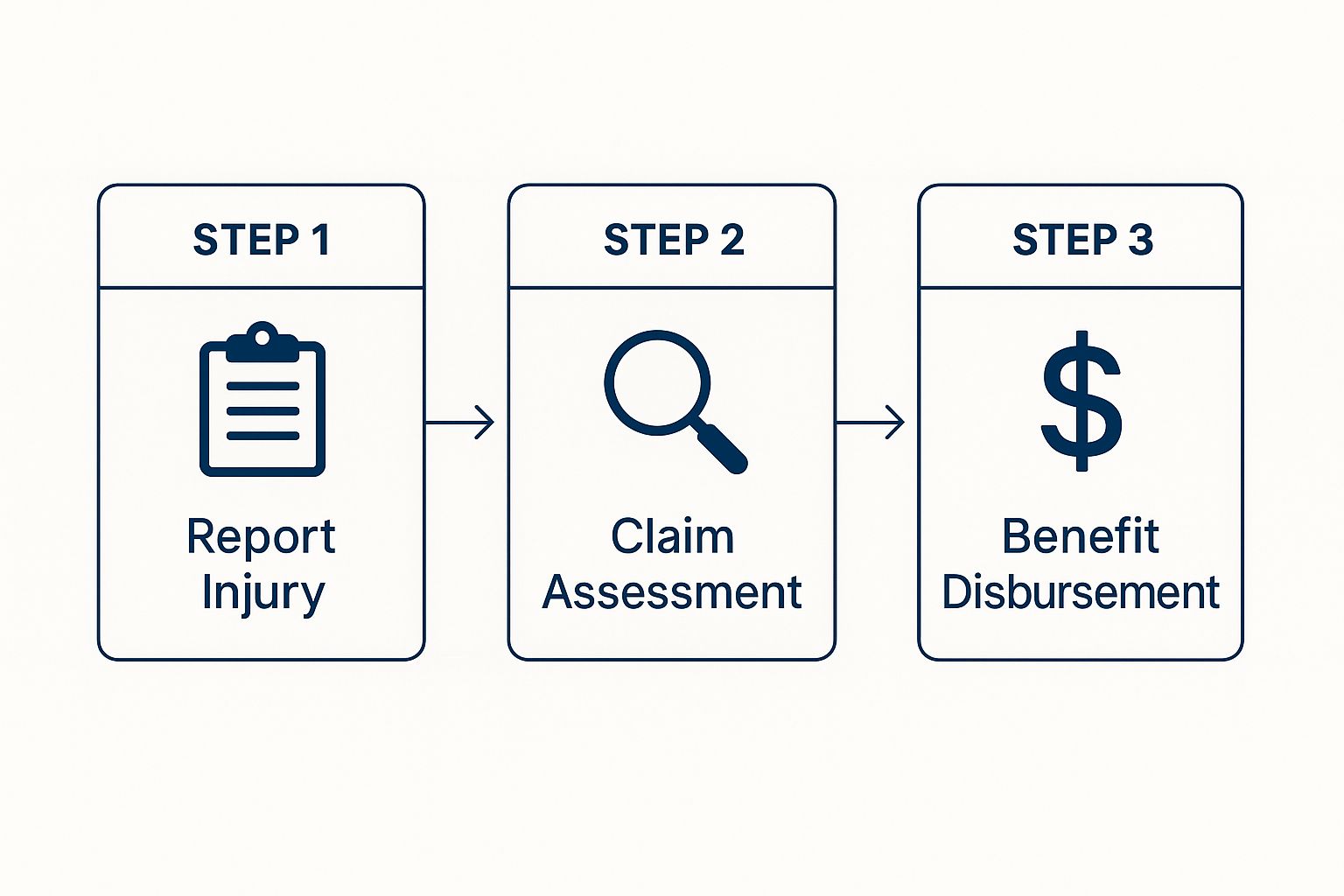
As you can see, everything hinges on that first report. How you handle the initial hours and days after an injury is absolutely critical.
Step 1: Report Your Injury Immediately
The second you get hurt, the clock starts ticking. Your very first move—and the most important one—is to report the injury to your employer. Don't put it off. Even if it seems minor, report it.
Many states have very strict reporting deadlines, sometimes just a few days. Missing that window is one of the fastest ways for an insurance company to deny your claim flat-out.
A quick verbal report is a good start, but it's not enough. You must follow up in writing. An email or a formal letter creates a paper trail with a date and time stamp—concrete proof that you did your part. This step is non-negotiable for protecting your rights.
Step 2: Get Medical Attention Right Away
Your health comes first. Get medical care as soon as you can, even if you feel you can "walk it off." Adrenaline is a powerful painkiller, and an injury that feels like nothing at first can turn into a serious problem down the road.
When you see the doctor, be crystal clear about how the injury happened and what you’re feeling. You need to connect the dots for them, explaining how your work duties led directly to the incident. That initial medical report is a cornerstone of your claim; it officially links your physical condition to your job.
Crucial Tip: Remember, the insurance company is a business, and their interests are not your interests. They might push you for a recorded statement right away. You are not obligated to give one, especially before you've had a chance to understand your rights or speak with an advisor.
Step 3: Document Absolutely Everything
From this point on, you need to be a meticulous record-keeper. Think of documentation as your most powerful tool in this entire process. Every conversation, every appointment, every receipt—it all needs to be tracked.
Get a dedicated notebook or file for your claim. This simple habit will prove invaluable if any part of your claim is questioned later.
- Medical Records: Keep copies of every doctor's note, test result, prescription, and treatment plan.
- Work Communications: Save all emails, texts, and letters you exchange with your supervisor or HR about your injury.
- Expense Receipts: Track every penny you spend out-of-pocket. This includes gas mileage for medical trips, prescription co-pays, and even bandages.
- Witness Information: If anyone saw what happened, get their name and contact information immediately.
This detailed log becomes the hard evidence you need to back up your claim at every turn.
Step 4: Officially File Your Claim Form
Just telling your boss you're hurt isn't the same as filing a claim. The final step is to complete and submit the official paperwork to your state’s workers' compensation board. Your employer should give you these forms, but they're almost always available on the state board's website.
Fill out the form with complete accuracy. This is where all your careful documentation pays off. As you prepare the claim, it can be helpful to fill out required workers' compensation forms using an online tool to make sure everything is neat and legible.
Read every line twice before you submit it; simple mistakes can cause serious delays. Always make a copy for your own records before sending it in. Once filed, your claim gets a case number, and the insurance company will start its investigation. Following these steps gives you the best possible foundation for a successful claim.
How to Respond When Your Claim Is Denied
Getting that denial notice in the mail can feel like a punch to the gut. After everything you've already been through—the injury, the initial paperwork, the uncertainty—a denial can feel like a final, insurmountable wall. But I'm here to tell you it's not the end of the road.
Honestly, for many people, a denial is just another step in the process. Think of it as the insurance company's opening move. Now, it's your turn to make yours, and you can come back much stronger. Especially for professionals like police officers and firefighters who face unique on-the-job risks, getting an initial denial is a common hurdle, but it’s one you can absolutely overcome.
Why Was Your Claim Denied?
Before you can fight back, you need to know exactly what you’re fighting against. That denial letter isn’t just a simple “no.” By law, the insurance company has to tell you the specific reason they rejected your claim.
This reason is your roadmap. It points directly to the weak spot in your claim that you now need to reinforce.
Here are some of the most common reasons insurers deny claims:
- Missed Deadlines: States have very strict timelines for reporting an injury and filing a claim. If you miss one, it's an easy reason for them to say no.
- No Medical Evidence: The initial doctor’s notes didn’t clearly connect your injury or illness to a specific event at work or your general job duties.
- Dispute Over "Work-Related": The insurance carrier is arguing that your injury happened somewhere else, or that it’s just a pre-existing condition that your job didn't make worse.
- Insufficient Documentation: You may not have provided enough information for them to make a decision, resulting in what’s basically a technical denial.
Once you understand their argument, you can start building your counter-argument.
The Appeals Process: Your Path Forward
Every state has a formal appeals process that gives you the right to challenge the insurance company’s decision. The exact steps will differ depending on where you live, but it generally involves filing an appeal with your state's workers' compensation board. This officially moves your case out of the insurer's hands and into a formal legal arena, which often leads to a hearing with a judge.
This is where you see the business side of insurance kick in. Even when the industry is doing well financially—private carriers reported a strong combined ratio of 86%—the average cost of a serious claim has still jumped by 6%. This means insurers are scrutinizing claims more than ever to manage rising costs. Understanding these workers' compensation trends can help you see why the appeals process is so vital.
Filing an appeal is a powerful statement. You're telling them you don't accept their decision and you're ready to prove it. This formal step helps level the playing field by bringing in a neutral party to hear your side of the story.
Building Your Case for the Appeal
A successful appeal boils down to one thing: evidence. Your mission is to systematically dismantle the insurer's reason for denial with proof that is too strong to be ignored. It's time to build a case that's undeniable.
1. Gather Stronger Medical Evidence
This is your most powerful tool. If the denial was based on a lack of medical proof, go get more. This could mean seeing a specialist who can write a detailed report linking your condition to your job. Even better is getting an Independent Medical Examination (IME). An IME is an evaluation from a neutral, third-party doctor who will review your entire case and give an unbiased opinion on your injury's cause and severity.
2. Collect Witness Statements
Did someone see the accident? Their account can be incredibly valuable. Get written, signed statements from coworkers, supervisors, or—for first responders—the partner on your call who can back up your story.
3. Organize Your Documentation
Your appeal is your chance to present a clean, organized, and overwhelming file of proof. Pull together everything you have:
- Every single medical bill and doctor's report.
- A log of your symptoms and how they impact your daily life.
- Copies of the official injury report and any emails with your employer.
- Pay stubs to show your earnings before the injury.
A well-organized file sends a clear message: you are serious, you are prepared, and you are not backing down. This entire process is a critical part of any complete workers compensation guide because it puts you back in the driver's seat. It might feel like a complicated legal battle, but at its core, you're just gathering the facts to tell your story so clearly that it can't be disputed.
Common Mistakes That Can Jeopardize Your Claim
Think of your workers' compensation claim as a high-stakes mission. One wrong move can compromise the entire operation, leading to delayed benefits or an outright denial. Every step you take, starting from the second you get hurt, dramatically shapes the outcome.
The best defense is a good offense. Knowing where others have gone wrong is the surest way to protect your own rights and build a rock-solid case from the get-go. Let’s walk through the critical errors that can sink an otherwise legitimate claim.
Delaying Your Injury Report
This is hands-down the most frequent and damaging mistake. Every state has a non-negotiable deadline for reporting a work injury, and some are surprisingly short—we're talking just a few days. Deciding to "wait and see" if the pain subsides on its own is a gamble you simply cannot afford.
The insurance company's logic is brutal and simple: "If you were truly injured, why did you wait so long to tell anyone?" That delay immediately plants a seed of doubt, giving them a perfect excuse to question your claim.
What to do instead: Tell your supervisor about your injury immediately, no matter how minor it seems. Right after, send a follow-up in writing, like an email, to create a dated record. This one act is the cornerstone of a successful claim.
Downplaying Your Symptoms or Injury
As a veteran or first responder, you’ve been trained to push through pain and get the job done. That "tough it out" mentality is an asset on the job, but it can be absolutely catastrophic for a workers' comp claim.
When you tell your doctor, "It's not that bad," that exact phrase gets logged in your official medical records. An insurance adjuster will use that statement as a weapon, arguing your injury doesn't justify serious medical care or time away from work.
Don't hand them the ammunition to shoot down your own claim. Your medical record is the most critical piece of evidence. What you tell the doctor is just as important as what an MRI shows. Be brutally honest and detailed about every single thing you're feeling.
Posting on Social Media
Make no mistake: insurance companies hire investigators to scour your social media accounts. That picture of you at a weekend cookout, lifting your kid, or even going for a "light walk" can be twisted and used as proof that you’re exaggerating your injuries.
Even posts that seem completely harmless can be ripped out of context to destroy your credibility.
- What to do instead: The smartest and safest bet is to go completely dark on social media until your claim is officially closed.
- Ask your friends and family not to post photos of you or tag you in any of their posts.
- Even if you set your profiles to private, remember that it's not a guaranteed shield.
As compensation costs for civilian workers have climbed by 3.6% in the last year, insurers are feeling the pressure and investigating claims more aggressively than ever. You can see more on these economic trends at BLS.gov. In addition to these claim-specific pitfalls, it's also smart to be aware of common legal document mistakes and how to avoid them.
Common Questions About Workers' Comp
When you're trying to get a handle on the workers' comp system, a lot of questions pop up right away. Let's tackle some of the most common ones we hear from veterans and first responders.
Can I Choose My Own Doctor?
This is a big one, and honestly, the answer is: it depends on where you live. Every state has its own set of rules. Some give you the freedom to see your own trusted doctor right from the get-go. Others, and this is pretty common, will require you to see a doctor from a list approved by your employer or their insurance company, at least for the first phase of your treatment.
Don't just assume you can go to your own physician. Going outside the approved system can lead to the insurance carrier denying payment for your medical bills, leaving you stuck with the cost. Before you book anything, always check your state's workers' compensation board website to understand the specific rules.
What if My Job Made a Pre-Existing Condition Worse?
This is a scenario we see all the time, especially with veterans who have service-connected disabilities. The good news is, yes, this is typically covered. If your job duties took a pre-existing condition and made it significantly worse, you should be able to file a successful claim. Think of a back injury from your military days that flares up and becomes debilitating because of the physical strain of your current job. That’s a valid claim.
The whole case hinges on solid medical evidence. Your doctor needs to clearly state, with professional certainty, that your work was a major contributing factor in aggravating that old injury. Without that strong documentation, it's tough to connect the dots for the insurance company.
Can I Get Fired for Filing a Claim?
Plain and simple: no. It is illegal for an employer to fire you or punish you in any way just for filing a legitimate workers' comp claim. This is called "retaliatory discharge," and there are strong laws in place to protect you from it.
If you suddenly find yourself fired, demoted, or facing disciplinary action right after you reported an injury or filed your claim, that's a huge red flag. You might have a separate legal case against your employer for retaliation. If you even suspect this is happening, you need to talk to a legal expert immediately to protect your rights.
The road to getting the benefits you deserve can feel like an uphill battle, but you don't have to face it on your own. Homefront Group specializes in guiding veterans and first responders through these complex claims. If you have more questions or need help with your case, take our 3-minute quiz to see how we can help.