
When you get hurt or sick on the job, the last thing you should have to worry about is how you'll pay your bills. That’s where workers' compensation benefits come in. It’s a specialized, employer-paid insurance designed to provide a financial and medical safety net, helping you focus on recovery.
What Are Workers' Comp Benefits, Really?

Think of workers' compensation as a financial first-aid kit for your career. In nearly every state, employers are legally required to carry this insurance. The whole point is to protect both you and your employer from the fallout of a workplace injury. It ensures you get the support you need, and it shields the employer from potentially devastating lawsuits.
The system is built on a "no-fault" principle. What does that mean for you? It means you don't have to prove your employer did something wrong to cause your injury. Whether the incident was due to a simple accident or someone's mistake doesn't matter. In exchange for this guaranteed, immediate coverage, you typically agree not to sue your employer over the injury. This fundamental trade-off is what makes the system work, preventing long, drawn-out legal fights and getting help to injured workers quickly.
The Core Purpose of Workers' Comp
At its heart, the system is there to create a reliable support structure for when things go wrong at work. It's designed to cover everything from a sudden, traumatic accident on a construction site to an illness that develops over years of exposure to workplace hazards. Instead of leaving you to shoulder massive medical debt and lost wages, workers' comp steps in.
This isn't just a small-scale program; it's a massive part of our economy. The global workers' compensation insurance market was valued at an incredible $75.7 billion in 2021 and is projected to climb to $93.4 billion by 2025. This growth reflects just how essential this protection is across all industries. For a deeper dive, you can explore more data on the workers’ compensation insurance market to understand its true scale.
Key Takeaway: Workers' comp isn't a handout. It's a legal right established to get you healthy and back on your feet by covering your most critical expenses. It acts as a bridge, helping you move from injury to recovery without falling into a financial hole.
To get you that practical support, the benefits are broken down into a few core components. The goal is to provide a quick, scannable overview of what the system actually delivers to an injured worker.
Quick Summary of Workers' Compensation Components
| Benefit Component | Primary Purpose |
|---|---|
| Medical Care | Covers 100% of all reasonable and necessary medical treatments, from ER visits to prescriptions and physical therapy. |
| Wage Replacement | Replaces a portion of your lost income (usually two-thirds) while you're temporarily unable to work. |
| Permanent Disability | Provides compensation if the injury results in a lasting impairment that affects your ability to earn a living. |
| Vocational Rehabilitation | Offers job retraining or educational support if you can't return to your previous job due to the injury. |
Each of these components plays a vital role in ensuring you have the resources needed to manage the aftermath of a work-related injury or illness.
Who Qualifies for Workers' Comp Benefits?

Figuring out who actually qualifies for workers' comp benefits can be surprisingly tricky. Just being on the payroll doesn't automatically mean you're covered if you get hurt. The absolute most important question is this: were you performing your job duties when the injury or illness occurred?
Courts and insurance companies use a specific legal test. They look to see if the injury "arose out of and in the course of employment." That phrase is the entire key to eligibility. Let's unpack what it really means.
Think of your job as a "bubble" of responsibility. If you get hurt while you're operating inside that bubble, you’re almost certainly covered. If it happens outside the bubble, you probably aren’t.
For instance, slipping on a wet floor in the breakroom is clearly inside the work bubble. But getting into a fender bender while running to the bank on your personal lunch break? That's typically outside of it. There has to be a direct link between the injury and your work.
The Employee vs. Contractor Distinction
Your official job title plays a huge role in whether you qualify for workers' comp. The system draws some pretty clear lines here, and where you fall on either side can change everything.
Most businesses are legally required to carry workers' compensation insurance for their employees. But who counts as an "employee"?
- Full-Time Employees: These workers are the most straightforward case. They are almost always covered by their employer's policy.
- Part-Time Employees: Working fewer hours doesn't take away your rights. In virtually every state, part-time staff have the same access to workers' comp as their full-time colleagues, as long as the injury is work-related.
Things get murky when independent contractors enter the picture. A genuine independent contractor is running their own business and isn't covered by a client's workers' comp policy. The problem is, some companies misclassify their employees as contractors to get around paying for insurance. If your "client" dictates your hours, your methods, and where you work, you might legally be an employee, no matter what your 1099 says.
Crucial Point: Don't assume you're out of luck just because you were labeled an "independent contractor." The law cares about the actual working relationship, not the title. If you've been hurt and denied coverage, it's vital to look closer at how you actually work.
When the Lines Get Blurry
Not every case is as simple as a slip-and-fall next to the copy machine. What happens when an injury occurs somewhere other than the official workplace, like at a company event or while traveling?
- Company Events: Got injured during a mandatory company picnic or a required team-building retreat? That injury is often considered to have happened "in the course of employment" and is likely covered.
- Travel for Work: If you’re a sales rep driving to a client's office or a technician heading to a job site, any injuries you sustain during that travel are usually covered.
- Working from Home: The "workplace" has changed. If your office is now in your spare bedroom, work-related injuries can still happen. Tripping over the power cord for your work-issued laptop and breaking your wrist, for example, could very well be a compensable claim.
At the end of the day, eligibility for workers' comp benefits hinges on the unique facts of your situation and the specific laws in your state. But the core question you always have to come back to is: was I hurt because of my job?
What Injuries and Illnesses Are Covered

When you hear "work injury," what comes to mind? For most people, it’s a sudden, clear-cut accident. A fall from a scaffold, a severe cut from a machine, or throwing out your back while lifting something heavy. These are called acute injuries, and they are definitely what workers' comp was made for.
But the protection doesn't stop there. Many health issues that stem from your job don't happen in a single, dramatic moment. They build up silently over months, or even years, of doing the same work day in and day out. These conditions are just as legitimate for a workers' compensation claim.
Beyond a Single Incident
The reality is, workers' comp covers a much wider range of conditions than many people assume. It’s designed to include illnesses and injuries that develop over time, as long as your job duties were a major cause. If you can draw a clear line from your work activities to your medical condition, it’s probably covered.
Let’s look at some examples of covered conditions that go far beyond a one-time accident:
- Repetitive Stress Injuries (RSIs): These are the classic "wear and tear" injuries. Think about carpal tunnel syndrome after years of typing, a torn rotator cuff from stocking shelves, or the chronic back pain that plagues a delivery driver. The damage comes from making the same motions repeatedly.
- Occupational Illnesses: This is a broad category for sickness caused by exposure to something harmful at your job. It could be a lung condition from breathing in dust or fumes, hearing loss from working around loud machinery, or a skin disorder from frequent contact with chemicals.
- Mental Health Conditions: Proving these claims can be more challenging, but psychological injuries are increasingly recognized. Post-traumatic stress disorder (PTSD) in first responders is a prime example of a mental health condition that may be eligible for benefits.
Key Takeaway: Your job doesn't have to be the only cause of your condition. In most states, the legal standard is simply that your work was a "significant contributing factor" to the injury or illness.
Evolving Trends in Claims
The landscape of workers' comp is always shifting. Recent data highlights that claims from two specific groups—retirement-age workers and very new employees—are often the most expensive to resolve.
We're also seeing a rise in mental health claims. This reflects a broader societal trend, where 1 in 5 U.S. adults now experiences mental illness each year. The link between unaddressed mental health struggles and physical workplace accidents is becoming a major area of focus for employers and insurers alike.
Understanding what is covered is the first step. The next is for businesses to be proactive in preventing these issues. For a deeper look at creating safer work environments, you can review some essential UK health and safety compliance strategies. Recognizing that a health problem is tied to your job is the critical first move toward securing the benefits you are entitled to.
The Four Key Types of Workers Comp Benefits
So, you’ve filed a claim and it’s been approved. What happens next? Knowing exactly what workers compensation benefits you’re entitled to can make all the difference in your recovery journey. The entire system is built on four core pillars of support, with each one designed to tackle a specific challenge you might face after getting hurt on the job.
It helps to think of these benefits not as separate pieces, but as a comprehensive safety net. They work together to address everything from the initial hospital visit to ensuring your financial stability down the road.
Medical Benefits
This is the absolute foundation of any workers' comp claim. Medical benefits are meant to cover 100% of all reasonable and necessary medical treatment tied to your work injury. The whole point is to ensure you get the care you need to heal, without ever having to worry about a bill showing up in your mailbox.
This coverage is incredibly thorough. We're talking about:
- Emergency room care and hospital stays
- Visits to your doctor and any required specialists
- All prescription medications
- Physical therapy and other rehabilitation services
- Medical equipment like crutches, braces, or walkers
Basically, if a doctor determines a treatment is necessary for your work-related injury, workers' comp should cover the cost.
Wage Replacement Benefits
Being out of work means your paychecks stop, which can quickly turn into a financial nightmare for you and your family. That’s where wage replacement benefits—often called temporary disability—come in. They are designed to bridge that financial gap while you're recovering and unable to do your job.
Typically, these benefits amount to two-thirds of your average pre-injury wages, though the exact calculation can vary from state to state. This support provides a crucial financial cushion, letting you focus on getting better instead of stressing about how you're going to pay the bills.
This infographic provides a clear visual of the steps involved in a claim, starting right from the moment an injury occurs.
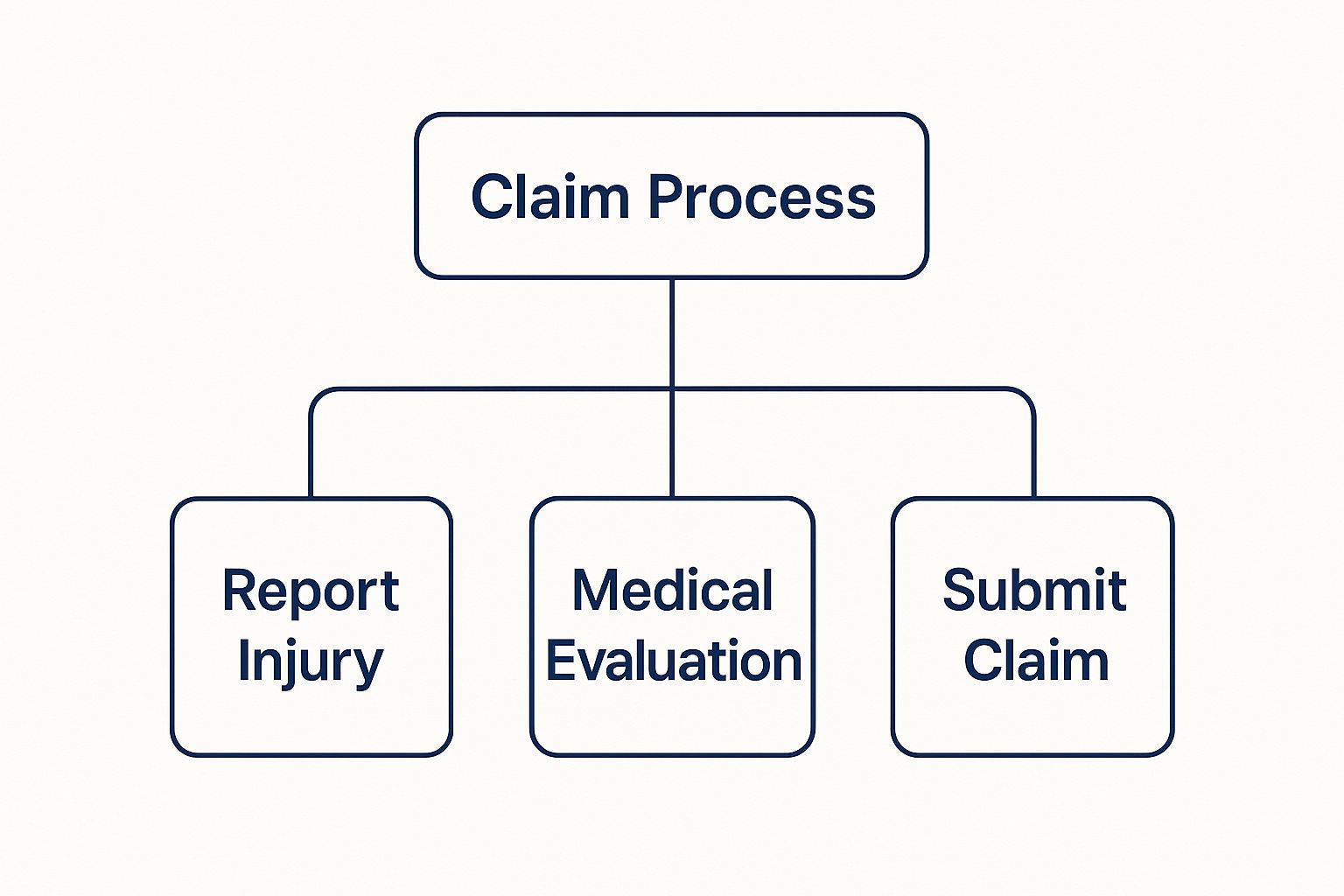
As you can see, the process is more than just a single step; it starts with formally reporting the injury and getting immediate medical attention.
Permanent Disability Benefits
Unfortunately, some work injuries have consequences that last a lifetime. If your injury leads to a permanent impairment that affects your ability to work and earn a living long-term, you may be eligible for permanent disability benefits. These payments are intended to compensate you for the lasting physical and financial impact of your injury.
These benefits generally fall into two categories:
- Permanent Partial Disability (PPD): This applies when you can still work, but maybe in a reduced capacity or in a different, lower-paying role.
- Permanent Total Disability (PTD): This is for catastrophic situations where the injury prevents you from returning to any type of gainful employment.
Crucial Insight: The value of these benefits is heavily influenced by an impairment rating given by a doctor. This makes your medical records one of the most important parts of your claim.
To help clarify how these benefits work in practice, here is a simple breakdown.
Breakdown of Workers Compensation Benefit Types
| Benefit Type | What It Covers | Example Scenario |
|---|---|---|
| Medical Benefits | 100% of reasonable and necessary medical care for the work-related injury. | A warehouse worker injures their back lifting a box. These benefits would cover their ER visit, MRI, pain medication, and physical therapy sessions. |
| Wage Replacement | A portion of your lost wages (usually 2/3) while you are temporarily unable to work. | A chef suffers severe burns and cannot work for six weeks. These benefits provide them with a weekly check to cover living expenses during their recovery. |
| Permanent Disability | Compensation for a lasting impairment that reduces future earning capacity. | A construction worker loses a finger in a machinery accident, resulting in a permanent impairment. They receive a lump sum or structured payments for this loss. |
| Vocational Rehabilitation | Costs for retraining, education, and job placement if you cannot return to your old job. | A firefighter with a permanent lung injury from smoke inhalation can no longer do their job. These benefits might pay for them to get certified as a fire inspector. |
Each benefit serves a distinct purpose, ensuring that injured workers have a path forward, no matter the severity of their injury.
Vocational Rehabilitation Benefits
What if your injury makes it impossible to go back to your old job? This is where vocational rehabilitation steps in. For instance, if a back injury means you can no longer work as a firefighter, these benefits are designed to help you pivot to a new career.
This support can cover the costs of job retraining, provide career counseling, or even pay for college courses to help you develop new, marketable skills. It’s a forward-thinking benefit that aims to get you back on your feet and into the workforce in a role that works with your physical limitations.
These benefits are a major part of an employer’s overall compensation costs. In the U.S., total employee benefits average $11.21 per hour worked, and workers' comp is a key driver of that expense. You can learn more about employer compensation costs on the BLS website.
Navigating the workers' compensation system can feel overwhelming, especially when you're already dealing with an injury and the stress that comes with it. But think of it less like a maze and more like a series of steps. It all boils down to a clear, straightforward process that begins with one crucial action.
Your absolute first move is to report your injury to your employer immediately. I can't stress this enough. Don't wait around, hoping the pain will just disappear on its own. Every state has strict reporting deadlines, often around 30 days, but the sooner you officially report it, the better. Any delay gives the insurance company an opening to argue that your injury didn't actually happen on the job.
Make sure you get it in writing. Even if you tell your supervisor face-to-face, always follow up with a written notice, like an email or your company's official incident report form. This creates a timestamped record that proves you gave them a heads-up right away.
Getting Medical Help and Keeping a Paper Trail
Once you've notified your employer, your next priority is getting medical treatment. Your health is obviously the most important thing, but this step also builds the foundation of your legal claim. The doctor's report is the key piece of evidence that officially links your injury to your work.
Depending on where you live, you might have to see a doctor selected by your employer or their insurance company, at least for your first appointment. It’s critical to follow these state-specific rules to make sure your medical bills are covered.
When you see the doctor, be thorough. Don't downplay your pain. Explain exactly how the injury happened and list every single symptom you're experiencing. Everything you say becomes part of your medical record, which is the bedrock of your claim for what is workers compensation benefits.
Pro Tip: Start a journal dedicated to your injury. Log every single thing: doctor's visits, mileage to and from appointments, medical bills, conversations you have with your boss or the insurer, and any days you're out of work. This personal file can be a lifesaver if any disputes come up down the road.
Filing the Formal Claim and What Happens Next
After reporting the injury and seeing a doctor, it's time to fill out the official claim form. It’s usually called a "First Report of Injury" or something similar. Your employer should give you the form, but you can also get it directly from your state's workers' compensation agency.
Take your time and fill this form out with painstaking accuracy. Any little inconsistency between this form, your initial report to your employer, and what you told the doctor can be used by the insurer to question your claim.
Once you submit the paperwork, the insurance company kicks off its investigation. They’ll go through your medical records, review the incident report, and might want to talk to you, your supervisor, or even your colleagues. They will then decide to either approve or deny your claim. The waiting game can be tough, but knowing you’ve been organized and honest is your best defense. If your claim gets the green light, your benefits will start. If it's denied, don't panic—you have the right to appeal.
That sinking feeling when you open a denial letter for your workers' comp claim is tough, but I want to be clear about something: this is not the end of the road. It’s simply the insurance company's first move, not the final say. You absolutely have the right to push back, and knowing what to do next is how you can get things back on track.
First things first, you need to find out precisely why they denied your claim. The insurer is required to give you a reason in writing. Often, it comes down to a few common issues: maybe a reporting deadline was missed, they’re questioning if the injury really happened at work, or they believe there isn’t enough medical proof connecting your injury to your job.
Your Right to Appeal
Once you know the "why," you can start the appeals process. This is the formal system for getting a fresh set of eyes on your case. Don't think of it as starting a fight; instead, see it as your chance to lay out your side of the story, backed by solid evidence.
The exact steps can differ from state to state, but the journey usually looks something like this:
- Mediation or Informal Conference: This is often the starting line. You, the insurance company's representative, and a neutral third party (a mediator) will sit down and try to work out a solution without heading to a formal hearing.
- Formal Hearing: If you can’t reach an agreement in mediation, your case moves on to a hearing with a workers' compensation judge. It operates a lot like a mini-trial, where you can present your evidence, have witnesses speak, and make your case.
Important Reminder: The appeals system runs on strict deadlines. If you miss the window to file your appeal, you could lose your chance to pursue what is workers compensation benefits for good. It's crucial to act fast after getting that denial notice.
When to Seek Legal Help
Trying to manage an appeal while you're also focused on getting better is a huge challenge. This is really the moment when bringing in a workers' compensation attorney is a smart move. They live and breathe this stuff.
An experienced lawyer will take over the complex paperwork, help you gather the right medical records and expert opinions, and stand up for you at hearings. Their job is to build the strongest case possible so you can focus on your recovery.
For veterans and first responders, the situation can be even more complex. The unique injuries and stresses that come with these jobs often require a deeper level of understanding. Having an advocate who gets these specific challenges isn't just helpful—it can be the key to winning your case and securing the benefits you've earned. They make sure you are heard and your rights are protected from start to finish.
Common Questions About Workers' Comp Benefits
Once you understand the basics of workers' comp, the real-world questions start popping up. It's one thing to know what the system is supposed to do, but it's another to figure out how it applies to your specific situation after an injury. Let's walk through some of the most common concerns we hear every day.
Can I Choose My Own Doctor After a Work Injury?
This is a big one, and the answer really depends on where you live. Some states give you the freedom to see your own trusted family doctor right from the start.
However, many states have rules that require you to see a physician from a network chosen by your employer, at least for your initial treatment. It's crucial to get this right from day one, so find out your state's specific rules to make sure your medical bills are covered.
What if the Injury Was Partly My Fault?
This is where one of the best features of workers' compensation comes into play. It's designed as a "no-fault" system.
What does that mean for you? It means that even if you made a mistake or were a bit careless, you're still entitled to benefits. The only thing that truly matters is that the injury happened while you were on the clock, doing your job.
Important Exception: There are a few rare situations where benefits can be denied. These usually involve serious misconduct, like being intoxicated at work, intentionally starting a fight, or trying to injure yourself on purpose.
Can I Be Fired for Filing a Workers' Comp Claim?
The answer is a hard no. It is completely illegal for your employer to retaliate against you for filing a workers' compensation claim.
Firing you, cutting your hours, demoting you, or punishing you in any way for simply using your legal rights is against the law. If you feel like you're being punished for filing a claim, you might have a separate wrongful termination case against your employer.
Navigating a workers' compensation claim, especially as a veteran or first responder, requires specialized knowledge and dedicated support. The team at Homefront Group is committed to ensuring you receive the justice and benefits you deserve. Take our free 3-minute quiz to see what you qualify for and let us help you build a strong case.