

Understanding Your Workers Compensation Rights and the Claim Landscape

When you get hurt on the job, it’s easy to feel lost in a sea of questions. What are you owed? Who covers the costs? Does your injury even count? First, know that you’re not alone. Workplace injuries are more frequent than most people realize. A recent study found there are about 3.1 workers' compensation claims filed for every 100 full-time employees in the U.S., with an injury rate of 2.8 per 100 workers. These numbers show that this is a well-traveled road, and knowing your rights is your first move in the workers comp claim process. To see how these numbers play out nationally, you can explore more insights about workers' compensation trends.
Getting through this process is less about being a legal expert and more about understanding a few core ideas and how people react under pressure. Your employer’s initial response doesn’t determine your rights, and the kind of support you get—or don't get—can make a big difference in your recovery.
What Does Workers Compensation Really Cover?
Most people assume workers' comp covers medical bills and lost pay, but the details are what really matter. The coverage goes far beyond the initial ER visit or doctor's appointment. True coverage is much broader, and being aware of this can keep you from missing out on benefits you're entitled to.
- Medical Treatment: This covers everything from emergency services and surgeries to ongoing physical therapy, prescriptions, and any medical gear you might need, like crutches or a back brace.
- Lost Wages (Temporary Disability): If your doctor confirms you can't work, you're supposed to receive a portion of your regular income. The exact amount varies by state.
- Permanent Disability: If your injury leaves you with a permanent impairment, you could be eligible for benefits that continue even after you’re back at work. This is to make up for the long-term effect on your ability to earn.
- Vocational Rehabilitation: Can't go back to your old job? Some state programs offer services to help you retrain for a new line of work.
Here’s a practical example: a warehouse worker injures their back. Workers' comp doesn't just pay for the MRI. It should also cover their pain medication, the physical therapy sessions they need to get back on their feet, and a part of their lost wages while they’re out. If the injury means they can never lift heavy objects again, it might even cover training for a new position, like a dispatcher.
Common Misconceptions That Can Derail a Claim
Many legitimate claims get derailed by simple misunderstandings. A big one is thinking that if your manager isn't supportive, your claim is dead in the water. The truth is, the workers' compensation system is run by insurance carriers and state agencies, not your immediate supervisor.
A frequent scenario involves an employee feeling pressured to not report a "minor" injury. They might think, "It's just a pull, I'll be fine." A week later, that pull has turned into a serious sprain. The delay in reporting gives the insurance adjuster an opening to question whether the injury actually happened at work. Always report injuries right away, no matter how small they seem. Your initial report is what protects your right to get care if things get worse.
It's also crucial to remember that your job should not be on the line for filing a claim; it is illegal for an employer to retaliate against you for doing so.
Immediate Actions After a Workplace Injury: Getting It Right From the Start

The first few hours after a workplace injury are a whirlwind of pain, confusion, and stress. The steps you take in this critical window can dramatically shape your entire workers' comp claim process. It's easy to make a mistake when you're overwhelmed, but getting these initial actions right builds a strong foundation for your case. This isn't just about checking off boxes; it's about protecting your health and your rights from moment one.
Think about a delivery driver who slipped on an icy patch while making a drop-off. He felt a sharp pain in his knee but pushed through to finish his route. His supervisor told him to "walk it off and see how it feels tomorrow." By the next day, his knee was badly swollen. That delay gave the insurance company an opening to question if the injury really happened at work.
This is a perfect example of why the first 24 hours are so important. To help you make the right moves, here’s a quick-action checklist.
Immediate Action Checklist: First 24 Hours After Injury
A comprehensive checklist comparing critical actions to take versus common mistakes to avoid in the first day after a workplace injury
| Action Required | Timeline | Why It Matters | Common Mistake to Avoid |
|---|---|---|---|
| Seek Medical Attention | Immediately | Establishes a medical record linking the injury to the work incident. Some injuries aren't immediately apparent. | Waiting to "see how it feels" or just telling your supervisor without seeing a doctor. |
| Report to Your Supervisor | As soon as possible, within hours | Fulfills your legal obligation and officially starts the claim process. Most states have strict reporting deadlines. | Downplaying the injury, apologizing, or speculating about who was at fault. |
| Document the Scene | Immediately after the incident (if able) | Captures crucial evidence like hazards or conditions that caused the injury before they can be changed or cleaned up. | Assuming your employer will take care of all the documentation for you. |
| Gather Witness Information | Immediately | Provides third-party accounts to support your claim. Memories fade quickly. | Forgetting to get names and contact info of coworkers who saw what happened. |
| Write Down Incident Details | Within 24 hours | Creates a personal record of the date, time, location, and exactly what you were doing. This helps you keep your story consistent. | Relying on memory alone, which can become fuzzy under stress. |
This checklist gives you a solid game plan. Following these steps helps make sure your claim starts on the right foot, backed by clear evidence and timely reporting.
Secure Medical Care Immediately
Your first priority is always your health. Seek medical attention right away, even if the injury seems minor. Things like concussions, internal bleeding, or soft tissue damage don't always show immediate, obvious symptoms. The adrenaline rush from an incident can easily mask pain.
Going to an urgent care clinic, an ER, or a company-approved doctor creates an official medical record. This document is a powerful piece of evidence that directly connects your injury to the workplace event. When you talk to the doctor, be very clear that your injury happened at work. Explain exactly what happened, what task you were performing, and every single symptom you're experiencing. Don't minimize your pain; the accuracy of this initial report is critical, as it's often the first thing an insurance adjuster will scrutinize.
Document Everything While It's Fresh
Once your immediate medical needs are handled, shift your focus to documentation. Memories fade and details get blurry, so it's vital to capture information right away. If you're physically able, use your phone to take pictures of the accident scene. For example, if you tripped over an unsecured cable or slipped on a wet floor with no warning sign, a photo of that hazard is hard to dispute.
Beyond pictures, you need to gather key information. Think of yourself as an investigator putting together the facts of the case. Try to collect:
- Witness Information: Get the full names and contact details of any coworkers or other people who saw the incident.
- Incident Details: Write down the exact date, time, and location. What were you doing? Was any specific equipment involved?
- Supervisor Conversation: Make a note of who you reported the injury to, when you reported it, and what they said in response.
A simple notebook or even a note-taking app on your phone can become your claim journal. This helps you keep your story straight when talking to doctors, your employer, and insurance reps down the line.
Report the Injury, But Choose Your Words Carefully
You must officially report your injury to your employer as soon as you possibly can. Many states have very strict deadlines for this, sometimes just a few days. This first conversation is important, so stick to the facts.
Instead of saying, "I think I might have hurt my back," be direct: "I was lifting a box and felt a sharp pain in my back." Avoid apologizing or guessing about who was at fault. Just state what happened. This formal report triggers your employer's legal duty to give you the paperwork you need to file a workers' compensation claim. Your actions in these first hours create an undeniable record that will be your strongest asset as you move forward.
Reporting Your Injury: Mastering Communication and Documentation

The U.S. Department of Labor offers a variety of resources that detail the different workers' compensation programs, including those specifically for federal employees. This underscores that the workers comp claim process is a formal, regulated system with its own set of rules—it’s not just a casual chat with your employer.
Think of reporting your injury as more than just a quick "hey boss, I got hurt." It's a strategic conversation where your words and actions matter. The way you communicate and document everything in these first moments can pave the way for a smooth claim or create frustrating roadblocks. Your mission is to be professional, clear, and protect your rights without coming across as aggressive.
What to Say, What to Write, and What to Avoid
When you first report your injury, stick to the objective facts. This isn't the time to apologize, guess who was at fault, or downplay how you feel. Your job is to explain what happened, simply and clearly. For example, instead of saying, "I guess I messed up my shoulder," a much better statement is, "I felt a sharp pain in my right shoulder while lifting a supply crate onto the top shelf."
That initial verbal report is just the opening move. You need to follow it up in writing. Sending an email to your supervisor and the HR department creates a timestamped, written record that’s hard to argue with later. This email should simply state the facts:
- The date and time the injury happened.
- Where you were when the injury occurred.
- A brief, factual account of how it happened.
- Which parts of your body were injured.
- A note that you are seeking (or have already received) medical attention.
This written follow-up is your proof that you reported the injury on time, which is a crucial requirement in every state's workers' compensation laws.
Handling Different Employer Reactions
In a perfect world, your employer would be supportive and walk you through the process. Unfortunately, that’s not always how it plays out. You might face pushback, have your concerns dismissed, or even encounter hostility. Research has shown that an employee's fear of getting fired is a significant factor leading to poor claim outcomes. If your supervisor makes you feel like your job is on the line, that's a serious red flag.
Here’s how you can manage different responses:
- The Dismissive Employer: If your boss says something like, "Just walk it off," or "Let's wait and see," politely hold your ground. You can respond with, "I understand, but for my health and to follow company policy, I need to officially report this and see a doctor. I need to get the claim paperwork started."
- The Unhelpful Employer: If they aren't giving you the necessary forms, send a certified letter requesting them. This creates a legal paper trail showing you tried to follow the correct procedure. This documentation can be incredibly important if your claim is challenged down the road.
- The Hostile Employer: If you're met with threats or intimidation, don't get into an argument. As soon as you can, write down everything that was said—who was present, the exact words used, the date, and the time. This is the point where calling an attorney becomes a very smart move.
Always remember to keep your communication professional. You aren't picking a fight; you're starting a formal, legally recognized process. For more information on these programs, you can get a good overview of workers' comp on the Department of Labor website. Getting this early stage of communication and documentation right builds a strong foundation for your entire workers comp claim process.
Medical Treatment and Building Your Case Through Healthcare
Your medical treatment is more than just a path to getting better; it’s the cornerstone of a successful workers' comp claim process. Each doctor’s visit, physical therapy session, and prescription creates a paper trail that proves your injury is work-related and justifies the benefits you need. Handling this part of the system the right way can be a game-changer for your claim.
Company Doctor vs. Your Own Physician: Making the Right Choice
One of the first big decisions you'll face is who provides your medical care. Some states require you to see a company-picked doctor, at least for the first few visits. These physicians are usually part of a network chosen by the insurance carrier. While it might seem straightforward, it's good to remember their connection to the insurer. Their main goal might lean towards keeping costs down.
For example, a company doctor might suggest you can return to light duty sooner than you feel ready. This isn't always a bad thing; they just operate within a particular system. But if you feel like your recovery is being rushed or your concerns aren't being heard, it's a red flag to look at your other options.
Many states let you switch to your own doctor after a certain time or get a second opinion. Using your own physician can be a real advantage, especially if you have an established relationship. They know your health history and their only focus is your well-being, which often leads to more detailed documentation and stronger support for your care.
Communicating for a Stronger Case
When you talk to any doctor about your work injury, what you say becomes part of the official record. You need to be clear, consistent, and detailed.
- Be Specific: Instead of saying "my shoulder hurts," describe how it hurts. Is it a sharp pain when you lift your arm? A constant, dull ache that wakes you up? Give them real-life examples: "I can't lift a gallon of milk out of the fridge without a shooting pain."
- Connect it to Work: Always start by explaining the work-related event that caused the injury. "This all started right after I slipped on the wet floor at the warehouse on Tuesday."
- Don’t Downplay Your Symptoms: This is a common mistake, especially for veterans who are used to pushing through pain. If a symptom is bothering you, bring it up at every single visit. Consistency is crucial. If you stop mentioning a symptom, the insurance company might argue it's no longer an issue.
This information goes directly into your medical records. These days, claims processing systems analyze massive amounts of data from these records, including injury specifics and treatment codes, to evaluate claims. Accurate and consistent reporting on your part ensures the data reflects your true condition. You can find out more about how data analytics is shaping workers' compensation claims on Milliman.com.
Handling Pre-Existing Conditions and Second Opinions
Insurance adjusters often search for pre-existing conditions to deny or lower a claim. If you had a previous back injury from your service, for instance, they might argue your current back pain isn't work-related.
This is where your doctor becomes your greatest ally. They can document how the new work injury has aggravated or worsened your prior condition. For example, your doctor can write a note like, "While the patient has a history of lumbar strain, the recent workplace fall caused a new herniated disc, which is a significant worsening of his underlying condition." This type of medical opinion is powerful evidence.
If your approved doctor seems unwilling to make this connection or won't refer you to a specialist, don't hesitate to seek a second opinion. It's your right, and it could be the most important step you take to protect both your health and your claim.
Filing Your Formal Claim: Navigating Paperwork and Legal Requirements
After you’ve reported the injury and seen a doctor, it’s time to tackle the formal claim. This is where the official workers' comp claim process really kicks into gear, and honestly, it's where a lot of veterans can hit a wall. It’s a world of paperwork, strict deadlines, and needing to tell your story perfectly on paper. The rules can seem tricky because they change from state to state, but if you take it one piece at a time, it’s completely manageable.
Think of the formal claim form as the official start of your legal case. This document, which might be called a "First Report of Injury" or a specific state form number, is what the insurance company uses to open your file. Your number one job is to fill it out completely and accurately. Any blank space or vague answer is like an open invitation for the insurance adjuster to delay or question your right to benefits.
Completing the Paperwork with Precision
When you receive that claim form, don't rush it. I’ve seen people try to fill it out in a noisy waiting room, and it's a recipe for mistakes. A common error is being too general about how the injury happened. Instead of just writing "hurt at work," you need to paint a clear picture. For example: "I was lifting a 50-pound box from a low shelf when I felt a sharp, tearing sensation in my lower back."
Be just as specific about your injuries. Don't settle for "back pain." Instead, write something like, "Sharp pain in the lower right side of my back that radiates down my right leg." This kind of detail makes it much harder for an adjuster to argue that your injury isn't serious.
Gathering Your Supporting Documents
Your claim form is the main event, but your supporting documents are what give it credibility. They provide the hard evidence that backs up everything you're saying. Your mission is to build an organized file that makes a strong case for you.
- Medical Records: This is your strongest evidence. Include every single doctor’s note, lab result, physical therapy report, and treatment plan related to your work injury.
- Witness Statements: If a coworker saw the accident happen, ask them to write down what they observed. Even a simple, signed statement describing the event can be incredibly powerful.
- Correspondence: Keep a copy of every email, letter, or official notice you send to or receive from your employer and the insurance company. This creates a paper trail.
When you're ready to submit these sensitive documents, it's vital to protect your private information. Look into secure online file transfer methods to ensure your personal and medical details are kept safe. It's a simple precaution that prevents your data from falling into the wrong hands.
State-by-State Filing Requirements Overview
Every state has its own set of rules, which can be confusing. The table below gives you a snapshot of the key differences in reporting deadlines, final filing deadlines (the statute of limitations), and required forms across a few major states to show you how much they can vary.
| State | Reporting Deadline | Filing Deadline | Key Forms Required | Special Considerations |
|---|---|---|---|---|
| California | Immediately or within 30 days | 1 year from date of injury | DWC-1 Claim Form | Employer must provide DWC-1 form within one business day of being notified of injury. |
| Texas | Within 30 days to employer | 1 year from date of injury | DWC Form-041 | Texas is an opt-out state; verify your employer has workers' comp insurance. |
| Florida | Within 30 days to employer | 2 years from date of injury | Not required for employee to file a specific form initially. | Employer files First Report of Injury (DWC-1) with the insurer. Employee may need to file a Petition for Benefits to resolve disputes. |
| New York | Within 30 days to employer | 2 years from date of injury | Form C-3 (Employee's Claim for Compensation) | Must be filed with the Workers' Compensation Board, not just the employer. |
| Pennsylvania | Within 120 days to employer | 3 years from date of injury | No specific state form required for employee to initiate. | Claims are often initiated by the employer/insurer filing a First Report of Injury. |
This table shows why it's so important to know your state's specific rules. Missing a deadline for the statute of limitations—the legal window to file—can mean losing your right to any benefits, permanently. This is different and much more final than the initial reporting deadline.
Understanding Deadlines and Timelines
Once your formal claim is filed, the clock starts ticking for the insurance company. This infographic gives a good overview of what to expect next.
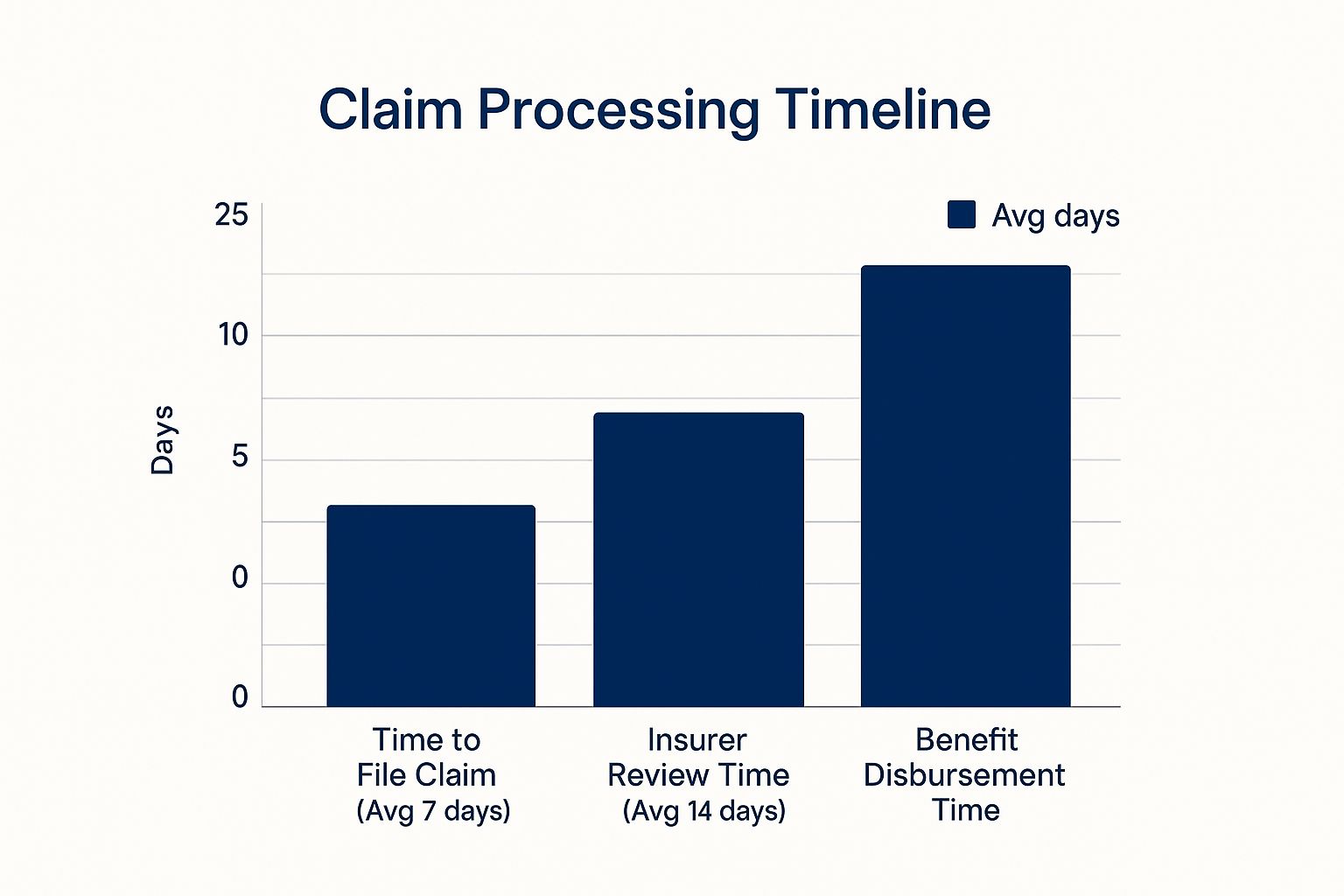
As you can see, patience is a virtue. The average review time for an insurer is about two weeks before they make a decision. After you file, you'll get an official notice that either accepts, delays, or denies your claim. If it’s accepted, the notice will detail your benefits. If it’s delayed, they'll ask for more information. And if it's denied, they must tell you why—which is your cue to get ready for the appeals process.
Managing Your Claim: Staying Proactive Without Becoming a Problem
Getting your claim filed is a major milestone, but your work isn't over yet. Honestly, the time after you submit everything can be the most trying part of the entire workers comp claim process. It's a tricky balancing act: you need to keep tabs on your case so it doesn’t fall through the cracks, but you also don't want to be the person who drives the insurance adjuster crazy with daily calls. Success here is about being organized and persistent, not a pest. The idea is to make the system work for you while making sure your own interests are protected.
Working with the Claims Adjuster
The claims adjuster is the person the insurance company assigns to your case. They aren't your enemy, but it's crucial to remember who they work for. The insurer's main goal is to resolve claims as quickly and cheaply as possible. How you interact with the adjuster can really shape how your claim unfolds. It's best to see them as a gatekeeper; your job is to give them the right keys to open the doors for you.
Here’s how you can build a solid working relationship:
- Stay Professional and Polite: Keep your cool, even when you’re frustrated. An adjuster will be much more willing to work with someone who is respectful instead of angry and demanding.
- Follow Up in Writing: After any phone call, shoot them a quick email summarizing your conversation. For example: "Hi [Adjuster's Name], just confirming our call from this morning. You mentioned you'd be looking over my latest physical therapy report and should have an update on the MRI approval by Friday. Thanks." This creates a paper trail.
- Be Responsive: If they request a document or a signed medical release, send it over right away. Delays on your end can give them an excuse to put your claim on the back burner.
Your experience during this phase has a real impact. Studies show that 23% of workers report neutral or negative claims experiences, often due to slow processing times. These bad experiences are directly linked to slower returns to work. On the other hand, positive interactions can lead to a quicker recovery. To see how these experiences affect outcomes, you can discover more insights about these workers' compensation statistics.
Recognizing Early Warning Signs
Even with your best efforts, a claim can start to go sideways. Spotting these red flags early gives you a chance to get things back on track. A classic warning sign is a communication blackout. If an adjuster who was once responsive suddenly goes radio silent for more than a week, that’s a problem.
Another red flag is when they start second-guessing your doctor's recommendations. You might hear comments like, "We'll need a second opinion on that surgery," or "We don't believe that much physical therapy is necessary." This is often a prelude to a denial of care. Also, if your weekly or bi-weekly benefit checks suddenly stop showing up without any notice, that's a major issue you need to address immediately. Don’t just wait around, hoping it sorts itself out. This is when you need to act—first by contacting the adjuster’s supervisor, and if that doesn’t work, by considering legal help. Looking into different types of claim closure processes, even from other sectors, can give you a better understanding of the bureaucratic steps involved in resolving a case.
When Things Go Wrong: Handling Disputes and Getting Back on Track
Not every workers' comp claim process is a straight shot to the finish line. It's actually pretty common to hit a snag. Maybe the insurance company is arguing that your injury isn't truly work-related, or they've refused to cover a critical medical treatment your doctor prescribed. It’s easy to feel discouraged when this happens, but this is the moment where your persistence and all that upfront preparation truly matter. Knowing how to navigate a dispute is what separates a stalled claim from a successful one.
The workers' compensation system itself is always changing. The pandemic, for example, changed employment patterns in big ways. While covered employment actually saw a 2.1% drop between 2016 and 2020, total covered wages went up. This shows a system that's constantly adjusting, and these adjustments can sometimes mean more scrutiny on your individual claim. You can dive deeper into these trends and system changes by checking out this recent workers' compensation report. For you, this just means you need to be prepared to stand your ground if your claim gets challenged.
Common Reasons Your Claim Might Be Disputed
Insurance adjusters are trained to look for reasons to question claims—it's a fundamental part of their role. If you know what they're likely to flag, you can build a much stronger case from day one.
- Work-Relatedness: The insurer might claim your injury didn’t happen on the job. This is a frequent issue with repetitive stress injuries, like carpal tunnel, or if there was any delay in reporting the incident.
- Pre-existing Conditions: This is a big one for veterans. If you have a prior injury, particularly one from your military service, the insurance company will probably try to argue that your current pain is from that old condition, not your new job.
- Disability Rating: This is where things can get contentious. Your doctor might determine you have a 20% permanent partial disability, but the insurance company's hand-picked doctor might come back with a rating of only 5%. That gap can have a massive impact on your financial compensation.
- Treatment Denials: An adjuster might deny a specific surgery, MRI, or round of physical therapy, arguing that it's not "medically necessary."
The Appeals Process: Your Path Forward
If your claim is denied or a specific benefit is disputed, you have the right to appeal. The exact steps are specific to your state, but the process generally moves from informal talks to formal hearings. Think of it like a military chain of command—you start at the first level and move up if you don't get the outcome you need.
First, you’ll likely need to file a formal appeal document with your state's workers' compensation board. Pay close attention to the deadlines here; missing one could get your appeal dismissed before it even gets reviewed. After filing, your case might proceed to mediation. This is a more relaxed meeting where a neutral mediator helps you and the insurance company try to find common ground and reach a settlement. It’s often a faster and less expensive route than a full-blown hearing.
If mediation doesn't work out, the next step is usually a formal hearing in front of a workers' compensation judge. This is basically a mini-trial. You'll present all your evidence—medical records, photos, witness statements—and your attorney will make your case. The judge will then issue a legally binding decision.
When to Hire an Attorney
So, should you get a lawyer involved? If you have a straightforward claim that the insurer accepted without any fuss, you might be fine on your own. But the second a dispute arises, the entire dynamic shifts.
You should seriously consider hiring an attorney if:
- Your claim has been flat-out denied.
- The insurance company is fighting your disability rating.
- Your employer is retaliating against you for filing a claim.
- You have a significant pre-existing condition, like a service-related disability, that complicates your case.
A reputable workers' compensation attorney works on a contingency fee basis, which means they don’t get paid unless you win. Their fee is typically a percentage of the final settlement or award, usually around 15-25%. The right lawyer can be a true game-changer, transforming a denial into an approval because they know exactly how to counter the insurance company's tactics. They take on the legal fight so you can focus on the most important job: your recovery.
Key Takeaways for Workers’ Comp Claim Success
Going through the workers' comp claim process can feel like a maze, but getting through it successfully often comes down to a few key actions. If you can master these, you'll be on the right path to a smooth resolution instead of a drawn-out fight. Think of this as your practical playbook, highlighting the moves that really count for veterans and first responders.
The Power of Empathy and Communication
It might sound simple, but the human element is one of the most powerful—and most overlooked—parts of a successful claim. When an injured employee feels left in the dark or worried about their job, the claim is far more likely to end up in a legal battle. In fact, a major study revealed that the fear of being fired was a top reason for poor outcomes, often leading to double the rate of unemployment and adding weeks to the disability period.
You can change this dynamic with simple, consistent communication. A call from a supervisor the day after an injury just to ask, "How are you doing?" can build a foundation of trust. This isn't about being overly sentimental; it's a smart approach. Workers who feel valued and supported are much less likely to hire a lawyer out of fear.
Here are a few practical tips to put this into action:
- Document your conversations: After you talk with an adjuster, send a quick, polite email recapping the discussion. This creates a paper trail you can refer to later.
- Keep it professional: Treat everyone involved—from the claims adjuster to your HR contact—with respect. A cooperative attitude often gets better results.
- Ask for clarity: If you receive a letter you don’t understand or aren't sure what to do next, just ask. It’s always better to get clarification than to make a mistake based on a guess.
Your Most Important Deadlines and Documents
While good communication sets the tone, the paperwork and deadlines are the legal framework of your claim. Missing a single critical deadline can put your entire case at risk.
These are your absolute must-haves:
- A Complete Claim Form: Don't leave any fields blank. Vague descriptions like "hurt my back" won't cut it. Be specific. For example: "Felt a sharp, tearing pain in my lower left back while lifting a 50-pound equipment case."
- Consistent Medical Records: Your medical file is your strongest piece of evidence. Make sure your doctor clearly links your injury to your job duties and documents all of your symptoms in every report.
- Statute of Limitations: This is the non-negotiable deadline for filing your claim with the state workers' comp board. It varies by state but is typically one to three years from the date of your injury. Mark this date on your calendar immediately.
Long-Term Considerations: Beyond the Claim
Getting your workers' comp claim process approved isn't always the end of the story. You need to think about your long-term health and financial stability. This means carefully considering any settlement offers. Is a lump-sum payment better for your situation, or do you need ongoing medical coverage? Make sure any future medical care you might need is factored into the agreement. Planning for a safe return to work, whether with special accommodations or in a different role, is another crucial step.
For veterans facing the challenges of a work injury, you don't have to figure this out on your own. The team at Homefront Group specializes in helping service members get the benefits they've earned. Our experienced advocates are here to guide you. Take our 3-minute benefits quiz today to see how we can help you build a winning strategy.