

Before you can even begin to think about specific VA benefits, you first have to clear two fundamental hurdles. Think of them as the gatekeepers to everything the Department of Veterans Affairs has to offer. Nearly all your potential benefits hinge on two things: your time on active duty and the character of your discharge.
Decoding Your Basic Eligibility for VA Benefits
Your path to accessing the benefits you've earned starts here. Let's break down the foundation of VA eligibility. It's helpful to think of your military service as a key. The VA has a very specific set of locks, and understanding these two core requirements will tell you which doors your key can open.
This is the baseline that every veteran needs to understand.
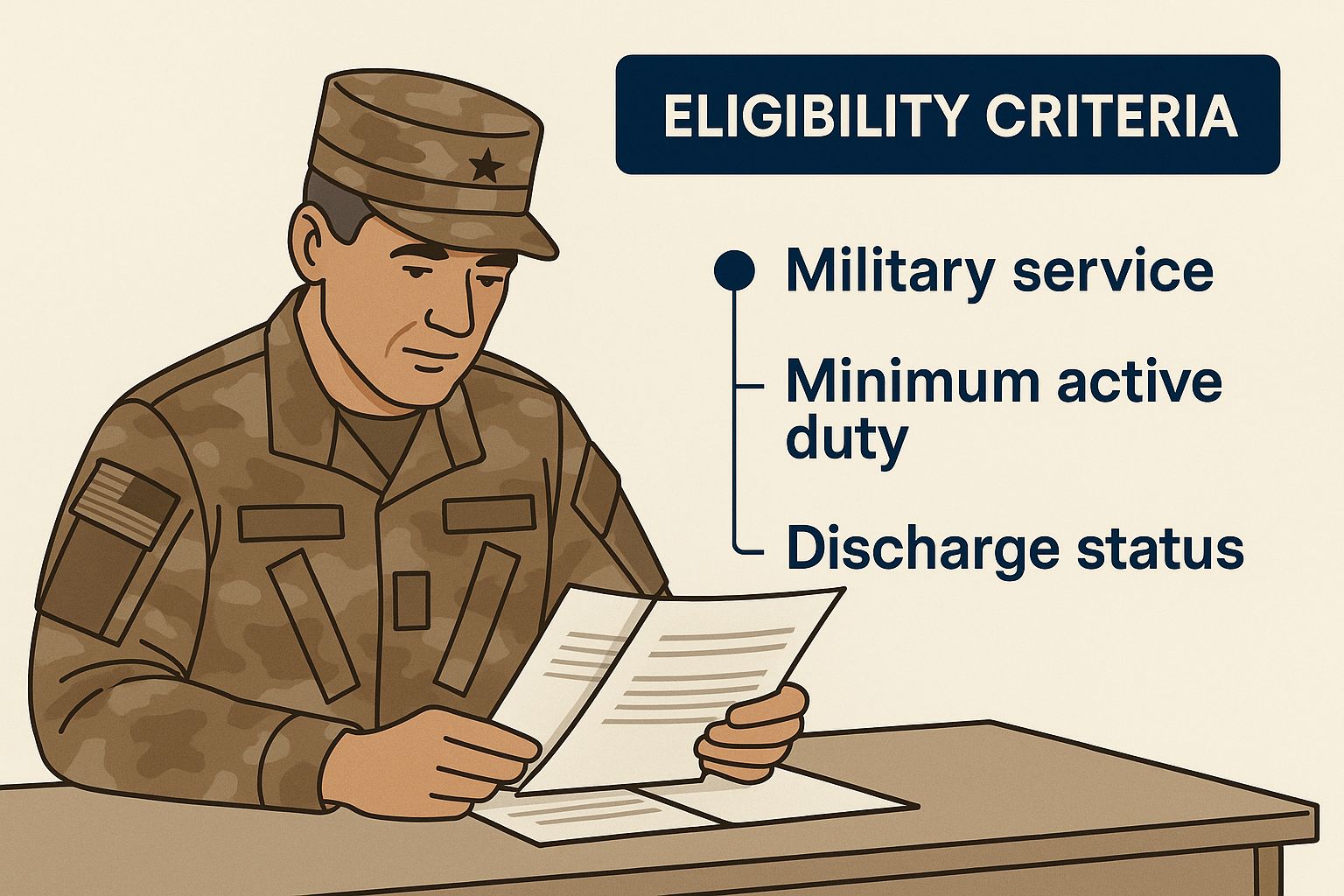
As you can see, it all starts with your service history and discharge status. These two pieces form the base of the entire eligibility pyramid.
Minimum Service Requirements
For most veterans who first enlisted after September 7, 1980, the standard rule of thumb is that you need to have served at least 24 continuous months of active duty. It's a straightforward benchmark, but it’s not set in stone. The VA knows that every service story is different, and there are some important exceptions.
You might still meet the service requirement, even with less than 24 months, if you:
- Were discharged due to a hardship or an "early out."
- Were discharged for a disability that was caused or aggravated by your active-duty service.
- Served before September 7, 1980, as the 24-month rule generally doesn't apply to you.
These exceptions are critical. They reflect the reality that a veteran's commitment can't always be measured by a calendar.
The Importance of Your Discharge Status
Your discharge status, which you'll find on your DD-214, is just as crucial as your length of service. To be eligible for most benefits, your service must have been under "other than dishonorable" conditions. This typically means an Honorable discharge or a General (Under Honorable Conditions) discharge.
An Other Than Honorable (OTH) discharge doesn't automatically close the door. The VA conducts its own independent "character of discharge" review. This means you could still qualify for some benefits, especially for healthcare related to a service-connected disability.
Special Rules for Reserve and National Guard
The rules look a bit different for members of the Guard and Reserve. Simply being a "weekend warrior" isn't enough to establish veteran status for most VA benefits.
The key factor is federal activation. You generally become eligible if you were called to active duty by a federal order for a purpose other than training. Your typical weekend drills and two-week annual training sessions don't count towards this requirement. It's the activation for a real-world mission that matters, and understanding this distinction is vital for determining your veterans benefits eligibility.
To make this easier to digest, let's summarize the core factors in a table. These are the main checkpoints the VA uses to determine basic eligibility.
Core Eligibility at a Glance
| Eligibility Factor | General Requirement | Common Exceptions |
|---|---|---|
| Length of Service | 24 continuous months of active duty if you enlisted after 9/7/1980. | Discharged for a service-connected disability, hardship, or "early out." Does not apply to those who served before 9/7/1980. |
| Discharge Status | A discharge under other than dishonorable conditions (e.g., Honorable, General). | The VA can make its own determination for OTH discharges, potentially granting access to certain benefits like healthcare. |
| Guard/Reserve Status | Completion of a full period of active duty for which you were federally activated (not for training). | No exceptions; federal activation for a non-training purpose is the primary qualifier. |
Ultimately, the entire VA benefits system is built on these foundational principles. Your service time, your discharge character, and any service-connected conditions are the pillars that support your claim. You can find out more about these requirements and how they apply to your specific situation from the experts at the VA.
Navigating VA Health Care and Its Priority Groups
So, you’ve confirmed you meet the basic service requirements for VA benefits. What's next? For many veterans, the goal is getting enrolled in VA health care. But it's not quite as simple as just walking in the door. The VA uses a structured system to manage who gets care and when, and it’s all based on what they call Priority Groups.

Think of it like triage in an emergency room. The VA has a responsibility to care for millions of veterans, and to do that effectively, they have to prioritize those with the most urgent needs. Your assigned Priority Group determines everything from how quickly you can get appointments to whether you'll have to pay a copay for certain services. It’s your place in line, plain and simple.
How VA Determines Your Priority Group
The VA looks at several key factors to place you into one of eight Priority Groups. This process is designed to put veterans with service-connected disabilities, special recognitions, or low incomes at the front of the line.
The main factors that decide your group are:
- Your service-connected disability rating from the VA.
- Your annual income, which is compared to specific geographic cost-of-living limits.
- Whether you receive other benefits like a VA pension or Aid and Attendance.
- Your eligibility for Medicaid.
- Any special status, like being a Purple Heart recipient or a former Prisoner of War (POW).
A higher disability rating is the most direct path to a higher priority group. For example, any veteran with a 50% or higher service-connected disability rating is automatically placed in Priority Group 1. This guarantees them the highest level of access and means they won't have copays for most types of care.
This system is at the heart of fulfilling the nation's promise to those most impacted by their service, a core principle behind veterans benefits eligibility.
Understanding the Different Tiers of Priority
The groups are numbered logically, from the highest priority (Group 1) down to the lowest. Generally, if you fall into Groups 1 through 6, you can expect solid access to care. Placement in Groups 7 and 8, however, often depends on your income and whether the VA has the capacity to see more patients.
A common myth is that you can't get VA health care without a disability rating. That's absolutely not true. Many veterans qualify based on other factors, like having recently returned from combat or having an income below the VA's threshold for their area.
For instance, a recently separated combat veteran might land in Priority Group 6, which grants them enhanced eligibility for up to 10 years after leaving the service. This is a crucial benefit that acknowledges the unique health challenges that can surface during the transition back to civilian life.
The VA's categorization is a complex but logical way to manage its resources, linking your service history, disability status, and financial situation to your level of access. For a complete breakdown of what each group entails, you can get detailed information from the VA Health Benefits Office.
Examples of Priority Group Placements
To see how this works in the real world, let's look at a few common scenarios:
- Veteran A: Has a 70% service-connected disability rating for injuries sustained in service. She is placed in Priority Group 1, giving her comprehensive care with no copayments for most services.
- Veteran B: Served in Iraq and separated from the military last year. While he hasn't filed a disability claim yet, he is placed in Priority Group 6, which gives him access to care for 10 years after his separation date.
- Veteran C: A Vietnam-era veteran with no service-connected disabilities. Her income is below the VA's geographic threshold for her county. She is placed in Priority Group 7, which means she qualifies for care but may have some copayments.
Knowing your potential Priority Group is incredibly important. It helps you set realistic expectations for your VA health care journey and gives you the knowledge you need to advocate for the benefits you've rightfully earned.
Qualifying for VA Disability Compensation
Beyond healthcare, VA disability compensation provides a crucial lifeline: direct financial support for injuries or illnesses tied to your time in the service. Getting these benefits all comes down to a single, critical idea called service connection. This is more than just a box to check; it’s about showing how your military service is directly responsible for a health condition you're dealing with today. Proving this link is the most important step in your entire claim.
Think about it like telling a story. You have to connect the dots for the VA, drawing a clear line from an event during your service to the diagnosis you have now. That line is your service connection.
The Three Pillars of Service Connection
To make your case successfully, the VA needs you to prove three specific things. You can't have just one or two; all three pillars must be standing strong, backed by solid evidence, for your claim to be approved.
Here’s what you need to establish:
- A Current Medical Diagnosis: You must have an official diagnosis for a disability or condition from a healthcare professional. Simply saying you have back pain isn't enough—a doctor needs to have formally diagnosed the underlying issue.
- An In-Service Event, Injury, or Illness: You need to point to something specific that happened while you were on active duty. This could be anything from a combat injury or a training accident to exposure to hazardous materials.
- A Medical "Nexus": This is the expert opinion that ties everything together. A medical professional has to state that your current condition is “at least as likely as not” caused or made worse by what happened during your service. This is often called a nexus letter.
For instance, let's say a Marine injured her back during a field exercise. Years after leaving the service, she's diagnosed with degenerative disc disease. The in-service event is the training injury, the current diagnosis is the disc disease, and the nexus is a doctor’s letter confirming the injury likely led to her current condition.
Demystifying the VA's Rating System
Once the VA agrees that your condition is service-connected, they'll assign it a disability rating. This rating is a percentage, ranging from 0% to 100%, and it’s meant to reflect how much the condition impacts your ability to work and live a normal life. This number isn't just for show—it's what determines the exact amount of your tax-free monthly compensation.
A 0% rating might sound useless, but it's actually a huge win. It officially confirms your condition is service-connected. If that condition gets worse down the road, you don't have to fight to prove the connection all over again; you only need to show that it has worsened.
Ratings are given in 10% increments. A 10% rating will get you a modest monthly payment, while a 100% rating provides the highest level of compensation. Higher ratings can also open the door to other powerful benefits, like Priority Group 1 healthcare, education benefits, and support for your spouse and dependents.
Simplifying Proof with Presumptive Conditions
Sometimes, proving that "nexus" link can feel almost impossible. How can you definitively connect a cancer diagnosis you received today to chemicals you were around decades ago? The VA understands this challenge. That’s why they created presumptive conditions.
This is basically the VA’s way of saying, "We know that certain diseases are so common after specific types of service that we'll automatically assume they're connected."
For veterans who meet the criteria, this is a game-changer. They don't have to hunt down a doctor to write a nexus letter for these specific conditions.
- Agent Orange Exposure: Veterans who served in and around Vietnam can get a presumptive service connection for illnesses like Type 2 diabetes, Parkinson's disease, and a number of specific cancers.
- Burn Pit Exposure: Thanks to the PACT Act, veterans who served in many parts of Southwest Asia and were exposed to burn pits may have a presumptive connection for over 20 conditions, including many respiratory illnesses and cancers.
These presumptions remove one of the biggest hurdles for thousands of veterans, making it much easier to get the disability compensation they earned. Understanding them is a key part of knowing your full veterans benefits eligibility.
Your Guide to VA Education and Training Benefits
Your time in the military earned you some of the best self-improvement tools out there: VA education benefits. These programs are your ticket to starting a new career, learning a skilled trade, or finally getting that college degree. But let's be honest, figuring out which program is right for you can feel overwhelming.
The two big players are the GI Bill and Veteran Readiness and Employment (VR&E). While both can pay for school, they serve very different purposes. Think of the GI Bill as a broad scholarship you’ve earned through your service. VR&E, on the other hand, is a focused job-training program specifically for veterans with service-connected disabilities.
Post-9/11 GI Bill Eligibility
The Post-9/11 GI Bill (Chapter 33) is the one most people have heard of, and for good reason. To get your foot in the door, you need to have served at least 90 days of active duty on or after September 11, 2001. But the real key is understanding that how much you get is tied directly to how long you served.
This tiered system makes sure your benefit matches your time in uniform. To receive 100% of the benefits—which can mean full tuition at a public university, a monthly housing allowance, and money for books—you generally need to have served at least 36 months on active duty.
A lot of veterans get tripped up here, thinking it's an all-or-nothing deal. It's not. Even shorter periods of service can provide a serious financial boost for your education, making it a critical part of your overall veterans benefits eligibility.
Understanding Your Benefit Tier
The VA figures out your benefit percentage based on your total active-duty service after September 10, 2001. Don't worry if you didn't hit the 36-month mark; you still earn a significant slice of the pie.
Here’s a quick look at how it breaks down:
- At least 36 months: 100%
- 30 to 35 months: 90%
- 24 to 29 months: 80%
- 18 to 23 months: 70%
- 6 to 17 months: 60%
- 90 days to 5 months: 50%
So, what does this mean in the real world? A veteran with 20 months of service would get 70% of the maximum tuition payment and 70% of their housing allowance. That partial benefit can easily be the deciding factor that makes a degree affordable.
Comparing GI Bill Programs
While the Post-9/11 GI Bill is the most popular, it isn't your only choice. Depending on when you served, another program like the Montgomery GI Bill (MGIB) might actually be a better financial move.
Post-9/11 GI Bill vs. Montgomery GI Bill (Active Duty)
| Feature | Post-9/11 GI Bill (Chapter 33) | Montgomery GI Bill (MGIB-AD, Chapter 30) |
|---|---|---|
| Payment Structure | Pays tuition right to the school. You get a separate monthly housing allowance (MHA). | Pays a fixed monthly amount straight to you. You're responsible for paying tuition from that. |
| Best For | Vets going to more expensive schools or who need the housing stipend to make ends meet. | Vets attending lower-cost schools where the fixed payment might be more than the actual tuition. |
| Transferability | You can transfer it to a spouse or kids if you meet specific service requirements. | Can’t be transferred. It’s for you and you alone. |
The Role of Veteran Readiness and Employment (VR&E)
Finally, there’s Veteran Readiness and Employment (Chapter 31), which is in a league of its own. VR&E isn't just about paying for school; it's a full-blown employment program for veterans with a service-connected disability rating of at least 10%.
The main goal here is to help you find and keep a job, overcoming any workplace barriers caused by your disability. That might mean paying for a college degree, but it could also cover vocational school, an apprenticeship, or even support to help you start your own business. You'll work one-on-one with a counselor to map out a personalized plan to hit your career goals.
Meeting the Requirements for a VA Home Loan
Owning a home can feel like a distant dream, but for veterans, the VA home loan is one of the most powerful benefits available to turn that dream into a reality. This program can help you get a mortgage with zero down payment and no private mortgage insurance (PMI), saving you a small fortune right from the start.
But before you start picturing yourself in a new home, you need to prove your veterans benefits eligibility for this specific loan program.
It all boils down to one key document: the Certificate of Eligibility (COE). You can think of the COE as your golden ticket for the VA loan process. It’s the VA’s official stamp of approval, telling your lender that you’ve met the minimum service requirements to qualify.
Securing Your Certificate of Eligibility
Getting your COE is usually a pretty painless process. The VA just needs to verify your service history, and the specific requirements vary slightly based on when and how you served. In many cases, your lender can pull this for you directly from the VA’s online system in just a few minutes.
Generally, you’ll meet the service requirements if you fall into one of these buckets:
- You served 90 continuous days of active service during wartime.
- You served 181 days of active service during peacetime.
- You have more than 6 years of service in the National Guard or Reserves.
- You are the spouse of a service member who died in the line of duty or from a service-related disability.
These are the broad strokes, and the VA has specific date ranges that define its wartime periods. For a deeper dive into the specific criteria, this VA Eligibility Loan Guide is a fantastic resource for understanding all the details.
The VA Is Your Guarantor, Not Your Lender
This is a really common point of confusion, so let's clear it up. The VA doesn't actually hand you the cash to buy your house. Instead, the VA guarantees a portion of the loan on your behalf.
Think of the VA as the most credible cosigner you could ever have. They provide a guarantee to private lenders—like banks, mortgage companies, and credit unions—assuring them that if you can't repay the loan for some reason, the VA will cover some of their losses.
This guarantee makes you a much safer bet in the lender's eyes. It’s the whole reason they're willing to offer such incredible terms, like requiring no down payment. But remember, a private company is still lending you a huge sum of money, so you have to meet their financial requirements, too. That means you'll still need to show you have enough income to handle the monthly payments and a credit history that meets their standards.
Housing Grants for Severely Disabled Veterans
Beyond the loan guarantee, the VA also offers direct financial help through housing grants. These are specifically for veterans with certain severe, permanent, and total service-connected disabilities. These grants can help disabled veterans buy or build an adapted home or modify their current one to accommodate their needs.
The two main grant programs are:
- Specially Adapted Housing (SAH) Grant: This is designed for veterans with specific needs, like those requiring a wheelchair-accessible home due to the loss of use of both legs.
- Special Home Adaptation (SHA) Grant: This grant helps veterans with other severe disabilities—such as blindness in both eyes or the loss of use of both hands—to adapt a home.
These grants are a crucial part of veterans benefits eligibility, offering life-changing support that empowers veterans with significant disabilities to live more independently and safely.
Seeing Beyond VA for Broader Health Coverage
It’s a common mistake to think that VA health care is the only option on the table. For many veterans, it's actually just one piece of the puzzle. The smartest approach often involves weaving together different programs to create a real safety net for your health and finances.
Thinking this way is crucial for understanding your full veterans benefits eligibility. It's not just about what the VA offers directly, but about how to build a complete plan. Let's look at how other major programs, like Medicaid and TRICARE, can fit into your strategy.
The Crucial Role of Medicaid
For a surprising number of veterans, Medicaid is an absolute lifeline. This is especially true if you don't qualify for VA health care—maybe your income is too high for one priority group but too low for private insurance, or you don't meet the minimum service requirements. It also helps veterans who are enrolled in the VA but are stuck with high copayments or need services their priority group doesn't cover.
Each state runs its own Medicaid program, and eligibility usually comes down to your income. It can be your main source of health insurance, or it can work in tandem with your VA benefits as secondary coverage. Having both can dramatically lower what you pay out-of-pocket and give you access to a much wider network of local doctors and specialists.
The numbers really tell the story here. About 10% of veterans—that’s roughly 1.6 million people—are covered by Medicaid, and for many, it's their only health plan. Considering only about half of all U.S. veterans are even enrolled in VA health care, you can see how many people rely on this kind of patchwork to stay covered. You can learn more about this in an insightful KFF issue brief that breaks down how veterans use Medicaid.
Clarifying the Purpose of TRICARE
TRICARE is one of the most misunderstood benefits out there. It’s easy to lump it in with other VA programs, but it serves a completely different purpose and is managed by a different entity: the Department of Defense.
The most important thing to remember is that TRICARE is not a standard health benefit for the general veteran population. It is specifically designed to serve a different group of people.
TRICARE's mission is to provide healthcare for those who are still tied to the military. Think of it as the health plan for the DoD family. This includes:
- Active-duty service members and their families
- Military retirees and their families
- National Guard and Reserve members and their families
- Survivors and certain former spouses
Once you separate from the military and are not considered a retiree, your TRICARE eligibility almost always ends. This is a critical point that trips up a lot of people. While TRICARE is an outstanding benefit for those who qualify, most veterans will need to turn to VA health care, Medicaid, or private insurance to build their post-service health strategy.
Common Questions About Benefits Eligibility
It's one thing to know the major VA benefit programs exist, but it's another thing entirely to figure out how they apply to your specific situation. After leaving the service, real life happens, and with it come a lot of "what if" questions.
This is where things can get confusing. So, let's clear up some of the most common questions we hear from veterans every day. Think of this as your practical, no-nonsense FAQ for navigating your eligibility.
Can I Have Both VA Health Care and Private Insurance?
Absolutely, and in many cases, you probably should. The VA actually encourages veterans to keep their private health insurance, whether it's from an employer or the marketplace. Having both gives you more options and a stronger healthcare safety net.
Here’s how they work together:
- For any health issue that isn't service-connected, the VA may bill your private insurance company.
- This is a good thing—it helps the VA recover costs, which allows them to stretch their budget and serve more veterans.
- Keeping private insurance can also reduce or sometimes even get rid of your VA copays for medical care and prescriptions.
Basically, you get the best of both worlds. You can use the VA's excellent care for your service-connected disabilities and have the flexibility of private insurance for everything else or for seeing doctors outside the VA system.
What Happens if My Disability Rating Changes?
Your VA disability rating is not a life sentence; it’s a reflection of your current condition. Since health can improve or worsen over time, the VA has a process to adjust your rating accordingly.
If a service-connected disability gets worse, you have the right to file for an increased rating. This involves submitting new medical evidence to show how your condition has progressed. If approved, your monthly compensation will increase, and you might unlock new benefits, like a higher priority for VA health care or access to Veteran Readiness and Employment (VR&E) services.
On the other hand, the VA can also propose to lower your rating if they have evidence that your condition has significantly improved. This isn't a final decision. You have the right to fight a proposed reduction by providing your own evidence that your current rating is still warranted.
The key here is to stay on top of it. If your health is declining, don’t hesitate to file for an increase. This directly affects your financial stability and the level of care you receive—two cornerstones of your veterans benefits eligibility.
Are My Family Members Eligible for Any Benefits?
Yes! The VA understands that military service is a family affair, and your sacrifices are often shared by your loved ones. Because of this, many programs extend support to spouses, dependent children, and even surviving parents.
Eligibility for your family often depends on your status—especially your disability rating or if your death was service-related. Here are a few of the most common family benefits:
- Health Care: Spouses and children of veterans who are deemed permanently and totally disabled or who passed away from a service-connected issue may be eligible for health care coverage through the CHAMPVA program.
- Education: The Survivors’ and Dependents’ Educational Assistance (DEA) program offers financial aid for college or training programs for eligible dependents.
- Burial Benefits: The VA provides burial benefits for eligible spouses and dependents, which can include interment in a VA national cemetery.
What if I Received an Other Than Honorable Discharge?
Getting an Other Than Honorable (OTH) discharge can feel like a closed door, but it's not always the end of the road for VA benefits. An OTH doesn't automatically disqualify you.
The VA is required to do its own review, called a “character of discharge” determination, to see if your service was “honorable for VA purposes.” This is separate from what your DD-214 says. You might still qualify for critical benefits, especially healthcare for service-connected injuries and mental health support. You also have the right to apply to your military branch for a formal discharge upgrade.
Trying to figure all this out on your own can be overwhelming. The team at Homefront Group is made up of fellow veterans and legal pros who know this system inside and out. If you're stuck on a claim or just don't know where to start, take our 3-minute quiz to see how we can help you get the benefits you earned.