
So, what’s the real story on the VA Higher Level Review timeline? The VA will tell you they aim to have a decision back to you in 4 to 5 months. But if you ask veterans who’ve been through it, you’ll hear a different number: expect to wait closer to 6 to 8 months, and sometimes even longer.
This appeal option is supposed to be faster, and there’s a good reason for that—you can’t submit any new evidence.
What is a Higher Level Review?

Think of a Higher Level Review (HLR) like asking for the manager. You’re not adding new information; you’re asking a more experienced, senior VA claims adjudicator to take a fresh look at the exact same evidence the original rater saw. The entire point is to catch errors.
This makes the HLR different from other appeal lanes. It’s not the time to add that new doctor’s note or a stack of buddy letters. You choose an HLR when you’re confident the VA already has everything it needs but made a mistake, like:
- They got a law or regulation wrong.
- They completely missed a key piece of evidence that was already in your file.
- They made a clear factual error in their decision.
Because the review is strictly limited to the existing record, the H-L-R process is designed to be one of the quicker ways to get a second look. The whole idea is to fix obvious mistakes without making you start all over again.
VA Goal vs. Reality
When it comes to timelines, what the VA hopes to do and what actually happens can be two very different things. It’s important to understand this gap to set your own expectations.
For a clearer picture, this table shows the official target versus what veterans are often experiencing on the ground.
VA Higher Level Review Timeline at a Glance
| Metric | Expected Timeframe |
|---|---|
| VA's Official Goal | 4 to 5 months (approx. 125 days) |
| Typical Veteran Experience | 6 to 8+ months |
Knowing this helps you prepare mentally for the wait. While some HLRs do get finished within the VA's target window, it's wise to be ready for a longer process. You can discover more insights about how long a Higher Level Review takes from others who have navigated this exact path.
The 3 Stages of Your Higher Level Review
When you're waiting on a VA decision, knowing what's happening can make a world of difference. It helps to think of the Higher Level Review (HLR) process as a journey with three distinct stages. Understanding where you are on this path gives you a much clearer picture of the overall VA Higher Level Review timeline.
This handy graphic breaks down the basic flow of the process.
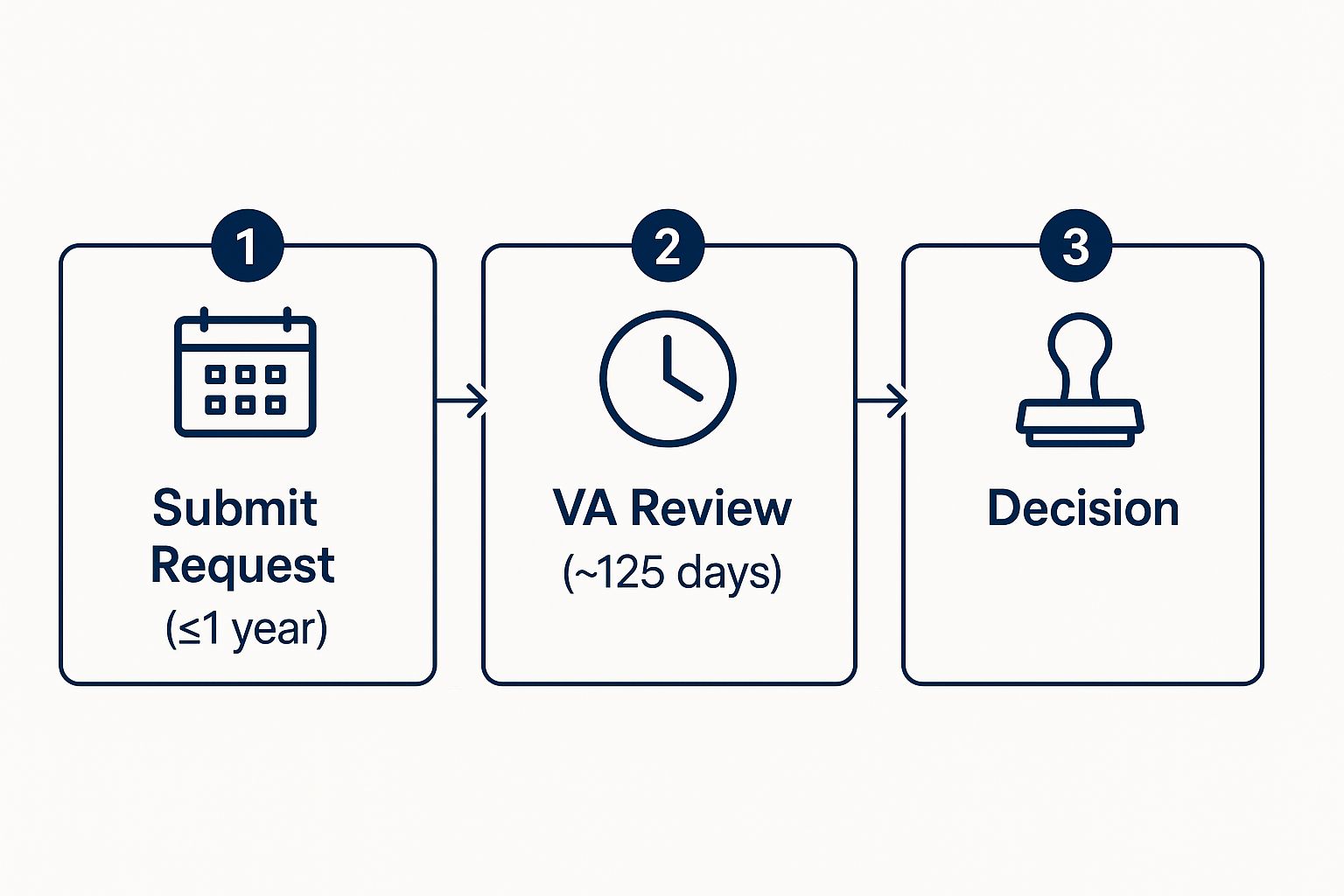
As you can see, it really boils down to filing on time, the VA's internal review, and finally, getting that decision in your hands.
Stage 1: Kicking Things Off and Filing Your Request
Your journey starts the day you get the decision letter for your initial claim. From that date, a one-year timer begins. To get the ball rolling, you need to properly file VA Form 20-0996, which is the official Request for a Higher Level Review.
Getting this form filled out correctly is critical. You have to pinpoint the exact issues you're disputing from the original decision. If you miss that one-year window, you lose the opportunity to use the HLR lane for that specific claim.
Stage 2: The Review Itself
Once the VA has your request, your file lands on the desk of a Senior Reviewer. This isn't just anyone; it's an experienced adjudicator who had absolutely nothing to do with your first decision. Their entire job is to give your case a fresh set of eyes.
The single most important thing to remember here is that no new evidence is allowed. The reviewer can only look at the exact same evidence the VA had when it made the original decision. They are looking for mistakes in how the law was applied or if procedures weren't followed—not evaluating new doctor's notes.
Stage 3: The Final Decision
After a thorough review, the Senior Reviewer will make a call. The outcome will be one of three things:
- Decision Overturned: This is the best-case scenario. The reviewer found an error in the original decision and grants the benefit you were seeking.
- Decision Upheld: The reviewer concludes the original decision was correct. Unfortunately, nothing changes.
- Duty to Assist Error: This is a bit of a curveball. The reviewer discovers the VA failed in its duty to gather all the necessary evidence, like a specific service record. Your HLR is closed, and the case is converted into a Supplemental Claim to fix that error, which unfortunately starts a new timeline.
Each of these outcomes will point you toward your next steps and will play a big role in how long your wait has been.
Factors That Speed Up or Slow Down Your HLR

When it comes to the VA Higher Level Review timeline, there's no magic number. While the VA has a target of 125 days, your actual wait time can swing wildly based on a few key variables. Some things speed it up, others bring it to a grinding halt.
Think of it like different checkout lanes at the grocery store. A simple case with one glaring error is like having just a couple of items—you’re in and out. But a complex case with several contested issues is like having an overflowing cart, and the cashier (the Senior Reviewer) needs to scan and check every single thing.
The Informal Conference Dilemma
One of the biggest variables you control is whether you ask for an Informal Conference. This is your chance to get on the phone directly with the Senior Reviewer and point out exactly where you think the original decision went wrong. It can be a game-changer.
However, it almost always adds time to your claim.
The trade-off is clear: requesting a conference gives you a direct line for clarification, but the simple logistics of scheduling and holding that call can tack on weeks, if not months, to the total wait. You have to decide if the strategic advantage is worth the guaranteed delay.
Other Key Timeline Factors
The conference isn't the only thing that dictates the pace. Several other factors are at play, many of which are completely out of your hands. The internal efficiency of VA systems, for example, can have a huge impact. Understanding aspects like the VA's investment in cloud fax technology can give you a peek into how they handle the massive flow of documents.
Here are a few other common reasons for delays or quicker decisions:
- Case Complexity: A claim for a single issue like tinnitus is usually much faster to review. A case involving interconnected conditions—say, PTSD, sleep apnea, and a back injury—requires the reviewer to untangle a much more complicated web of evidence.
- VA Regional Office Workload: Let's be honest, not all VA offices are the same. A regional office buried under a mountain of claims will naturally take longer to get to yours than an office with a lighter load.
- File Organization: You can't submit new evidence, but how your original file was put together matters. If your records were well-organized and clearly labeled, it makes it much easier for the Senior Reviewer to find the specific error you're pointing out.
The Informal Conference: A Key Decision That Affects Your Timeline
When you file for a Higher Level Review, you’ll face a critical choice: should you request an optional Informal Conference? This isn't just another box to check; it's a direct phone call between you (or your representative) and the Senior Reviewer handling your case.
Think of it as your one chance to have a real conversation with the decision-maker. On this call, you can personally explain why you think the original decision was wrong and guide the reviewer to the specific evidence in your file that proves your point. It's a powerful opportunity to make your case.
Should You Request the Conference? Weighing the Trade-Offs
This conference is your moment to be your own best advocate. You can ensure the reviewer sees the full picture from your perspective, walk them through crucial medical reports, and clear up any confusion that might have led to the initial denial.
But this strategic advantage comes at a cost, and that cost is time. Requesting the conference will absolutely add to your VA Higher Level Review timeline. The simple logistics of scheduling the call, giving both sides time to prepare, and having the reviewer document everything afterward guarantees a longer wait.
The real question is whether the benefit of a direct conversation outweighs the certainty of a delay. For a simple, clear-cut error in your file, you might not need it. But for a complex case with nuanced arguments, that conference call could be the very thing that turns a denial into an approval.
Remember, the HLR process requires you to file your request within one year of the VA's initial decision. A senior reviewer then re-examines the exact same evidence that was available for that first ruling, looking for errors without accepting anything new. While the VA’s goal is to complete HLRs in 125 days, the reality is that wait times can be anywhere from a month to six months or even longer. If you want to learn more, you can discover more insights about the HLR appeal process and its timelines.
What Happens When the VA Finds an Error
It can feel like a huge win when a Higher Level Review (HLR) comes back with a “duty to assist” error. And while it’s definitely a positive step, it’s critical to understand that this isn’t the finish line. An error finding doesn't mean your benefits are automatically approved.
What it really means is the VA is admitting, "We missed something or made a mistake while gathering evidence." Your case is then converted into a Supplemental Claim to fix that specific mistake.
A New Lane, a New Wait
Think of it as a detour on a road trip. The HLR identified a roadblock, but now you're being rerouted onto a different path to get to your destination. Your Higher Level Review is officially closed, and a new process—the Supplemental Claim—begins. Unfortunately, this means the clock starts over.
This is where the VA Higher Level Review timeline can stretch out much longer than many veterans anticipate. You're no longer waiting for a single decision; you're now in for a second wait.
The key takeaway is that an HLR finding an error often creates a two-step journey. The HLR identifies the problem, and a subsequent Supplemental Claim is opened to fix it, each with its own timeline.
Data from the VA Office of Inspector General backs this up. The VA aims to complete an HLR in 125 days, but that number doesn't tell the whole story. For veterans whose cases are sent back to be corrected, the average total time can jump to around 196 days. You can dig into the specifics in the full VAOIG report on decision accuracy.
Knowing this from the start helps you set far more realistic expectations for the entire process.
Even with a general idea of the timeline, it's natural to have more specific questions pop up. Let's tackle some of the most common ones we hear from veterans navigating the Higher Level Review process.
Getting these details straight can save you a lot of time and frustration down the road.
Can I Submit New Evidence During a Higher Level Review?
This is a big one, and the answer is a firm no. A Higher Level Review is designed to be just that—a review. It’s a second look at the exact same evidence the VA had when they made their first decision.
Think of it like asking a different referee to review a play using the same camera angles. The goal is to spot an error in the original call, not to introduce new footage. If you have new doctor’s notes, updated test results, or compelling buddy letters, the right move is to file a Supplemental Claim, not an HLR.
How Can I Check the Status of My HLR?
Thankfully, you don't have to be completely in the dark. The easiest way to keep tabs on your review is by logging into your VA.gov account and using their "Check your claim and appeal status" tool. This portal will show you when your case hits major milestones.
If you prefer talking to a person, you can always call the VA's main number at 1-800-827-1000.
A pro tip: try to be patient with the online status checker. It doesn't update in real-time. You'll typically only see a change when your HLR moves from one stage to the next, like when it’s finally assigned to a Senior Reviewer or after a decision is made.
What if I Disagree with the HLR Decision?
Getting an unfavorable HLR decision can feel like a major setback, but it's not the end of the line. You still have powerful options, but you need to choose the right one for your specific situation.
- File a Supplemental Claim: This is your go-to option if you now have new and relevant evidence to submit. This is the "new footage" we talked about earlier. The evidence must be strong enough that it could realistically change the outcome.
- Appeal to the Board of Veterans' Appeals (BVA): If you believe the Senior Reviewer made a legal mistake and you don't have new evidence, you can take your case to the BVA. This is a more formal appeal reviewed by a Veterans Law Judge, but be prepared for a much longer wait.
Making the right choice here is absolutely critical to successfully continuing your claim.
Navigating the VA appeals system is tough, and it's easy to feel lost or overwhelmed. At Homefront Group, our team is made up of fellow veterans and legal experts who know this process inside and out. If you're stuck or just not sure what to do next, take our free 3-minute quiz. We can help you figure out a winning strategy for your claim. Start your free quiz at Homefront Group today.