

Your VA Claims Journey: Understanding How the System Really Works
Submitting a VA claim can feel like sending a message in a bottle and hoping for a reply. While stories of year-long waits still make the rounds, the VA has made significant changes to its process. Knowing what actually happens after you click "submit" can help manage expectations and bring some clarity to your va claims processing time.
Think of your claim's journey as a multi-stage investigation. It all starts the moment the VA receives your application. For the first couple of weeks, a Veteran Service Representative (VSR) acts as a case manager. Their first job is to review your file and make sure all the basic paperwork is there. If you've submitted a Fully Developed Claim (FDC)—meaning you provided all your evidence upfront—this part usually moves along quickly.
From Gathering Evidence to Final Decision
If any information is missing, your claim moves into the evidence-gathering stage, which is often the longest part of the process. This is where the VA might:
- Request your service medical records.
- Ask for notes from your private doctors.
- Schedule you for a Compensation & Pension (C&P) exam.
This phase isn't always linear. If new evidence brings up new questions, your claim might cycle back to this stage for further development. This is a normal part of making sure the review is complete and accurate.
Once all the evidence is collected, a Rating Veterans Service Representative (RVSR) takes over. This specialist carefully analyzes everything—your personal statements, all medical records, and the C&P exam results—to recommend a decision. Thanks to system updates and better workflows, this entire journey is quicker than it used to be.
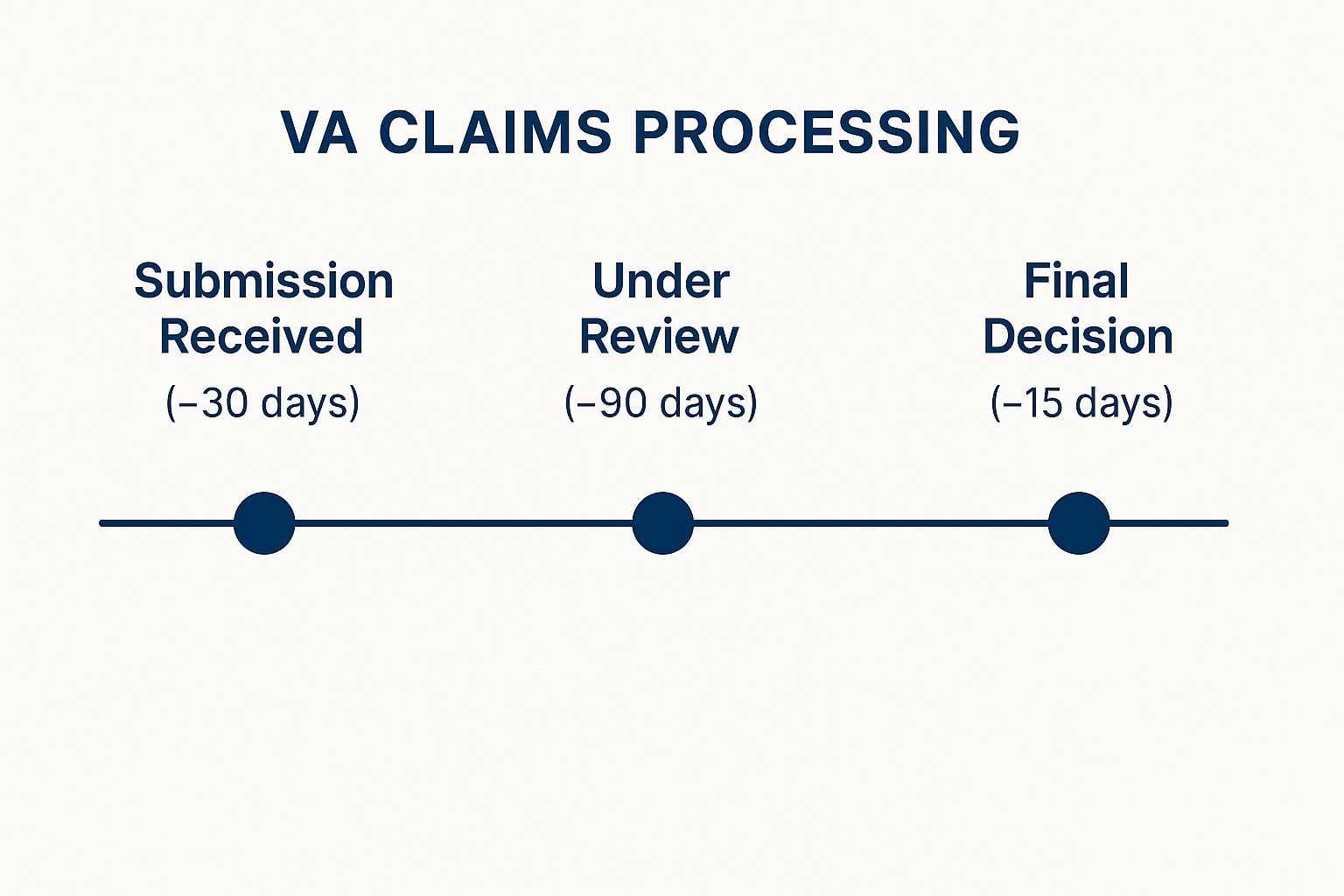
As the infographic shows, the "Under Review" phase takes up the most time, which highlights why submitting as much evidence as possible from the beginning is so important.
The VA's efforts to improve its systems are paying off. The table below shows just how much the average processing times have changed over the years.
VA Claims Processing Timeline Comparison
Historical comparison showing how VA processing times have improved over the years
| Time Period | Average Processing Days | Key Improvements |
|---|---|---|
| 2013 | 344-642 Days | The backlog peaked; initial efforts to digitize records began. |
| 2019 | 125-150 Days | Widespread adoption of digital claims processing; Fully Developed Claim (FDC) program becomes more prominent. |
| March 2024 | 141.5 Days | Refined digital workflows and reduced backlog lead to more consistent and predictable timelines. |
The data clearly shows a major improvement, with current wait times being a fraction of what they were a decade ago. As of March 2024, the average time to get a decision is about 141.5 calendar days. This progress is largely due to a smaller backlog and more efficient regional office operations, heavily supported by the FDC program. You can get more details about the latest trends on VA Claims Insider.
After the RVSR makes a recommendation, your claim goes through one last quality check. Once everything is confirmed, the final decision packet is prepared and sent to you, bringing your claim's journey to a close.
Inside the Numbers: What VA's Record-Breaking Performance Means for You

When you hear that the VA is setting new records, it can feel a bit distant from your personal situation. If your claim is one of thousands waiting in line, how does the big picture really help you? The truth is, it matters quite a bit. These large-scale statistics have a direct effect on the va claims processing time for every single veteran, including you.
Record-Breaking Pace, Record-Breaking Volume
The latest numbers are genuinely impressive. In Fiscal Year 2025, the VA achieved a major milestone by processing one million disability claims faster than ever before. This goal was met on February 20, which was almost two full weeks ahead of the record set in the previous year. This is even more noteworthy considering it was done while handling a 15.6% increase in the number of new claims. At one point, on February 12, 2025, the VA managed to process over 12,000 claims in a single day. You can read the official announcement on these record-setting VA performance metrics.
So, what does this increased capacity mean for your specific claim? It means the entire line is moving more quickly than ever. Think of it like a grocery store on a busy holiday weekend. If they open up more checkout lanes, the wait time for each shopper decreases, even with more people in the store. This is what the VA has done by improving workflows, increasing staff, and updating their systems to handle the rush.
Quality and Accuracy in High-Volume Processing
A natural question that arises with faster processing is whether quality takes a hit. Is the VA simply rushing through claims and making more errors? The data actually points to the contrary. The VA has successfully maintained a high accuracy rate, which is what truly matters to veterans. A quick denial doesn't help anyone; the goal is a decision that is both fast and accurate.
This focus on quality ensures that when your claim is up for review, it's being evaluated by a system designed to manage a massive workload without compromising precision. This data-backed approach provides a more consistent experience, no matter which regional office handles your file. While your individual timeline will still depend on the complexity of your claim, this new operational standard is good news for everyone. It points to a more dependable and predictable process, which helps reduce the uncertainty that has often been a frustrating part of the VA claims journey.
Why Your Claim Takes As Long As It Does: The Hidden Factors
Not every VA claim moves at the same speed. The wide range in VA claims processing time isn't arbitrary; it's the direct result of several factors that can either push your claim forward or send it on a long detour. Getting a handle on these elements is the first step to setting realistic expectations for your own timeline.
Think of it like this: a straightforward claim for a back injury that was well-documented during your service is like a race car. It has a clear track and all its parts are ready to go. On the other hand, a complex claim for PTSD tied to non-combat trauma is more like a delivery truck navigating a packed city—it has more stops to make and a higher chance of hitting traffic. The complexity of your claim and the number of conditions are the biggest factors affecting your wait.
The Impact of Claim Complexity and Evidence
The number of conditions you file for at once can create a domino effect. A veteran claiming one to three well-documented conditions will usually get a decision much faster than someone filing for eight or more conditions. Each disability requires its own separate review, evidence collection, and possibly a unique C&P exam, which multiplies the overall time.
This leads to the most important element you have control over: the evidence you submit from the start. The VA’s own guidance makes it clear that providing all relevant records upfront is critical.
This screenshot from VA.gov shows just how important it is to submit your private medical records, service records, and any supporting statements right when you file. The difference between a decision in weeks versus months often comes down to how much digging the VA has to do for you.
Other Key Factors Influencing Your Timeline
Beyond the complexity of your case and the evidence you provide, other variables are at play. You can't always control these, but it's good to be aware of them:
- Regional Office Workload: Just like any office, some VA Regional Offices (ROs) are busier than others. The number of claims already in the queue at the office handling your file can directly affect how quickly they get to yours.
- C&P Exam Scheduling: The availability of doctors for Compensation and Pension (C&P) exams is a frequent bottleneck. A delay in scheduling your appointment or getting the final exam report back can put your claim on hold for weeks.
- Need for Federal Records: If the VA has to request your service records from the National Archives or other federal agencies, it adds an outside dependency that can tack on significant waiting time.
In the end, the best strategy is to concentrate on what you can influence. Submitting a well-organized claim with as much supporting evidence as possible is your most effective tool for helping the process move along. A complete package makes it easier for the VA to make a decision without unnecessary delays.
Decoding Different Claim Types: What to Expect and When
Not every VA claim takes the same journey through the system. The specific type of claim you file charts your course and directly impacts the va claims processing time. Knowing which path you're on from the start helps in setting realistic expectations. Think of it like planning a road trip: a direct shot on the highway will get you there much faster than a scenic route with lots of stops.

Standard vs. Specialized Claim Paths
Your claim will be sorted into one of several categories, each with its own typical timeline. The most common is a standard initial disability claim, which follows the general 8-step process. However, other claim types have their own distinct workflows.
| Claim Type | What It Is | Typical Processing Nuance |
|---|---|---|
| Supplemental Claim | Filed when you add new and relevant evidence to a previously denied claim. | This can be faster if the new evidence strongly and directly addresses the reason for the original denial. |
| Claim for Increase | Submitted when you believe a service-connected condition has become more severe. | The review focuses only on the change in your condition, often requiring a new C&P exam to assess its current severity. |
| PACT Act Claim | For conditions linked to toxic exposure during specific military service eras and locations. | Though often complex, these claims are being handled with priority by dedicated teams, leading to more efficient processing. |
Take, for instance, claims filed under the PACT Act. Despite their complexity, many veterans are surprised by how quickly they are processed. The VA has established specialized teams to manage these toxic exposure cases, which helps them progress through the system faster than one might assume. This focused approach is a key reason for the quicker decisions on these specific claims.
When Can a Claim Be Expedited?
While most claims are handled in the order they are received, the VA does offer a "fast lane" for veterans who are in particularly urgent situations. You might be eligible for expedited processing if you are dealing with extreme circumstances. These include:
- Having a terminal illness
- Being diagnosed with Amyotrophic Lateral Sclerosis (ALS)
- Facing severe financial hardship, like homelessness or a pending foreclosure
- Being a former Prisoner of War (POW)
- Being age 85 or older
If you think you meet these criteria, you need to submit a Priority Processing Request along with documents to prove your situation. While this doesn't mean an instant decision, it does move your file to the front of the queue at every step. The key is to provide clear and powerful evidence, such as a doctor's letter confirming a terminal diagnosis or an official eviction notice, to get your claim the priority attention it needs.
Behind the Scenes: How Data Drives Your Claim's Success
When you submit a claim to the VA, it becomes more than just a file. It’s a vital piece of information in a large system designed for constant improvement. While you see the status updates on your end, behind the scenes, detailed data tracking is hard at work to shorten the overall va claims processing time for every veteran. This system isn't just about moving faster; it's about making the process smarter and more transparent.
Think of it as the VA's operational command center. Every week, analysts pour over performance data from across the nation. They can quickly identify a regional office that's getting overwhelmed or pinpoint a specific type of claim that's creating a slowdown. This allows them to strategically redirect resources, such as assigning skilled processors to manage a wave of PACT Act claims, and resolve issues before they become major roadblocks.
The Metrics That Matter
The VA looks at much more than just how quickly claims are completed. A successful process is measured by a blend of key performance indicators that ensure veterans get the fair and accurate decisions they deserve. These metrics provide a clear picture of the system's health and effectiveness.
To put this in perspective, here's a look at the core performance indicators the VA uses to gauge its efficiency and the quality of its service to veterans.
| Metric | Current Performance | Target Goal | Impact on Veterans |
|---|---|---|---|
| Processing Speed | Average 141.5 days | Under 125 days | Reduces the financial and emotional strain that comes with long waits. |
| Claim Accuracy | 92% accuracy rate | 95%+ | Ensures decisions are correct the first time, lowering the need for appeals. |
| Backlog Reduction | Consistently below peak levels | Continued reduction | Frees up resources to give proper attention to new and complex claims. |
| Veteran Satisfaction | Monitored via surveys | Increasing positive feedback | Drives policy adjustments that directly improve the veteran experience. |
These numbers aren't just for internal reports; they represent a commitment to accountability and show how data-informed strategies lead to better outcomes for the entire veteran community.
Data in Action: The PACT Act Example
This data-first approach has been central to managing even the most complicated claims. For instance, weekly data from the Veterans Benefits Administration reveals a steady improvement in both the speed and accuracy of claim processing. The VA’s data strategies, which are available in public reports, monitor everything from backlog clearance to decision accuracy.
A powerful illustration is the handling of PACT Act claims. Despite their complexity, the VA has already processed 375,961 of these claims in FY25 alone, proving it can effectively manage specialized workloads. You can review these trends and other detailed statistics in the VA's Detailed Claims Data reports.
This level of transparency gives power to everyone involved. It enables veterans, their advocates, and lawmakers to hold the VA accountable, ensuring the system continually evolves to better serve those who have served our country.
Proven Tactics to Speed Up Your Claim (That Actually Work)
While you can't control every aspect of the VA claims processing time, you certainly have more power than you might realize. Simply waiting for a decision isn't a strategy. Instead, taking proactive and informed steps can help steer your claim through the VA's system more efficiently. These aren't just theories; they are proven tactics used by experienced veterans and service officers to get quicker decisions.

Master the Fully Developed Claim (FDC) Program
The single most effective strategy you can use is filing a Fully Developed Claim (FDC). Think of this as handing the VA a perfectly organized case file right from the start. Instead of making them hunt down your service records or private medical notes, you provide everything upfront. By doing this, you're certifying that there is no more evidence for them to gather.
This simple step allows the VA to skip the evidence-gathering phase—often the longest part of the journey—and move directly to the review and decision stages. To build a solid FDC package, you should include:
- All relevant service treatment records.
- Complete medical records from any private doctors you've seen.
- Persuasive buddy letters and personal statements that clearly connect your condition to your military service.
Strategic Evidence and Communication
How and when you submit your information truly matters. The goal is to make the VA rater's job as straightforward as possible. Organize your evidence logically, and if you have many documents, include a clear table of contents. If the VA requests more information, respond immediately. Any delay on your part directly causes a delay on theirs.
The same strategy applies to your C&P exam. Confirm your appointment as soon as you get the notification and arrive prepared. Missing this appointment can push your claim back by months while you wait for it to be rescheduled. While it's wise to check your status on VA.gov, avoid calling the general helpline for daily updates. If you have a specific, important question, use the "Ask VA" secure messaging portal for a documented inquiry.
Partner with an Expert
You don't have to go through this process alone. Working with a skilled Veterans Service Organization (VSO) or a dedicated legal team like Homefront Group can be a huge advantage. These professionals know the system's complexities inside and out.
They can review your file before you submit it to identify potential weaknesses, help you gather the right evidence, and make sure your claim is presented in the most compelling way. Their expertise serves as both a quality check and an advocacy layer, helping you steer clear of common mistakes that lead to delays and denials. This expert guidance can be priceless in moving your claim forward.
Staying Informed and Managing the Wait Like a Pro
Waiting for a decision on your claim can be one of the most stressful parts of the entire process. The good news is you don’t have to sit in the dark. Taking control during this period involves learning how to monitor your claim, understanding what each status update means, and managing the emotional toll of the wait. This active approach can make your VA claims processing time feel much more manageable.
How to Check Your VA Claim Status
The best tool for keeping up with your claim's progress is the VA's official website. By logging into your account, you can see exactly which of the eight stages your file is in. This gives you a real-time window into the process, saving you from having to call the VA for every little update.
Here is a look at the claim status page you'll use on VA.gov.
This dashboard clearly displays the current step your claim is in, such as "Gathering of Evidence," offering a direct and immediate understanding of its progress.
Interpreting the Stages of Your Claim
Knowing your claim's status is one thing; understanding what it actually means is another. The journey is broken down into eight distinct steps, but they can be simplified into five key phases:
- Claim Received: This is the starting line. The VA has your file and is performing an initial review. This is usually a quick step.
- Gathering of Evidence: Think of this as the investigation phase, and it's often the longest. The VA is requesting records, scheduling C&P exams, and collecting all the necessary information. Your claim might move back and forth within this phase if new evidence comes to light.
- Review of Evidence: A Rating Veterans Service Representative (RVSR) is now carefully analyzing all the documents that have been collected.
- Preparation for Decision: The RVSR has made a recommendation and is now drafting the official decision documents.
- Decision Notification Sent: The finish line is in sight. The final decision packet is officially in the mail and should arrive within 7 to 10 business days.
It's perfectly normal for a claim to remain in the "Gathering of Evidence" phase for 30 to 60 days or even longer. Patience during this stage is essential. However, if your claim seems stuck for an unusually long time with no updates, sending a polite, documented message through the Ask VA portal is a reasonable next step.
Navigating the wait for a VA claim decision requires a patient and proactive mindset. If you find the process overwhelming or believe your claim has been unfairly delayed or denied, professional guidance can be invaluable. The expert team at Homefront Group specializes in these complex cases. We understand the system and can provide the support you need to secure the benefits you have rightfully earned.