

When your VA claim gets denied, it’s easy to feel like you've hit a brick wall. But I’m here to tell you that’s not the case. A denial isn't the end of the road; it’s more like a detour. It simply means the VA needs more information, different evidence, or a stronger argument to get you to an approval.
Your job now is to dissect their decision letter and build a smarter, more strategic case based on exactly what they said was missing.
What a VA Denial Letter Really Means
Getting that thick envelope from the Department of Veterans Affairs can absolutely sink your spirits. I’ve seen it countless times. But before you let the frustration take over, take a deep breath and shift your perspective. A VA claim denied isn't a personal judgment on you or your service—it's a bureaucratic hurdle.
The VA runs on a very specific, evidence-based system. If there’s a gap in your claim, even a tiny one, the person reviewing your file often has no choice but to issue a denial. Think of it less as a "no" and more as a "show me more." Your new mission is to find that gap and plug it with solid evidence.
The system is getting faster and more accurate, which is good news. In Fiscal Year 2025, the VA processed over one million disability claims, hitting that milestone almost two weeks sooner than the year before, even with a 15.6% increase in new claims. With over 60% of claims granted and an accuracy rate topping 92%, it shows that approvals are happening. You just have to give them exactly what they need to say "yes." You can explore more about these trends and what they mean for veterans on a deeper level.
Common Reasons for a Denial
Your decision letter is the treasure map. Find the section called "Reasons for Decision" and read it like your claim depends on it—because it does. Most denials come down to a handful of recurring issues.
- Not Enough Medical Evidence: The VA rater didn't see enough in your medical records to confirm your diagnosis or its severity.
- No Clear Service Connection (Nexus): This is the big one. You didn't successfully connect the dots between your current disability and your time in the military.
- Simple Administrative Goofs: It happens. You might have used an outdated form, missed a signature, or couldn't make it to a C&P exam.
- Claiming an Ineligible Condition: Some conditions require a mountain of proof to be considered service-connected unless they fall under a presumptive list.
The most powerful shift in mindset a veteran can make is viewing the denial letter not as an obstacle, but as a checklist. The VA is literally telling you what you need to provide next.
Understanding why your claim was denied is the first, most critical step. The table below breaks down the common reasons you'll see in a decision letter and gives you an immediate action plan for each.
Decoding Your Denial and Planning Your Next Move
| Reason for Denial | What It Means for Your Case | Your First Action Item |
|---|---|---|
| Lack of Service Connection | You didn't prove the link between your military service and your current condition. The VA couldn't connect Point A (service) to Point B (disability). | Obtain a strong Nexus Letter from a qualified medical professional who can clearly state your condition is "at least as likely as not" caused by your service. |
| Insufficient Medical Evidence | Your submitted records didn't adequately demonstrate the diagnosis, frequency, or severity of your symptoms according to VA standards. | Schedule an appointment with your doctor or a specialist. Gather updated medical records, diagnostic reports, and consider getting a new Disability Benefits Questionnaire (DBQ) filled out. |
| Administrative or Procedural Error | You may have missed a deadline, failed to attend a C&P exam, or submitted the wrong form. It's a technicality, not a judgment on your condition. | Carefully review the letter for the specific error. If you missed an exam, call the VA immediately to explain why and request to reschedule. If it was a form error, find the correct, most current version on the VA website. |
| Condition Not Service-Related | The VA believes your condition developed after service and is unrelated to your time in the military. | Find evidence to challenge this. This could be service medical records showing early signs of the condition, "buddy letters" from fellow service members, or a medical opinion refuting the VA's timeline. |
This isn't about starting from scratch; it's about refining your approach with the new information you have.
Turning Frustration into Action
Once you've pinpointed the exact "why" behind your denial, you can build a targeted plan. If the problem was a missing service connection, your top priority is getting a powerful nexus letter. If it was a lack of medical evidence, your focus shifts to gathering more treatment records or getting fresh evaluations.
Don't let the initial sting of rejection stop you. A denial is a normal part of the process for many veterans, and successfully appealing an initial decision is incredibly common. By breaking down the letter and tackling each issue one by one, you turn that frustrating moment into a clear, actionable strategy. This is how you win.
Receiving a denial letter from the VA can feel like hitting a brick wall, but it’s absolutely not the end of the road. Thanks to the Appeals Modernization Act (AMA), you now have three distinct ways to fight back. Think of them as different lanes on a highway—choosing the right one is the most critical strategic decision you'll make.
Your decision letter is the map. It will spell out why the VA said no, and that reason is your key to picking the best path forward. But don't sit on it. You generally have just one year from the date on that letter to file your appeal. If you miss that window, you could lose your original effective date, which can cost you thousands in back pay if you eventually win.
Let's walk through your three options so you can choose wisely.
The Supplemental Claim Path
This is your go-to option if the VA’s denial letter basically said, "You didn't give us enough proof." The Supplemental Claim lane is built for one thing: adding new and relevant evidence to your file to fill the gaps the VA pointed out.
So, what kind of evidence moves the needle?
- A powerful Nexus Letter: This is a statement from a medical expert directly connecting your condition to your military service. It’s often the missing link.
- Buddy Letters: These are firsthand accounts from friends, family, or—even better—fellow service members who witnessed your injury or can speak to how your condition has progressed since your service.
- New Medical Records: If you have recent diagnoses, reports from specialists, or new test results that weren't in your original submission, this is where you add them.
When you file a Supplemental Claim using VA Form 20-0995, you’re asking the VA to take a fresh look at your case with this new information. The VA even has a "duty to assist," which might mean they'll help you track down federal records or even schedule a new C&P exam if your new evidence is compelling enough. This is the perfect route if your initial claim was strong but just needed a little more firepower.
The Higher-Level Review Option
What if you're looking at your file and thinking, "The evidence is all there, they just got it wrong"? That’s exactly what the Higher-Level Review (HLR) is designed for. You're not adding anything new; instead, you're asking a more senior, experienced claims adjudicator to review the exact same file and check the original rater's work for errors.
You cannot submit any new evidence with a Higher-Level Review. The entire point is to argue that the original decision was flawed based on the information the VA already had.
You'll use VA Form 20-0996 to request an HLR. A key feature here is the option for an "informal conference." This is a quick phone call with the senior reviewer where you can personally point out the specific mistakes you believe were made. You can direct their attention to that key piece of evidence they overlooked or explain why you think they misinterpreted a medical report. If you're confident the proof is in the file, this is your path.
Many claims get denied for reasons that are entirely fixable. Just look at the common culprits:
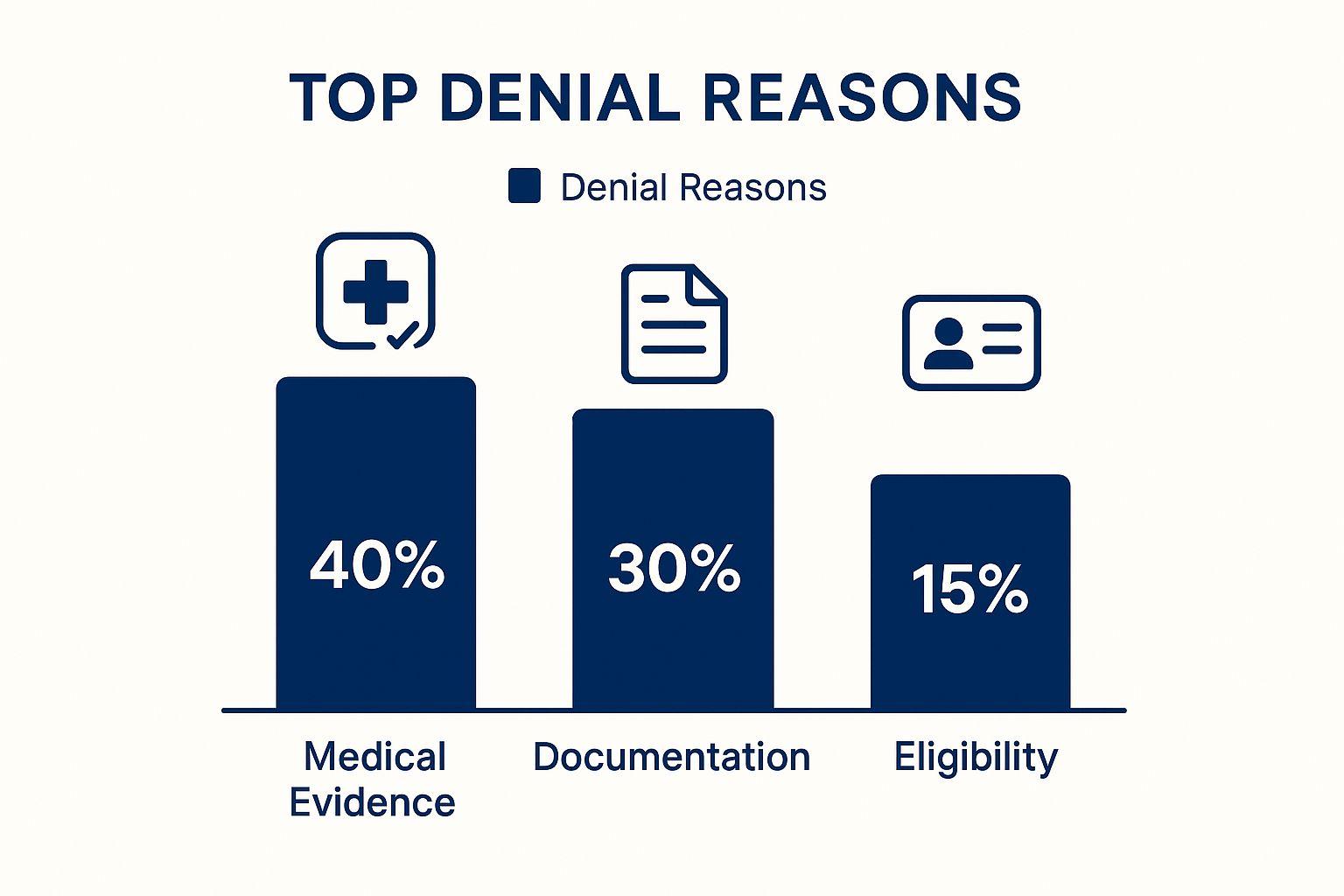
As you can see, a lack of sufficient medical evidence is the number one reason a VA claim is denied. This really drives home how important it is to build a rock-solid, medically-supported case from day one.
The Board of Veterans' Appeals Lane
Your third and most formal route is taking your case directly to the Board of Veterans' Appeals (BVA). This moves your claim out of the regional office and puts it in front of a Veterans Law Judge. Be prepared, though—this is usually a much longer process and is best reserved for complicated cases, especially those with tricky legal arguments or after you've already tried the other lanes.
If you go this route, you have to choose one of three dockets:
- Direct Review: You ask the judge to review the same evidence the regional office had. There's no new evidence and no hearing.
- Evidence Submission: You have new evidence you want the judge to see. You get 90 days after filing your appeal to get it submitted.
- Hearing: You want to submit new evidence and testify before the judge, either in person, over video, or at a nearby regional office.
Comparing Your VA Appeal Options
Choosing the right appeal lane can feel overwhelming, but breaking it down can make the decision clearer. This table compares the three paths side-by-side to help you see which one aligns with your specific situation.
| Appeal Type | Best For… | Can You Submit New Evidence? | Average Success Rate |
|---|---|---|---|
| Supplemental Claim | When the VA said you lacked proof and you now have new medical records, buddy letters, or a nexus letter to strengthen your case. | Yes, this is the whole point. | Around 50% |
| Higher-Level Review | When you believe the VA had all the right evidence but made a legal or factual mistake in their decision. | No, the review is based on the existing record. | Around 50% |
| Board of Veterans' Appeals | For complex legal arguments or after other options have failed. It's a more formal, lengthy process involving a judge. | Yes (in two of the three dockets). | Around 38% |
The statistics are telling. As of 2025, both Supplemental Claims and Higher-Level Reviews see about a 50% success rate, while the Board has a lower success rate of 38%. As you can discover more insights about these success rates, it becomes clear that resolving the issue at the regional office level—either by providing the missing evidence or pointing out a clear error—is often your most effective strategy. Carefully weigh these options against your denial letter to give yourself the best shot at winning the benefits you've earned.
Building a Winning Supplemental Claim

If the VA denied your claim because you didn't have enough evidence, don't lose hope. The Supplemental Claim lane is your best path forward. It’s designed specifically for veterans to submit new and relevant evidence—the kind of information the VA has never seen before. This is your chance to look at exactly why they said "no" and build a case they can't deny.
Filing a Supplemental Claim with VA Form 20-0995 isn't about just resending the same old paperwork. It's a strategic move. When your VA claim denied letter points to a lack of proof, this is how you fix it.
The Power of a Strong Nexus Letter
From my experience, one of the biggest hurdles for veterans is proving the "nexus"—that clear, undeniable link between your disability and your time in service. This is where a rock-solid Nexus Letter from a qualified medical professional can be a complete game-changer. It's often the single most powerful piece of new evidence you can add.
A weak letter might say something generic like, "The veteran's back pain seems related to his service." That’s not going to cut it. It’s vague and lacks any real medical analysis. A truly persuasive nexus letter, on the other hand, is much more detailed.
A great Nexus Letter connects the dots for the VA rater. It should show that the doctor has dug into your records—your service medical history, your post-service treatment, everything—and can then medically explain precisely why your military service is at least as likely as not the cause of your current condition.
Here's what you want to see in a strong nexus letter:
- A clear statement that the professional has reviewed your entire file.
- Specific references to events, injuries, or exposures noted in your service records.
- A detailed medical explanation linking your service to your current diagnosis.
- The magic phrase: "it is at least as likely as not" that your condition is service-connected.
Without this, you're essentially asking a VA claims rater, who isn't a doctor, to make a medical judgment. That's a recipe for another denial.
Gathering Persuasive Lay and Buddy Statements
Medical evidence is critical, but it only tells part of the story. This is where lay statements, or "buddy letters," come in. They add the human element and personal context that sterile medical reports just can't provide. These are simply firsthand accounts from people who have witnessed how your condition affects you.
The most compelling buddy letters often come from those who served alongside you. They can verify the specific incident that caused your injury or describe the environment you served in. But don't discount statements from family, friends, or even old coworkers. They can provide powerful testimony on how your symptoms have progressed over the years or impact your daily life—details a doctor might never see.
Real-World Example of a Powerful Buddy Letter Excerpt:
"I served with John in Afghanistan from 2010 to 2011. I was there when the IED blast threw him from the vehicle in July 2010. He complained about constant ringing in his ears right after it happened, and it never stopped. He still talks about that ringing today, more than ten years later."
See the difference? That's miles better than a generic, "John has hearing problems." It paints a clear picture with a specific event, a timeline, and a direct tie to his service.
Organizing Your Evidence for Maximum Impact
Once you’ve collected your new evidence—the nexus letter, buddy statements, and any new medical records—you need to present it in a way that makes sense. Don't just throw a messy stack of papers at the VA. Your goal is to make the rater's job easy.
I always recommend creating a simple cover letter that acts as a table of contents for your new evidence. Think of it as a roadmap for the rater.
Evidence Submission Checklist:
- Cover Letter: Briefly state you're filing a Supplemental Claim and list the new evidence included.
- VA Form 20-0995: Double-check that it's filled out completely and signed.
- Nexus Letter(s): Put your strongest medical evidence right on top.
- New Medical Records: Arrange them in chronological order so the timeline is clear.
- Buddy Letters: Keep all your lay statements grouped together.
When a VA claim is denied, this kind of organized, evidence-first approach shows the VA you are serious and have diligently addressed the reasons for the original denial. You're not just asking again; you're proving your case.
Using a Higher-Level Review to Correct Errors
Sometimes, the problem isn’t a lack of evidence. You submitted a mountain of paperwork, your service records were clear, and your medical history was solid. Yet, you still received that dreaded denial letter.
When you’re certain the VA had everything they needed but simply made a mistake, the Higher-Level Review (HLR) is your most direct path forward.
This isn't about adding new documents; in fact, you are prohibited from submitting new evidence in an HLR. The entire purpose is to have a more senior, experienced reviewer take a fresh look at the exact same file. You’re essentially asking for a second opinion from someone higher up the chain, arguing that the original decision was flawed based on the information already in their hands.
If your va claim denied letter left you scratching your head because the reasoning didn't match the evidence you sent, this is the lane for you. It’s a powerful tool for correcting errors in judgment, misinterpretations of the law, or instances where a key piece of evidence was simply overlooked.
When Is a Higher-Level Review the Right Choice?
Choosing the HLR path is a strategic decision. It’s the perfect fit when your denial letter makes you think things like:
- "They completely ignored my private doctor's report."
- "The C&P examiner's opinion contradicts the facts in my service records."
- "They applied the wrong legal standard for my condition."
This is your chance to contest the VA's interpretation of the facts. The process kicks off when you file VA Form 20-0996, Decision Review Request: Higher-Level Review. You have one year from the date on your decision letter to file this form. Acting quickly is crucial to protect your effective date and any potential back pay you're owed.
A Higher-Level Review is not a do-over; it's a fact-check. Your goal is to prove that the correct decision was already possible with the evidence on file and that an error was made by the initial rater.
Filing the form is just the first step. The most impactful part of the HLR process is the optional informal conference, which gives you a direct line to the person re-evaluating your claim.
Mastering the Informal Conference
The informal conference is an optional—but highly recommended—phone call with the senior reviewer. This is your moment to be your own best advocate. You get to speak directly to the decision-maker and guide them through your file, pointing out the exact errors you believe were made.
Preparation is everything. Don't go into this call cold. Before the conference, you should:
- Review Your Entire File: Know your evidence inside and out. Have your decision letter and key documents right in front of you during the call.
- Create a Simple Script: Jot down the 2-3 main points you want to make. You won't have much time, so be concise and direct.
- Pinpoint Specific Errors: Be ready to say something like, "On page 14 of my service medical records, it clearly documents my back injury, but the denial letter stated there was no in-service event."
This isn't a time for emotional appeals; it's a time for factual arguments. Be polite, professional, and prepared.
Real-World Example of an Informal Conference Argument:
"Good morning. I’d like to draw your attention to the nexus letter from Dr. Smith, located in the file as Exhibit C. The original decision stated there was no link between my tinnitus and my service as an artilleryman. However, Dr. Smith, an audiologist, explicitly states that my hearing loss and tinnitus are ‘at least as likely as not’ a direct result of my documented acoustic trauma in service. This key medical opinion appears to have been overlooked."
This kind of specific, evidence-based argument is incredibly effective. You are making the senior reviewer's job easier by leading them directly to the information that supports your case. When your va claim denied decision feels unjust, the HLR and a well-prepared informal conference provide the ideal platform to have that error corrected.
What to Expect After You File Your Appeal

You did it. You’ve filed your appeal, whether it was a Supplemental Claim loaded with new evidence or a Higher-Level Review pointing out a clear error. Now comes the part that can test anyone's patience: the wait. It's easy to feel like your claim has fallen into a black hole, but knowing what's going on behind the scenes can make a world of difference.
The good news is that the VA has made some serious progress on processing speeds. The horror stories of waiting a year or more for an initial decision are thankfully becoming a thing of the past. Let's walk through what really happens after you hit "submit."
Understanding Appeal Timelines
How long you'll be waiting really hinges on the appeal lane you picked. Each one has its own track and its own timeline.
- Supplemental Claims: The VA’s internal goal is to process these within 125 days. From what I've seen, they often beat that mark.
- Higher-Level Reviews: These run on a similar schedule, also hovering around the 125-day average.
- Board of Veterans' Appeals (BVA): This is the long haul. If you go this route, you need to be prepared for a much longer wait—potentially a year or more, depending on which docket you choose.
Of course, these are just averages. A straightforward claim with solid, clear-cut evidence might breeze through, while a more complex case that needs extra medical opinions or difficult-to-find records will naturally take longer. Factors like the current VA backlog and even the specific regional office handling your file can also affect the timeline.
We've seen a huge push for efficiency lately. In fact, by mid-2025, the average processing time for a Supplemental Claim was down to just 92.5 days—way under the VA's own target. These improvements are a big deal for veterans, and you can see more by exploring the full 2025 VA claims processing time report.
My best advice while you're waiting? Don't check the status every day. Seriously. It will only drive you crazy. Trust the process, understand the general timelines, and try to put it out of your mind.
How to Track Your Appeal Status
The best way to keep an eye on things is through the VA.gov website or the official VA mobile app. These tools give you a direct look at where your claim is in the pipeline. When you log in, you’ll find a status tracker that walks you through the different stages.
It helps to know what these stages actually mean:
- Claim Received: Simple enough. The VA has your appeal and is getting it assigned to a reviewer.
- Initial Review: Someone is doing a first pass to make sure everything is in order.
- Evidence Gathering, Review, and Decision: This is where your claim will spend most of its time. The VA is digging into your evidence, possibly scheduling exams, or requesting records.
- Preparation for Notification: A decision has been made. They're just putting the official letter together.
- Complete: The decision packet is in the mail and on its way to you.
Don't panic if your claim seems to sit in the "Evidence Gathering" phase for what feels like forever. This is completely normal, especially if the VA needs to schedule a new C&P exam or get federal records on your behalf.
What Happens After the Decision
Once the dust settles, your appeal will have one of three possible outcomes. Each one points you toward a different path forward.
| Appeal Outcome | What It Means | Your Next Move |
|---|---|---|
| Granted | Success! The VA overturned the original denial. You'll get a rating decision and back pay. | Action: Carefully review the rating. If it seems too low, you can appeal the rating percentage itself. |
| Remanded | The reviewer found an error but needs more info. Your claim is being sent back to get it fixed. | Action: This is a good sign! Cooperate with any requests. It means the VA agrees an error was made. |
| Denied | The appeal was not successful, and the original denial stands. | Action: Don't give up. Read the new decision letter, then prepare for the next step, like a BVA appeal. |
If your va claim denied appeal is denied yet again, remember that this isn't the end of the road. You still have options. The key is to dissect the new decision, understand why they said no, and gear up for the next round in the fight for the benefits you've earned.
Common Questions After a VA Claim Denial
When that thick envelope from the VA arrives with bad news, your head starts spinning with questions. It's a frustrating and confusing moment, but getting clear answers is the first step toward turning things around. Let's walk through some of the most common questions I hear from veterans who've just had their VA claim denied.
What’s the Top Reason the VA Denies a Claim?
Hands down, the number one reason for denial is a failure to prove service connection. You might have a current diagnosis from your doctor and your DD-214 in hand, but if you can't show the VA a clear link—what they call a "nexus"—between your military service and your condition, the claim is dead in the water.
Another common pitfall is simply not having enough evidence. The VA rater can only make a decision based on the documents right in front of them. If your file is missing recent medical records showing how severe your condition is today, or you haven't explained how it cripples your daily life, they don't have what they need to say yes.
How Long Do I Have to Appeal a Denial?
This is a big one, and the clock is ticking. You have exactly one year from the date printed on your decision letter to file an appeal. Treat this as a hard-and-fast deadline, because it is.
Miss that one-year window, and you lose your original effective date. This is a huge deal. It means you forfeit your right to potentially thousands of dollars in back pay that would have been tied to your first application date.
Filing a completely new claim after the deadline passes means starting from scratch. Your number one priority after a denial should be protecting that effective date by appealing on time.
Can I Get Help With My Appeal?
Yes, and honestly, you probably should. While you can go it alone, navigating the legal maze of a VA appeal is a tough fight. Getting an experienced guide in your corner can make all the difference.
You have a few options:
- Veterans Service Officers (VSOs): These folks are trained and certified by organizations like the VFW or The American Legion. Their help is completely free.
- Accredited Attorneys or Agents: These professionals typically work on a contingency fee basis. That means they only get paid if you win, usually taking a percentage of the back pay the VA owes you.
The right expert can pinpoint exactly where your first claim went wrong and help you gather the specific evidence needed to build a much stronger, winnable case. This is especially true if your denial involves complex legal arguments or requires specialized medical opinions.
What Happens if I Missed My C&P Exam?
Missing a scheduled Compensation and Pension (C&P) exam is one of the fastest ways to get your VA claim denied. From the VA's perspective, if you don't show up, you're not cooperating.
If you miss an exam, you have to act fast. Call the VA immediately and explain what happened. If you had a legitimate reason—a family emergency, a sudden illness, a car breakdown—they are usually willing to reschedule. But just being a no-show with no explanation will almost guarantee a denial. They'll simply decide your claim based on the (now insufficient) evidence they have.
Can I Appeal the Disability Percentage if I Think It’s Too Low?
Absolutely. Winning service connection is often just the first part of the battle. The VA might agree your condition is from your service but then slap you with a 10% rating when your symptoms are clearly impacting your life far more significantly.
You can appeal a low rating just like you would an outright denial. The key is to submit new evidence that proves your condition is more severe than the rating reflects. This could be:
- A detailed log tracking your daily symptoms and limitations.
- "Buddy letters" from your spouse, friends, or coworkers describing how they see the disability affecting you.
- New medical reports or a freshly completed Disability Benefits Questionnaire (DBQ) from a specialist who understands your condition.
Your goal is to paint a vivid picture for the VA, showing them precisely how your symptoms meet the criteria for a higher rating under their official Schedule for Rating Disabilities. Don't just accept a rating that doesn't truly reflect what you're going through every day.
Tackling a VA appeal takes more than just filling out forms—it requires a solid strategy and deep expertise. Homefront Group was founded by a veteran with a single mission: to fight for other veterans. Our team of skilled lawyers and dedicated advocates knows what it takes to transform a denial into an approval.
Take our quick, 3-minute quiz today to see how we can help you build a winning case and secure the benefits you earned. Find out more at https://homefrontgroup.com/.