Why Your VA Back Pay Matters More Than You Think

Let's be honest, waiting for a VA disability decision can be a nail-biter. It's like being stuck in a holding pattern, uncertain about your future and juggling your current finances. Amidst all this, something that often slips under the radar is VA back pay. Understanding this isn't just about knowing a chunk of change might be coming; it's about feeling a little more in control during a tough time.
Frankly, no one really preps you for the emotional rollercoaster of the VA disability process. You're dealing with the impact of your disability, mountains of paperwork, and the agonizing wait. That's where understanding back pay becomes so important, both for your peace of mind and your financial well-being. It's about having a game plan for that potential influx of cash.
This is where the VA back pay calculator comes in handy. This tool helps you estimate the potential back pay you might receive. Think of it as a peek into a possible financial future—one where you might be able to finally tackle that debt, invest in something you've always dreamed of, or just breathe a little easier. I’ve seen firsthand how this can change lives. For example, I know a veteran who used his back pay to finally launch that small woodworking business he’d always talked about.
Understanding the Impact of Processing Times
Here’s the thing about VA processing times: While they're undeniably frustrating, they actually play a role in how much back pay you might receive. It’s a weird silver lining, I know, but an important one. VA back pay calculators are designed to help veterans estimate what they might be owed due to these processing delays.
Historically, the time between filing a claim and getting a decision has varied, sometimes stretching from several months to well over a year. In the early 2020s, the average processing time for disability compensation claims was between 90 and 120 days, but complicated cases could easily take more than 365 days. This means veterans could be owed back pay for a significant period, potentially even years.
The Role of COLA and Disability Ratings
There’s another factor that affects your back pay: cost-of-living adjustments (COLA). These adjustments, usually between 1% and 3% each year (the 2025 COLA is 2.5%), mean your calculated back pay gets adjusted annually based on the current rates for your disability rating and dependent status. Learn more about VA disability rates.
To give you a concrete example, a veteran awarded a 60% disability rating in October 2023, with an effective date of January 2022, could be owed over $27,000 in retroactive benefits (based on historical rates for their rating and status). This really highlights the significant impact of both processing delays and rate changes. So, even though the waiting game is tough, remember that potential back pay can make a real difference in your future financial security.
Finding Your Hidden Paperwork Goldmine

Let's be honest, gathering your paperwork for a VA back pay calculation can feel like searching for buried treasure. It's often scattered, and the most important bits can be hiding in plain sight. I've been there with other veterans, and I know it can be overwhelming. But stick with me, because once you know the tricks, it becomes a whole lot easier.
Unearthing Crucial Documents
Sure, your discharge papers and medical records are important – those are the obvious ones. But think beyond those. That crumpled receipt from your very first medical exam? Potentially worth thousands. Those confusing, sometimes contradictory letters from the VA? Packed with crucial dates and details. I once worked with a veteran who almost tossed an old email confirming a change of address. Turned out, it was proof of a critical date affecting his dependency status, significantly increasing his back pay. It's the seemingly insignificant stuff that can make all the difference.
Remember, every piece of paper related to your service, your health, and your dependents could be a piece of the puzzle. Don't dismiss anything until you've carefully considered its potential relevance.
Dependency Deep Dive
One area that often gets overlooked is dependency changes. Life changes – marriages, divorces, kids becoming adults – and these all have a direct impact on your back pay. Keeping meticulous records of these changes is crucial. Even something like understanding credit reporting, which might seem unrelated, can be important for your overall financial stability. There's a great ITIN Credit Report Guide that explains this connection, even in the context of VA benefits. Think of your paperwork like a financial timeline; every detail matters.
Accurately documenting dependency changes isn't just about getting the numbers right; it's about ensuring you receive the full benefits you've earned.
Lost and Found: Backup Strategies
What if you can't find a crucial document? Don't panic! There are ways to recover lost information. Contact your local VA office to request copies of your records. Reach out to former employers or medical providers. I once helped a veteran who lost everything, including his discharge papers, in a house fire. We were able to reconstruct his service history through his old unit’s personnel records. It was a long shot, but it worked! Never give up hope. There are always avenues to explore. Persistence is key, especially when it comes to your benefits.
Before you start digging through boxes, take a look at this checklist I put together. It’s a lifesaver when it comes to organizing your search.
Introducing the "Essential Documents Checklist for Back Pay Calculation," your go-to resource for gathering everything you need for an accurate calculation.
| Document Type | Where to Find It | Why It Matters | Backup Options |
|---|---|---|---|
| Discharge Papers (DD 214) | Personal files, National Archives | Confirms service dates and type of discharge | VA records, service branch records |
| Medical Records | VA medical facilities, private providers | Documents service-connected disabilities | VA records, medical provider records |
| Marriage Certificates | County clerk's office | Establishes dependency status | State vital records office |
| Divorce Decrees | County clerk's office | Affects dependency status | State vital records office |
| Birth Certificates of Dependents | County clerk's office/Hospital | Establishes dependency status | State vital records office |
| Change of Address Records | Post office, USPS website, personal files | Can impact benefit amounts | VA records, bills, official correspondence |
| Income Records (if applicable) | Employers, tax returns | May be relevant for certain benefits | IRS transcripts, bank statements |
This checklist provides a solid starting point. Remember, your specific situation might require additional documents, so it's always a good idea to consult with a VA representative or a veterans service organization. Getting everything organized upfront can save you a lot of time and frustration down the road.
Cracking the Code on VA Back Pay Math
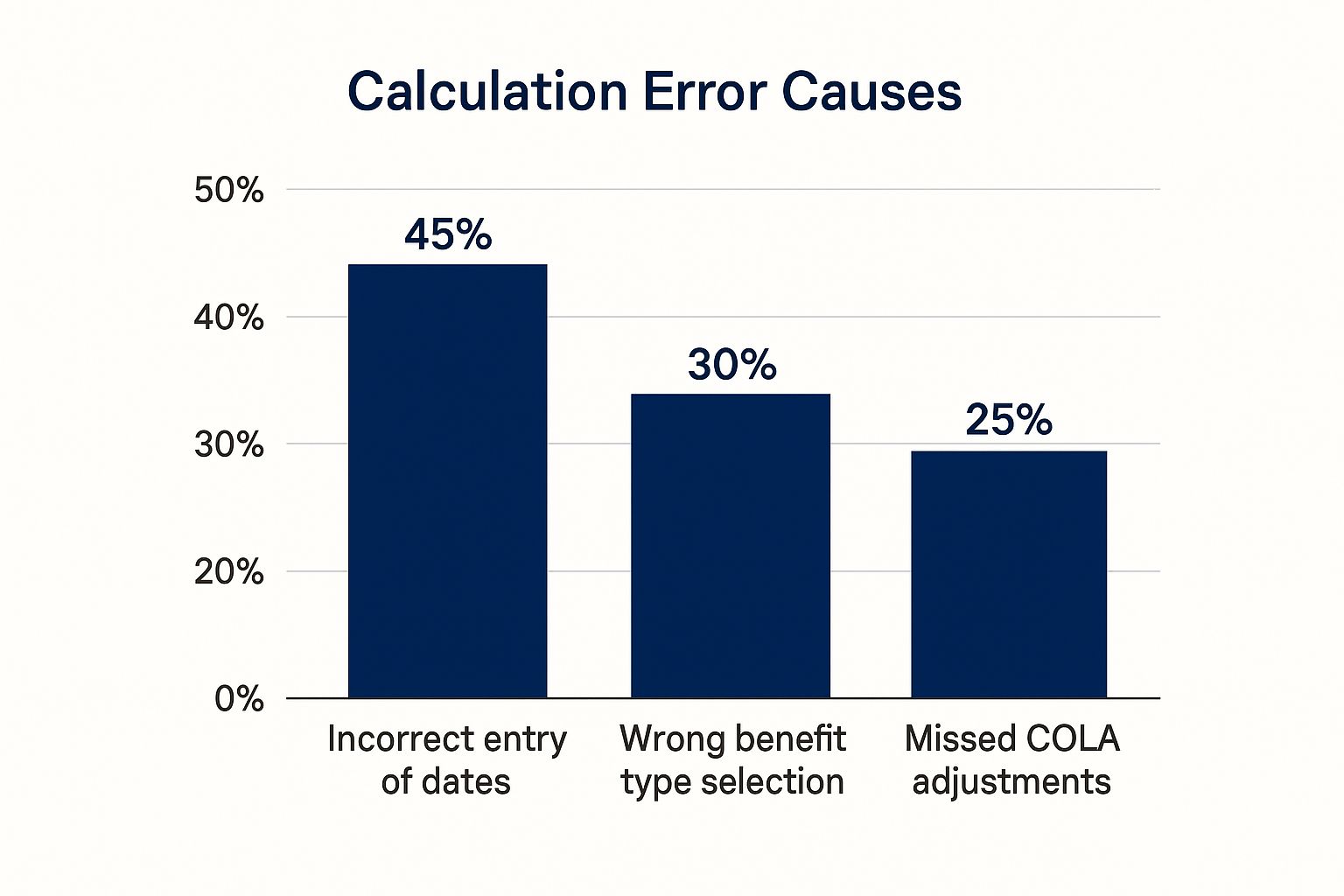
The infographic above shows the biggest headaches veterans face with VA back pay calculations: messing up the dates, picking the wrong benefit, and forgetting about COLA adjustments. Notice how 45% of errors come from incorrect dates? Double-checking your records is essential.
Let's be honest, the VA's official explanation of back pay is about as clear as mud. But the math itself isn't that bad once you get the hang of it. I've walked a bunch of veterans through this process, and trust me, real-world examples make it way easier. Think about two veterans, both 70% disabled, filing on the same day. One's single, the other has three kids. Big difference in their back pay because dependents change the whole equation.
COLA: The Compounding Factor
Cost-of-Living Adjustments (COLA) are a game-changer. Those yearly bumps might look small – 1.3% in 2021, 5.9% in 2022, and 2.5% in 2024 – but they add up over time, significantly boosting your total back pay. Think of it like interest, but for your disability compensation. A VA back pay calculator is incredibly helpful here because it automatically handles the COLA calculations.
The VA figures things out based on your effective date, disability rating, and historical compensation rates. Picture a veteran with a 70% rating, effective date of June 1, 2021, and claim approval on September 1, 2024. The calculator looks at the monthly compensation rate for each of those 38 months, including COLA and any changes in dependents. Learn more about VA compensation rates. For a single vet at 70%, that's around $1,444 monthly in 2021, $1,529 in 2022, and $1,678 after the 2024 increase. We're talking over $60,000, and that's not even counting partial months!
Partial Months and Dependency Changes
Now, things get interesting with partial months and changes in dependents (marriage, divorce, kids turning 18). A good VA calculator usually handles these automatically, but it's good to know the logic. For example, if your dependents change mid-year, your monthly rate adjusts for the rest of that year and every year after in the back pay period. Even hospitalizations can sometimes affect your rate. These little details can really add up, so take your time and make sure they're correct in your calculations.
To give you a better understanding of how COLA impacts compensation rates over time, let's look at some historical data:
VA Compensation Rate Changes by Year
| Year | COLA Increase | 30% Rating | 70% Rating | 100% Rating |
|---|---|---|---|---|
| 2021 | 1.3% | $467.54 | $1,444.35 | $3,146.42 |
| 2022 | 5.9% | $495.42 | $1,529.01 | $3,332.06 |
| 2023 | 8.7% | $538.53 | $1,658.97 | $3,621.95 |
| 2024 | 2.5% | $551.93 | $1,678.52 | $3,711.37 |
This table demonstrates how even small annual COLA adjustments can accumulate to substantial changes in compensation over the years. It underscores the importance of accurately factoring in these adjustments when calculating VA back pay. Don't leave money on the table!
Digital Tools vs. Old-School Math: What Really Works

This screenshot from the VA website shows the current disability compensation rates. These rates are key to figuring out your back pay. Take a look at how much they change based on your disability rating and how many dependents you have. Getting this information right, whether you're using a VA back pay calculator or doing the math yourself, is super important for a reliable estimate.
Speaking of calculators, every veteran I know seems to have a strong opinion on them! I've personally put a bunch of them to the test, using real scenarios, and the accuracy can be…well, let's just say inconsistent. Some calculators are built by people with good intentions, but they just don't quite grasp the VA's, shall we say, unique way of doing things. Others are made by veterans who’ve been there, done that, and really understand the ins and outs.
Navigating the Calculator Landscape
There are some excellent online VA back pay calculators that get it right time and time again. These often include important things like changes in dependents and Cost of Living Adjustments (COLA), which saves you a ton of number crunching. But I’ve also seen calculators that miss crucial details, throwing off the estimate completely. That’s why knowing what to look for is so important. Make sure the calculator accounts for things like partial months, changes in your dependency status, and any time spent in the hospital. These little things add up.
If you’re looking for other financial calculators, the propcalc Homepage has quite a few. But no matter which digital tool you use, always have a backup plan.
The Power of Manual Calculation
Knowing how to calculate your back pay manually is invaluable. It gives you total control and lets you double-check those online calculators. It’s really helpful to understand the math behind your benefits. Think of it as your safety net in case of tech issues or outdated information.
Some veterans prefer the hands-on approach of manual calculation. They like seeing each step, checking the numbers, and making sure nothing is missed. Others love their go-to digital tools. The best way really depends on what you’re comfortable with. But knowing both methods? That gives you the ultimate flexibility.
Choosing the Right Tool for You
Whether you prefer digital tools or old-school math, the end goal is the same: an accurate estimate of your potential VA back pay. Understanding both approaches lets you make informed decisions and advocate for yourself. Don't just blindly trust one method. Take the time to understand the process, compare your results, and feel confident in the numbers. Your financial well-being is worth it.
The Expensive Mistakes Veterans Make
Let's be honest, dealing with VA paperwork can be a headache. Even the most organized veterans sometimes trip up when calculating their VA back pay, and those missteps can cost serious money. I've seen it happen firsthand, and it's tough to watch. I worked with an Air Force vet who miscalculated his effective date by six months! Another veteran, a Marine, completely forgot to update her dependency status after her divorce. These aren't just stories; these are real people losing out on money they deserve.
The Effective Date Trap
One of the biggest gotchas is thinking your effective date is the same as the day you filed your claim. Nope, not always. Your effective date can actually be earlier, especially if you have proof your condition existed before you filed. Missing this can seriously shrink your back pay. Imagine waiting years for a decision, only to find out you missed out on thousands because of a simple date. Double-checking this is absolutely critical.
Dependency Status: The Overlooked Factor
Life happens. Marriage, divorce, kids growing up – these changes affect your dependency status, and that directly impacts your VA back pay. I’ve seen vets lose out on significant amounts simply because they forgot to update this information. Even something small, like a child turning 18 while you're waiting for a decision, can change your final payment. Keep meticulous records of these life changes. For more insights, check out our Blog.
The Calculator Conundrum
Listen, not all VA back pay calculators are created equal. Some are fantastic, accurate tools built by veterans who know the system inside and out. Others…not so much. They might miss crucial factors, giving you a wildly inaccurate estimate. Don't blindly trust any online calculator. Look for ones that handle all the details – partial months, dependency changes, hospitalizations. And always, always double-check the results. This is your money; it's worth verifying.
Double-Checking Your Way to a Bigger Paycheck
The best way to avoid these painful mistakes? Check, double-check, and triple-check everything. Go over your records carefully. Make sure you understand the VA’s rules about effective dates and dependency status. Don’t hesitate to ask questions. Reach out to other veterans or a veterans service organization. A little extra effort up front can save you a lot of heartache – and money – down the line. Your financial future is worth it.
When Your Math Doesn't Match the VA's
So, you’ve plugged everything into a VA back pay calculator, gathered your mountain of paperwork, and painstakingly crunched the numbers… only to find the VA’s payment is off. Take a deep breath. This happens. Honestly, it's more common than you'd think. I’ve talked to so many veterans who’ve been down this road, and many have successfully appealed incorrect payments. Let me share some of their strategies—and a few tips I've picked up along the way—to help you navigate this frustrating situation.
Understanding the Discrepancy
First off, don’t immediately jump to the conclusion that the VA made a mistake. Sometimes, it's an honest oversight on their end. Sometimes, it’s a simple misunderstanding of the incredibly complex rules and regulations surrounding VA benefits. And yes, sometimes, we veterans make errors in our own calculations. Before you draft that strongly-worded email, take a moment to compare your calculations to the VA’s. Look for any differences, big or small.
Gathering Your Ammo: Documentation is Key
When it comes to the VA, documentation is king. Think of it as your arsenal. The VA needs hard evidence to support any changes to your back pay. This means everything you used for your initial estimate: your DD-214, medical records, dependency information, and any correspondence you’ve had with the VA. Even that seemingly insignificant email about your change of address? It might be more important than you realize. Keep it all. My advice? Organize everything chronologically. This makes it so much easier for the VA to follow your train of thought and understand your calculations.
Speaking Their Language: Effective Communication
Here’s an insider tip: the way you communicate with the VA can make a world of difference. Instead of accusatory language, focus on clear, concise explanations. For example, instead of saying, “The VA messed up my back pay,” try something like, “I’ve noticed a discrepancy between my calculated back pay and the amount I received. I’ve attached my supporting documentation for your review.” It’s all about presenting your case logically and professionally.
Real-World Victories: Learning From Others
Let me share a couple of real-world examples. I spoke with a Navy veteran who meticulously tracked his back pay, only to discover a $12,000 difference. He contacted the VA, calmly explained the situation, and provided his detailed calculations. The VA reviewed his case, admitted their error, and corrected the payment. Another veteran, this time from the Army, discovered the VA hadn’t correctly factored in her dependency status, resulting in a smaller payment. She provided her marriage certificate and the birth certificates of her children. The VA promptly adjusted her back pay. These stories demonstrate the power of clear communication and thorough documentation. Don't hesitate to stand up for yourself. Your persistence can and often does pay off—literally.
Maximizing Every Dollar You've Earned
Calculating your VA back pay is essential, sure. But it's not the end of the road. There are some smart moves you can make to ensure you're truly getting everything you deserve. Through my experience working with veterans service organizations and advocates, I've seen firsthand how small, often overlooked details can make a real difference in a veteran's final payout. Let's talk about some common missed opportunities to maximize your benefits.
Retroactively Applying Dependency Changes
Life happens. Marriages, divorces, kids—these changes in your dependency status directly affect your VA back pay. What many veterans don’t realize is that these changes can often be applied retroactively. Imagine your divorce finalized while you were waiting for your claim decision. Submitting that divorce decree to the VA could significantly change your back pay calculation, often for the better. Keep those documents – birth certificates, marriage licenses, court orders – anything official that tells your story. They're all important.
The Impact of Hospitalization
Time spent in the hospital for your service-connected disabilities can also affect your back pay. Inpatient periods might mean you qualify for a higher benefit rate, even looking back. I once worked with a veteran hospitalized for several weeks due to complications from a service-connected injury while his claim was being processed. We were able to get him a higher back pay amount just because of that hospitalization. It’s not always something that comes to mind, but it's definitely worth looking into if you've had any related hospital stays while your claim was pending.
Navigating Combined Ratings
Combined disability ratings are another tricky area. If you have multiple service-connected disabilities, they aren’t simply added up. The VA uses a combined ratings table (VA Combined Ratings Table) to figure out your overall rating, and it can be a bit less than the sum of the individual ratings. Understanding how this calculation works and how it impacts your back pay is key. Even a small change in that combined rating percentage can mean a big difference in your final payment.
From Lump Sum to Long-Term Security: Planning for Your Future
Let’s talk about what happens after you get that back pay. It’s often a substantial amount, so planning how you’ll use it is essential. The tax implications can catch you off guard, so talking to a financial advisor is always a good idea. I’ve seen veterans use their back pay for all sorts of things—paying off debt, going back to school, starting businesses, and finally getting the healthcare they’ve put off. It’s not just about getting what you’re owed; it’s about using it to build a more secure future.
Ready to ensure you're getting everything you deserve? Connect with Homefront Group today.