
Getting a decision letter from the VA that misses the mark can feel like hitting a brick wall. But I want to be clear: this is not the end of your claim. Think of it as the start of a new phase. Your journey to a successful appeal begins with understanding your three options: a Supplemental Claim, a Higher-Level Review, or a Board Appeal. Each one uses a different VA appeal form and a distinct strategy.
Making Sense of the VA's Decision and What to Do Next
When that official envelope from the Department of Veterans Affairs arrives, the decision inside can feel monumental. If it’s a denial or a disability rating that’s lower than you expected, it's natural to feel frustrated and even defeated.
The first thing you need to do is push past that initial feeling and read the decision letter—every single word. It holds the clues you need, explaining exactly why the VA decided the way it did. This is the foundation of your counter-argument. Don’t get bogged down by the dense language; focus on the reasons they give. For a wider view of all potential entitlements you might be missing, it can be helpful to look through a comprehensive veteran benefits guide.
Understanding Your Three Appeal Pathways
The Appeals Modernization Act (AMA) gives you three distinct lanes for your appeal. Picking the right one is probably the most important decision you'll make at this stage, as it dictates the entire process, starting with which VA appeal form to fill out.
Let's break down your options.
- Supplemental Claim: This is the lane for you if you have new and relevant evidence. Say your claim for a knee injury was denied because they said there was no current diagnosis. If you've since seen a specialist who provided a new medical opinion or MRI results, a Supplemental Claim is the way to go.
- Higher-Level Review: Choose this path if you believe the VA made a legal or procedural mistake with the evidence you already submitted. You can’t add new information here. Instead, you're asking a more senior adjudicator to take a fresh look at the file, hoping they'll see the error of the initial decision.
- Board Appeal: This is the most formal route, taking your case directly to the Board of Veterans' Appeals (BVA). A Veterans Law Judge will personally review your file. Here, you have further choices: you can add more evidence, request a hearing to speak with the judge, or simply have them review the existing record.
The AMA has completely changed the appeals landscape. In just one recent fiscal year, the BVA made a staggering 116,192 decisions. What's telling is that 61% of those were handled under this newer AMA framework, showing it’s now the standard for almost all appeals.
Key Takeaway: Your first move—choosing the right appeal lane—sets the stage for everything that follows. It determines the form, the evidence you can use, and how long you might wait for a new decision. Get this part right.
Your Three VA Decision Review Options at a Glance
Navigating these choices can be confusing, especially when you're just starting. This table is designed to cut through the noise and help you see which path aligns with your specific situation.
| Appeal Pathway | What It Is For | When It Makes Sense | Required VA Form |
|---|---|---|---|
| Supplemental Claim | Submitting new and relevant evidence that the VA hasn't seen before. | You have new medical records, a buddy statement, or a nexus letter that strengthens your case. | VA Form 20-0995 |
| Higher-Level Review | Requesting a senior reviewer to re-examine the original decision and evidence for errors. | You believe the law was misapplied or evidence was overlooked, and you have nothing new to add. | VA Form 20-0996 |
| Board Appeal | Appealing directly to a Veterans Law Judge at the Board of Veterans' Appeals. | Your case is complex, you want a formal hearing, or you've been denied after other reviews. | VA Form 10182 |
Think of these three lanes as different tools for different jobs. The key is matching the right tool to your specific disagreement with the VA's decision.
This infographic really drives home the first hurdle you have to clear.
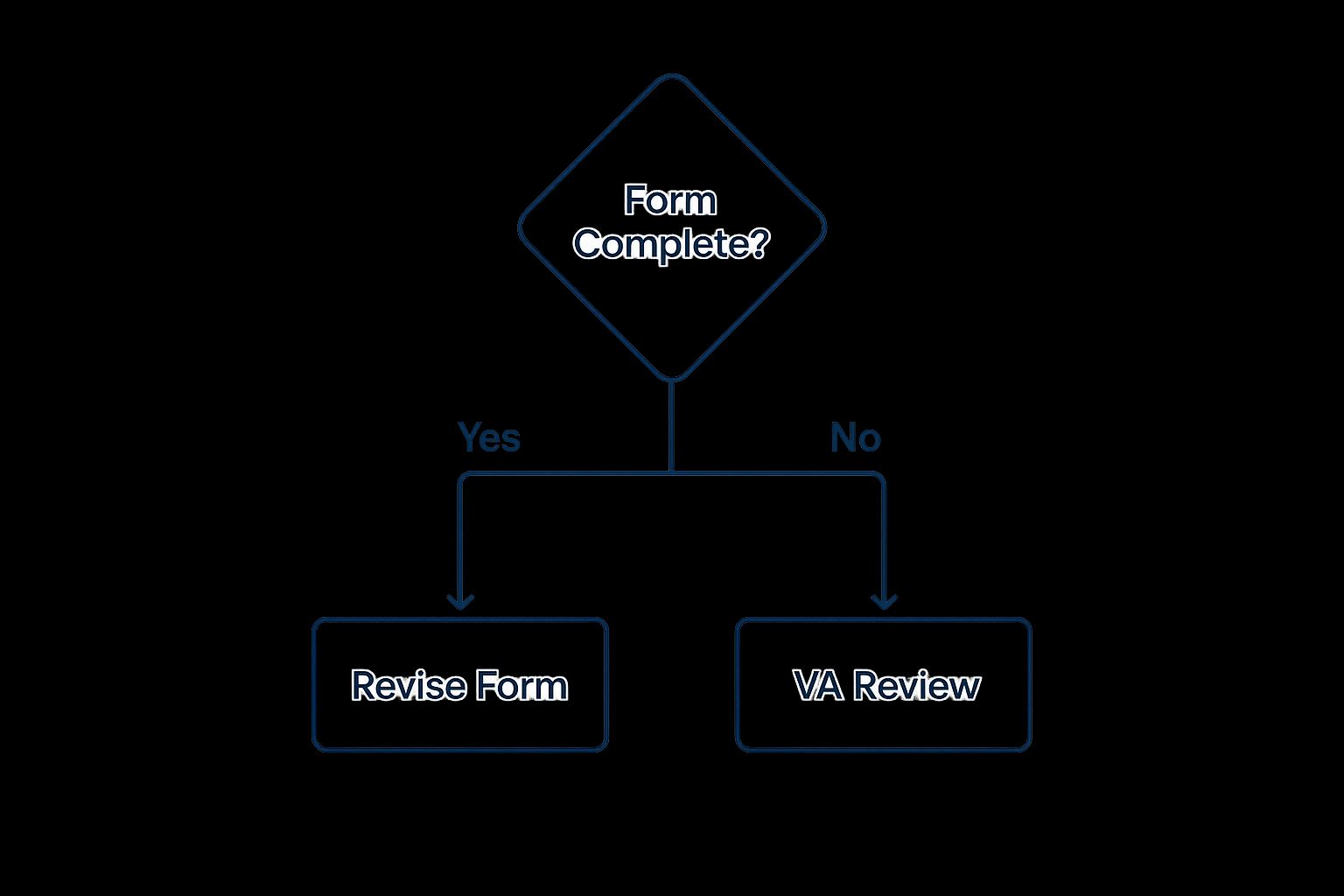
It’s a simple but powerful reminder. An accurate, complete form gets your appeal in the door for review. An incomplete one just sends you back to square one, adding weeks or even months of delay.
Choosing the Right VA Appeal Form for Your Case

Picking the correct VA appeal form is more than just paperwork; it’s a strategic choice that sets the direction for your entire claim. Getting this wrong can lead to frustrating delays or even a procedural denial that sends you right back to the starting line. Think of this as your playbook for making sure your appeal is built on a solid foundation from day one.
The key to it all is your decision letter from the VA. That letter is your map. It doesn’t just tell you what the VA decided, but why. Your job is to take their reasoning and match it to one of the three distinct appeal lanes, each with its own specific form.
The Supplemental Claim Path with VA Form 20-0995
Think of VA Form 20-0995, the Supplemental Claim application, as your chance to fill in a missing piece of the puzzle. This is the VA appeal form you reach for when you have fresh evidence that the VA has never seen before.
The critical phrase here is "new and relevant." This can’t just be a rehash of what you’ve already sent. It has to be something that genuinely adds weight to your case and gives the VA a new reason to see things your way.
Let’s walk through a real-world example. A Navy vet files a claim for sleep apnea, believing it’s a secondary condition to his service-connected PTSD. The VA denies it, stating there's no medical link—or "nexus"—between the two.
This is a textbook situation for a Supplemental Claim. The veteran's next move is clear: he needs to find that missing link. He could:
- Get a nexus letter from a private doctor who reviews his records and writes an opinion directly linking his sleep apnea to the PTSD.
- Submit a sleep study report that he didn't include in his initial filing.
- Ask his wife to write a "buddy letter" that describes how his sleep problems started or got worse as his PTSD symptoms intensified.
With this powerful new evidence in hand, he files VA Form 20-0995. He isn't arguing that the VA made an error with the old information; he's giving them a compelling new reason to approve his claim. Since the average processing time for these claims is about 4-5 months, it's a pretty efficient option when you have the right proof.
The Higher-Level Review Path with VA Form 20-0996
But what if you're certain all the evidence needed for an approval was already in your file, and the VA just missed it or misinterpreted it? That’s where VA Form 20-0996, the Request for Higher-Level Review, comes in. With this VA appeal form, you are not allowed to submit any new evidence.
You're essentially asking for a fresh set of eyes—a more experienced VA adjudicator who will review the exact same file. You’re arguing that an error was made in how the law was applied or how the facts were weighed.
Important Insight: A Higher-Level Review is what we call a "closed record" review. The senior reviewer can only look at the evidence that was in your file when the original decision was made. This makes it a tactical choice when you're confident the VA's mistake is already on paper.
Picture an Army veteran who was denied a higher rating for his back condition. His private medical records, which he submitted, clearly showed his range of motion was limited enough to qualify for a higher rating under VA rules. The original rater simply overlooked those specific measurements.
In this scenario, filing a Supplemental Claim with more of the same evidence would be a waste of time. The proof is already there. Instead, the veteran should file VA Form 20-0996. In the section for disagreement, he can be very specific: "I disagree with the evaluation of my lumbosacral strain. The evidence of record from Dr. Smith, dated January 10, documents flexion limited to 30 degrees, which warrants a higher rating."
This is a direct, fact-based challenge to the VA's original interpretation.
The Board Appeal Path with VA Form 10182
Finally, we have the most formal and intensive route: appealing directly to the Board of Veterans' Appeals (BVA) with VA Form 10182, the Notice of Disagreement. This move takes your case out of the regional office and puts it before a Veterans Law Judge (VLJ).
This path is typically reserved for complex cases, situations where other options have been exhausted, or when a veteran feels they need their "day in court" to explain things. When you file this VA appeal form, you have to select one of three dockets:
- Direct Review: You just want a judge to review the same evidence the regional office had. This is the quickest of the three BVA lanes.
- Evidence Submission: You have new evidence you want the judge to see. The BVA gives you 90 days after you file the form to get it submitted.
- Hearing: You want to testify before a Veterans Law Judge, either virtually or in person. This is the longest route, but it gives you a powerful opportunity to tell your story directly.
Let’s say a Marine veteran’s claim for a rare cancer linked to toxic exposure has been denied twice. The medical science is tricky, and he feels the nuances of his case are getting lost in translation at the regional level. He decides to appeal to the Board and chooses the hearing option. This gives him and his representative the chance to explain the complex medical evidence directly to the judge, a conversation that could change everything.
Choosing the right VA appeal form—in his case, VA Form 10182—was the gateway to that critical opportunity.
Getting the Details Right on Your VA Appeal Form
Think of your VA appeal form as the foundation for your entire case. A clean, accurately filled-out form can mean the difference between a smooth review and a frustrating delay. Whether you're using Form 20-0995, 20-0996, or 10182, getting the details right is your first chance to present a clear, convincing argument to the VA.
Unfortunately, many veterans stumble on what seems like the easiest part: identifying the specific issues they want to appeal. Vague statements are the enemy here. Your goal is to leave absolutely no room for a VA reviewer to misinterpret what you're fighting for.
Pinpointing the Exact Issue for Appeal
This is where you have to be precise. You need to connect your appeal directly to the VA's decision letter. Don't just say you disagree with the outcome; you have to name the exact condition and explain the nature of your disagreement.
For instance, a lot of veterans will write something generic like, "My back hurts." That doesn't give the reviewer anything to work with. A much stronger, more effective statement would be: "Disagreement with the 10% disability rating for lumbosacral strain." See the difference? This immediately tells the VA the specific diagnosis and the part of the decision—the rating percentage—you are contesting.
Let's look at a couple more real-world examples:
-
Weak: "Denial of my leg problem."
-
Strong: "Disagreement with the denial of service connection for patellofemoral pain syndrome, right knee."
-
Weak: "PTSD claim denied."
-
Strong: "Disagreement with the denial of service connection for Post-Traumatic Stress Disorder."
This level of detail is critical because it frames the entire review from the start. The person looking at your file instantly understands the scope of your appeal and can zero in on the relevant evidence for that exact condition.
How to Explain Why You Disagree
After you've identified the issue, you need to explain why you believe the VA got it wrong. This part changes a bit depending on which form you're using, but the core principle is always to be direct and stick to the facts.
On a Higher-Level Review form (VA Form 20-0996), there's a specific block to argue why the previous decision was flawed. This is your shot to point out an error in their logic or how they applied the law.
An Insider's Tip: When you're filling out the Higher-Level Review form, point directly to the evidence that was already in your file when they made the decision. You could write something like, "The decision failed to consider the range of motion measurements documented by Dr. Smith on May 15, which support a higher disability rating under 38 CFR § 4.71a."
For a Supplemental Claim (VA Form 20-0995), you're submitting new evidence, so that evidence will do most of the talking. Your main job on the form is to clearly list the new documents. If there's a comments section, you can add a brief note explaining how this new piece of evidence overcomes the VA's previous reason for denial.
When you file an appeal to the Board of Veterans' Appeals using Form 10182, your statement of disagreement is the very first thing a Veterans Law Judge will see. Clarity here is paramount. You don't need to write a full legal brief, but you should connect the dots for the judge in a clear, straightforward way.
This attention to detail might feel like a small thing, but it makes a huge difference in processing times. The VA has made some real progress, with the average time to complete a disability claim recently dropping to around 131.8 days. A clear, error-free form helps keep your case moving through the system without hitting those preventable speed bumps. You can find out more about the latest VA processing times and claim data here.
Avoiding Common Traps That Derail Appeals
Beyond being specific, a few other common mistakes can get an appeal kicked back or seriously delayed. The good news is they're easy to avoid once you know what to look for.
Keep an eye out for these common pitfalls:
- Sloppy Handwriting: If you're filing by mail, please write in clear, block letters. If the reviewer can't read your form, it's going straight into the "delay" pile.
- The Missing Signature: An unsigned form is an invalid form. Period. Before you mail it or upload it, double- and triple-check that you signed and dated it in the correct spot. This is easily one of the most common mistakes we see.
- Incorrect Personal Info: One wrong digit in your Social Security number or VA file number can send your form into a black hole. Verify your full name and all identifying numbers are correct on every single page.
- Forgetting to List All Issues: Appealing decisions on more than one condition? You must list each one separately on the form. Never assume the VA will figure it out. If it's not explicitly listed, it's not officially part of your appeal.
By treating your appeal form with the seriousness it deserves, you're taking back control of your claim. You're making it easier for the VA to see things your way and review your case efficiently—the critical first step toward getting the benefits you've earned.
Gathering the Evidence That Will Win Your Appeal

Your argument to the VA is only as strong as the proof you provide. Once you've figured out which VA appeal form to use, your next mission is to build a case file so solid it leaves no room for another denial. The kind of evidence you’ll need really comes down to the appeal lane you've chosen.
If you're filing a Supplemental Claim, the whole thing boils down to two words: "new and relevant." This means you have to give the VA something they haven't seen before—something that directly proves your case.
Building Your Case for a Supplemental Claim
When you submit that VA Form 20-0995, you’re essentially telling the VA, "You didn't have all the facts before, but you do now." The evidence you add must directly punch holes in the original denial. If they denied you for lacking a current diagnosis, you get them records showing that diagnosis. If they said there was no link to your service, your job is to provide that missing link.
Here are the heavy hitters when it comes to evidence:
- Nexus Letters: For many veterans, this is the single most important document you can get. A nexus letter is a medical opinion from a qualified professional that draws a clear, unmistakable line connecting your disability to a specific event, injury, or illness from your time in service.
- Medical Opinions from Private Doctors: Don't underestimate the power of reports from your own physicians. These records should detail your diagnosis, explain how severe your symptoms are, and describe exactly how the condition messes with your daily life.
- Buddy Letters (Lay Statements): These are sworn statements from people who know you best—your spouse, close friends, or fellow service members. They can share firsthand accounts of when your condition started, how it's gotten worse, or what it looks like day-to-day. A letter from a Marine who was in the same IED blast that caused your tinnitus? That’s incredibly powerful stuff.
Let's walk through a common scenario. An Air Force veteran gets denied for migraines because the VA says there's no proof the headaches started in service. He can file a Supplemental Claim and include a buddy letter from his old roommate on base, who vividly remembers him constantly canceling weekend plans because of skull-crushing headaches. This new testimony directly contradicts the VA's reason for denial.
Making the Right Choice for a Board Appeal
Filing VA Form 10182 to take your case to the Board of Veterans' Appeals presents a whole different set of strategic decisions. How you fill out this form will dictate your appeal's timeline and how you interact with a Veterans Law Judge.
You have to pick one of three distinct lanes:
- Direct Review: Choose this if you have no new evidence. You’re arguing that the VA regional office simply got it wrong with the information they already had, and you want a judge to give it a fresh look. This is the fastest track at the Board.
- Evidence Submission: This is your lane if you have new evidence for the judge to review. You have 90 days from the day the Board gets your appeal form to turn in that new information.
- Hearing: Pick this option if you want to speak directly to the judge. It’s a powerful opportunity to explain your situation in your own words, but be warned: this is the slowest path, often taking more than a year to schedule.
A Key Strategic Decision: Asking for a hearing is a big deal. It gives you a rare chance to connect with the judge on a personal level, but it also means a much longer wait. If your case is straightforward and well-documented on paper, the Direct Review or Evidence Submission lanes are probably a more efficient bet.
Imagine a veteran with a complicated claim related to toxic exposure. The science is still emerging, and the initial reviewers at the regional office might not be up to speed. In this situation, choosing the Evidence Submission lane lets the veteran submit the latest medical studies and an expert opinion. On the other hand, a hearing would allow the veteran and their representative to explain all that complex science directly to the judge.
The right choice really depends on whether your story is best told through documents or through your own testimony. No matter which path you take, assembling a powerful evidence file is the most important thing you can do to win your appeal.
Getting Your Appeal Filed and Keeping Tabs on It
You’ve done the hard work of gathering your evidence and getting the paperwork just right. Now it’s time to get your appeal form officially submitted. This is a crucial moment, and how you choose to file can make a real difference in your peace of mind and how your case gets started.
For most veterans I talk to, the best bet is filing online through the official VA.gov portal. When you submit electronically, you get an instant, trackable confirmation. That digital receipt is your proof that you met your deadline—and in the world of VA claims, proof of timely filing is everything.
If you'd rather go the old-school route, you can always mail your appeal or drop it off in person at a VA regional office. My advice? If you're putting it in the mail, always use a service with tracking, like Certified Mail. That delivery receipt is worth its weight in gold, so you’re not left wondering if your carefully prepared package made it.
How to Check Your Appeal Status Online
Once you've sent your appeal on its way, the waiting game begins. I know this part can be stressful, but the VA gives you tools to see exactly where your case is in the process. Learning to use them makes you your own best advocate.
You can check on your appeal's progress by logging into your account on VA.gov. The dashboard will show you the current stage of your claim and any recent activity. Understanding what these updates mean is the key to managing your expectations.
Here’s a common scenario: A veteran files for a Higher-Level Review. A few weeks later, she logs into her account and sees the status has changed to: "A reviewer is examining your case." This is great news. It tells her the appeal is out of the initial mailroom pile and is now with a senior adjudicator who is actively looking at it. That little bit of information can provide a lot of reassurance.
What to Expect from the VA Appeal Timeline
Knowing the typical timeline for your chosen appeal lane can really help take the edge off the anxiety of waiting. Each of the three appeal options moves at a different pace, and having a realistic timeframe in mind is incredibly helpful.
| Appeal Type | Average Timeline | What This Means for You |
|---|---|---|
| Supplemental Claim | 4-5 months | This is a fairly quick turnaround, designed for when you have new and relevant evidence to submit. The timeline is built around reviewing those new documents. |
| Higher-Level Review | 4-5 months | This lane moves at a similar pace to a Supplemental Claim. It involves a senior reviewer taking a completely fresh look at the evidence you already submitted. |
| Board Appeal | 1 year or more | This is the long haul. If you request a hearing with a judge, expect a significant wait. The timeline has to account for getting on the docket, judge assignment, and the hearing itself. |
Remember, these are just averages. A straightforward case might move a bit faster, while a more complex one could take longer. The best thing you can do is check your status online every so often. Staying on top of it ensures you won't miss any updates or requests for more information, keeping you in control of your appeal from start to finish.
Common Questions About the VA Appeal Form
It’s completely normal to have questions when you’re staring down the VA appeals process. Even when you’ve picked your appeal lane and started pulling together evidence, tricky situations can pop up that leave you feeling stuck.
Let's walk through some of the most common questions and concerns we hear from veterans. The goal here is to give you clear, no-nonsense answers so you can keep your appeal moving forward without hitting frustrating roadblocks.
What Happens If I Miss the Appeal Deadline?
This is a big one, and for good reason. The answer really depends on which deadline you’ve missed.
Generally, you have a one-year window from the date stamped on your decision letter to file for a Higher-Level Review or take your case to the Board. Once that year is up, those two specific options for that decision are off the table.
But don't panic—it’s usually not the end of the line for your claim. You can almost always file a Supplemental Claim using VA Form 20-0995. The great thing about a Supplemental Claim is that there’s no time limit, as long as you have new and relevant evidence to submit. It effectively reopens your case, but just be aware that it might change your potential effective date for any back pay you’re owed.
Can I Switch Appeal Lanes If I Change My Mind?
Yes, you can, but timing is everything. The modern appeals system is designed to be continuous, letting you choose a new path after you get a decision on your current one.
- After a Supplemental Claim decision, you can request a Higher-Level Review or appeal to the Board.
- After a Higher-Level Review decision, you can file a Supplemental Claim (if you've got new evidence) or appeal to the Board.
The critical thing to remember is that you can’t switch lanes while an appeal is actively in progress. Once you’ve submitted a VA appeal form for one lane, you have to see it through and get a decision before you can make your next move.
For example, you can't file for a Higher-Level Review and then, a month later, decide you'd rather go to the Board because it's taking too long. You have to let the first process finish before choosing your next step.
What Is the Difference Between New and Relevant Evidence?
To file a successful Supplemental Claim, your evidence has to be both “new” and “relevant.” The VA has very specific definitions for these terms, and getting them right is key.
- New Evidence: This is just what it sounds like—information the VA has never seen before in your file. It wasn't part of the record when they made their last decision.
- Relevant Evidence: This means the information tends to prove or disprove something you’re trying to claim. Put simply, it has to connect directly to the issue at hand.
Let's say your claim for a knee condition was denied because you didn't have a current diagnosis. If you go to a doctor and get an MRI that shows arthritis in that knee, the report would be both new (the VA hasn't seen it) and relevant (it proves a current, diagnosed condition). On the other hand, a record from a flu shot appointment wouldn't be relevant at all.
Do I Need a Lawyer or VSO to File an Appeal?
Technically, no. You are not required to hire a lawyer or work with a Veteran Service Officer (VSO) to fill out and submit a VA appeal form. Plenty of veterans handle their own appeals.
However, having an accredited professional in your corner can be a game-changer. These folks live and breathe VA law and know how to sidestep the common pitfalls that can sink an appeal.
Here's where a representative can really help:
- Pinpointing the strongest legal arguments for your specific situation.
- Knowing exactly what kind of evidence the VA needs to see and helping you get it.
- Making sure every form is filed correctly and on time, which helps avoid procedural denials.
A VSO’s services are usually free. Accredited attorneys and claims agents often work on contingency, meaning they don't get paid unless you win your appeal and receive back pay. For many veterans, that expert guidance is more than worth it.
The VA appeals process can feel like a maze, but you don't have to navigate it alone. The team at Homefront Group is made up of veterans and legal experts who specialize in these complex cases. If you're facing a denied claim and aren't sure what to do next, we can help you build the strongest possible appeal. Take our 3-minute quiz to see how we can assist you at https://homefrontgroup.com/.