Navigating the VA disability claims process can feel like a significant challenge, but the right documentation can make all the difference. Well-crafted letters are the backbone of a successful claim, serving as the primary communication tool between you and the VA. They provide the necessary evidence, articulate the basis of your claim, and create a clear, official record. A poorly written or incomplete letter can lead to delays, denials, or a lower disability rating than you deserve. This is why understanding how to structure these documents is not just helpful, it's essential.
This guide provides a comprehensive collection of sample VA disability letters to help you build a stronger, more effective claim. We will move beyond generic templates by breaking down the strategic purpose of each letter type. You'll find fully formatted examples you can adapt for your unique situation, complete with actionable insights and tactical advice. Our goal is to demystify the process and equip you with the tools needed to communicate clearly and persuasively with the VA.
You will learn how to draft compelling letters for a variety of critical scenarios, including:
- Initial disability claims and requests for increased ratings.
- Filing a Notice of Disagreement (NOD) to appeal a decision.
- Claiming benefits for secondary conditions and Individual Unemployability (TDIU).
- Applying for survivor benefits (DIC).
- Submitting a Fully Developed Claim (FDC) for expedited review.
Each example is designed to be a practical, replicable model. By mastering the structure and content of these sample VA disability letters, you can present your case with confidence and clarity, significantly improving your chances of a favorable outcome. Let's get started.
1. Initial Disability Compensation Claim Letter (VA Form 21-526EZ)
The most critical document in any veteran's disability journey is not a letter in the traditional sense, but the official application form itself: VA Form 21-526EZ, Application for Disability Compensation and Related Compensation Benefits. This form acts as your formal declaration to the VA, establishing your intent to claim benefits for conditions you believe are connected to your military service. It is the foundational document that kicks off the entire claims process, from evidence gathering to your C&P exam and final rating decision.
Think of this form as the master key to unlocking your benefits. While supplemental documents like buddy letters and medical opinions add crucial detail, the 21-526EZ organizes your entire claim. It tells the VA who you are, details your service history, and most importantly, lists every single condition you are claiming.
Strategic Analysis: Why the 21-526EZ is Foundational
This form is non-negotiable; you cannot receive compensation without it. Its strategic importance lies in its structure, which forces you to clearly and officially state your claimed disabilities. This creates the official record the VA will work from.
Key Insight: A well-prepared VA Form 21-526EZ sets the stage for a smoother claims process. Listing a condition here officially puts the VA on notice, obligating them to assist you in gathering relevant records and scheduling necessary examinations. Missing a condition on this form means it won't be considered.
Accuracy and completeness are paramount. A hastily filled-out form can lead to processing delays, requests for more information, or even outright denial of a valid claim.
Actionable Takeaways & Tactical Tips
To leverage this form effectively, follow a precise strategy. These tips are essential for anyone preparing one of these sample VA disability letters and forms.
- Preserve Your Effective Date: Before you start gathering documents, submit an "Intent to File" (VA Form 21-0966). This simple step can lock in your effective date, meaning your back pay could go back to the date you submitted the intent, not the date you submit the full 21-526EZ.
- List Every Condition: Be comprehensive. If you are claiming PTSD from an IED blast, also list the associated tinnitus and hearing loss. If you have a back injury from shipboard duties, don't forget the secondary radiculopathy (nerve pain) in your legs. It is easier to have the VA evaluate a claimed condition than to add it later.
- Work with a Professional: Don't go it alone. A licensed Veterans Service Officer (VSO) or VA-accredited attorney can review your form for accuracy and completeness at no initial cost. Their expertise is invaluable.
The VA Form 21-526EZ is the official starting line for your claim. It’s not just paperwork; it’s the most important sample VA disability letter you will submit because it is the one that initiates your entire case.
Download VA Form 21-526EZ Here
2. Notice of Disagreement (NOD) Appeal Letter
If the VA's decision on your claim isn't what you expected, the process is far from over. A Notice of Disagreement (NOD) is your formal declaration that you dispute the outcome and wish to appeal. This action moves your claim from the initial decision phase into the VA's appeals system, allowing you to challenge aspects like a low disability rating, a service-connection denial, or an incorrect effective date.
Under the Appeals Modernization Act (AMA), the traditional NOD letter has evolved into a choice between three distinct appeal lanes, initiated by submitting the appropriate form. This is your opportunity to present your case again, often with new evidence or a new set of eyes reviewing the file. Whether you're a veteran disagreeing with a 30% PTSD rating when your evidence supports 70% or challenging a denial for a condition linked to Agent Orange, this is the next critical step.
Strategic Analysis: Why a Formal Appeal is Crucial
Initiating an appeal is the only way to officially contest a VA decision you believe is incorrect. Simply calling the VA or sending an informal letter will not work. A formal appeal preserves your right to seek a more favorable outcome and protects your potential effective date, which determines the amount of back pay you may receive if your appeal is successful.
Key Insight: The most important decision in the appeal process happens at the very beginning: choosing the correct appeal lane. Your choice between a Higher-Level Review, a Supplemental Claim, or a Board Appeal dictates the entire path forward, including whether you can submit new evidence or have a hearing.
Making the wrong choice can lead to significant delays or a missed opportunity to present your strongest case. Understanding the strategic advantages of each lane is fundamental to a successful appeal.
This infographic provides a clear decision tree to help you navigate which of the three appeal lanes is best suited for your specific situation.
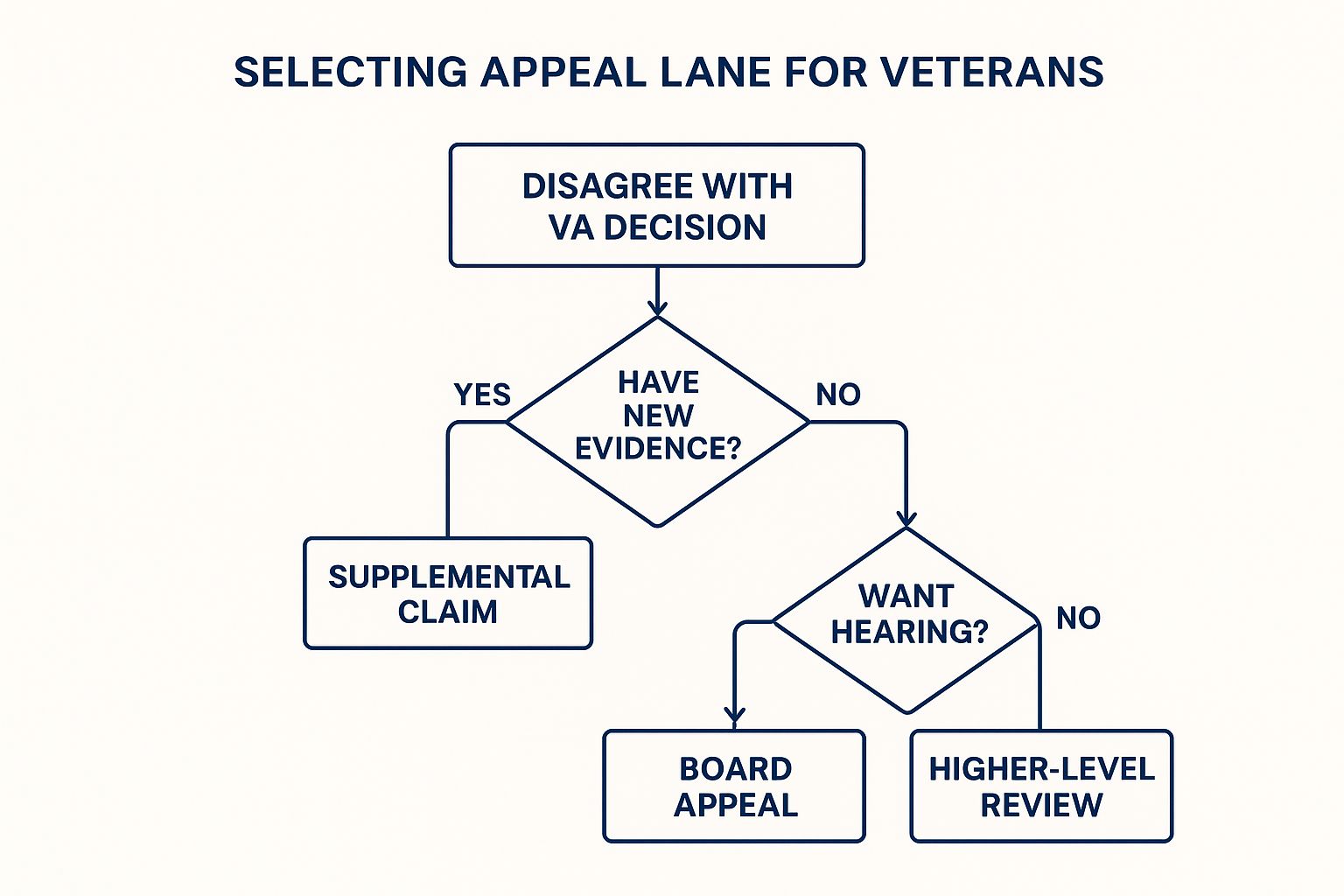
The flowchart clarifies that your ability to submit new evidence is the primary factor in choosing between a Supplemental Claim and the other two options.
Actionable Takeaways & Tactical Tips
To effectively launch an appeal, you must be methodical. These tips are vital for any veteran preparing one of these crucial sample VA disability letters for an appeal.
- Act Within One Year: You have a strict one-year deadline from the date on your decision letter to file an appeal. Missing this window means the decision becomes final, and you may lose out on thousands of dollars in retroactive benefits.
- Clearly Identify the Disagreement: Be specific. On the appropriate form, state exactly what you are appealing. For example, state "I am appealing the 30% rating for PTSD, as the evidence supports a 70% rating," not just "I disagree with my rating."
- Choose Your Lane Wisely: Use the decision tree above. If you have new, relevant evidence, file a Supplemental Claim (VA Form 20-0995). If you believe there was an error in the initial decision and have no new evidence, request a Higher-Level Review (VA Form 20-0996). If you want a judge to review your case, with or without a hearing, appeal to the Board (VA Form 10182).
- Organize Evidence Before Filing: If you choose the Supplemental Claim lane, gather all your new evidence first. This includes new medical records, nexus letters, or buddy letters that directly address the reason for the initial denial.
Filing an appeal is a strategic move that reopens your case. Choosing the right path and submitting a well-supported claim is the key to turning a denial or a low rating into the benefits you've earned.
Download VA Form 10182 for a Board Appeal Here
3. Increase Rating Request Letter (VA Form 21-526EZ for increases)
When a veteran's service-connected disability worsens over time, simply accepting the original rating is not the final step. The VA provides a specific pathway to request a higher rating through what is effectively an "increase rating request letter," which is filed using the same foundational form as an initial claim: VA Form 21-526EZ. This form serves as your official notification to the VA that your condition has deteriorated and now warrants a higher disability percentage and increased monthly compensation.
Think of this process as a re-evaluation of your current health status against the VA's rating schedule. For example, a veteran with a 50% PTSD rating who can no longer work due to worsening symptoms might file for an increase, potentially to 70% or even 100% TDIU (Total Disability based on Individual Unemployability). Similarly, a veteran with a 20% back condition who undergoes spinal fusion surgery would use this form to demonstrate that their functional limitations have significantly increased.
Strategic Analysis: Why a Proactive Increase Claim is Crucial
Filing for an increase is a proactive measure that puts you back in control of your benefits. Your health is not static, and your VA rating shouldn't be either. The strategic importance of using the 21-526EZ for an increase lies in its ability to trigger a new C&P exam and force the VA to re-adjudicate your condition based on current evidence, not outdated medical records.
Key Insight: The burden of proof in an increase claim shifts from proving service connection (which is already established) to proving increased severity. Your goal is to provide clear, objective medical evidence showing your condition now meets the criteria for a higher rating in the VA's Schedule for Rating Disabilities (VASRD).
Waiting for the VA to recognize your worsening condition is not a strategy. You must initiate the process. A well-supported increase claim can significantly impact your financial stability and access to care, reflecting the true level of your disability.
Actionable Takeaways & Tactical Tips
To successfully file for an increase, your approach must be evidence-based and precise. These tips are critical for veterans preparing one of these specific sample VA disability letters and forms.
- Review the Rating Criteria First: Before filing, look up your condition in the VASRD. Understand exactly what symptoms and limitations are required for the next highest rating. This allows you to tailor your evidence and arguments directly to the VA's own standards.
- Document Functional Impairment: Your claim should focus on how the condition has worsened in your daily life. Detail new or increased difficulties with work, social interactions, and personal care. A Disability Benefits Questionnaire (DBQ) completed by your private doctor can be powerful evidence.
- Submit New and Relevant Medical Evidence: This is the most critical element. Obtain current medical records, treatment notes, and a new medical opinion (nexus letter) that specifically discusses the worsening of your symptoms and connects it to the criteria for a higher rating. Simply stating you feel worse is not enough.
Filing for an increase using VA Form 21-526EZ is the official mechanism for ensuring your benefits align with your current level of disability. It’s not just about more compensation; it’s about getting the recognition and support you deserve for your ongoing struggles.
Download VA Form 21-526EZ Here
4. Secondary Condition Claim Letter
Many veterans find that their service-connected disabilities cause new, separate health problems over time. A Secondary Condition Claim Letter is a crucial communication tool used to formally link these new conditions to an existing, already service-connected disability. This establishes a chain of causation, arguing that the new ailment would not have occurred but for the primary condition, making it eligible for its own disability rating and compensation.
This type of claim is powerful because it acknowledges the cascading effect of chronic health issues. For example, a veteran with a service-connected knee injury might develop an altered gait, leading to a secondary back or hip condition. Similarly, the stress and medication side effects from a condition like PTSD can directly contribute to developing issues like sleep apnea, GERD, or even diabetes. This letter formalizes that medical link for the VA.
Strategic Analysis: Why the Secondary Claim is a Force Multiplier
Filing for secondary conditions is one of the most effective ways to increase your overall disability rating. Its strategic value comes from building on a foundation that the VA has already accepted: your primary service-connected disability. You are not starting from scratch trying to prove a new in-service event; you are demonstrating a direct medical link to a condition the VA already acknowledges.
Key Insight: A successful secondary claim creates a new pillar of compensation based on an established one. The focus shifts from proving a service event to proving a medical connection. This often requires less historical evidence and more compelling current medical evidence, such as a strong nexus letter from a medical professional.
Properly documenting this link is the entire battle. A claim for radiculopathy (nerve pain) secondary to a back injury, or depression secondary to chronic pain, requires a clear, evidence-based narrative showing how one condition caused or aggravated the other.
Actionable Takeaways & Tactical Tips
To effectively leverage a secondary claim, a precise medical and administrative strategy is required. These tips are vital when preparing these specific sample VA disability letters.
- Secure a Powerful Nexus Opinion: This is the most critical element. Obtain a letter from a specialist (e.g., a pulmonologist for sleep apnea secondary to PTSD) who explicitly states it is "at least as likely as not" that your secondary condition was caused or aggravated by your primary service-connected disability. An Independent Medical Examination (IME) from a doctor familiar with VA terminology can be invaluable here.
- Document the Timeline: Clearly show the VA how the secondary condition developed after the primary one was established. For instance, show that your sleep apnea symptoms began years after your PTSD diagnosis and treatment started. Medical records, sleep studies, and even personal journals can help illustrate this timeline.
- Cite Medical Research: Strengthen your claim by including medical literature or scholarly articles that support the connection between your primary and secondary conditions. For example, numerous studies link PTSD to an increased risk of obstructive sleep apnea. Providing this research helps educate the VA rater.
- File with the Correct Form: While a cover letter outlining your argument is beneficial, the claim must be officially submitted using VA Form 21-526EZ. In Section IV, "Claim Information," you will list the secondary condition and clearly state which primary service-connected condition it is secondary to (e.g., "Sleep Apnea secondary to PTSD").
5. Individual Unemployability (TDIU) Claim Letter (VA Form 21-8940)
For veterans whose service-connected disabilities prevent them from working, the Total Disability based on Individual Unemployability (TDIU) claim is a powerful pathway to financial stability. This isn't a traditional letter but a formal application using VA Form 21-8940. It argues that even if your disability ratings don't combine to 100%, their severity and impact on your ability to maintain "substantially gainful employment" are so profound that you should be compensated at the 100% rate.

Think of TDIU as a bridge between your disability rating and your real-world inability to work. A veteran with a 70% rating for PTSD who cannot handle workplace stress, or a veteran with a combined 60% rating for back and knee conditions who cannot perform physical labor, could qualify. This claim shifts the VA's focus from a simple schedular rating to the functional impact of your conditions on your livelihood.
Strategic Analysis: Why the TDIU Claim is a Game-Changer
A TDIU claim is crucial because it acknowledges that the VA's rating schedule doesn't always capture the full economic devastation a disability can cause. Its strategic importance lies in its ability to secure maximum compensation without needing a 100% schedular rating, which can be difficult to achieve. The form requires you to detail your work history and explain exactly how your service-connected conditions caused you to stop working.
Key Insight: A successful TDIU claim hinges on proving a direct link between your service-connected conditions and your unemployment. It's not enough to be unemployed; you must demonstrate that you are unemployable because of your disabilities.
This form transforms your claim from a medical argument into an economic and vocational one. A well-documented application, often supported by vocational expert opinions and employer statements, can be one of the most impactful sample VA disability letters you can model a claim after.
Actionable Takeaways & Tactical Tips
To build a compelling TDIU case, you must provide clear and overwhelming evidence of your inability to work. These tactics are critical for success.
- Document Every Work Attempt: Detail all employment you've held since your conditions worsened. Include start dates, end dates, job duties, and the specific reasons (tied to your disabilities) why you had to leave each job.
- Show Failed Accommodations: If employers tried to accommodate your disabilities but you still couldn't perform the work, document it. This shows your unemployability isn't due to a lack of effort or opportunity.
- Obtain a Vocational Assessment: A vocational expert can provide a professional opinion stating that, given your age, education, work history, and specific disability limitations, you are unable to secure and maintain substantially gainful employment in the competitive job market.
- Leverage Medical Evidence: Your medical records should clearly describe the functional limitations that prevent work. For example, a note from your psychiatrist about panic attacks in social settings strongly supports a claim that you cannot work in a customer-facing role.
The TDIU application provides a vital route to 100% compensation when your disabilities, while not rated at 100%, have effectively ended your working career.
6. Dependency and Indemnity Compensation (DIC) Survivor Benefits Letter (VA Form 21P-534EZ)
For surviving families, the Dependency and Indemnity Compensation (DIC) application is one of the most significant claims they will ever file. It’s not a letter from the veteran, but a formal claim filed by a surviving spouse, child, or parent using VA Form 21P-534EZ, Application for DIC, Survivors Pension, and/or Accrued Benefits. This form establishes a request for monthly, tax-free monetary benefits following the death of a veteran from a service-connected condition or other qualifying circumstances.
This application is the gateway to critical financial support for families who have lost their veteran. It formalizes the connection between the veteran's military service and their cause of death, ensuring their sacrifice continues to be recognized through support for their loved ones. While filed during a time of grief, its correct and timely submission is paramount.
Strategic Analysis: Why the DIC Application is a Lifeline
The DIC application is the sole mechanism for a survivor to claim these specific benefits. Its strategic importance lies in its role as a formal, evidence-based request that obligates the VA to investigate the link between the veteran's service and their death. This is fundamentally different from a veteran's own disability claim, as it requires proving the ultimate outcome of a service-connected disability.
Key Insight: A successful DIC claim hinges on proving a "nexus" or direct link between the veteran's military service and their cause of death. The application form is the vehicle for presenting this argument, supported by crucial evidence like the veteran’s death certificate and medical records.
Without this form, survivors have no official standing to claim benefits. The information provided, such as marriage certificates and the veteran's service history, creates the legal and administrative framework for the VA to award compensation.
Actionable Takeaways & Tactical Tips
Navigating a DIC claim requires careful documentation and a focused approach. These tips are vital for survivors preparing one of these essential sample VA disability letters and forms.
- Gather Essential Documents First: Before filling out the form, collect the veteran's death certificate (listing the cause of death), your marriage certificate, and any children's birth certificates. Having these ready prevents major delays.
- Establish the Service Connection: The most critical element is linking the cause of death to service. If a veteran died from Ischemic Heart Disease (an Agent Orange presumptive), ensure the death certificate clearly states this. If the cause is less direct, a medical opinion letter connecting the death to a service-connected disability is powerful evidence.
- Work with Survivor Support Specialists: Organizations like Gold Star Wives of America and dedicated VSOs specializing in survivor benefits offer expert guidance. They can help navigate the complexities of the application process at no cost, providing invaluable support during a difficult time.
The DIC application represents a final act of care, securing the benefits a veteran earned for their family. It’s more than paperwork; it’s a solemn request to honor a lifetime of service and sacrifice.
Download VA Form 21P-534EZ Here
7. Fully Developed Claim (FDC) Expedited Processing Letter
While not a traditional letter, participating in the Fully Developed Claim (FDC) program is a strategic declaration that you are submitting all necessary evidence with your initial application. This approach signals to the VA that your claim is "decision-ready," potentially bypassing the VA's lengthy evidence-gathering phase and leading to a much faster decision. It essentially serves as a cover letter for a meticulously prepared evidence packet.
This method transforms the standard claims process. Instead of waiting for the VA to request records from military, private, and federal sources, you take full ownership of the evidence submission. You are telling the VA, "Everything you need to make a decision is in this file."
Strategic Analysis: Why the FDC Program is a Game-Changer
The FDC program is designed for speed and control. By submitting a complete claim package upfront, you significantly reduce the back-and-forth communication and delays that plague the standard process. This is your best tool for expediting a well-documented claim.
Key Insight: The FDC program shifts the burden of evidence gathering from the VA to the veteran. While this requires more upfront work, it grants you unprecedented control over the narrative and evidence presented, minimizing the risk of the VA overlooking crucial documents or misinterpreting your case.
Submitting an FDC claim doesn't guarantee approval, but it guarantees a faster evaluation. A well-prepared FDC package, such as one for a combat veteran with clear in-service injury reports and current medical diagnoses, can move through the system in a fraction of the time.
Actionable Takeaways & Tactical Tips
To successfully leverage the FDC program, you must be exceptionally thorough. These tips are crucial for preparing one of these expedited sample VA disability letters and claim packages.
- Gather ALL Evidence First: Before submitting your claim, obtain every relevant document. This includes Service Treatment Records (STRs), complete private medical records, a Disability Benefits Questionnaire (DBQ) from your doctor, and powerful lay statements (buddy letters).
- Certify Your Submission: When you file online or use VA Form 21-526EZ, you must certify that you have submitted all relevant evidence and that there is no more evidence you plan to submit. This certification is what officially places you in the FDC program.
- Work with a Professional: The FDC process has no room for error. An experienced VSO or accredited attorney is invaluable for ensuring your package is truly "fully developed." They can spot missing records or weak arguments before you submit, preventing your claim from being kicked out of the expedited lane.
The FDC program is a powerful strategy for veterans with well-documented conditions who want to accelerate the decision process. It is a proactive approach that rewards preparation with speed.
Learn More About the FDC Program Here
7 Key VA Disability Letter Types Comparison
| Claim Type | Implementation Complexity 🔄 | Resource Requirements 💡 | Expected Outcomes ⭐📊 | Ideal Use Cases 💡 | Key Advantages ⚡ |
|---|---|---|---|---|---|
| Initial Disability Compensation Claim Letter | High – requires detailed documentation and medical evidence | Moderate – military records, medical exams | Moderate to high – ~70% approval if well-prepared | First-time disability compensation claims with multiple conditions | Establishes effective date; no filing fee; multiple conditions |
| Notice of Disagreement (NOD) Appeal Letter | High – involves legal procedures and deadlines | High – possible new medical exams, legal representation | Variable – can increase ratings or benefits; no guarantee | Challenging unfavorable VA decisions within 1 year deadline | Multiple appeal options; allows new evidence submission |
| Increase Rating Request Letter | Moderate to High – requires current medical proof of worsening | Moderate – medical opinions and treatment records | Moderate – potential monthly benefit increase; risk of reduction | When condition worsens after initial rating | Retroactive payments; no limit on frequency; online filing |
| Secondary Condition Claim Letter | Moderate to High – strong medical causation evidence needed | High – specialist opinions, nexus letters | Moderate – expands compensation through secondary conditions | Conditions caused by already service-connected disabilities | Often easier to prove causation; retroactive benefits |
| Individual Unemployability (TDIU) Claim Letter | High – detailed work history and medical proof required | High – vocational evaluations, extensive documentation | High – 100% compensation without 100% rating | Veterans unable to maintain substantially gainful employment | Includes dependents benefits; retroactive to unemployability |
| Dependency and Indemnity Compensation (DIC) | Moderate – complex eligibility and documentation | Moderate – death certificates, relationship proof | High – monthly survivor benefits and healthcare | Surviving spouses, children, or parents of deceased veterans | Ongoing income; healthcare; education; home loan eligibility |
| Fully Developed Claim (FDC) Expedited Processing | High – must compile all evidence upfront | High – comprehensive medical and service records | High – faster processing (60-90 days), better approval | Claims with complete documentation ready at submission | Faster decision; higher approval; less back-and-forth |
Final Thoughts
Navigating the VA claims process can often feel like a formidable journey, but as we've demonstrated throughout this guide, a well-crafted letter is your most powerful tool. It’s the primary vehicle for communicating the facts of your case, the severity of your condition, and the direct link, or nexus, to your military service. Moving beyond generic templates to a strategically constructed narrative is the key to transforming a claim from a set of forms into a compelling, undeniable case for the benefits you have earned.
The sample VA disability letters we’ve explored, from the initial claim to appeals and requests for increased ratings, all share a common foundation. They are built on clarity, specificity, and irrefutable evidence. Mastering this framework is not just about filling out paperwork; it’s about taking control of your story and presenting it in a way that leaves no room for ambiguity.
Key Takeaways: From Template to Triumph
To truly leverage the power of these sample letters, remember the core principles that elevate a good letter to a great one. These are the strategic pillars that support a successful VA claim.
-
Precision is Paramount: Vague statements lead to vague outcomes. Always use specific dates, medical terminology, and detailed descriptions of your symptoms and their impact on your daily life. Instead of saying "I have back pain," describe "a constant, sharp pain in my lower lumbar region, rated 8/10, that prevents me from lifting more than ten pounds."
-
Evidence is Your Advocate: Your letter is the argument, but your evidence is the proof. Every statement you make must be corroborated by medical records, service records, buddy letters, or expert opinions. A strong claim weaves these documents into a cohesive narrative, directly referencing them to support your points.
-
Structure Creates Clarity: The VA adjudicator reviewing your file is managing a heavy caseload. A logically structured letter, using clear headings, short paragraphs, and bullet points, makes their job easier. This ensures they can quickly grasp the essential facts of your claim, the evidence you've provided, and the specific benefit you are seeking.
-
The Nexus is Non-Negotiable: For any service-connected claim, the "nexus" is the bridge between your current disability and your time in service. Your letter must explicitly draw this connection. Use a nexus letter from a medical professional whenever possible to make this link undeniable.
Your Actionable Next Steps
Empowered with this knowledge and our collection of sample VA disability letters, your path forward is clear. It’s time to move from learning to doing.
- Select the Right Template: Identify the letter template from our guide that matches your specific situation, whether it's an initial claim, an appeal, a request for an increase, or a claim for a secondary condition.
- Gather Your Documentation: Before you write a single word, assemble all your evidence. This includes your DD-214, all relevant medical records (both military and civilian), buddy statements, and any diagnostic reports.
- Customize with Your Details: Methodically work through the sample letter, replacing the placeholder text with your personal information, specific details about your condition, and references to your supporting documents. Be thorough and honest.
- Review and Refine: Read your completed letter out loud. Does it clearly and concisely tell your story? Is it free of emotion and focused on the facts? Have a trusted friend or family member review it for clarity before you submit it.
By following these steps, you are not just submitting a claim; you are presenting a meticulously prepared case. The effort you invest in crafting a powerful, evidence-backed letter significantly increases your chances of securing the disability benefits you rightfully deserve, providing the financial stability and recognition for your service and sacrifice.
Navigating the complexities of VA law requires more than just the right forms; it demands expert guidance. The attorneys at Homefront Group specialize in helping veterans, first responders, and their families secure the benefits they are owed for service-connected injuries and toxic exposure. If you need dedicated legal support to build a winning claim or appeal a denial, visit Homefront Group to see how their experience can make all the difference.