

Facing a Compensation and Pension (C&P) exam for Post-Traumatic Stress Disorder (PTSD) can be one of the most intimidating parts of the VA disability claim process. The questions are deeply personal, the stakes are high, and the outcome directly impacts the benefits you have rightfully earned through your service. This guide is built to demystify the experience by providing a clear roadmap of what to expect.
We will walk you through the most common PTSD C&P exam questions, offering crucial context, practical preparation strategies, and actionable advice for each one. Our goal is to empower you to articulate your experiences clearly and honestly, ensuring the VA examiner understands the true, daily impact of your service-connected trauma.
Knowing what to expect and how to prepare is the key to a successful evaluation. By understanding the purpose behind the questions, you can approach your exam with confidence, ready to provide the specific information needed to secure the rating and support you deserve. This article provides a breakdown of the most frequently asked questions and equips you with the tools to navigate your C&P exam effectively.
1. Describe the original traumatic event(s) in detail
This is often the first and most critical question in a PTSD C&P exam. The examiner asks you to recount the specific, service-related incident or incidents that you believe caused your PTSD. Their goal is to establish a "stressor event," which is the linchpin of any successful PTSD claim. The VA needs to verify that a traumatic event occurred during your service and that it is the root cause of your current mental health symptoms.

Recounting trauma is incredibly difficult, but being prepared can make the process more manageable. The examiner isn't trying to upset you; they are gathering the necessary facts to complete the Disability Benefits Questionnaire (DBQ) accurately. This question directly addresses the "stressor" criteria needed for a PTSD diagnosis according to the DSM-5, which the VA uses.
Why This Question is Asked
The primary purpose is to establish the service connection for your PTSD. The examiner must document the "who, what, when, and where" of the event to see if it meets the VA's definition of a traumatic stressor. This documentation is crucial for verifying your claim against your service records or other evidence.
Sample Scenarios
Your answer must be honest and specific to your experience. The nature of the trauma can vary significantly.
- Combat Exposure: "During a patrol in Fallujah, Iraq, on or around May 15, 2004, our vehicle was hit by an IED. I was the gunner and was thrown inside the vehicle. Two members of my squad were severely injured."
- Military Sexual Trauma (MST): "In November 2008, while stationed at Fort Hood, I was sexually assaulted in the barracks by a superior NCO. It happened after a unit function."
- Non-Combat Trauma: "While working on the flight line at Bagram Airfield in 2012, a hydraulic line ruptured on an aircraft I was servicing, spraying me with hot fluid and causing severe burns."
Preparation and Actionable Tips
Key Insight: Your goal is not to relive the trauma for emotional effect, but to provide a clear, factual account that allows the examiner to connect the event to your diagnosis.
To prepare for one of the most challenging PTSD C&P exam questions, consider the following steps:
- Create a Timeline: Before your exam, write down a chronological list of the events. Include dates, locations, and key details. You can bring this with you as a reference.
- Be Specific: Provide as much detail as you can recall. Vague answers like "I saw some bad things in combat" are less effective than specific incidents.
- Honesty is Key: If you don't remember a specific detail, say "I don't remember" or "My memory of that part is unclear." Memory gaps are a common symptom of PTSD.
- Bring Documentation: If you have buddy statements, performance reports showing a decline after the event, or combat medals (like a CAR or Purple Heart), bring copies to support your account.
2. How do PTSD symptoms affect your daily functioning and relationships?
After establishing the traumatic event, the examiner will shift focus to the present-day impact of your symptoms. This question is designed to measure the severity of your condition by understanding how it concretely disrupts your life. Your VA disability rating is not based on the trauma itself, but on the level of functional impairment it causes in different areas, such as your work, social life, and family relationships.

Answering this question effectively requires you to connect your symptoms to real-world consequences. It’s not enough to say you have anxiety; you must explain how that anxiety prevents you from going to the grocery store or attending your child's school events. This is one of the most important PTSD C&P exam questions for determining your final disability percentage.
Why This Question is Asked
The examiner uses this information to fill out the section of the DBQ that assesses social and occupational impairment. The VA needs a clear picture of your limitations to assign a rating that accurately reflects your level of disability. They are looking for specific examples of how PTSD symptoms like hypervigilance, emotional numbing, or angry outbursts translate into tangible problems.
Sample Scenarios
Your response should provide detailed examples of the "before and after" effect of your trauma on your life.
- Work Impairment: "Before my deployment, I was a successful project manager. Now, my concentration is so poor that I can't finish tasks on time. I was recently placed on a performance improvement plan because of angry outbursts at coworkers when I feel stressed."
- Relationship Breakdown: "My irritability and emotional distance have destroyed my marriage. My ex-wife said she felt like she was living with a stranger. I can't connect with my kids because I'm always on edge and can't handle the noise and activity."
- Social Isolation: "I used to enjoy going to baseball games and concerts with friends. Now, I can't be in crowds due to severe hypervigilance. I spend nearly all my free time at home alone because it's the only place I feel safe."
Preparation and Actionable Tips
Key Insight: Focus on painting a vivid picture of your daily struggles. Show the examiner how your symptoms manifest as actions (or inactions) that limit your ability to function.
To prepare a clear and impactful answer, use these strategies:
- Keep a Symptom Diary: For a few weeks before your exam, document specific instances where your PTSD symptoms caused a problem. Note the date, the symptom, and the resulting difficulty (e.g., "Had a panic attack in Walmart and had to abandon my cart").
- Provide Concrete Examples: Avoid generalizations like "I'm always angry." Instead, say, "Last week, I got into a shouting match with a neighbor because their dog was barking, and my startle response is extreme."
- Include Family Input: Ask your spouse, partner, or a close friend for their perspective on how you have changed. They can provide valuable examples that you might overlook. You can bring a written "buddy statement" from them to the exam.
- Document Work Issues: If you have been fired, demoted, or disciplined at work due to your symptoms, bring copies of performance reviews, termination letters, or emails to support your testimony.
3. What specific PTSD symptoms do you currently experience?
After establishing the traumatic event, the C&P examiner will shift focus to your present-day condition. This question is designed to systematically evaluate how the trauma affects you now by exploring the four main symptom clusters of PTSD as defined by the DSM-5. The examiner needs to document the frequency, intensity, and duration of your symptoms to confirm a diagnosis and determine your disability rating.
This is a core component of the PTSD C&P exam questions because it directly links the past event to your current functional impairment. The examiner will likely go through a checklist of symptoms, asking you about each one. Being prepared to discuss them specifically is crucial for an accurate assessment.
Why This Question is Asked
The examiner's goal is to map your experiences to the diagnostic criteria for PTSD. They need concrete evidence of symptoms across four categories: intrusion, avoidance, negative changes in cognition and mood, and marked alterations in arousal and reactivity. A thorough answer provides the specific details needed to complete the DBQ for PTSD and justify a potential service connection and disability rating.
Sample Scenarios
Your responses should be specific and illustrate how these symptoms manifest in your daily life.
- Intrusive Symptoms: "I have nightmares about the IED attack at least three or four times a week. During the day, the sound of a car backfiring can trigger a flashback where I feel like I’m right back in the convoy."
- Avoidance: "I stopped going to fireworks shows because the loud noises are too much. I also avoid crowded places like the mall because I can’t relax and feel constantly on edge."
- Negative Cognition/Mood: "I feel detached from my family, like I’m just going through the motions. I struggle to feel happy about anything, and I carry a lot of guilt about surviving when others in my unit didn’t."
- Arousal/Reactivity: "I’m always hypervigilant, constantly scanning for threats. I can’t sit with my back to a door in restaurants. My wife says I jump at the slightest sound, and I have trouble falling and staying asleep most nights."
Preparation and Actionable Tips
Key Insight: Provide real-world examples of how each symptom impacts your work, social life, and family relationships. Connecting symptoms to functional impairment is vital for your claim.
To effectively answer one of the most detailed PTSD C&P exam questions, use these strategies:
- Review PTSD Symptoms: Before the exam, look up the DSM-5 criteria for PTSD. Make a list of the symptoms you experience from each of the four clusters.
- Give Specific Examples: Instead of saying "I have anger issues," describe a specific instance: "Last week, I had an outburst and yelled at my kids for spilling a drink because my startle response is so high."
- Describe Frequency and Intensity: Be ready to explain how often symptoms occur (e.g., "daily," "a few times a week") and how severe they are (e.g., "the nightmares are so intense they wake me up").
- Be Honest and Don't Downplay: This is not the time to be tough or minimize your struggles. The examiner can only report what you tell them. If a symptom is severe, say so.
4. How do you cope with your PTSD symptoms?
After discussing your symptoms, the examiner will explore how you manage them day to day. They want to understand your coping mechanisms, both positive and negative, to get a complete picture of how PTSD impacts your life. This includes formal treatments, personal strategies, and unhealthy habits you may have developed to survive.
This question is a key part of the PTSD C&P exam questions because it helps the examiner assess the severity and pervasiveness of your condition. Your coping strategies, or lack thereof, provide insight into your level of functioning and the effectiveness of any treatment you have received. The VA uses this information to see if your coping methods align with the symptoms you've described.
Why This Question is Asked
The goal is to evaluate your current functional impairment and your efforts to manage your condition. The examiner needs to understand what you do to get through the day, which can reveal the true depth of your struggles. Documenting unhealthy coping mechanisms like substance use or social withdrawal can actually strengthen your claim, as they are often symptoms of severe, unmanaged PTSD.
Sample Scenarios
Your answer should be a candid reflection of your daily reality. Honesty about both healthy and unhealthy strategies is vital.
- Positive Coping: "I attend weekly therapy sessions with my psychologist and take my prescribed Zoloft every morning. When I feel a panic attack coming on, I use the 4-7-8 breathing technique my therapist taught me. Going for a run also helps clear my head."
- Negative Coping: "Honestly, I drink more than I should to fall asleep and stop the nightmares. I mostly keep to myself and avoid going to crowded places like the grocery store because it makes my anxiety unbearable. I’ve lost touch with a lot of my old friends."
- Mixed Strategies: "I try to meditate using an app, which sometimes helps. My wife is my main support, but I often get irritable and push her away. I haven’t found a medication that works without bad side effects, so I stopped taking it."
Preparation and Actionable Tips
Key Insight: Be completely honest about your struggles. Admitting to negative coping mechanisms like substance use or isolation is not a sign of weakness; it is evidence of your PTSD's severity.
To effectively answer this question, think about all the ways you manage your life now compared to before your trauma.
- List Your Strategies: Before the exam, make two columns: "Healthy Coping" and "Unhealthy Coping." List everything you do, from therapy and exercise to avoidance and substance use.
- Include Treatments: Be prepared to discuss all current and past treatments. Bring a list of medications (including dosage), names of doctors or therapists, and dates of therapy.
- Explain What Works (and What Doesn't): Talk about your experience. If a certain medication caused severe side effects or a type of therapy wasn't helpful, explain that. This shows you have been proactive in seeking help, even if unsuccessfully.
- Mention Your Support System: Discuss the role your family, friends, or veteran peer groups play. Explain how you rely on them or, conversely, how your symptoms have caused you to withdraw from these important connections.
5. Describe your sleep patterns and nightmares
Sleep disturbances are a hallmark symptom of PTSD and a critical component of the C&P exam. The examiner will ask about your sleep quality to understand how your condition impacts your daily life and contributes to your overall disability. This question directly assesses the "Intrusion" and "Alterations in arousal and reactivity" criteria for a PTSD diagnosis.

Your answers provide the examiner with concrete evidence of how PTSD disrupts your biological functions, leading to chronic fatigue, irritability, and difficulty concentrating. Problems like insomnia, recurrent nightmares, and waking up in a panic are powerful indicators of the severity of your condition and are directly linked to higher disability ratings.
Why This Question is Asked
This question helps the examiner evaluate the severity and frequency of your sleep disturbances, which are weighted heavily in the VA's rating schedule for mental health conditions. Documenting poor sleep provides objective evidence for symptoms like hypervigilance (being unable to fall asleep) and re-experiencing the trauma (nightmares), which are core to a PTSD diagnosis.
Sample Scenarios
Be specific about the nature and frequency of your sleep issues. Connect them back to your service-related trauma if possible.
- Recurrent Nightmares: "I have nightmares about the IED attack three to four nights a week. I wake up yelling and covered in sweat, and my heart is racing. It takes me at least an hour to even think about trying to sleep again."
- Difficulty Falling Asleep (Insomnia): "Most nights, I can't fall asleep until 2 or 3 a.m. I just lie there, replaying events in my head. Any little noise startles me, so I feel like I have to stay on guard."
- Frequent or Early Waking: "I wake up every two hours, almost like clockwork. Or, I'll wake up at 4 a.m. wide awake with a feeling of dread and can never get back to sleep, leaving me exhausted for the entire day."
Preparation and Actionable Tips
Key Insight: Quantifying your sleep problems with numbers and specific examples is more impactful than general statements like "I don't sleep well."
To effectively communicate the extent of your sleep issues during your PTSD C&P exam, follow these steps:
- Keep a Sleep Diary: For one to two weeks before your exam, log your sleep. Note what time you go to bed, roughly how long it takes to fall asleep, how many times you wake up, and the frequency and content of any nightmares.
- Document Averages: Be ready to state the average number of hours of sleep you get per night. For example, "I'm in bed for eight hours, but with all the waking up, I probably only get four hours of broken sleep."
- Include Partner Statements: If you have a spouse or partner, their observations are valuable evidence. A "buddy statement" describing you thrashing, yelling, or waking up in a panic can strongly support your claim.
- Explain the Aftermath: Describe how poor sleep affects your next day. Mention things like fatigue, inability to focus at work, irritability with your family, or falling asleep during the day.
6. How has your condition changed since military service?
Examiners ask this to understand the progression of your symptoms over time. They want to see how your PTSD has evolved since your military discharge, establishing a clear timeline that connects your current condition back to your service. This question helps differentiate service-connected PTSD from a condition that may have developed or worsened due to later, non-service-related life events.
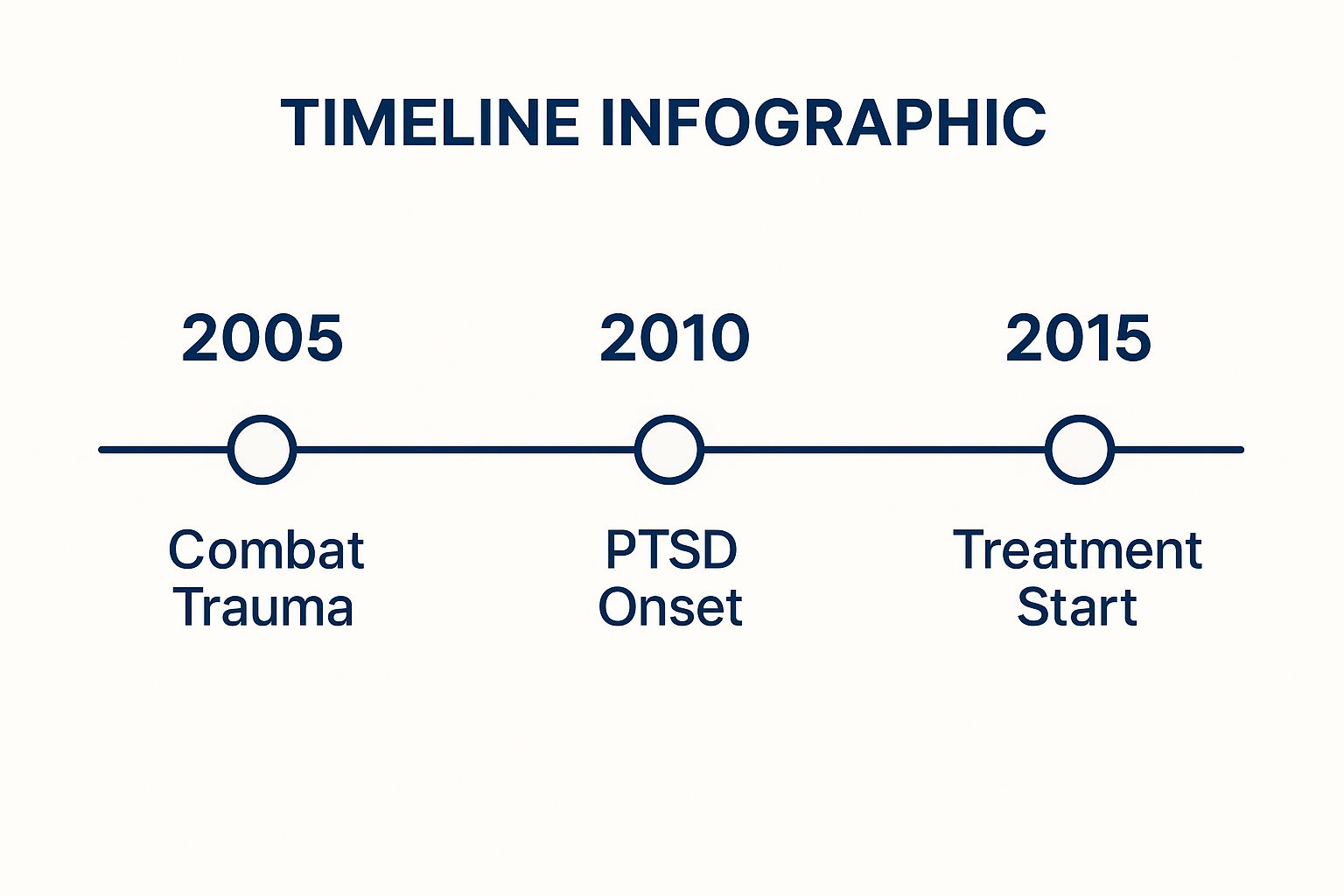
The timeline above illustrates a common progression: a traumatic event occurs during service, followed by a delayed onset of symptoms, and then an eventual attempt at treatment. This visual representation helps the examiner see a clear, chronological link between the in-service stressor and your current need for care, which is a key part of answering PTSD C&P exam questions effectively.
Why This Question is Asked
The primary goal is to map the longitudinal course of your PTSD. The VA needs to see if your symptoms began during or shortly after service, and whether they have persisted, worsened, or fluctuated since. This helps them confirm that your current disability is a direct result of your military experiences and not a new issue that arose years later for unrelated reasons.
Sample Scenarios
Your narrative should detail the trajectory of your symptoms, linking them to major life events where possible.
- Delayed Onset: "After I got out in 2005, I thought I was fine. I just felt on edge. But around 2010, after I lost my job, the nightmares and anger started. It's only gotten worse since then."
- Gradual Worsening: "My symptoms were manageable for a few years, but they’ve steadily become more severe. I used to be able to hold a job, but now my anxiety and irritability make it impossible to work with others."
- Fluctuating Symptoms: "I'll have good months where I feel okay, especially when I was in therapy. But then something will trigger me, like a loud noise, and I'll relapse for weeks, unable to leave the house."
Preparation and Actionable Tips
Key Insight: A clear timeline demonstrating symptom progression since service strengthens the argument that your PTSD is chronic and directly linked to your military experience.
Use these tips to prepare a coherent and compelling answer:
- Develop a Symptom Timeline: Before the exam, write down a timeline. Note when symptoms first appeared, when they worsened, and any life events (divorce, job loss, etc.) that coincided with these changes.
- Connect to Life Impact: Explain how the progression of your symptoms has increasingly affected your life. For instance, "In the first five years after service, I could still maintain friendships, but as my hypervigilance worsened, I isolated myself completely."
- Discuss Treatment Effects: Detail how therapy or medication has impacted your symptoms. Did they help? Did the effects wear off? This provides a fuller picture of your condition's severity.
- Use Your Records: Refer to private medical records, performance reviews, or lay statements that show a decline in functioning over time. This provides objective evidence to support your personal account.
7. What is your current treatment history and medication regimen?
This question allows the examiner to understand the full scope of your efforts to manage your PTSD symptoms. They will ask about your complete treatment history, including all forms of therapy, medications, hospitalizations, and even alternative approaches you have tried. The goal is to create a longitudinal picture of your condition, its severity, and its response (or lack thereof) to treatment.
Documenting your treatment journey is crucial evidence. It demonstrates that your condition is persistent and that you have actively sought help. This information helps the examiner assess the chronicity and severity of your PTSD, which directly influences the disability rating assigned. A long and complex treatment history often correlates with a more severe and debilitating condition.
Why This Question is Asked
The examiner’s primary goal is to assess treatment compliance and effectiveness. A history of consistent treatment, especially with various medications or therapies that have failed to provide lasting relief, substantiates the severity of your symptoms. This question helps the VA understand if your condition has been resistant to standard treatments, which is a key factor in determining a higher disability rating.
Sample Scenarios
Your answer should be a comprehensive but organized summary of your medical and therapeutic journey.
- Complex Medication History: "I was first prescribed Zoloft, but it gave me severe insomnia. Then, the doctor switched me to Paxil, which helped with anxiety but had major side effects. Currently, I'm on Effexor for depression and Trazodone to help me sleep."
- Therapy and Hospitalization: "I have been in weekly individual therapy with a private psychologist for two years. I also attended a VA-sponsored group therapy for MST survivors for six months. In 2019, I was hospitalized for a week at the VA medical center due to suicidal ideation."
- Multiple Treatment Modalities: "I've tried cognitive behavioral therapy (CBT) and am now doing Eye Movement Desensitization and Reprocessing (EMDR). I've also tried acupuncture and yoga for stress management, in addition to my prescribed medications."
Preparation and Actionable Tips
Key Insight: A well-documented treatment history is objective proof of your condition's severity and impact on your life. Do not downplay or omit any treatments, even if they were unsuccessful or brief.
To provide a clear and thorough answer to these ptsd c&p exam questions, follow these steps:
- Compile a Complete List: Before the exam, create a detailed list of every medication you have taken for your PTSD. Include the drug name, dosage, dates you took it, and the reason for stopping (e.g., side effects, ineffectiveness).
- Document All Providers: List every therapist, psychiatrist, and doctor you have seen for your mental health. Include their names, the facility (VA and private), and the dates of treatment.
- Note Side Effects: Be prepared to discuss any side effects you have experienced from medications. This information is critical as it can be considered a symptom of your condition.
- Be Honest About Gaps: If there were periods where you did not seek treatment, be prepared to explain why. Common reasons include side effects, feeling that treatment wasn't helping, or financial barriers.
7-Point PTSD C&P Exam Question Comparison
| Question / Item | Implementation Complexity 🔄 | Resource Requirements ⚡ | Expected Outcomes 📊 | Ideal Use Cases 💡 | Key Advantages ⭐ |
|---|---|---|---|---|---|
| Describe the original traumatic event(s) in detail | Medium – requires detailed recall, chronological account | Moderate – needs preparation and supporting documents | Clear trauma documentation, establishes causation | Establishing service connection, foundational exam | Detailed trauma timeline, assesses credibility |
| How do PTSD symptoms affect your daily functioning and relationships? | Medium – multi-domain functional assessment | Moderate – may use diaries, family input | Comprehensive impact on life, aids disability rating | Assessing real-world disability and life impact | Holistic view of symptom impact, quality of life data |
| What specific PTSD symptoms do you currently experience? | High – systematic DSM-5 criteria evaluation | Low to Moderate – knowledge of symptoms required | Complete symptom profile, diagnostic clarity | Diagnostic confirmation and differentiation | Thorough symptom coverage, ensures diagnostic accuracy |
| How do you cope with your PTSD symptoms? | Medium – evaluates coping strategies and treatment engagement | Moderate – may require medication/treatment history | Insight into coping effectiveness and treatment needs | Treatment planning, identifying barriers | Reveals self-awareness and treatment compliance |
| Describe your sleep patterns and nightmares | Low to Medium – focuses on specific sleep symptoms | Low – sleep diaries recommended | Objective sleep disturbance data, impacts rating | Assessing sleep-related symptoms and functionality | Measurable data, clear disability evidence |
| How has your condition changed since military service? | Medium – requires chronological symptom tracking | Moderate – timelines and medical records advised | Tracks symptom progression, assists service connection | Establishing symptom timeline and disability evolution | Identifies symptom patterns, documents condition change |
| What is your current treatment history and medication regimen? | High – comprehensive treatment and medication review | High – requires complete medical and medication records | Objective evidence of treatment and compliance | Assessing treatment history, determining barriers | Detailed treatment timeline, compliance documentation |
Your Next Steps: Securing the Justice and Support You Deserve
Navigating the path to a successful VA disability claim for PTSD can feel like one more battle after you have already served. However, by understanding the framework of the Compensation and Pension (C&P) exam, you transform a potentially intimidating interview into a structured opportunity to advocate for yourself. The questions we have explored are not random; they are the building blocks the VA uses to connect your service to your current condition and determine its impact on your life.
Your primary goal is to provide a clear, honest, and detailed narrative. Remember, this is not a test of your memory or character. It is a diagnostic and documentary process. Your truth, presented consistently and specifically, is your most powerful tool.
Mastering Your C&P Exam: Key Takeaways
To distill this guide into its most critical components, focus on these core principles as you prepare:
- Be Specific, Not Vague: Instead of saying "I have trouble with crowds," describe a specific incident: "Last week at the grocery store, the crowded checkout line made me feel trapped, my heart started racing, and I had to leave my cart and walk out." This level of detail provides concrete evidence.
- Connect Symptoms to Function: Do not just list your symptoms. Explain how they affect your life. How do nightmares impact your energy for work the next day? How does hypervigilance prevent you from enjoying time with your family at a park? This is the nexus the examiner needs to see.
- Honesty is Your Anchor: Never exaggerate or invent symptoms. It is equally important not to downplay or minimize what you are experiencing. A common veteran trait is to "tough it out," but this exam is the one place where that instinct works against you. If you cannot remember specific details of a traumatic event, simply state that. "I don't remember the exact sequence" is a valid and honest answer.
- Consistency is Crucial: Ensure the information you provide during the exam aligns with the statements in your application, your buddy letters, and your medical records. Consistency across all your documentation builds a credible and compelling case.
Ultimately, preparation for your PTSD C&P exam is an act of empowerment. You are taking control of your narrative and ensuring the full scope of your struggles is accurately documented. The insights gained from preparing for these ptsd c&p exam questions are invaluable, giving you the confidence to communicate your experience effectively. Your service earned you this support; this exam is simply the formal process to secure it. You have already proven your strength and resilience on the battlefield. Now is the time to apply that focus to securing the benefits you rightfully deserve for your long-term well-being.
Feeling overwhelmed by the claims process? You are not alone. The team at Homefront Group, comprised of fellow veterans, understands the complexities of a PTSD claim and can help you navigate the system. Get the expert guidance you need to build a strong case and prepare effectively for your C&P exam.