
Getting ready for mediation is about much more than just organizing your paperwork. It's about a fundamental shift in your mindset. Success doesn't come from viewing mediation as another battle to be won, but as a shared problem that needs a practical solution. Getting your head in this space is the single most important thing you can do to make clear, strategic decisions when it counts.
Shifting Your Mindset from Conflict to Collaboration
The way you walk into that mediation room will absolutely define the outcome. Too many people treat it like a pre-trial skirmish, seeing the other party as an enemy to be taken down. That’s a huge mistake. Real preparation starts with understanding what mediation actually is and adjusting your approach to fit.
There's a reason the global alternative dispute resolution (ADR) market—which includes mediation—has exploded in recent years. It grew from USD 7.97 billion to USD 8.47 billion in a single year and is on track to hit USD 12.43 billion by 2030. These numbers tell a story: people and organizations are actively choosing collaboration over costly court battles. You can dig into these ADR market trends to see just how significant this shift is.
Embrace the Core Principles of Mediation
To get the most out of the process, you have to buy into its core principles. Unlike a courtroom, where a judge calls the shots, mediation is all about mutual respect and shared control.
- Confidentiality: This is a big one. What’s said in mediation, stays in mediation. This creates a safe space where you can speak freely and explore different options without worrying that your words will be twisted and used against you later on.
- Neutrality: The mediator isn't a judge. They don't take sides, and they don't decide who's right or wrong. Their only job is to help the conversation along and guide both sides toward an agreement you can both live with.
- Self-Determination: You are in the driver's seat. You and the other party hold all the power, and absolutely no agreement can be forced on you. Nothing is final until you say it is.
This visual breakdown shows just how effective mediation can be when you commit to the process.
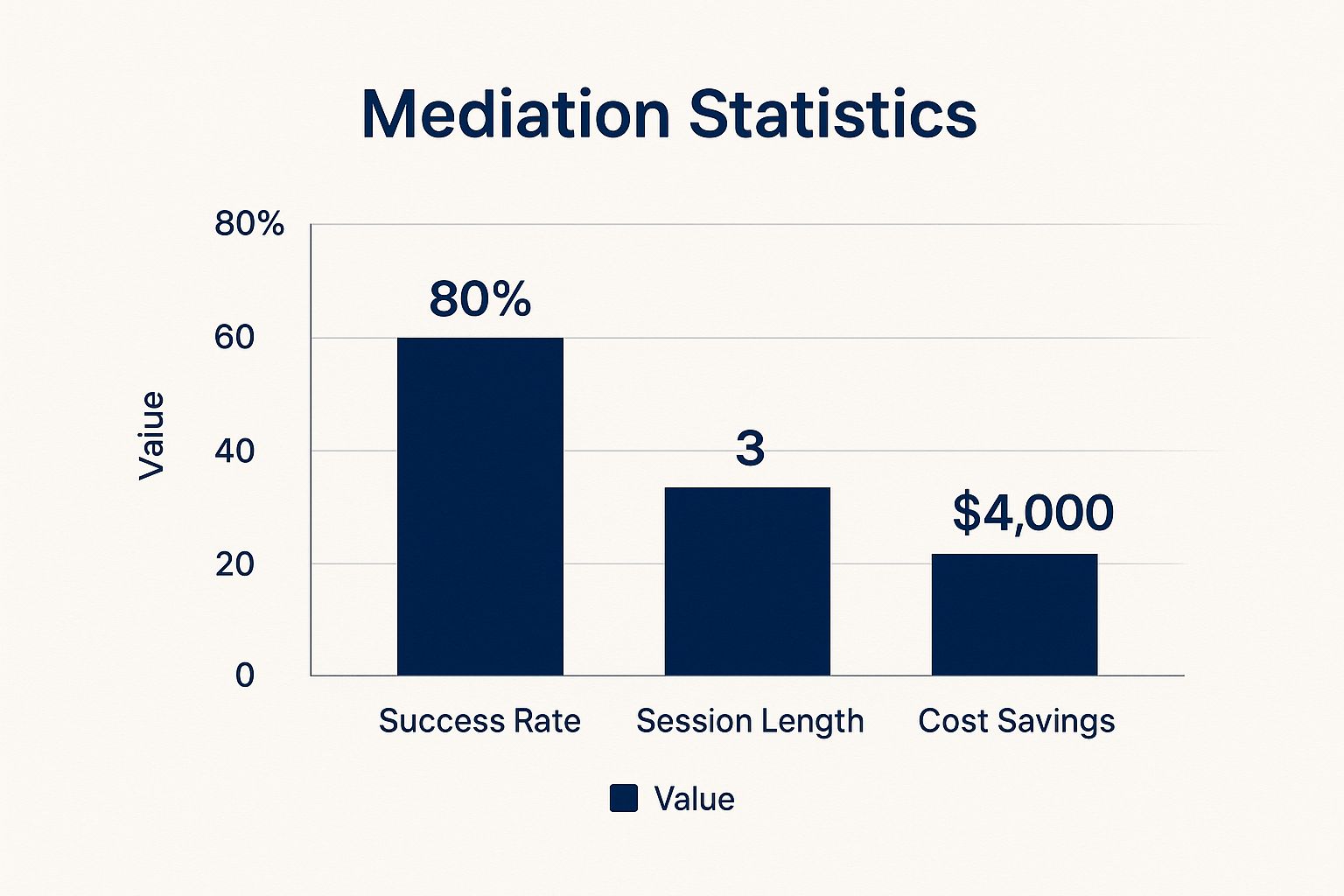
The numbers don't lie. Mediation consistently proves to be a faster, cheaper, and highly successful alternative to letting a court decide your fate.
From Winning a Fight to Solving a Problem
Switching to a problem-solving mindset is the most powerful tool you have. It means reframing the entire situation. Stop focusing on what they did wrong or what you think you're "owed." Instead, concentrate on the real issues at the heart of the conflict and look for creative ways to fix them—together.
This doesn't mean you give up on what you need. It just means you change your strategy for getting there. It's about focusing on your interests, not just your positions. A position is a hard-line demand ("I want $50,000"). An interest is the why behind it ("I need that money to cover my medical bills and the wages I lost while I was out of work").
The people who walk away with the best outcomes are the ones who can step back from the raw emotion of the conflict and see the bigger picture. They get that a durable, long-term solution serves them far better than "winning" a fight that leaves everything scorched.
Before you even think about what to offer or accept, it's critical to shift out of the adversarial mindset that a lawsuit encourages. Mediation is a different arena with different rules for success.
Key Pre-Mediation Mindset Shifts
| Litigation Mindset (Win/Lose) | Mediation Mindset (Problem-Solving) |
|---|---|
| The other side is the enemy. | The other side is a negotiating partner. |
| My goal is to defeat their arguments. | My goal is to understand their needs. |
| I must prove I am right and they are wrong. | We need to find a mutually acceptable solution. |
| The focus is on past grievances and blame. | The focus is on future needs and resolutions. |
| "Winning" is the only acceptable outcome. | A fair and practical agreement is a "win." |
Internalizing this shift from a battle to a puzzle is the first—and most important—step in your mental preparation. It opens the door to creative solutions you would never find in a courtroom.
Define Your Strategic Anchors: BATNA and WATNA
A huge part of your mental prep is figuring out your boundaries ahead of time. This is what keeps you from making a bad call based on emotion or pressure in the moment. The two concepts you absolutely need to understand are your BATNA and your WATNA.
- BATNA (Best Alternative to a Negotiated Agreement): Put simply, what’s your Plan B if you walk away from the table with no deal? What’s the most likely outcome if you push forward with a lawsuit? Knowing your BATNA gives you a solid benchmark. If an offer on the table is better than your BATNA, you know it's a serious contender.
- WATNA (Worst Alternative to a Negotiated Agreement): This is the other side of the coin. What’s the absolute worst-case scenario if you don't settle? Think about the money, the time, and the emotional toll of continuing the fight. Having a clear picture of your WATNA helps you see the real value in reaching a reasonable agreement.
By setting these two anchors before you ever walk into the room, you build a logical framework for the entire negotiation. You’re no longer just reacting; you’re making informed choices designed to get you a resolution that actually works for you.
Weaving Your Story with Hard Evidence
Once you've got your head in the right space, it's time to get practical. The real work of mediation prep involves building the story of your case, and every good story needs a solid foundation of proof. This isn't about just gathering every piece of paper you can find. It’s about being a strategist—carefully choosing and organizing evidence to create a powerful, logical narrative that backs up everything you’re asking for.
Think of it this way: your story, supported by undeniable facts, is what convinces the mediator and, just as importantly, the other side that your proposed solution isn’t just what you want, but what is fair.
Rounding Up Your Key Documents
First things first, you need to collect all the relevant paperwork. What you’ll need depends entirely on your specific situation, but the goal is the same for everyone: find concrete proof for every single point you plan to make. Your credibility in the mediation room is directly tied to your ability to back up what you say.
A good starting point for a first responder with a work-related injury claim might look something like this:
- The official incident report from the event.
- Photos or videos of the scene, if they exist.
- All medical records, from the first ER visit to ongoing physical therapy notes and prescription receipts. Don't leave anything out.
- Pay stubs and employment records to clearly show lost wages and time away from the job.
- Witness statements from colleagues who were there.
For a veteran fighting a VA benefits appeal, the list will be different. You’ll be pulling together your DD-214, service records, private medical opinions (Nexus letters are gold), and every piece of correspondence you've had with the VA. The more thorough you are, the stronger your foundation.
Turning a Pile of Paper into a Powerful Narrative
Here's a crucial point that many people miss: just having the documents isn't enough. You need to arrange them so they tell a clear, chronological story. Your evidence should walk the mediator through exactly what happened, the domino effect it had on your life, and why the outcome you’re fighting for is the only logical conclusion.
This is how you transform a dry stack of records into a persuasive argument. You're connecting the dots for everyone in the room, making your position easy to follow and incredibly difficult to argue against. As you organize and prepare to share this evidence, it's absolutely vital to ensure shared document security to protect your sensitive information.
Your story is the "why" behind your position. It’s not just about what you’re asking for. It’s about showing them, with evidence, why it’s the fair and just resolution.
A big part of this is trying to get inside the other party's head. What evidence will they bring? What story will they try to tell? Thinking about their angle ahead of time lets you find the weak spots in your own case and prepare solid counter-arguments. It makes your entire position much more resilient.
Sharpening Your Story for Maximum Impact
With your evidence organized and your narrative mapped out, the final step is to boil it all down into two powerful tools: your opening statement and a mediation brief. This is your chance to frame the entire conversation before it even really begins.
Your Opening Statement
This is your two-to-three-minute verbal summary of your case. Keep it concise, clear, and focused on what truly matters to you. It's an opportunity to speak directly to the other side and the mediator, setting a human, constructive tone right from the start.
The Mediation Brief (or Position Paper)
This is a short, written document—usually just 2-5 pages—that you send to the mediator before the session. It gives them a roadmap to your case.
It should briefly cover:
- The basic history of the dispute.
- Your main arguments and the key evidence supporting them.
- What you hope to achieve (your interests).
- A quick summary of any past settlement talks.
Think of the brief as the mediator's cheat sheet. A well-crafted brief means the mediator walks in already understanding the core issues. This makes the session itself infinitely more efficient and gets everyone closer to finding common ground.
Crafting a Flexible and Effective Settlement Strategy
Think of your negotiation strategy as your playbook for game day. This isn't about setting a single, rigid demand and stubbornly sticking to it. A truly effective plan is dynamic, built to adapt to the twists and turns of the actual conversation. Success hinges on creating a flexible framework that empowers you to make clear-headed decisions, even when the pressure is on.
The foundation of this plan is built on your strategic anchors: your BATNA (Best Alternative to a Negotiated Agreement) and WATNA (Worst Alternative to a Negotiated Agreement). Now, let’s use those anchors to build a practical, multi-layered strategy with well-defined settlement tiers.
Building Your Settlement Tiers
Before you even think about walking into that mediation room, you need to know your numbers cold. This means creating three distinct settlement points that will act as your internal roadmap, preventing you from making rash decisions based on emotion rather than your core objectives.
Here’s how to structure them:
- Your Ideal Outcome (The "Home Run"): This is your best-case scenario. It’s ambitious, sure, but it's still firmly rooted in the evidence and documentation you've gathered. Consider this your opening position.
- Your Acceptable Target (The "Realistic Win"): This is the goal you're genuinely aiming for. It's a fair, well-supported outcome that covers your primary needs, like paying for medical treatments and compensating for lost income after a work injury.
- Your Walk-Away Point (The "Bottom Line"): This is your absolute floor, informed directly by your BATNA and WATNA analysis. If an offer drops below this number, you know with complete confidence that you’re better off walking away and pursuing your alternative.
Having this three-tiered approach gives you the structure to negotiate with confidence. You’ll know exactly where you want to start, where you realistically hope to land, and precisely where you must draw the line.
Look Beyond Positions to Uncover Interests
One of the most powerful tools in any negotiator's toolkit is principled negotiation. The concept is simple but profound: focus on the underlying interests driving each side's demands, not just the stated positions.
A position is what someone says they want—"I need $100,000." An interest is why they want it—"I need to cover my surgery costs, make up for six months of lost wages, and have a cushion for future physical therapy."
When you start digging into the "why," you open up a world of creative, win-win solutions. For instance, maybe the other side can’t manage a large lump-sum payment but could offer structured payments over time or agree to cover future medical expenses directly.
Understanding the other party’s interests doesn’t mean you have to agree with them. It means you’re gathering critical intelligence that lets you craft offers that meet their underlying needs without gutting your own.
This shifts the dynamic from a tense battle of wills to a collaborative search for a workable solution. It's a crucial part of mediation prep that many people overlook. For those navigating a divorce, finding this kind of common ground is essential. Resources offering consultation services for a joint divorce petition can provide a structured path toward this kind of interest-based resolution.
Master the Art of the Concession
Real negotiation is a dance of give and take. You’re unlikely to hit your "home run" outcome without giving something up along the way. The trick is to plan your concessions strategically, not just hand them out for free.
Before the mediation, decide what you’re willing to concede and what’s completely off the table. Think of these concessions as your negotiating currency. When you make a concession, always link it to a request.
For example: "I'm willing to come down from my initial number if you are willing to agree to a non-disclosure clause."
A common tactic for managing this back-and-forth is bracketing. This involves making offers that systematically narrow the gap between your position and theirs. If they offer $20,000 and you counter at $80,000, your next move might be to $70,000. This signals a clear, measured willingness to find a middle ground and keeps the negotiation from stalling over extreme numbers.
Having this foresight is what separates a prepared participant from a reactive one, empowering you to respond thoughtfully as the negotiation unfolds.
Partnering With Your Legal Counsel for Success

When you walk into mediation with an attorney, the two of you are a team. This isn't just about having legal muscle in your corner; it's about building a unified front. A strong, collaborative relationship with your counsel means you stay in the driver's seat while tapping into their deep legal and strategic experience.
This partnership has never been more crucial. With the international commercial mediation market recently pulling in $2.7 billion in global revenue, it's clear that mediation is no longer a soft alternative—it's serious business. We're seeing more and more cases, which tells me that people are finally investing in the expert guidance needed to get it right.
The Pre-Mediation Huddle: Where the Game Plan Is Made
Your pre-mediation meetings with your lawyer are where the real work happens. This is your time to sync up, hash out every detail, and make sure there are no surprises on the day. Trust me, the other side can spot a disorganized team a mile away.
Use these sessions to get specific about your roles. Who's leading the opening statement? Usually, you’ll share the personal side of the story—the real-world impact—while your attorney lays out the legal foundation. It's also a good idea to agree on a subtle signal for when you need a private word with them.
Most importantly, you need to be crystal clear about your lawyer's settlement authority. They have to know your absolute bottom line and your ideal outcome to negotiate effectively. There can be no gray area when it comes to the numbers.
You are always the final decision-maker. Your lawyer advises and advocates, but they can't accept any deal without your explicit green light. This pre-mediation conversation ensures that boundary is clear and respected by both of you.
Getting Clear on Roles and Responsibilities
A smooth, professional presentation hinges on knowing who does what. Defining these roles ahead of time keeps you from talking over each other and shows the other party you’re organized and prepared.
- You (The Client): You are the expert on the facts. You bring the human element, explaining why this dispute matters and what the impact has been on you. Your authenticity is your power.
- Your Attorney: They manage the legal process. Their job is to frame the arguments, handle the nitty-gritty negotiation on legal points, and act as your strategic advisor.
As you and your lawyer prepare, using modern tools for streamlining legal workflows with legal feedback and annotation tools can make your document review and strategy sessions incredibly efficient. This way, your private caucus time is spent on decision-making, not playing catch-up.
Your Lawyer Is Your Best Strategic Asset
During the mediation itself, your attorney is more than just a legal expert—they're your objective sounding board. When you’re in a private caucus with the mediator, they are your strategist and confidant.
Lean on their experience. Don't be afraid to ask direct questions. "From what you've seen in other cases, is this offer fair?" or "What are the hidden risks if I accept this?" They can cut through the emotion of the negotiation and help you evaluate offers with a cool head.
This dynamic lets you keep full control over the outcome while having an expert right there with you, analyzing the field and helping you make the smartest possible move. It’s this collaborative groundwork that turns legal representation into a true strategic advantage.
Building Your Emotional Armor for the Big Day
Let's be honest: preparing for mediation is about more than just paperwork and legal arguments. It's an emotional marathon. The way you handle the inevitable stress and frustration on the day can make or break the outcome. Building up your psychological resilience isn't some soft, optional skill—it's your most critical tool for thinking clearly when the pressure is on.
Your head space directly controls your ability to negotiate. When you’re calm and collected, you can listen, process what’s being said, and make decisions that are actually in your best interest. But when you’re overwhelmed, you’re far more likely to react impulsively, give away too much, or slam the door on a perfectly good solution.
Know Your Triggers, Control the Room
We all have them. Emotional triggers are those specific words, topics, or even just a look from the other person that can set you off. A crucial part of getting ready is figuring out exactly what yours are before you even walk into that room. Think of this self-awareness as your first line of defense.
For a first responder, a trigger might be someone downplaying the seriousness of an on-the-job injury. For a veteran, it could be the dismissive tone that reminds them of the bureaucracy that held up their claim for years.
Once you’ve identified your triggers, you can game-plan your response. This isn’t about bottling up your emotions; it’s about acknowledging them without letting them drive. A deceptively simple technique is the "pause and breathe" method. The second you feel that trigger getting pulled, consciously take a slow, deep breath. That tiny gap is just enough time for your rational brain to catch up with your gut reaction.
It also helps to have a "deflection phrase" in your back pocket. Instead of biting back, you can say something neutral and controlled, like, "It sounds like we see that differently. Maybe the mediator can help us unpack that point." This move acknowledges the disagreement without pouring fuel on the fire.
The Strategic Power of Shutting Up and Listening
In a tense negotiation, our instinct is to think about our comeback while the other person is still talking. Fight that urge. This is the exact opposite of what you need to be doing. True active listening—listening to actually understand, not just to reload—is your secret weapon.
When you genuinely listen, you start picking up on invaluable clues about the other side's real priorities, their bottom line, and where they might be willing to bend. You don't have to agree with them. You just have to understand their side of the story.
Listening intently isn't just about gathering intel; it’s a sign of respect. That simple act can instantly lower the hostility in the room and make the other party more willing to hear you out when it's your turn.
This takes serious discipline, especially when there's a lot of bad blood. It means focusing on their words, watching their body language, and asking questions to confirm you're getting it right. Try saying, "So, if I'm hearing you correctly, your main worry is…" This proves you're engaged and looking for a solution, not just a fight.
Special Considerations for Deeply Personal Conflicts
Some disputes are just heavier. If you're going through a family law mediation or an employment battle that feels tied to your very identity, the psychological toll is immense. The feelings of betrayal, loss, and injustice aren't just background noise—they are the conflict.
If this is your situation, building a strong support system outside the mediation room is non-negotiable.
- Practice Self-Care: Seriously. Get enough sleep, eat decent meals, and do something—anything—that helps you de-stress in the days leading up to it.
- Use Your Network: Talk it out with trusted friends, family, or a therapist. Getting your anxieties out in the open can provide a massive sense of relief and perspective.
- Set Your Boundaries: Decide ahead of time what you will and will not engage with. Your lawyer is your shield here; let them deflect the personal jabs and low blows.
For veterans and first responders, the conflict is often tangled up with traumatic events or the struggle of a lost identity after service. The mediation can feel like you're being forced to re-litigate your own experience. The first step is to simply acknowledge that this is a real and valid challenge. Grounding techniques—like focusing on the feeling of your feet on the floor or your hands on the table—can be a lifeline, pulling you back to the present moment and preventing your emotions from flooding your system.
Ultimately, building this resilience is about equipping yourself to stay anchored. It lets you navigate the choppy emotional waters of mediation so that the agreement you reach is a product of clear thinking, not a reaction to a bad moment.
Common Questions on Preparing for a Mediation

As your mediation date gets closer, it's completely normal for a few nagging questions to surface. Getting straightforward answers can make all the difference, calming those last-minute jitters and helping you walk in feeling grounded and ready.
Let's dive into some of the most common questions we get from clients heading into a mediation.
What Should I Wear to a Mediation?
Think "important business meeting," not "courtroom drama." The goal is to look professional and serious without being overly formal. Business casual is the perfect target.
For men, that usually means slacks with a collared shirt or a nice polo. For women, slacks or a skirt with a professional top or blouse is a great choice. The most important thing, though, is comfort. You're going to be sitting for a long time, so don't wear anything that will distract you. It’s also wise to avoid clothing with any kind of slogan or bold graphic—you want the focus on the case, not on your t-shirt.
Do I Have to Speak During the Mediation?
Yes, you do, and your voice is one of the most powerful tools in the room. While your lawyer will handle the legal arguments and navigate the process, the mediator needs to hear directly from you.
No one knows the facts of what happened and the impact it's had on your life better than you. Your story provides the human element that facts and figures alone can't convey. You'll be especially involved during your opening statement and in private sessions (caucuses) with just your team and the mediator. This is where you can speak candidly about what you need to resolve the dispute.
Your lawyer is your advocate, but you are the principal. The most successful mediations happen when the client and attorney work as a seamless team, with your personal narrative providing the foundation for the legal strategy.
What Happens if We Don’t Reach an Agreement?
First, it’s not a failure. I’ve seen many cases where mediation didn’t end with a final handshake but still proved incredibly valuable. You might solve a few key issues, which streamlines the case and saves everyone time and money later.
Most importantly, the process is completely confidential. Nothing you say or offer during mediation can be brought up or used against you if the case proceeds to court. This protection creates a safe space to explore solutions freely.
If you don't reach a deal, your case simply continues on its path toward a potential trial. But you won’t leave empty-handed. You’ll have a much clearer picture of the other side’s arguments, their strengths, and their weaknesses—that's priceless intelligence for the next phase.
Can I Bring Someone for Support?
This is a question that comes up a lot, and the answer is: it depends. The default is that only the official parties and their legal counsel attend. Sometimes an expert, like an accountant, might be present if the case requires it.
Bringing a spouse, partner, or friend for emotional support is sometimes possible, but you must get clearance from the mediator and the other party well ahead of time. Honestly, having extra people in the room can sometimes complicate the dynamic.
A better strategy is to have your support person on standby. Let them know you’ll be in mediation and might call them during a break to decompress or talk through an offer. This gives you the backup you need without disrupting the formal process. Planning for your own well-being is a key part of mediation prep.
At Homefront Group, we understand the unique challenges veterans and first responders face. Our team, led by fellow veterans, is here to provide the expert legal and professional guidance you need to secure the benefits and justice you deserve. Take our 3-minute quiz today to identify your qualifying benefits and let us build a strategy that meets your goals. Find out how we can help at https://homefrontgroup.com/.