

When you've been injured, the road ahead can feel uncertain and overwhelming. It helps to have a map, and in the world of personal injury claims, that map is the case timeline. This timeline outlines the journey from the moment of your injury to the final resolution of your claim.
Some cases wrap up in just a few months, especially simpler ones. Others, particularly those involving serious injuries or disputes over fault, can stretch out for several years if they end up in a courtroom. The key is to understand the stages involved so you can manage your expectations and feel more in control. Think of it less as a race and more as a methodical process.
The Complete Personal Injury Timeline at a Glance
If you're trying to figure out what comes next after an accident, you're not alone. The legal process can feel like a maze, but a personal injury timeline acts as your guide, showing a clear path from the initial incident to a final settlement or verdict. Each step has a purpose and builds on the one before it to create a solid, well-supported claim.
It's best to view this as a journey with specific milestones. You wouldn't expect to arrive at your destination the moment you start a trip, and the same logic applies here. The first phases are all about addressing your immediate medical needs and gathering crucial evidence. From there, the focus shifts to strategic negotiations and, only if absolutely necessary, formal legal proceedings.
To give you a clearer picture, this infographic breaks down the core stages you can expect.
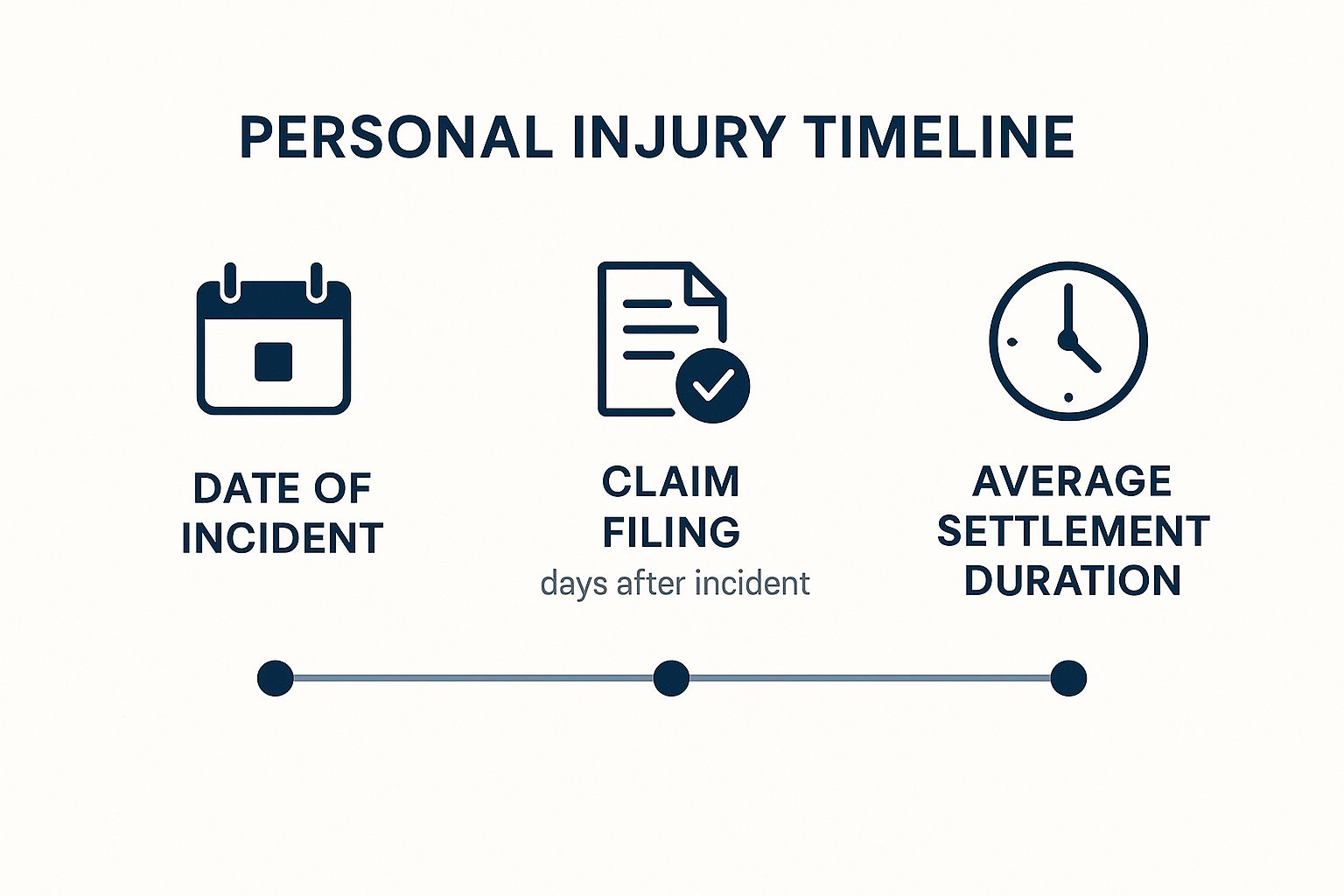
As you can see, the process isn't instant. It moves from the incident itself through filing a claim and then into a settlement period that can take time. Patience is truly a virtue here.
Understanding the Scale of Personal Injury Claims
The need for a clear timeline becomes even more apparent when you look at the numbers. In 2023, the personal injury law market in the U.S. was valued at a staggering $57 billion. That same year, private industry employers reported around 2.6 million nonfatal workplace injuries. These figures show just how frequently people find themselves needing to take legal action to get the compensation they deserve. You can learn more by exploring these personal injury statistics and what they mean for claimants.
To give you a step-by-step look at what your journey might entail, the table below breaks down the key stages of a personal injury claim. Think of this as your roadmap—it details what happens in each phase, why it's important, and a realistic timeframe. Having this overview can help you feel much more prepared for what's to come.
Key Stages of Your Personal Injury Claim
| Stage | Key Activities | Estimated Timeline |
|---|---|---|
| 1. Incident & Medical Care | Seeking immediate medical treatment, reporting the incident, preserving initial evidence (photos, witness info). | Immediate (First 72 Hours) |
| 2. Legal Consultation | Finding and hiring a personal injury attorney to evaluate your case and guide you. | First 1-2 Weeks |
| 3. Investigation & Evidence | Attorney gathers police reports, medical records, employment records, and expert opinions. | 1-4 Months |
| 4. Demand & Negotiation | Attorney sends a demand letter to the at-fault party's insurer; negotiations for a settlement begin. | 2-6 Months |
| 5. Filing a Lawsuit | If no settlement is reached, a formal lawsuit is filed with the court to begin litigation. | Within the Statute of Limitations |
| 6. Discovery Phase | Both sides exchange information through interrogatories, depositions, and requests for documents. | 6-12 Months (or more) |
| 7. Mediation & Settlement | A neutral third party helps facilitate a settlement before trial; most cases resolve here. | 1-3 Months |
| 8. Trial & Resolution | If no settlement is reached, the case is presented before a judge or jury for a final verdict. | Varies (can add 1-2 years) |
As you can see, each stage has its own timeline and set of goals. While most claims settle out of court, knowing the full process ensures you're ready for every possibility.
Navigating the First 72 Hours After an Injury

The first few days after an accident are a blur, but the steps you take during this crucial window can make or break your entire personal injury claim. Think of these initial 72 hours as laying the foundation for your case. Your health is priority number one, of course, but the evidence is also at its freshest. What you do right now directly shapes the outcome down the road.
First things first: get checked out by a doctor. This is non-negotiable. Even if you think you’ve just been shaken up, some serious injuries—like concussions or internal damage—don't always announce themselves immediately. Waiting not only gambles with your health, but it also hands insurance companies a ready-made excuse to argue that your injuries aren’t related to the accident at all.
A documented medical visit creates an official, time-stamped record linking your injuries directly to the incident. This single piece of evidence is one of the most powerful tools in your personal injury timeline, shutting down potential disputes before they start.
Once you know you're medically stable, your next mission is to preserve the scene. This is your only opportunity to capture the environment exactly as it was when the injury happened.
Your Accident Scene Checklist
Your smartphone is your best friend in this moment. Before anything is moved or cleaned up, use it to document everything.
- Take tons of photos and videos. Get every angle you can think of. Snap pictures of the vehicle damage, your visible injuries, the road conditions, nearby traffic signs, skid marks—anything that helps tell the story.
- Talk to witnesses. Did anyone see it happen? If so, get their name and number. An unbiased account from a third party is incredibly powerful.
- Make it official. For a car accident, call the police and get a report filed. If you were hurt at work, notify your supervisor right away. This creates a formal record of the incident.
For a more detailed breakdown of what to do on-site, this guide on what to do immediately after a car accident is an excellent resource to have bookmarked.
Why Acting Fast Matters
So, why the rush? Because memories get fuzzy and physical evidence disappears. An insurance adjuster's primary job is to protect their company's bottom line by paying out as little as possible. If you wait days to see a doctor or don't have photos from the scene, they will use it against you.
They’ll plant seeds of doubt, suggesting your injuries could have happened later or that the accident wasn't that bad. By gathering solid proof from the very beginning, you're building a fortress around your claim. You're not just telling them what happened; you're showing them with concrete, undeniable evidence captured in the heat of the moment. This sets a strong, proactive tone for the entire claims process.
Building Your Case with Strong Documentation
After you've handled your immediate medical needs, the focus of your personal injury claim shifts. You move from crisis mode to a more deliberate, methodical stage: building the factual backbone of your case. Think of it like this: your story is the blueprint, but the documents you gather are the steel beams and concrete that make it unshakable.
This is where you translate your pain, your missed work, and your overall disruption into cold, hard proof. It isn't about just grabbing a random stack of papers. It's about carefully constructing a detailed narrative that leaves no room for doubt in an insurance adjuster's mind. The goal is to hand them a file so complete they can't help but see the full picture of what this injury has cost you.
Gathering Your Medical Evidence
The absolute cornerstone of your case is your medical history from the moment the accident happened. These records tell the official story of your injuries and recovery, and they're written by the undisputed experts: your healthcare providers.
Make sure your file is packed with:
- Complete Medical Records: This means getting everything. Request all the notes, reports, and charts from every single doctor, specialist, physical therapist, and hospital you’ve seen since the injury.
- All Medical Bills: Don't miss a single one. Collect every invoice, from the ambulance ride and ER visit to prescriptions and ongoing physical therapy sessions. Every dollar counts.
- Diagnostic Imaging Results: Get copies of any X-rays, MRIs, or CT scans. These images provide powerful, visual proof of what’s going on inside your body.
Having a full set of these documents is non-negotiable. They are the primary way you'll connect the accident to your injuries and prove the very real costs of your treatment.
Documenting Financial and Other Losses
A serious injury impacts far more than just your body; it hits your wallet, too. To get the compensation you truly deserve, you have to prove every single financial ripple effect the injury has caused. It’s time to look beyond the obvious and document everything.
Think of yourself as a financial detective examining your own post-injury life. You'll need to collect:
- Proof of Lost Income: This is crucial. Gather recent pay stubs, W-2s, and ask your employer for a letter confirming the exact dates you couldn't work. If you're self-employed, your tax returns and client invoices will do the job.
- Police or Incident Reports: This is the official, third-party account of what happened. An insurance adjuster will almost always ask for this report first.
- Repair Estimates and Invoices: Was your car or other property damaged? Keep every estimate, repair receipt, and even the bills for a rental car you needed.
- A Personal Injury Journal: This is your story, in your own words. Every day, jot down notes about your pain levels, your emotional state, and the simple things you can no longer do. This journal is incredibly valuable for putting a number on your pain and suffering, which is a major part of any claim.
While overall accident fatalities have dropped over the last century, preventable deaths haven't followed the same trend. This underscores the fact that many injuries, from falls to workplace accidents, still happen even when safety measures are well-known. Your detailed documentation helps show that your injury was one of these preventable events. You can see more about these historical trends in preventable fatalities.
This meticulous evidence-gathering is a big reason why many people decide to bring in an attorney at this point. A good lawyer knows precisely what's needed to build a rock-solid case. They can take over the process of officially requesting records, making sure nothing gets missed, and organizing it all into a persuasive demand package.
Taking this step now can dramatically strengthen your negotiating position later. It stops the insurance company from lowballing your claim and sets you up for a much fairer settlement.
The Investigation and Negotiation Process

After you've pulled together all your initial paperwork, the personal injury timeline shifts gears. This is where the real action begins. Your claim starts to transform from a simple stack of files into a solid, persuasive case that’s ready to be presented.
You can think of this stage in two parts. First, we build your case with rock-solid evidence. Then, we use that evidence to strategically negotiate the best possible outcome for you.
Proving Fault and Building Your Case
This is the detective work phase. Your legal team will dig much deeper than the documents you've already gathered. Their job is to independently confirm the facts, hunt down any missing pieces of the puzzle, and construct an airtight argument that proves the other party was responsible for your injuries. Legally, this is all about proving liability, which is just a formal way of saying "fault."
An attorney's investigation is thorough and proactive, aiming to get ahead of any arguments the insurance company might try to make later on.
This investigative work often involves a few key steps:
- Analyzing the Evidence: Every single piece of evidence gets a second look. Your team will pore over the police report, witness statements, and your medical records to find the connections that prove your case.
- Bringing in the Experts: For more complicated accidents, your attorney might hire an accident reconstructionist to show exactly how a crash happened. They may also consult with medical specialists who can explain the full, long-term impact of your injuries.
- Digging for More Proof: This is where we uncover things others might miss, like pulling traffic camera footage, checking a commercial truck driver's logbooks, or finding a business's maintenance records to show they were negligent.
Depending on how complex your situation is, this deep dive can take anywhere from one to four months. The entire goal is to build a story so compelling that the other party's responsibility is undeniable.
Crafting the Demand Letter
Once the investigation is wrapped up, all that powerful evidence is organized into a formal document known as a demand letter. This is far more than just a quick note asking for money. It's a detailed legal document that lays out the facts, proves liability, breaks down every single one of your damages, and formally demands a specific settlement amount.
The demand letter is your opening move in the negotiation chess match. It sets the tone for everything that follows and tells the insurance company you have a serious, well-supported claim that you’re ready to fight for.
After the demand letter is sent, the insurance company usually has a set timeframe, often 30 days, to review everything and prepare a response. Their reply officially kicks off the negotiation process—a strategic back-and-forth that requires a ton of patience and skill.
The Art of Negotiation
This is where having a seasoned pro in your corner really makes a difference. Insurance adjusters are trained negotiators, and their primary goal is to pay out as little as possible. They have a playbook of tactics they use, like making a quick, lowball offer right out of the gate or questioning whether your medical treatments were truly necessary.
An experienced lawyer sees these moves coming a mile away and knows exactly how to counter them with the facts and evidence collected earlier. This exchange can go on for several rounds, with offers and counteroffers flying back and forth. This part of the timeline can last from one to three months, sometimes longer. It’s a delicate dance of pushing for what you deserve while also knowing when an offer is fair enough to accept.
Here are a few common tactics from the insurance adjuster’s playbook to watch out for:
- The Quick, Low Offer: They’ll offer you a fast payout, hoping you’re stressed about money and will take a small fraction of what your claim is actually worth.
- Disputing Your Medical Bills: They may argue that some of your care was "excessive" or claim it wasn't related to the accident at all.
- Shifting the Blame: A classic move is to try and pin some of the fault on you, which would reduce the amount they are required to pay.
Your attorney's job is to systematically dismantle these arguments using the mountain of evidence gathered during the investigation. Having a professional negotiator handling this ensures you aren't backed into a corner or pressured into taking an unfair deal. This is a critical stage, as the vast majority of personal injury cases are successfully settled here, without ever needing to go to court.
Filing a Lawsuit and Navigating Discovery
So, what happens if the insurance company’s offer is just plain unreasonable, or they deny your claim outright? It’s easy to feel like you’ve hit a wall, but this is often just the next strategic step in the process. This is where filing a lawsuit comes into play.
When most people hear the word "lawsuit," they immediately picture a dramatic courtroom battle from a movie. The reality is usually quite different. Filing a lawsuit is less about going to trial and more about gaining the leverage needed to bring the other side to the negotiating table seriously. It’s a powerful signal that you’re not backing down. In fact, the overwhelming majority of personal injury cases that are filed still settle long before a judge or jury ever gets involved.
Filing the suit officially kicks off one of the most critical stages in the entire timeline: discovery.
What Is the Discovery Process?
Think of discovery as the point in a card game where everyone has to show their hand. Up until now, your lawyer has been running their own investigation behind the scenes. Now, the process becomes formal, court-supervised, and mandatory for both sides.
This isn't about ambushing each other in court; it's the exact opposite. Discovery is designed to make sure there are no surprises by forcing both parties to share all the information and evidence they have. This is where all the facts—the good, the bad, and the ugly—get laid out on the table. For an insurance company, seeing the full strength of your case in black and white often makes settling look like a much better option.
Be prepared, though—this phase isn't quick. Discovery can easily take six to twelve months, and in more complicated cases, it can stretch even longer.
Key Tools Used in Discovery
During the discovery phase, your attorney and the defense lawyer will use a few standard legal tools to get information from one another. Your lawyer will guide you through this, as you'll almost certainly need to participate.
The three main tools you’ll encounter are:
-
Interrogatories: These are simply written questions sent to the other side, which must be answered in writing and under oath. For instance, the defense might ask you to list every doctor you've seen since the accident. Your lawyer, in turn, might ask the at-fault driver to provide their cell phone records from around the time of the crash.
-
Requests for Production of Documents: This is a formal demand for physical documents and records. Your legal team might request maintenance logs for the truck that hit you or the company’s internal safety policies. The defense will ask for your medical records, pay stubs to prove lost wages, and other paperwork that backs up your claim.
-
Depositions: This is probably the most well-known part of discovery. A deposition is basically sworn testimony given outside of the courtroom. You, the other party, and important witnesses will be questioned by the opposing lawyer while a court reporter transcribes everything that’s said. It gives lawyers a preview of how a witness will hold up under pressure.
A deposition is a make-or-break moment. It's a chance for your attorney to lock the defendant into their version of events and for you to clearly show how this injury has turned your life upside down. Honest, compelling testimony here can dramatically increase the value of your case.
This intense, fact-finding stage is what builds the foundation of your legal strategy. It's interesting to look at the bigger picture here. For a long time, from 1973 to 1992, society made huge strides in safety, and preventable deaths dropped by a third, thanks to things like safer cars. But lately, we've seen a shocking 157% jump in these deaths, driven by new problems like the opioid crisis and an aging population. This just goes to show that even with past progress, serious injuries are a constant threat, making the discovery process more important than ever for proving fault. You can see a more detailed breakdown of these modern personal injury challenges and statistics.
Ultimately, the facts dug up during discovery are what force a resolution. Once all the cards are on the table, the true value of a claim becomes much harder to deny, pushing both sides back to the negotiating table to get the case settled.
Reaching a Settlement or Preparing for Trial

We've now arrived at the point where all the hard work of gathering evidence and negotiating comes to a head. This is where your case will either resolve with a settlement or head toward a courtroom.
The good news? Most personal injury claims never actually go to trial. In fact, well over 90% of cases are resolved through a settlement agreement. It's the most common outcome by a long shot.
Think of a settlement as a formal compromise. The insurance company for the at-fault party agrees to pay you a lump sum. In return, you agree to drop the lawsuit and release them from all future liability for your injuries. Both sides get certainty and avoid the high costs and unpredictable nature of a trial.
The Path to Settlement
Just because a lawsuit has been filed doesn't mean the talking stops. If anything, settlement negotiations often ramp up at this stage.
A popular and highly effective tool used to get a deal done is mediation. This is a structured negotiation where a neutral third-party mediator steps in to help you, your attorney, and the defense team find some common ground. The mediator’s only job is to guide the conversation and help break any logjams—they don't take sides or force anyone to agree.
Mediation provides a confidential, less formal setting to hash things out, and it’s amazing how many cases that seem deadlocked find a resolution here.
If the talks are successful, your attorney will draft the settlement agreement, which is the final, legally binding contract that lays out every detail of the deal.
Think of the settlement agreement as the official finish line. It locks in your compensation, ends the stress of the legal fight, and lets you close this chapter for good so you can focus entirely on your health and future.
What Happens After a Settlement Is Reached?
Once you sign the dotted line, the insurance company will send the settlement check to your attorney's office. Your lawyer is required to hold these funds in a special trust account before distributing them.
Before you receive your portion, your attorney will settle any outstanding costs related to your case. This typically includes:
- Legal Fees: The contingency fee you agreed to with your attorney.
- Case Costs: Reimbursing the law firm for expenses they covered, like court filing fees or paying for expert witnesses.
- Medical Liens: Paying off any doctors or hospitals who treated your injuries and were waiting for the case to resolve.
After these obligations are squared away, the remaining money is yours. That final payment officially concludes your personal injury claim.
When a Trial Becomes Necessary
So, what about that small percentage of cases that just can't find a middle ground? If the insurance company simply refuses to offer a fair settlement, your case will proceed to trial. This is the most formal part of the entire process, governed by strict rules and procedures.
While every trial is unique, they all follow a predictable sequence of events:
- Jury Selection: Choosing the citizens who will hear the case.
- Opening Statements: Both attorneys lay out their version of the facts.
- Presenting Evidence: This is where witness testimony and documents are shown to the jury.
- Closing Arguments: The final chance for each side to argue their case.
- Jury Deliberation and Verdict: The jury decides the outcome.
Whether your case ends with a handshake on a settlement or a verdict from a jury, the ultimate goal is the same: getting you the financial support and justice you deserve. Knowing how both paths work ensures you're ready for whatever comes next.
Common Questions About the Injury Claim Process
Going through the personal injury claims process naturally brings up a lot of questions. Getting straight answers can give you a real sense of control and clarity when you need it most. Let's walk through some of the questions we hear all the time from people just like you.
How Long Does a Personal Injury Case Really Take?
Honestly, there's no single timeline that fits every case. A straightforward claim—where the fault is obvious and the injuries are minor—might wrap up in a few months. But for more complicated situations, especially those with serious injuries or where the other party is fighting liability, it's not unusual for a case to take one to two years to resolve. If it has to go all the way to a trial, the clock keeps ticking.
I often tell clients to think of it like a construction project. A simple pre-fab shed goes up fast. A large, custom-built home with complex architecture and high-end finishes? That's going to take a lot more time and care to get right. The goal isn't speed; it's building a solid case that gets you the compensation you deserve.
What Factors Can Delay My Claim?
Several things can pump the brakes on your claim's timeline. Knowing what these are ahead of time can help you set realistic expectations from the get-go.
- Arguing Over Who's at Fault: If the other side refuses to accept responsibility, your lawyer has to dig in and prove it. That means gathering more evidence, tracking down witnesses, and building an airtight argument, all of which takes time.
- Serious or Long-Term Injuries: When you're dealing with significant injuries, it’s actually wise to wait until you’ve reached what’s called Maximum Medical Improvement (MMI). This is the point where your doctors have a clear picture of your long-term prognosis. Settling before you reach MMI is a huge gamble because you won't know the full cost of your future medical needs.
- A High-Value Claim: The more money on the line, the harder the insurance company will fight. They'll scrutinize every single detail, looking for any reason to reduce what they have to pay out. This almost always leads to a longer negotiation process.
- Uncooperative Insurance Companies: Let's be blunt: some insurance adjusters use delay tactics as a negotiation strategy. They hope that by dragging things out, you'll get frustrated and cave, accepting a lowball offer just to be done with it.
It's crucial to understand that a delay isn't automatically a bad sign. Sometimes, taking that extra time is exactly what's needed to fully document your injuries and build the strongest possible case. A fair outcome is worth the wait.
What Is the Statute of Limitations?
The statute of limitations is a legal countdown timer. It's a state law that dictates the absolute final deadline for filing a lawsuit after you've been injured. This deadline changes depending on where you live and the specifics of your case.
Here in Virginia, for example, most personal injury cases have a two-year statute of limitations from the date of the incident. If you miss that window, your right to seek compensation is almost certainly gone forever. It’s one of the most unforgiving rules in the legal system.
Can I Still Have a Case If I Was Partially at Fault?
This is a great question, and the answer completely depends on your state's laws. The legal rules at play here are comparative negligence and contributory negligence.
Some states, like Virginia, follow a very strict rule called "pure contributory negligence." This means if you are found to be even 1% at fault for the accident, you can be completely blocked from recovering any money at all. It’s incredibly harsh.
Thankfully, most other states use a "comparative negligence" model. Under this system, you can still recover damages even if you share some of the blame. Your final award is just reduced by your percentage of fault. For instance, if you were found to be 20% responsible in a case that resulted in a $100,000 award, you would receive $80,000. A good lawyer will know your state's rules inside and out and can advise you on how it impacts your case.
At Homefront Group, we know that dealing with the legal system after an injury can be overwhelming, particularly for our nation's veterans and first responders. If you've been hurt and aren't sure what to do next, our team is here to help you understand your rights and options. Take our free 3-minute quiz today to see how we can help you get the support you deserve.