

Cracking the Nexus Letter Code: What VA Raters Actually Want

Securing VA disability benefits often depends on proving a connection between your current health condition and your military service. This is where the nexus letter plays a vital role. A nexus letter is a medical opinion that bridges this critical gap, providing essential evidence for VA raters. However, submitting just any nexus letter isn't sufficient. Understanding what VA raters look for is crucial for a successful claim.
One key element is credibility. VA raters carefully examine the qualifications and expertise of the medical professional who authors the letter. They look for demonstrated experience and knowledge relevant to your specific condition. Choosing the right medical professional is therefore essential.
Additionally, specificity is vital. Vague statements about your condition won't be persuasive. The nexus letter must detail your military service, outlining the specific stressors or incidents that likely contributed to your health issues. For instance, if you're claiming Post-Traumatic Stress Disorder (PTSD), the letter should describe the traumatic events you experienced and how they connect to your present symptoms.
Furthermore, a strong nexus letter incorporates compelling medical reasoning. It goes beyond simply stating a diagnosis, providing a clear, logical, evidence-based explanation of the link between your military service and your current condition. This might involve citing medical research or referencing similar cases.
The Growing Importance of Nexus Letters
Over the past decade, nexus letters have become increasingly important in VA disability claims. These letters are key to establishing service connection for veterans. As of 2022, the VA processed over 1.3 million disability claims annually, highlighting the significant role nexus letters play. Effective nexus letters significantly increase the likelihood of approval by providing the necessary medical evidence. You can find more detailed statistics at Valor4Vet.
Finally, using the correct terminology is crucial. The phrase "at least as likely as not" is significant in the VA system. This phrase indicates a 50% or greater probability of service connection. Including this specific language demonstrates that your claim meets the VA’s evidentiary requirements. Meticulous attention to detail, from choosing the right medical professional to using precise terminology, is essential for obtaining VA approvals and presenting a persuasive case for your benefits.
The Anatomy of Winning Nexus Letter Formats
Behind every successful VA claim lies a meticulously crafted nexus letter. This critical document isn't simply a formality; it's the bridge connecting your current condition to your time in military service. Understanding the key elements of a winning nexus letter format can significantly influence your claim's success.
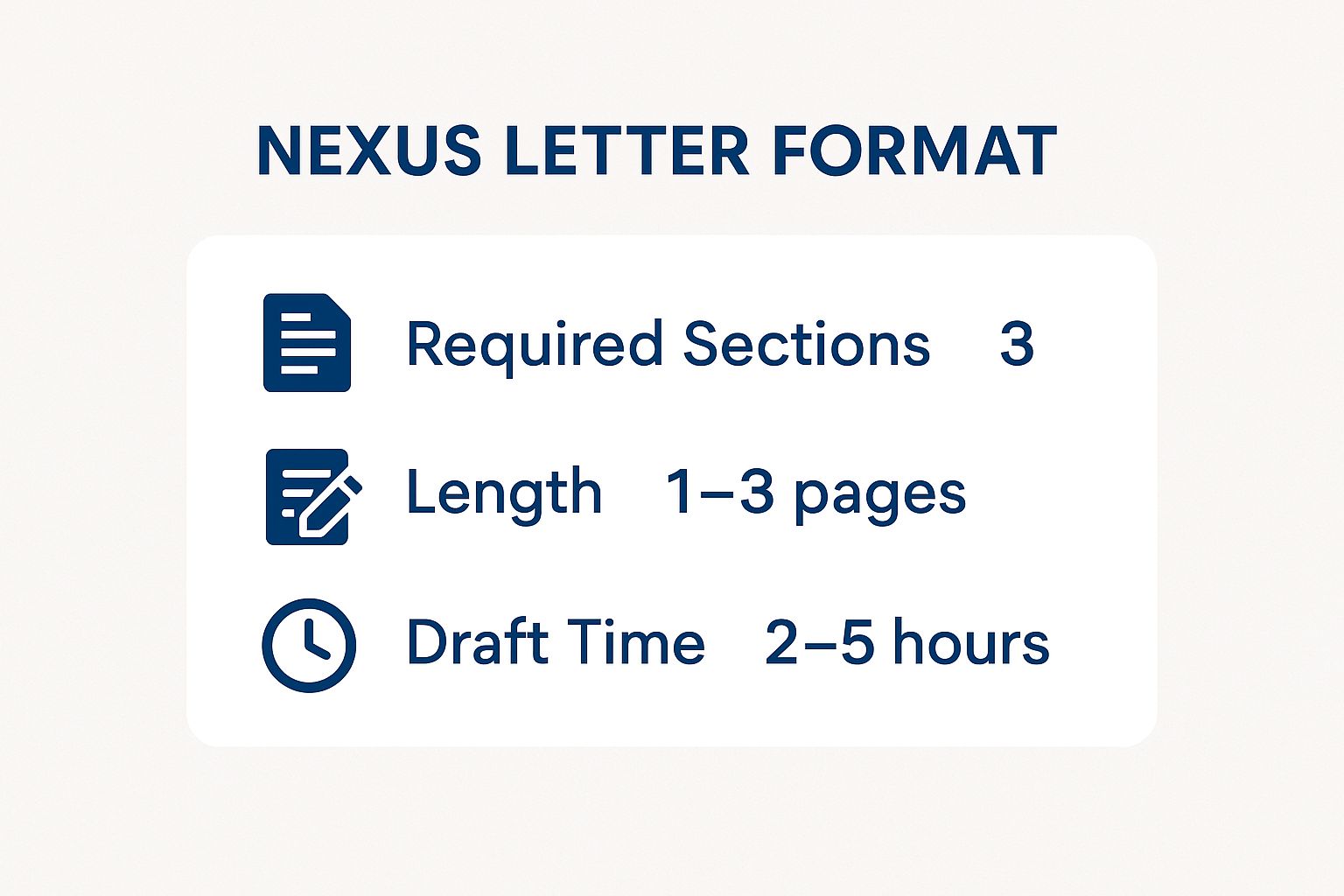
The infographic above provides a visual overview of key metrics related to nexus letter formatting: the necessary sections, typical length (1–3 pages), and estimated drafting time (2–5 hours). This underscores the importance of presenting comprehensive information concisely and efficiently.
Essential Components of a Winning Nexus Letter
A winning nexus letter follows specific guidelines to maximize its impact. These guidelines ensure clarity, bolster credibility, and ultimately, increase the chances of approval. Think of a strong nexus letter format like a well-built house: each component plays a vital role in supporting the overall structure.
-
Clear Diagnosis: The letter should begin with a clear and concise diagnosis of your condition, using established medical terminology and the corresponding ICD-10 code. This sets the foundation for your claim.
-
Service Connection Explanation: This section details precisely how your military service led to your current condition. It requires a thorough explanation linking specific incidents, exposures, or stressors to the diagnosis. For instance, if you're claiming respiratory issues, you should explicitly link them to exposure to burn pits during deployment. Similarly, neurological symptoms could be connected to a traumatic brain injury sustained in service.
-
Medical Rationale: This section provides the medical reasoning that supports the service connection. This includes relevant medical evidence, research, and studies. It's crucial to explain not only how your service led to your condition, but also why, providing a strong medical basis for your claim.
To help veterans and medical professionals ensure they are including all the necessary information, we've compiled a checklist of essential components.
The table below, "Essential Nexus Letter Components Checklist," provides a comprehensive overview of the required and recommended elements for a properly formatted nexus letter. This checklist serves as a valuable tool for ensuring that your nexus letter includes all the necessary information to support your VA claim effectively.
| Component | Purpose | Example/Format | Importance Level |
|---|---|---|---|
| Clear Diagnosis | Establishes the medical basis of the claim | Condition name, ICD-10 code (e.g., Post-traumatic Stress Disorder, F43.10) | Required |
| Service Connection Explanation | Details how military service contributed to the condition | Description of relevant incidents, exposures, or stressors (e.g., combat exposure, chemical exposure) | Required |
| Medical Rationale | Provides medical reasoning supporting the service connection | Relevant medical evidence, research studies, and explanations of the causal link | Required |
| Medical Professional's Credentials | Establishes the credibility of the author | Full name, license number, specialization | Required |
| Contact Information | Allows VA to contact the medical professional for clarification | Phone number, email address, mailing address | Required |
| Date | Indicates when the letter was written | MM/DD/YYYY | Required |
| Signature | Authenticates the letter | Signed by the medical professional | Required |
| Veteran's Information | Identifies the veteran making the claim | Full name, date of birth, social security number | Required |
| Military Service History | Provides context for the claim | Branch of service, dates of service, unit assignments | Recommended |
| Supporting Documentation | Strengthens the claim | Medical records, service records, personal statements | Recommended |
This checklist helps ensure all key elements are present, increasing the likelihood of a successful claim. By including all required components and considering the recommended elements, veterans can create a more comprehensive and persuasive nexus letter.
The Power of Precise Language and Formatting
The way a nexus letter is formatted is crucial for its effectiveness. The optimal format includes a clear diagnosis, a detailed explanation linking the condition to military service, and a strong medical rationale backed by evidence. For example, when claiming sleep apnea, referencing studies linking sleep disorders to military stressors can significantly strengthen your claim. Learn more about nexus letter formats. Using specific language like "at least as likely as not" ensures your letter aligns with the VA's standards.
Formatting for Clarity and Credibility
Beyond the content itself, the presentation of your nexus letter is paramount. A professional, easy-to-read format enhances credibility. Here are some essential formatting best practices:
-
Professional Letterhead: Using professional letterhead displaying the medical professional's credentials immediately establishes their authority and trustworthiness.
-
Clear and Concise Language: Avoid complex medical jargon. Use clear, concise language that is easy for a layperson to understand. This ensures the VA rater can easily comprehend the connection between your service and your condition.
-
Proper Citations: When referencing medical studies or research, use proper citations to reinforce your argument.
-
Organized Structure: Use headings and subheadings to organize the letter into logical sections, making it easier to follow and understand.
By following these formatting guidelines, you present a compelling and credible argument, maximizing the chances of a favorable outcome for your VA claim. A well-structured and well-written nexus letter is a crucial investment in your future well-being.
Crafting Medical Opinions That Actually Convince VA Raters

The core of a successful nexus letter lies in its persuasive medical reasoning. It’s not enough to simply state a diagnosis. The letter must convincingly link the veteran's current condition to their military service. This requires more than just medical jargon. It demands a clear, logical argument that VA raters find irrefutable. This means moving beyond generic medical statements and crafting compelling narratives that resonate with the raters evaluating the claim.
Building a Persuasive Medical Argument
Imagine a veteran claiming hearing loss. A generic statement might simply mention the diagnosis. However, a compelling argument would detail the veteran’s exposure to loud noises during service, such as artillery fire or aircraft engines. It would explain how that exposure likely caused the hearing loss. This demonstrates a direct link, creating a stronger case for service connection.
Additionally, incorporating relevant medical literature further bolsters the argument. Studies linking noise exposure to hearing loss, for example, can provide strong support. However, it's important to present this information concisely. Avoid overwhelming the reader with technical details.
Furthermore, a persuasive nexus letter anticipates potential counterarguments. For instance, if the veteran also worked in a noisy civilian job, the letter should address this. Explaining why military service is the more likely cause of the hearing loss demonstrates thoroughness and strengthens the overall argument.
The Power of Persuasive Language and Real-World Examples
This attention to detail separates successful claims from denied ones. A well-crafted nexus letter not only presents the facts but also frames them to highlight the service connection. Understanding the structure of a strong letter is key, much like the anatomy of a good business testimonial letter.
For example, showcasing before-and-after examples of medical rationales can be highly persuasive. Demonstrating how a revised nexus letter led to a successful claim after an initial denial provides a concrete example of the letter's impact. Additionally, clear, concise language enhances readability and understanding. This makes the rater's job easier and increases the chances of a favorable outcome.
This is where the nexus letter format becomes crucial. A well-organized and formatted letter adds to its overall credibility. A well-crafted nexus letter can significantly enhance the likelihood of a successful VA claim. In fact, between 2015 and 2020, the overall disability compensation success rate improved by about 8%, partly attributed to better documentation like nexus letters. Find more detailed statistics here. The inclusion of relevant medical studies and past Board of Veterans' Appeals (BVA) decisions further strengthens the claim. Ultimately, a persuasive medical rationale, supported by clear evidence and presented in a compelling nexus letter format, is crucial for convincing VA raters and securing the benefits veterans deserve.
The Magic Words: Language That Unlocks VA Approvals

The difference between approved and denied VA disability claims often comes down to the language used in the nexus letter. While medical facts form the foundation of a claim, how these facts are presented significantly influences a VA rater's decision. This section explores the importance of precise terminology and how it can significantly improve your chances of VA approval.
The Power of "At Least As Likely As Not"
The phrase "at least as likely as not" holds significant weight in the VA claims process. This language indicates a 50% or greater probability that a veteran's current disability is connected to their military service. This threshold is the VA's standard for establishing service connection. Using this specific phrase demonstrates that your claim meets this critical requirement.
For example, a nexus letter clearly stating, "It is at least as likely as not that the veteran's tinnitus is due to their exposure to artillery fire during service," directly addresses the VA's evidentiary standard and leaves no room for ambiguity. This clarity is essential for a successful claim.
Choosing the Right Words for a Stronger Claim
While "at least as likely as not" is essential, other strong terms can further bolster your nexus letter. "More likely than not" indicates a greater than 50% probability, strengthening the asserted service connection. Including specific medical terminology, such as referencing relevant ICD-10 codes, reinforces the medical basis of your claim and adds to its credibility. Supporting your assertions with relevant medical research further solidifies your case.
Conversely, vague language can undermine even a well-supported claim. Avoid terms like "possible," "may be related," or "could be due to." These phrases introduce doubt and weaken the link between the veteran's condition and their military service. A statement like, "The veteran's back pain may be related to their service," lacks the necessary certainty required for VA approval.
To illustrate the impact of language choice, let's consider a few examples. The table below compares effective and ineffective terminology and how these choices can affect the outcome of a VA claim.
Nexus Letter Terminology Comparison: A comparison of effective vs. ineffective language choices in nexus letters and their potential impact on VA claims.
| Recommended Terminology | Terminology to Avoid | Impact on Claim |
|---|---|---|
| "It is at least as likely as not that…" | "It is possible that…" | Clearly establishes service connection vs. weak assertion |
| "The veteran's condition is more likely than not due to…" | "The veteran's condition could be related to…" | Presents a higher probability vs. introduces uncertainty |
| "Medical evidence strongly suggests…" | "There may be a connection between…" | Conveys confidence in the connection vs. vague speculation |
As this table demonstrates, subtle wording changes can significantly impact a claim's outcome. Choosing precise and confident language strengthens the connection between the veteran's condition and their service, increasing the likelihood of approval.
The Impact of Precise Language on VA Decisions
Analyzing successful and denied claims reveals a clear pattern: precise, assertive language, coupled with comprehensive medical evidence, significantly influences VA decisions. By understanding the nuances of terminology and working with medical professionals experienced in writing nexus letters, veterans can significantly improve their chances of receiving the benefits they deserve. A strong nexus letter clearly and convincingly presents the case for service connection, ultimately helping veterans secure the support they have earned.
Finding Your Perfect Medical Advocate
Securing a strong nexus letter often depends on choosing the right medical professional. This advocate needs to understand the complexities of the VA system and effectively link your current condition to your military service. This section explores how successful veterans find and work with medical professionals who can significantly impact their VA claims.
Identifying Doctors Familiar With the VA System
Finding a doctor who understands the specific requirements of a nexus letter is essential. This goes beyond medical expertise; they need to know how to present that expertise to VA raters. Look for professionals with experience writing these letters or who demonstrate a solid understanding of VA disability claims. Veterans Service Organizations (VSOs) or online veteran support communities can be valuable resources.
Discussing Nexus Letters With Your Doctor
Approaching the conversation about a nexus letter requires thoughtful preparation. Be direct about your needs and provide all relevant medical and military service records. Clearly explain the letter's purpose and its importance to your VA claim. A concise summary of your service history and current condition can streamline the process. The more organized your information, the better your doctor can understand your situation and advocate effectively.
Overcoming Obstacles and Considering Alternatives
Some medical professionals might be hesitant or unfamiliar with nexus letters. If you encounter resistance, explain the letter's significance and offer resources like the nexus letter format template. Consider an Independent Medical Examiner (IME) as an alternative. While IMEs can be expensive, they often specialize in VA disability evaluations.
Specialists Versus Primary Care Providers
Choosing between a specialist and a primary care provider depends on your condition. For complex conditions, a specialist's expertise may hold more weight. However, a primary care provider with a long-standing relationship and a thorough understanding of your health history can be equally valuable. This established relationship can lend credibility, as highlighted by experts at the Eisenberg Law Office.
Building Relationships and Seeking Expert Advice
A strong relationship with your medical advocate is crucial. Open communication and collaboration are essential throughout the claim process. Just as a legal team prepares a case, your medical team helps build a solid claim. A nexus letter is an investment in your future. A comprehensive client onboarding checklist can help prepare your advocate. If you need further guidance, a veterans’ benefits attorney can offer valuable insights and help you find the right medical advocate for your situation.
Avoiding the Format Mistakes That Sink VA Claims
A compelling medical opinion, presented clearly in a well-formatted nexus letter, can significantly impact the success of a VA claim. However, even minor formatting errors can weaken a strong medical argument. This section explores common formatting issues that can negatively affect VA claims and provides practical strategies for creating a successful nexus letter.
The Importance of First Impressions
The first impression your nexus letter makes is critical. A disorganized or unprofessional presentation can create immediate doubt in the VA rater's mind. Just like a job interview requires professional attire, your nexus letter needs a polished presentation.
-
Professional Letterhead: Use official letterhead, clearly displaying the medical professional’s name, credentials, contact information, and practice address. This establishes immediate credibility. Missing or incomplete letterhead information can raise concerns.
-
Date and Signature: Include the date and the medical professional's original signature for authentication. A missing date or an unsigned letter can invalidate the document. Avoid using digital signatures or stamps.
Presenting Medical Credentials Effectively
Clearly presenting the medical professional's credentials is essential. VA raters need to quickly understand the author's qualifications and area of expertise.
-
Credentials and Specialization: Clearly state the medical professional’s degrees, licenses, and board certifications. Emphasize any specialization relevant to the claimed condition. For example, a psychiatrist's opinion carries more weight than a general practitioner's for a PTSD claim.
-
Curriculum Vitae (CV): Including a concise CV strengthens the medical professional's credibility, especially for complex or unusual conditions. A CV allows the VA rater to quickly assess the doctor's qualifications and experience.
Structural Elements That Matter
The structure of the nexus letter impacts its clarity and readability. A poorly formatted or disorganized letter can hinder the VA rater's understanding of the medical opinion and its link to your service.
-
Clear and Concise Language: Use clear, concise language that is easy to understand, avoiding complex medical jargon. This helps the VA rater understand the connection between your service and your condition.
-
Organized Sections: Use headings and subheadings to divide the letter into logical sections, improving readability. Headings like "Diagnosis," "Service Connection," and "Medical Rationale" create a clear structure. A client onboarding checklist can help ensure your medical advocate is well-prepared.
-
Proper Citations: If the letter references medical studies or research, include proper citations to support the medical reasoning and enhance credibility.
Quality Control and Revision Strategies
Before submitting, carefully review the nexus letter for any errors. A simple typo or omission can delay your claim.
-
Proofreading: Thoroughly proofread the letter for grammatical errors, typos, and inconsistencies. A polished, error-free document demonstrates professionalism.
-
Checklist: Use a quality control checklist to ensure all necessary components are present and correctly formatted. This checklist should cover letterhead, medical credentials, content organization, and supporting documents.
-
Collaboration with Your Advocate: Work with your medical professional to revise and refine the letter, ensuring accuracy, completeness, and effective presentation of your case.
Securing a well-written and properly formatted nexus letter is crucial for a successful VA claim. By avoiding these common formatting pitfalls, you can improve your chances of receiving the benefits you deserve. Invest the time and effort to get it right. Consider partnering with Homefront Group for expert assistance with your VA claim.