

A medical malpractice statute of limitations is a state law that puts a firm deadline on your right to file a lawsuit if you've been hurt by a healthcare provider. Think of it as a legal countdown. If that clock hits zero before you file, your case is likely over—no matter how strong it might be.
Understanding The Legal Ticking Clock

This time limit isn't just an arbitrary rule. It's a legal concept designed to strike a balance. It gives patients a reasonable window to seek justice after being harmed, but it also shields doctors and hospitals from the lingering threat of decades-old lawsuits.
It’s really a rule of fairness for everyone involved. Over time, evidence gets lost, memories fade, and records can become unreliable. These laws push people to bring claims forward while the details are still fresh, which makes for a more accurate and efficient legal process. Imagine a system clogged with cases from 20 years ago—it would be nearly impossible to figure out what really happened.
Why Every State Is Different
Here's one of the most important things to understand: there is no single, national statute of limitations for medical malpractice. Every state sets its own rules, creating a complex patchwork of deadlines across the country.
In the United States, most states give you between 1 and 3 years to file a claim, but some extend this to six years or more in specific situations. You can dig deeper into these differences by reviewing findings on state-specific legal frameworks. This state-by-state system means your rights and deadlines in Texas will look very different from those in New York.
The bottom line is this: The statute of limitations is an absolute, non-negotiable deadline. If you miss it, you almost certainly lose your right to pursue compensation forever. Acting quickly is non-negotiable.
The Core Concepts You Must Know
Figuring out your deadline isn't as simple as circling a date on the calendar after your procedure. The real question—and often the most debated part of a case—is when the clock actually starts ticking. It all comes down to a few fundamental ideas.
To make sense of it all, let's break down the concepts that determine when the statute of limitations clock starts and stops.
Key Time Limit Concepts at a Glance
| Concept | What It Means for Your Case |
|---|---|
| Date of Injury/Negligence | The clock starts the moment the medical mistake happens. It’s a strict, clear-cut rule. |
| The Discovery Rule | The clock starts when you discover the injury and realize (or should have realized) it was likely caused by medical negligence. |
| Tolling | This is a legal pause button. Certain situations (like the patient being a minor) can temporarily stop the clock from running. |
| Statute of Repose | This is an absolute, final deadline that no exceptions can extend. It’s the ultimate cutoff date, regardless of discovery. |
These concepts are the building blocks for every medical malpractice timeline. Now, let’s look at the two most important ones that determine the start date.
-
Date of the Negligent Act: In some states, the rule is brutally simple: the clock starts the second the error occurs. This is straightforward but can be incredibly harsh, especially if you don't realize you've been injured right away.
-
Date of Discovery: Thankfully, many states have adopted a more forgiving "discovery rule." This rule starts the clock on the date you actually discover—or reasonably should have discovered—both the injury and its connection to your medical care.
This distinction makes a world of difference. For example, if a surgeon accidentally leaves a sponge inside a patient, the negligent act happened on the day of the surgery. But the patient might not feel any pain or discover the problem until a year later. The discovery rule acknowledges this gap and gives the patient a fair chance to take action once they're actually aware of what happened.
How the Discovery Rule Impacts Your Filing Deadline

What happens if a medical mistake harms you, but you don’t realize it until months or even years later? It’s a terrifyingly common scenario, and it’s precisely why the discovery rule exists. This legal principle is a lifeline for patients with injuries that aren't immediately obvious.
Without the discovery rule, the statute of limitations clock would start ticking the moment the negligent act occurred. But that's not always fair. The rule acknowledges a simple reality: you can't be expected to file a claim for an injury you don't even know you have.
Instead, the clock only starts running on the date you discover—or reasonably should have discovered—both the injury and the fact that it was likely caused by medical negligence. Honestly, this is one of the most critical concepts in any malpractice case.
What Does "Reasonable Discovery" Mean?
That phrase, “reasonably should have discovered,” is where things can get tricky. It’s not just about when you personally connected the dots. The law looks at the situation objectively and asks when a sensible person in your shoes would have figured it out.
Let’s walk through a classic example. A patient has abdominal surgery and goes home to recover. A year later, they’re dealing with chronic pain and digestive problems that won't go away. After months of appointments and tests with a new doctor, an X-ray finally reveals a surgical sponge was left inside them.
- Date of Negligent Act: The day the surgery happened.
- Date of Discovery: The day the X-ray showed the sponge.
In this case, the statute of limitations clock would almost certainly start on the date of the X-ray, not the surgery date. It would be completely unreasonable to expect the patient to have known about a hidden surgical tool any sooner.
The discovery rule is all about fairness. It prevents the injustice of your right to sue expiring before you even know you have a reason to.
Proving that discovery date often becomes a major point of contention in a lawsuit. The defense might argue that you should have recognized the symptoms earlier, while your attorney will work to show that you acted reasonably with the information you had at the time.
Proving Your Date of Discovery
To successfully use the discovery rule, you can't just state when you found out about the injury; you have to prove it with evidence. Building a solid timeline is absolutely essential to protecting your right to file a claim.
So, what does that evidence look like? It often includes:
- Medical Records: Notes from other doctors, second opinions, or new tests that officially identified the problem.
- Diagnostic Reports: The X-ray, MRI, or lab results that finally pinpointed the injury and its likely cause.
- Personal Journals: Any detailed notes you kept about your symptoms, pain levels, and conversations with doctors can be surprisingly powerful.
- Communications: Emails or other written correspondence with your healthcare providers about your ongoing concerns.
Think about a misdiagnosis case. The discovery date isn't when you started feeling sick; it’s often the day a second specialist gives you the correct diagnosis and explains how an earlier, accurate one would have led to a better outcome. That second doctor's report becomes the cornerstone of your timeline.
Because this can get so complicated—especially in places like California with a tight one-year deadline from the date of discovery—figuring out your timeline is urgent. Speaking with an attorney early is the best way to ensure you can properly document your discovery date and file your claim well within the medical malpractice statute of limitations. This single date can be the difference between your case moving forward or being dismissed before it ever truly begins.
How State Laws Shape Your Malpractice Claim
When it comes to the time limit for filing a medical malpractice claim, there's no single, national rulebook. Instead, your right to sue is almost entirely governed by the laws of the state where the medical treatment happened. This is a critical point. A deadline in Florida can be vastly different from one in Oregon, creating a patchwork of laws that can feel overwhelming for patients.
Getting a handle on these state-specific rules is the first, most important step you can take to protect your rights. While the fine print varies from state to state, most deadlines fall into a few common categories. Figuring out which category your state uses will give you a solid baseline for understanding the timeline you're working with.
This infographic helps visualize the core concepts that all state laws build upon.
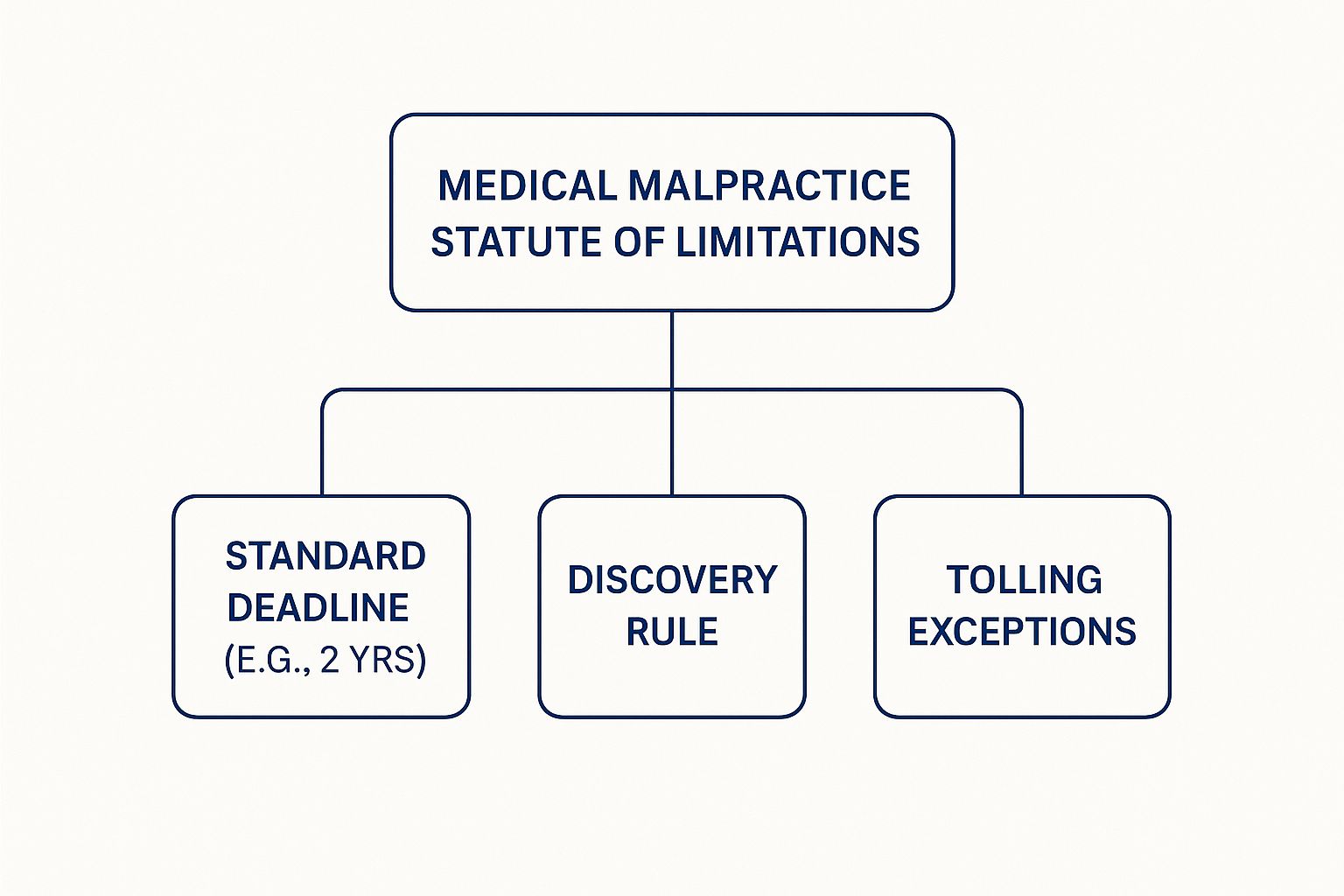
As you can see, the standard deadline, the discovery rule, and any exceptions are all pieces of the same puzzle—the statute of limitations.
Grouping States by General Timelines
To make sense of this legal maze, we can roughly group states based on their general filing windows. Remember, this is just a starting point and not a substitute for real legal advice.
- One-Year States: Some states, like California and Kentucky, have a very tight one-year window. This clock often starts ticking the moment you discover the injury, making it incredibly urgent to act fast.
- Two-Year States: This is the most common timeframe. A large number of states, including Texas, Florida, and Illinois, generally give you two years. The key difference between them is when that clock starts—some from the date of the injury, others from the date of discovery.
- Three-Year States: Places like South Carolina and New York are a bit more generous, offering a three-year period. But even these longer timelines have their own set of conditions and fine print.
These timelines are just the tip of the iceberg. Every state has its own specific rules about what starts the clock and what might pause it. That's why you absolutely must confirm the exact deadline in your jurisdiction.
The Ultimate Deadline: The Statute of Repose
Beyond the standard time limit, many states have a second, much stricter deadline called a statute of repose. Think of it as the ultimate, non-negotiable cutoff. It’s the final day you can file a claim, no matter when you discovered the injury.
A statute of repose is like a hard stop on a stopwatch. While the discovery rule can delay when the clock starts, the statute of repose shuts the entire timer down for good after a certain number of years have passed since the original medical mistake.
For instance, a state might have a two-year statute of limitations but a six-year statute of repose. If you discover an injury five years after a surgery, the discovery rule gives you a year to file. But if you find it seven years later? The statute of repose has already expired, and your right to file a claim is gone for good.
How Different State Rules Play Out
Let's look at a couple of real-world scenarios to see how these rules can make or break a case.
- The Foreign Object Scenario: In South Carolina, if a surgeon leaves an object inside a patient, the victim has two years from the date they discover it to file a claim. However, this is capped by a rigid three-year limit from the date of the surgery itself. If you find the object three years and one day later, your legal options have vanished.
- The Minor Patient Scenario: The rules are often different for children. In California, if a child under six is injured by malpractice, the timeline is extended. The family has until the child's eighth birthday or three years from the incident—whichever provides more time—to file.
These examples drive home just how much your location and individual circumstances matter. The medical malpractice statute of limitations isn't one single rule; it's a complex web of interconnected state laws. Because missing a deadline will permanently bar your case, the only way to truly protect your rights is to speak with a legal expert who knows the specific laws in your state inside and out.
Common Exceptions That Can Extend Your Deadline

Beyond the discovery rule, the legal system has built-in safeguards for situations where filing a claim on time is either unfair or flat-out impossible. These aren't loopholes, but rather specific exceptions where the law essentially hits a pause button on the countdown clock.
This legal concept is called "tolling." Think of it as a timeout in a football game—the game clock stops running because of a specific event on the field. In the legal world, tolling pauses the statute of limitations to protect those who can't protect themselves.
Of course, you can't just claim an exception; you have to prove it with clear and convincing evidence. Let's walk through some of the most common scenarios that might give you more time.
When the Patient Is a Minor
The law recognizes that it's completely unreasonable to expect a child to understand complex legal rights or file a lawsuit. Because of this, the statute of limitations for medical malpractice is almost always paused—or tolled—for minors.
Typically, the clock doesn't even start ticking until the child legally becomes an adult, which is 18 years old in most states. Once they turn 18, the state's standard statute of limitations kicks in.
- For example: Imagine a 12-year-old child is harmed by a surgical error. The legal clock would likely stay paused for six years. On their 18th birthday, if the state has a two-year statute of limitations, they would then have until their 20th birthday to file their claim.
It's important to remember that some states have unique rules. California, for instance, has a specific provision for young children: a claim for a child under six must be filed within three years of the injury or by their eighth birthday, whichever period is longer.
Fraudulent Concealment by a Provider
This is a serious one. This exception comes into play when a healthcare provider doesn't just make a mistake—they actively and intentionally hide it. This goes far beyond a simple failure to disclose; it's about deliberate deception.
If a doctor or hospital knowingly covers up their negligence, the statute of limitations clock is paused until the patient finally discovers the truth. To successfully argue for this exception, you generally need to prove three things:
- The provider was aware they committed malpractice.
- They intentionally concealed that fact from you.
- You were unaware of the malpractice because of their deception, which caused you to miss the filing deadline.
The Bottom Line: Fraudulent concealment changes everything. The issue is no longer about an honest error but about a calculated cover-up. Courts toll the deadline because no one should be able to benefit from their own deceit.
Mental Incapacity of the Patient
If a patient is legally declared mentally incompetent when the malpractice occurs, or if the malpractice itself causes the incapacity, the filing deadline can be paused. This could apply to someone in a coma, a patient with a severe brain injury, or someone with a pre-existing condition like advanced Alzheimer's.
The reasoning here is the same as it is for minors: a person who can't manage their own affairs can't be expected to navigate the legal system. The clock is usually stopped until the patient is declared competent again or until a court appoints a legal guardian to act for them. Proving this requires meeting a very high standard, often with a formal court ruling on the patient's capacity.
While these exceptions provide critical lifelines, it's interesting to see how claim numbers change over time due to legal reforms and public awareness. For instance, in 2023, the National Practitioner Data Bank logged roughly 11,400 medical malpractice payment reports. You can dive deeper into the data and see more medical malpractice statistics and trends to get a fuller picture.
Filing a Claim as a Veteran? Here’s What You Need to Know
If you’re a veteran who has suffered from medical negligence at a VA hospital or another federal facility, it’s crucial to understand that the rules are completely different. State medical malpractice laws don’t apply here. Instead, your claim is governed by a single, powerful federal law: the Federal Tort Claims Act (FTCA).
The FTCA has its own strict, non-negotiable timeline. While state laws vary wildly, the federal government gives you a firm two years from the date you knew—or reasonably should have known—about your injury. Missing this window isn't just a setback; it means losing your right to seek compensation forever.
The federal process has a mandatory first step that, unfortunately, many people miss. Getting this wrong can be fatal to your case.
Your First Move: The Administrative Claim
Before you can even consider filing a lawsuit, the FTCA demands that you file an administrative claim with the right federal agency. For an injury at a VA facility, this means you must file directly with the Department of Veterans Affairs.
This isn't an optional warm-up. It's a required prerequisite, and you cannot go to court without first completing this step.
By far, the most common mistake veterans make is failing to file this administrative claim within the FTCA's two-year statute of limitations. While the clock for a lawsuit is paused during the agency's review, you absolutely must get this initial claim filed on time.
To do this, you'll need to use a specific government form called Standard Form 95 (SF-95). On this form, you’ll lay out the facts of what happened and—this is critical—demand a specific dollar amount for your damages. This is known as a "sum certain."
Sidestepping Common Pitfalls
Navigating the FTCA is like walking through a minefield. Knowing where the most common traps are is your best defense for getting a valid claim heard.
- Blowing the Two-Year Deadline: This is the number one claim-killer. Your SF-95 must be in the hands of the correct federal agency within two years of discovering the harm.
- Forgetting the "Sum Certain": Your SF-95 has to state the exact amount of money you're seeking. You can't just write "more than $1 million." It needs to be a precise number, or your claim will likely be rejected.
- Filing in the Wrong Place: Sending your claim to the wrong federal department can cause deadly delays. It has to go to the agency that employed the person who caused your injury—for a VA doctor, that’s the Department of Veterans Affairs.
For veterans working through this process, properly submitting all the required paperwork is essential. You might find resources on sending documents to the Veterans Administration helpful.
Once you’ve submitted your SF-95, the agency has six months to review your claim and make a decision. If they deny it, or if they simply don’t respond within that timeframe, you then have the green light to file a lawsuit in federal court. This two-part system is unique and complex, which is why getting advice from an experienced lawyer is so important for any veteran pursuing a malpractice claim.
What to Do If You Suspect Medical Malpractice
Realizing you or someone you love might be the victim of a medical error is overwhelming. The initial shock, confusion, and stress can be paralyzing. But it’s in these critical moments that taking the right steps can make all the difference, both for your health and for preserving your legal options before the statute of limitations runs out.
The clock starts ticking immediately, so your first move should always be to protect your health. Get a second opinion from a completely different doctor or hospital. This will help you understand your current medical situation and ensure you're getting the right care now.
Start Building Your Case
Once your immediate medical needs are under control, it’s time to shift gears and start gathering information. This isn't about rushing to file a lawsuit; it's about methodically collecting the evidence you'll need while it's still available and fresh in your mind.
Your first action item is to request a complete copy of your medical records from the doctor or facility where the suspected error occurred. Don't just ask for a summary. You need everything: handwritten notes, lab and test results, imaging scans, and even the billing records. These documents are the foundation of any potential claim.
Next, start a detailed journal. It might feel like a chore, but it’s one of the most powerful tools you have. Write down everything you can recall about your treatment.
- Create a timeline of your symptoms and how they've changed over time.
- Log every conversation you had with doctors, nurses, or staff. Note the dates and who said what.
- Track every single expense related to the issue—co-pays, prescriptions, gas for travel to appointments, and lost wages.
This journal isn't just a list of facts; it’s the human story behind the medical charts. It captures your personal experience with the pain, suffering, and emotional distress, which are often central to a malpractice case.
Don't Wait to Get Professional Advice
Finally, and this is the most crucial step, contact a lawyer who specializes in medical malpractice. Do it now, not when you think the deadline is getting close. An experienced attorney can evaluate your situation, pinpoint the exact statute of limitations for your case, and lay out your options clearly.
As you collect your evidence, a document preparation consultation can also be incredibly helpful for organizing the complex paperwork and statements your attorney will need. Taking these proactive steps gives you a solid footing and ensures you’re fully prepared to fight for the justice you deserve.
Common Questions About Malpractice Filing Deadlines
It's completely normal to feel overwhelmed by the legal timelines for a medical malpractice claim. Most people find the rules confusing, but getting a handle on them is the first step toward protecting your rights. Let's walk through some of the questions I hear most often from clients.
When Does the Clock Really Start Ticking?
This is the million-dollar question, and the answer isn't always straightforward. In a few states, the law is brutally simple: the countdown begins the moment the medical mistake happens.
Thankfully, most states have adopted what's called a “discovery rule.” This is a more forgiving standard. It means the clock doesn't start until you actually discover the injury, or the point at which a reasonable person should have discovered that medical negligence was the cause. Since this is so specific to your state's laws and the unique facts of your case, the only way to get a reliable answer is to speak with an experienced attorney.
What If I Miss the Filing Deadline?
I can't stress this enough: missing the statute of limitations is fatal to your case. The court will almost certainly dismiss your claim for good.
It doesn't matter how strong your evidence is or how badly you were harmed. If you file even one day late, the door to justice is permanently closed. This is precisely why it’s so critical to act with urgency. The moment you suspect medical negligence caused you harm, it's time to get legal advice.
The statute of limitations isn't a suggestion; it's a hard stop. Missing that date means losing your legal right to pursue compensation, which underscores why understanding your specific timeline is so urgent.
Is the Deadline Different for a Surgical Mistake vs. a Misdiagnosis?
Generally, no. The legal deadline itself is usually the same for all types of medical malpractice claims within a given state. A 2-year statute of limitations, for example, applies whether the mistake was in the operating room or in the lab.
What does change is when you're likely to "discover" the harm. A surgeon operating on the wrong knee is an obvious, immediate injury. But the damage from a missed cancer diagnosis might not surface for months or even years. This is where the discovery rule becomes a crucial lifeline for patients harmed by less obvious errors.
Can a Doctor or Hospital Give Me More Time to File?
Absolutely not. A healthcare provider has zero authority to change a legal deadline. The statute of limitations is written into state law and can only be paused—or “tolled”—in very specific, legally defined circumstances.
These exceptions are rare and might include situations where a provider actively hid their mistake (fraudulent concealment) or when the patient was a child at the time of the injury. You can never count on a doctor's apology or a hospital's promise to "make things right" to protect your legal timeline. Your rights are only preserved by following the official clock.
Navigating a medical malpractice claim, especially as a veteran, requires expert guidance. Homefront Group specializes in helping veterans and first responders secure the justice and compensation they deserve. Take our 3-minute quiz to see how we can help you with your claim. Learn more about our services for veterans.