Navigating the world of VA disability claims means getting familiar with the VA Schedule for Rating Disabilities, or VASRD. This massive document contains a complete list of VA disability codes—over 1,100 of them, in fact. Each of these four-digit codes represents a specific medical condition, creating a direct link between what your doctor diagnosed and how the VA assigns a disability rating, which can range from 0% to 100%.
How to Navigate VA Disability Codes and Ratings

Getting a handle on the list of VA disability codes is really the first big step toward successfully filing a claim. These codes aren't just arbitrary numbers. They form the very foundation of how the Department of Veterans Affairs systematically evaluates and rates service-connected conditions. Think of each four-digit diagnostic code as a specific label for an illness or injury, connecting it directly to a pre-defined set of rating criteria.
The rating system, the VASRD, has come a long way. It's no longer the outdated system of the past; today, it’s built to measure how a disability truly impacts a veteran’s ability to earn a living. This modern approach is designed to make sure the compensation you receive is fairly matched to the severity of your condition and the functional loss you experience because of it.
The Purpose of a Diagnostic Code
So, what happens when you file a claim? The VA takes your condition, assigns it a specific diagnostic code, and uses that code to find the right rating formula. It’s a very structured process.
For instance, if you're claiming benefits for ringing in your ears, the VA will apply Diagnostic Code 6260 for tinnitus. This code points the VA rater to a very specific rule: tinnitus gets a maximum 10% rating, period. It doesn't matter if it's in one ear or both. This system is all about consistency. Without it, ratings could be all over the place, depending on the individual rater or VA office. Having a basic understanding of medical terminology can also be a huge help when you’re trying to decipher the specific criteria for your condition.
A Roadmap to the VA Disability Codes
The VA organizes every single condition into 15 distinct categories based on the body systems they affect. If you know which category your condition belongs to, finding the right diagnostic code and its rating rules becomes much, much easier. That’s exactly how this guide is set up—we follow those official categories to give you a clear roadmap.
The table below is a quick-glance reference to help you get started. It shows all 15 categories, the range of diagnostic codes they contain, and a few examples of common conditions in each. Use it as a launchpad to find the section you need.
VA Disability Code Categories Quick Reference
| Category Name | Diagnostic Code Range | Common Conditions Included |
|---|---|---|
| The Musculoskeletal System | 5000-5999 | Arthritis, Back Pain, Joint Conditions |
| The Organs of Special Sense | 6000-6299 | Vision Loss, Hearing Loss, Tinnitus |
| Impairment of Auditory Acuity | 6100 | Hearing Loss |
| The Endocrine System | 7900-7999 | Diabetes Mellitus, Thyroid Conditions |
| The Genitourinary System | 7500-7599 | Kidney Disease, Erectile Dysfunction |
| The Gynecological System and Disorders of the Breast | 7610-7699 | Hysterectomy, Endometriosis |
| The Hemic and Lymphatic Systems | 7700-7799 | Anemia, Leukemia, Hodgkin’s Disease |
| The Skin | 7800-7899 | Scars, Psoriasis, Dermatitis |
| The Respiratory System | 6500-6899 | Asthma, Sleep Apnea, COPD |
| The Cardiovascular System | 7000-7199 | Hypertension, Heart Disease |
| The Digestive System | 7200-7399 | GERD, IBS, Hernias |
| Mental Disorders | 9201-9499 | PTSD, Depression, Anxiety |
| Neurological Conditions and Convulsive Disorders | 8000-8999 | Migraines, Nerve Damage, Seizures |
| Dental and Oral Conditions | 9900-9999 | TMJ, Loss of Teeth |
| Infectious Diseases, Immune Disorders, and Nutritional Deficiencies | 6300-6399 | HIV, Chronic Fatigue Syndrome, Lupus |
This table should help you pinpoint exactly where to look for more detailed information on your specific condition within our comprehensive guide.
Musculoskeletal System Disability Codes
It’s no surprise that conditions affecting the musculoskeletal system are, by a long shot, the most common disabilities claimed by veterans. This system, which includes your bones, muscles, tendons, and joints, bears the brunt of the physical demands of military service. The VA groups these conditions under diagnostic codes 5000-5329.
Because of how prevalent these issues are, the VA has a very specific way of evaluating them. This section will walk you through some of the most frequently claimed conditions, like back problems, arthritis, and joint limitations. A key takeaway for any veteran dealing with these issues is that your claim will live or die based on objective medical evidence, especially your Range of Motion (ROM) measurements.
How the VA Rates Back and Spine Conditions
Back pain is practically a universal complaint among vets. When the VA evaluates back conditions like lumbosacral strain (lower back) or cervical strain (neck), it almost always turns to the General Rating Formula for Diseases and Injuries of the Spine. This formula is heavily dependent on the ROM measurements a doctor takes during your Compensation and Pension (C&P) exam.
It’s crucial to understand the concept of "painful motion." This is a huge factor. Even if you can technically bend and move through a "normal" range, if doing so causes pain, the VA is required to award at least the minimum compensable rating, which is typically 10%. This acknowledges that your ability to function is limited not just by how far you can move, but by the pain it costs you.
Ultimately, spine ratings are determined by how much you can bend forward (flexion) and the overall mobility of your spine, separated into the thoracolumbar (mid and lower back) and cervical (neck) regions. In the most severe cases, like unfavorable ankylosis where the spine is essentially fused in a non-neutral position, ratings can reach 100%.
Understanding Joint Disability Ratings
Just like with the spine, getting a disability rating for your major joints—think knees, shoulders, hips, and elbows—comes down to precise ROM measurements. The VA has a whole set of diagnostic codes for each joint and the specific ways its movement can be limited.
- Knee Conditions: The VA uses code 5260 for limited flexion (bending) and 5261 for limited extension (straightening). For instance, a knee that can't straighten beyond 45 degrees gets a 50% rating. Knee instability, that feeling of your knee "giving out," is rated under code 5257 and ranges from 10% to 30%.
- Shoulder Conditions: Limited arm movement falls under codes 5200-5203. The ratings get very specific. For example, not being able to lift your arm to shoulder level (90 degrees) will result in a specific rating, and it's higher if it’s your dominant arm.
Amputations follow a similar logic, rated on where the amputation occurred (e.g., above or below the elbow/knee) and whether it's your dominant limb. For arthritis (code 5003), the VA looks at how many joints are affected and, critically, how often you have debilitating flare-ups. This is why keeping a detailed log of your bad days is so important for your claim.
Respiratory and Cardiovascular System Codes

From a medical standpoint, your heart and lungs are a team, and the VA’s rating system reflects that deep connection. When one system is compromised, the other often feels the strain. This section covers the VA disability codes for conditions affecting the respiratory system (codes 6502-6847) and the cardiovascular system (codes 7000-7199)—some of the most serious health challenges a veteran can face.
For both of these categories, the VA’s evaluation process is heavily data-driven. They rely on the numbers from specific diagnostic tests to measure how much your condition impacts your daily life and ability to function. Whether it's a breathing test for asthma or a cardiac stress test, understanding what those results mean is absolutely critical for your claim.
Common Respiratory Disability Ratings
It’s no secret that military service can expose you to things that are tough on the lungs. Because of this, many veterans find themselves dealing with respiratory conditions long after they've hung up the uniform. The VA uses very specific rating formulas for these issues, with sleep apnea and asthma being two of the most frequently claimed.
- Sleep Apnea (DC 6847): This is a big one for veterans. The rating criteria are quite direct—if your doctor determines you need a Continuous Positive Airway Pressure (CPAP) machine to breathe properly while you sleep, the VA almost always grants a 50% rating. While lower ratings are possible for milder cases, the requirement for a CPAP is the major benchmark.
- Bronchial Asthma (DC 6602): For asthma, the VA looks at objective data from lung function tests. Specifically, they focus on your Forced Expiratory Volume in one second (FEV-1) or your Forced Vital Capacity (FVC). As an example, if your test shows an FEV-1 between 40% and 55% of what’s considered normal for your age and height, you're looking at a 60% rating.
Key Takeaway: For nearly all respiratory claims, the evidence that matters most comes from a Pulmonary Function Test (PFT). This test gives the VA rater the hard data they need to assign a rating directly from the schedule.
Cardiovascular System Rating Criteria
When it comes to your heart and blood vessels, the VA's main concern is how the condition limits your ability to perform physical activity. They often use a measure called Metabolic Equivalents (METs), which is typically calculated during an exercise stress test, to get a clear picture of your heart's functional capacity.
Heart Disease and Hypertension
Among the most impactful cardiovascular claims for veterans are heart disease and high blood pressure. Each is evaluated differently, but both hinge on solid medical evidence.
- Ischemic Heart Disease (DC 7005): Also known as coronary artery disease, this condition is rated based on evidence of poor cardiac function. For instance, if you’ve had episodes of congestive heart failure, require continuous medication, and your ability to work is limited to 3-5 METs, a 60% rating is likely. If your limitations are more severe, such as being able to handle only 1.5-3 METs of activity, a 100% rating is warranted.
- Hypertension (DC 7101): High blood pressure ratings are tied directly to your readings. A diastolic pressure (the bottom number) that consistently falls between 110 and 119, or a systolic pressure (the top number) of 200 or higher, will secure a 20% rating. The ratings climb from there for more severe and sustained high blood pressure.
For any veteran navigating these serious health issues, the path to getting the benefits you've earned is paved with clear, documented medical evidence. Things like EKG results, stress test reports, and detailed blood pressure logs are not just helpful—they are essential.
Mental Health and Neurological Disorder Codes
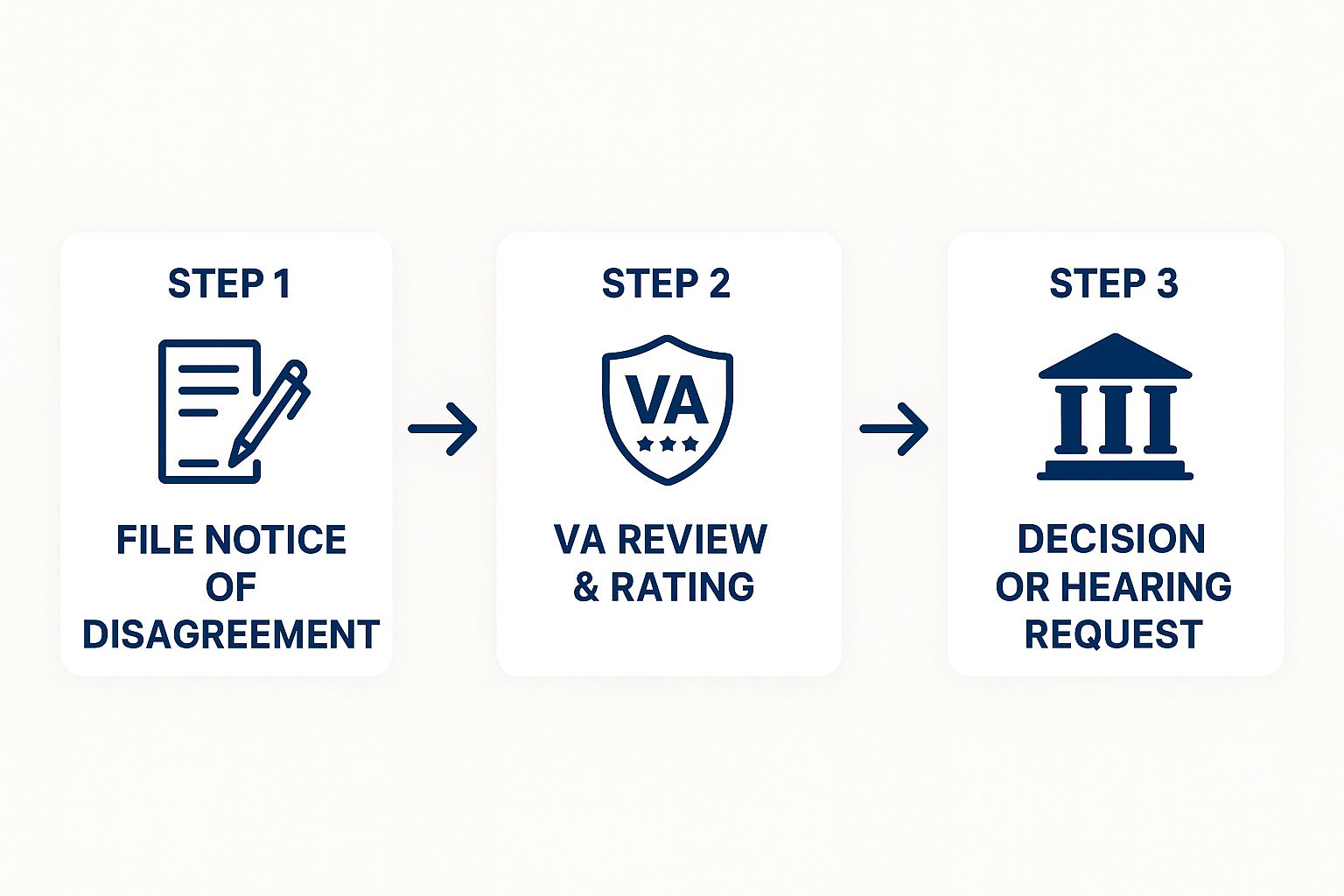
The image above gives you a good look at the typical path a veteran follows when appealing a VA rating decision. It’s a process that can feel daunting, especially when you're dealing with the often complex claims for mental health and neurological conditions.
The VA's list of disability codes carves out specific sections just for these issues. You'll find mental health conditions under codes 9201-9440, while neurological disorders fall between codes 8000-8999. It's important to understand that the VA evaluates these "invisible wounds" based on how they genuinely affect your day-to-day life.
One of the most critical things to know about VA mental health claims is that specific diagnoses like Post-Traumatic Stress Disorder (PTSD), anxiety, or depression don't get rated on their own. Instead, the VA uses a single framework called the General Rating Formula for Mental Disorders to evaluate all of them. This system is designed to measure one thing: the level of social and occupational impairment a veteran is experiencing.
Important Note: Even if you have several mental health diagnoses, you will only receive one disability rating for mental health. The VA will look at all your symptoms together and assign a single rating that reflects your total impairment.
How Mental Health Ratings Work
The General Rating Formula operates on a scale from 0% to 100%, with specific ratings at 0%, 10%, 30%, 50%, 70%, or 100%. Each percentage directly corresponds to a set of symptoms and how severely they impact your ability to hold a job and maintain healthy relationships.
- 10% Rating: This typically applies to mild symptoms that might cause some trouble during stressful times but are otherwise well-controlled.
- 50% Rating: This rating points to more significant issues. Think flattened affect, panic attacks happening more than once a week, or noticeable trouble keeping up with friendships and family relationships.
- 100% Rating: This is reserved for veterans experiencing total social and occupational impairment. Symptoms at this level can include persistent danger to oneself or others, severely disorganized thought processes, or major memory loss.
Getting a firm grasp of this framework is absolutely essential for putting together a strong claim. You need to focus your evidence on showing how your symptoms impact your daily routines, not just on proving your diagnosis.
Neurological Conditions and Secondary Service Connection
The codes for the neurological system cover a huge range of issues, from Traumatic Brain Injury (TBI) all the way to chronic nerve pain. For a lot of veterans, these conditions are directly tied to other injuries they sustained in service.
A perfect example is migraine headaches, covered under DC 8100. The rating here hinges on how often you have "prostrating" attacks—headaches so severe you have no choice but to lie down. If you experience completely prostrating attacks that average at least once a month over several months, that warrants a 30% rating.
Another concept you need to know is secondary service connection. This is when a new health problem develops as a result of a primary, service-connected disability. A classic case is a veteran with a service-connected back injury who later develops radiculopathy—that shooting nerve pain, numbness, or tingling down a leg or arm. That radiculopathy can be claimed as a secondary condition, which can lead to an additional disability rating.
This is more important than ever. The number of veterans with a high disability rating (70% or more) has surged, increasing nearly fivefold from 2.6% in 2008 to 12.8% in 2022. You can learn more about these veteran disability trends on VA.gov. Successfully connecting secondary conditions is often the key to making sure your final rating truly reflects the full scope of your health problems.
How the VA Calculates Combined Disability Ratings
One of the most confusing parts of the entire VA disability process is figuring out how individual ratings add up to a final, combined score. It's a common trap to think a 50% rating and a 30% rating simply equal 80%. That makes perfect sense, but it’s not how the VA does it.
Instead, the VA uses a special formula, often called "VA Math," which is based on the "whole person theory." Think of it this way: the VA starts by seeing you as 100% whole or 100% efficient. Each disability you have chips away at that efficiency. The key is that each new disability rating is calculated based on how much efficiency you have left, not from the original 100%.
A Step-by-Step Example of VA Math
Let's walk through a real-world example to see how this works. Say a veteran has two service-connected conditions:
- Condition A: 50% rating
- Condition B: 30% rating
Here’s the breakdown of the VA's calculation:
- Start at 100% whole. The veteran begins with 100% efficiency.
- Apply the highest rating first. The 50% rating for Condition A cuts the veteran's efficiency in half. Now, they are considered 50% efficient (100 – 50 = 50).
- Calculate the next rating on what's left. Here's the tricky part. The 30% rating for Condition B is applied to the remaining 50% efficiency, not the original 100%. So, the VA calculates 30% of 50, which is 15.
- Add this new value to the first rating. That 15 points of disability gets added to the initial 50%. This gives you a combined value of 65% (50 + 15 = 65).
- Round to the nearest 10. Finally, the VA rounds the combined value to the nearest ten. Since 65% is halfway, it rounds up to a final combined disability rating of 70%.
Understanding the Big Picture
This system might seem strange, but it's designed to ensure a veteran’s disability rating can never exceed 100%. Each additional rating still adds value, but its impact on the final percentage gets smaller as the total gets higher. It’s a system of diminishing returns.
This structured rating method is the foundation for a massive compensation network that helps millions of veterans every year. These payments are based on how much service-connected disabilities are estimated to affect a veteran's ability to earn a living. To give you an idea of the scale, back in fiscal year 2013, the Veterans Benefits Administration paid out nearly $50 billion in compensation to about 3.7 million veterans.
For more information on this topic, you can review data on the labor supply of veterans with disabilities at BLS.gov.
Frequently Asked Questions About Disability Codes
Navigating the world of VA disability codes can feel like learning a new language. It's completely normal to have questions about the details. This FAQ section tackles some of the most common things veterans ask, giving you clearer insight into how your conditions are evaluated and what to expect during the claims process.
How Does the VA Rate Unlisted Conditions?
So what happens if you have a medical condition that isn't on the VA's official list of diagnostic codes? This is more common than you might think, and the VA has a specific procedure for it called rating "by analogy."
Essentially, the VA looks for a listed condition that causes the most similar symptoms and functional limitations as your unlisted one. They then apply the diagnostic code and rating formula from that analogous condition to your claim. For example, if you have a rare degenerative joint disorder that lacks its own specific code, the VA might rate it by analogy to a well-defined condition like rheumatoid arthritis (DC 5003), assuming the levels of pain and motion loss are comparable.
Can My VA Disability Rating Be Reduced?
Yes, a VA disability rating can be lowered, but there are important protections built into the system to safeguard veterans. A reduction isn't arbitrary; it can only happen if there's clear medical evidence proving your condition has significantly and permanently improved. The VA can't just slash your rating after one good check-up.
Even more importantly, several "protected rating" rules provide veterans with long-term stability:
- The 5-Year Rule: Once your rating has been in effect for five years, the VA can't reduce it unless your condition shows sustained improvement over time. A temporary upswing in your health isn't enough.
- The 10-Year Rule: After a disability has been service-connected for ten years, the VA cannot terminate that connection unless they can prove the original claim was fraudulent. The rating percentage can still be reduced if your condition improves, but the service connection itself is secure.
- The 20-Year Rule: When a rating has been continuously in place for 20 years, it becomes stabilized. It cannot be reduced below the lowest rating it has ever held during that 20-year period, with the only exception being cases of fraud.
These rules are there to provide peace of mind, ensuring the benefits you depend on remain secure as long as your condition continues.
What Is an Example of a Secondary Condition?
A secondary condition is a disability that was either caused or aggravated by a disability you already have connected to your service. This is a crucial concept because it opens the door to additional compensation for health issues that are a direct consequence of your service, even if they show up years later.
Here's a classic example: A veteran has a service-connected back injury, like a lumbosacral strain (DC 5237). Over time, the chronic pain and changes in posture cause radiculopathy—nerve pain, numbness, or tingling that shoots down a leg. That radiculopathy can then be claimed as a secondary condition. The nerve issue gets its own separate rating, which can lead to a higher combined disability rating.
This perfectly illustrates how a single primary injury can set off a chain reaction of related health problems, all of which could be eligible for VA compensation. For organizations that manage complex information like this, exploring self-service options can be incredibly helpful; you can learn more about creating an FAQ bot for support.
At Homefront Group, we know firsthand that the VA claims process can be a tough road to travel alone. Our team is made up of experienced pros—many of us veterans ourselves—who are committed to helping you get the benefits you've earned. Take our free 3-minute quiz today to see what you qualify for, and let us help you build a winning strategy. Visit us at https://homefrontgroup.com/ to get started.