
Getting ready for a deposition doesn't have to be overwhelming. It really boils down to a straightforward plan: gather all your key documents, go over the case details thoroughly with your attorney, and practice how you'll answer potential questions. Following this approach can turn a nerve-wracking experience into something you can handle with confidence.
Your First Steps in Deposition Preparation
So, what is a deposition? It's a formal, out-of-court question-and-answer session where you, as the witness (or "deponent"), give testimony under oath. The main goal for the opposing lawyer is "discovery"—they want to uncover the facts of the case from your point of view. Everything you say is recorded by a court reporter and can be a major factor in how the case settles or plays out in a trial.
For veterans, this might be part of a VA disability claim appeal, a personal injury lawsuit, or a medical malpractice case. No matter the context, what you say carries significant weight.
The best way to start isn't by trying to memorize a script. Instead, focus on organizing the facts. This creates a solid foundation for your testimony that can't be easily shaken. Begin by pulling together every relevant piece of paper, email, or digital file you have.
Gather and Organize Your Documentation
Think of this as assembling your personal "intel file" for the case. Memories can get fuzzy, but documents create a concrete, verifiable timeline. Don't just look for the big, official reports; sometimes the smallest detail can make a huge difference.
Your document collection should be comprehensive. Make sure to include:
- Medical Records: Pull everything—doctor’s notes, lab results, prescriptions, imaging reports, and even billing statements related to your condition.
- Official Communications: This includes any letters, emails, or decision notices from the VA, insurance companies, or anyone else involved.
- Personal Notes or Journals: If you’ve been keeping a log of your symptoms, pain levels, appointments, or conversations about your case, these are gold.
- Photos and Videos: Any visual proof that documents your injury or its impact on your life.
- Financial Documents: If your case involves lost wages, gather pay stubs, W-2s, or other records that show a loss of income.
Once you have everything, arranging it all in chronological order is a game-changer. It helps you piece events together accurately and gives your attorney a clear, organized file to work with when building your case strategy.
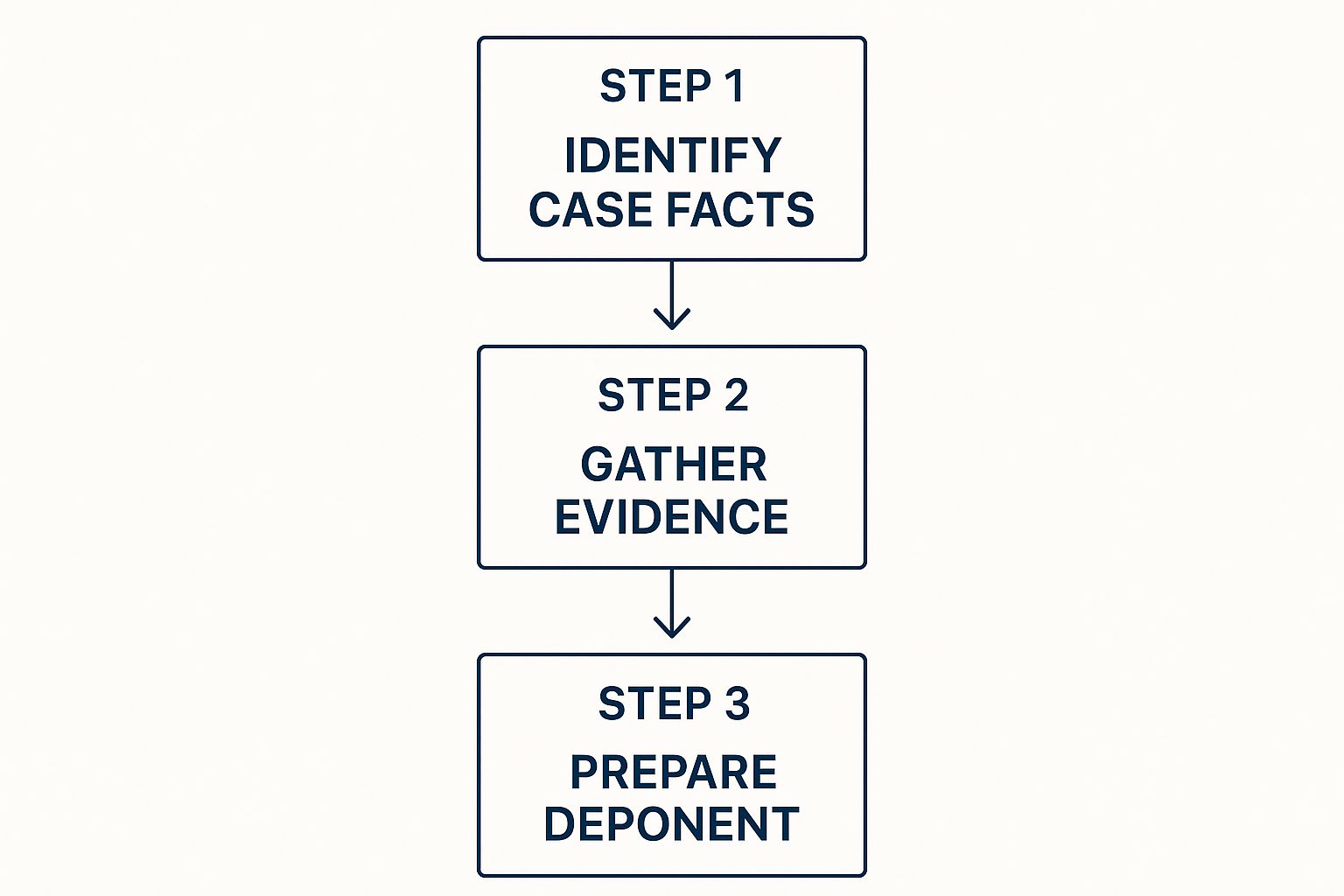
This initial preparation is often the most critical phase. The sooner you get organized, the more prepared you and your legal team will be. Here's a quick checklist to get you started.
| Initial Deposition Preparation Checklist |
| :— | :— | :— |
| Action Item | Why It's Important | Expert Tip |
| Contact your attorney immediately. | They need to know the deposition is scheduled so they can start preparing and protect your rights. | Don't wait. The moment you receive a notice, make the call. Time is a valuable resource. |
| Block out your calendar. | You need to clear your schedule not just for the deposition day but also for prep meetings beforehand. | Treat prep sessions like mandatory appointments. Ask for time off work well in advance if needed. |
| Start a "Case" folder. | Centralize all physical and digital documents in one place to avoid last-minute scrambling. | Use a simple system. A physical binder with dividers or a dedicated folder on your computer works great. |
| Write down your initial questions. | Jot down everything you're unsure about so you can address it with your lawyer. | No question is a "dumb" question. It’s better to ask now than to be confused during the deposition. |
Getting these initial tasks out of the way reduces stress and sets a positive tone for the entire process.
Understand Your Role and Objective
After you've got your documents in order, it's time to sit down with your attorney and get clear on your mission. It's crucial to remember that you're not there to win the entire case in one afternoon.
Your primary job in a deposition is to give truthful, direct, and consistent answers. It's not the time to tell your entire life story—it's about responding accurately to the specific questions you are asked, and nothing more.
Your lawyer will walk you through what the other side is probably trying to accomplish. Are they fishing for inconsistencies in your account? Are they trying to get you to admit something that hurts your case? Knowing their likely strategy is key to anticipating their questions and responding effectively. This early preparation isn't just about what you know; it's about framing that knowledge correctly within the legal fight you're in.
Mastering the Details with Document Review

The strength of your testimony isn't just in what you say—it's in the paper trail that backs it up. Once you've gathered all your documents, the real work begins. We need to go through them with a fine-tooth comb. This isn't about memorizing every single word. It's about understanding the story these documents tell and anticipating how the other side will try to poke holes in it.
Think of each piece of paper—a doctor's note, an email to your boss, a performance review—as a puzzle piece. By themselves, they might not mean much. But when you and your attorney lay them all out, a clear picture emerges. Knowing that picture, that narrative, is the core of being ready for a deposition.
For instance, if you have an email you fired off in a moment of frustration that seems to contradict a formal incident report, you can bet the opposing counsel has it circled in red. A thorough review ahead of time means you're ready to explain that discrepancy without getting flustered.
Creating Your Personal Event Timeline
One of the most powerful tools I have my clients create is a detailed timeline. Using your documents, you're going to map out the key events chronologically. This is more than just a list of dates; it’s about connecting the dots between actions and outcomes.
- Start at the beginning: What was the first domino to fall? Was it a specific medical diagnosis? A workplace incident? The day you signed a particular contract? Pinpoint that first event.
- Add every key interaction: Log every significant meeting, phone call, or email chain. Make a note of who was there and what was discussed.
- Trace your medical journey: Include dates for consultations, treatments, physical therapy, and any notes from your records about changes in your condition.
- Log all official communications: When did you send or receive important letters or notices? Think about anything from the VA, an insurance company, or your employer.
This timeline becomes your anchor. It solidifies the sequence of events in your own mind, making it incredibly difficult for an opposing lawyer to trip you up with confusing questions about "who said what when." When you can mentally walk through the timeline, your answers will naturally be consistent and accurate.
A well-constructed timeline does more than just organize facts. It reveals the cause-and-effect relationships that are at the heart of your case, giving you a powerful framework for your testimony.
This process helps you absorb the facts organically. You'll know the story because you’ve rebuilt it yourself, piece by piece, from the evidence.
Pinpointing Strengths and Weaknesses
Let's be realistic: no case is perfect. A critical part of our document review will be an honest look at the good, the bad, and the ugly. Identifying both the high points and the potential trouble spots is absolutely essential for deposition prep.
Together, we'll look at your case through the other side's eyes. Which documents are your cornerstones, the ones that make your claim undeniable? On the flip side, which ones could they use to attack your credibility? These are the areas we need to fortify.
Common "Weakness" Scenarios to Prepare For
| Document Type | Potential Weakness Example | How to Prepare |
|---|---|---|
| Emails or Texts | An informal, emotional email sent in a moment of frustration that seems to exaggerate or misstate a fact. | Be ready to provide context. You'll explain your state of mind at the time without getting defensive. "Yes, I wrote that. I was in a great deal of pain and frustrated." |
| Medical Records | A doctor's note that mentions a pre-existing condition or an injury from years ago. | We'll work together to draw a clear line, showing how your current issue is new, different, or was made significantly worse by the event in question. |
| Performance Reviews | A past review that brings up an issue totally unrelated to your case, which a lawyer might use to paint you in a bad light. | Acknowledge it, own it, and pivot back. "Yes, that was noted. It's something I worked on. Now, regarding the incident on May 15th…" Don't let them drag you off-topic. |
By facing these potential issues head-on, you strip them of their power. There won't be any "gotcha" moments because you'll have already seen the document, analyzed it, and practiced a truthful, straightforward answer. This proactive approach can actually turn a potential liability into a moment that showcases your credibility and proves you are unshakable.
Working Effectively With Your Attorney

Think of your attorney as your most crucial ally in this process. They aren't just there to offer legal advice; they're your guide and strategic partner. Building a solid relationship with them isn't just a nice-to-have—it's absolutely essential to getting through a deposition successfully.
You and your lawyer need to be perfectly in sync on your case strategy, what you hope to accomplish, and what traps the other side might lay. To put it in terms you’ll understand, they're your CO for this mission. Clear communication and a shared understanding of the plan aren't negotiable.
It all starts with getting on the same page about the "case theory." This is the core story of what happened and why you deserve a favorable outcome. Your job is to know this story cold. Your attorney will lay out the legal points they need to prove, and your testimony provides the real-world facts to back them up. This isn't a one-way street, either. Your personal knowledge and detailed memories can make the case theory much stronger and more convincing.
Defining Your Mission for the Deposition
Walking into a deposition without clear objectives is like heading out on patrol without a map or a mission. You and your attorney need to sit down and define exactly what success looks like for your testimony. The goal is almost never to "win" the case in that room.
Instead, the objectives are usually much more focused and tactical:
- Establish Key Facts: Your primary mission is to get the critical facts on the record, simply and truthfully. This could be anything from confirming dates and specific events to describing how an injury affects your day-to-day life.
- Maintain Your Credibility: You need to come across as an honest, consistent, and believable witness. That means answering questions directly and never, ever exaggerating.
- Contain the Scope: A major goal is to answer only the question that was asked. Don't volunteer extra information. Your lawyer will help you practice this so you don't accidentally open up a new line of questioning that could hurt your case.
Setting these objectives helps you focus your efforts. It changes the deposition from a scary, open-ended interrogation into a structured task with a clear purpose.
Your job isn't to be a brilliant storyteller who anticipates every question. Your job is to be a reliable historian who answers truthfully and concisely based on your preparation. Stick to the mission your attorney outlines.
This focused approach is particularly critical in complicated cases, like those involving toxic exposure or medical malpractice, where the devil is truly in the details.
What to Expect in Complex and International Cases
When a case crosses borders, the complexity skyrockets. You have to understand the unique legal and practical challenges that come with it. Preparing for a deposition in these scenarios adds extra layers of strategy you wouldn’t have otherwise.
Did you know that more than 20 countries have major legal restrictions or even outright bans on U.S.-style depositions? This forces legal teams to get creative. For instance, if a witness is in China, the deposition often has to happen in Hong Kong. For a U.S. case involving someone in Japan, it might be restricted to an American diplomatic site, like the consulate in Osaka.
These rules mean your attorney has to plan months in advance just to secure a location and follow local laws—messing up can lead to serious penalties. You can get a better sense of these global deposition challenges and see how legal teams work around them.
This is exactly why your partnership with your lawyer is so vital. They handle the logistical nightmare so you can focus on one thing: your testimony. Your role is to be an open book about every detail of the case. This transparency allows them to anticipate and manage these jurisdictional hurdles, ensuring your deposition goes as smoothly as possible.
Don't Skip the Dress Rehearsal: The Power of Mock Depositions
Reading articles like this one is a great start, but it’s not enough. You can’t truly prepare for a deposition until you’ve sat in the hot seat. This is where the real work—and the real confidence—is built.
The single most valuable preparation tool you have is the mock deposition. Think of it as a full-contact scrimmage before the big game. It's not a gentle Q&A; it's a realistic simulation where your lawyer takes on the role of the opposing attorney.
Their job is to come at you with everything they've got: the confusing questions, the leading questions, the ones designed to make you angry or defensive. It sounds intense, and it is. But it’s far better to get flustered and make mistakes with your own attorney in a conference room than in front of a court reporter with the other side taking notes.
Building Your Skills Under Pressure
During these practice runs, you move from theory to reality. This is your chance to get a feel for the unique rhythm of a deposition—the question, the deliberate pause while you think, and your measured answer.
You and your lawyer will drill down on the essentials:
- Handling Ambush Questions: The opposing counsel might intentionally ask a convoluted or misleading question. Your lawyer will do the same, training you to stop, breathe, and ask for clarification instead of guessing or stumbling into a trap.
- Controlling Your Body Language: How you sit, where you look, and your general demeanor speak volumes. A mock deposition gives your attorney a chance to see what the other side will see and give you direct, honest feedback to ensure you project quiet confidence.
- Working with Documents: It’s a classic tactic: an attorney slides a document across the table and asks, “Do you recognize this?” You'll practice how to take your time, read it carefully, and only answer based on what’s actually on the page—not what you think it says or what you remember about it.
This rehearsal is invaluable for finding the weak spots in your testimony. It lets you patch the holes before the other side gets a chance to tear them open.
The point of a mock deposition isn’t to memorize a script. It’s to build the muscle memory you need to stay calm, listen carefully, and give truthful, precise answers, no matter what gets thrown at you.
This level of preparation is even more critical today. The legal world is facing a major shortage of court reporters. In one survey, 54% of court reporters said they were reluctant to handle depositions in person, and 21% said they would "never" do so again. This can create scheduling logjams and makes everyone’s time more precious. When you're well-rehearsed, you’re more concise and efficient, which helps keep the entire process moving forward. You can read more about how reporter shortages impact litigation on esquiresolutions.com.
Mastering the Three Most Powerful Phrases
One of the hardest things for any witness to do is to admit they don't know something. There’s a natural human urge to try and answer every question, which can lead you to guess or speculate. That’s a catastrophic mistake that can sink your credibility.
A mock deposition is the perfect place to get comfortable saying three simple, honest phrases.
| If the Question Is… | The Best, Most Truthful Answer Is… |
|---|---|
| Asking for a specific detail you can't be sure of | "I don't recall." or "I don't remember." |
| Asking for information you genuinely don't have | "I don't know." |
| Confusing, long-winded, or has multiple parts | "Can you rephrase the question?" |
These aren't tricks or evasions. They are the most accurate answers you can give in those moments. Your lawyer will help you practice using them until they feel completely natural. Being a good witness isn't about being a human encyclopedia; it's about being an honest one.
Navigating Deposition Day with Confidence
When the day of your deposition arrives, all the prep work is behind you. Now, it's about execution. Your mission is to stay calm, focused, and disciplined, turning all that practice into confident, truthful testimony. It’s game time.
First, get your bearings. You won't be in a formal courtroom, but likely a conference room. In that room will be you, your attorney, the opposing lawyer, and a court reporter typing down every single word. Knowing who's who and what they do strips away the mystery and helps you lock in on your role.
The rules for testifying are simple but absolutely critical. Following them is non-negotiable—they protect your credibility and your case. Think of them as your rules of engagement for the day.
The Three Pillars of Effective Testimony
Your entire performance during the deposition hinges on three core principles. If you master these, your testimony will be accurate and strategically sound, giving the opposing counsel no room to twist your words.
-
Listen to the Entire Question. Don't jump the gun. Wait for the other lawyer to completely finish speaking before you even think about an answer. This simple habit prevents you from answering a question that wasn't actually asked and, just as importantly, gives your attorney a moment to object if the question is improper.
-
Pause Before Answering. Once the question is out, take a beat. Breathe. This isn't a race. Use that moment to fully process what was asked and form a concise, honest answer. A deliberate pause shows you're in control, not just reacting.
-
Answer Only What Was Asked. This might be the most important rule of all. If a question can be answered with a simple "yes," "no," or "I don't recall," leave it at that. Do not volunteer extra information, stories, or explanations. Every extra word you offer is a potential new thread for the other side to pull on.
Sticking to these pillars shifts the dynamic. You go from feeling like you're being interrogated to providing controlled, deliberate testimony.
Understanding Objections and Taking Breaks
Sooner or later, you'll hear your attorney say, "Objection." When that happens, your job is simple: stop talking immediately. An objection is a legal signal for the record, and it’s your cue to pause and wait for your lawyer's direction.
They might object to the form of a question (maybe it's confusing or asks two things at once) or because it asks for protected, privileged information. Your lawyer will then tell you whether or not to answer. Follow their lead, no questions asked. They are your shield.
Breaks are another tool in your kit. A deposition can feel like a marathon. If you start to feel tired, confused, or frustrated, you have every right to request a short break. Use that time to get up, clear your head, or talk privately with your attorney. Don't be a hero; use this option to stay sharp.
A deposition isn't an endurance test. Taking a strategic break is the mark of a well-prepared witness who understands the importance of staying focused from the first question to the last.
By controlling the pace, you ensure you're always at your best.
The Impact of Technology on Modern Depositions
The deposition environment is changing, largely thanks to technology. The legal tech industry is growing fast—it's projected to become a $25 billion industry by 2025. Much of this growth involves tools making depositions more efficient, like AI software for instant transcription and evidence management.
You can learn more about the specific growth in deposition software at datainsightsmarket.com.
What does this mean for you? You might see a live transcript appear on a screen during your testimony or even give your deposition remotely over a video call. While the setting may change, the fundamentals of how to testify do not. Stick to the golden rules—listen, pause, and answer truthfully—whether you're across a table or a screen. Your confidence comes from your preparation, not the format.
Answering Your Lingering Deposition Questions
After all the preparation, it's completely normal to still have some practical questions buzzing around in your head. Getting these last-minute details sorted out can make all the difference, helping you walk into that room with confidence instead of uncertainty.
Think of this as the final pre-mission brief. We'll tackle the common "what ifs" and logistical queries so you know exactly what to expect on the day of your deposition.
What Should I Wear to My Deposition?
Before you say a single word, your appearance sends a message. The golden rule is to dress like you're heading to court. This doesn't mean you need to rush out and buy a brand-new suit, but your clothes should communicate that you take this process seriously.
- For men: Business casual is a solid choice. Think slacks and a button-down shirt. A sport coat is a nice touch that adds a layer of professionalism but isn't always necessary.
- For women: Business or business-casual attire is perfect. A blouse with slacks or a skirt, or a conservative dress, all work well.
The goal is to look credible and composed. You should avoid anything that could be distracting—t-shirts with logos, shorts, workout clothes, or anything with loud patterns or political slogans. Keep jewelry minimal. You want the opposing lawyer to see a serious, respectable witness, not a distraction.
How Long Is This Going to Take?
This is probably the most common question, and the honest answer is: it really depends. There's no one-size-fits-all timeline. A straightforward car accident deposition might wrap up in just a couple of hours.
On the other hand, a complex case involving toxic exposure or years of medical records could easily take a full day, sometimes even stretching into a second. The length is dictated by the complexity of your case and the number of documents involved.
Your attorney will be your best guide here. They have a good feel for the case, know the other attorney’s style, and can give you a pretty solid estimate of what to expect.
A deposition isn’t a test of endurance. If you feel yourself getting tired or losing focus, you have every right to ask your lawyer for a break. It's better to pause and regroup than to push through and make a mistake.
What Happens After It's Over?
Once the last question is asked, your part in the deposition is done, but the gears of the legal process keep turning. Here’s a quick rundown of what comes next:
- The Transcript Is Created: The court reporter, who has been taking down every word, will prepare a full written transcript of the entire session. This usually takes a couple of weeks.
- You Review and Correct: You and your lawyer will get a copy. You have the right to read through it and correct any errors on what’s called an errata sheet. This is your chance to fix a misspelled name, a wrong date, or any technical term the reporter might have misheard.
- It Becomes Official Evidence: After it's finalized, that transcript is now a key piece of evidence. Lawyers on both sides can use your answers in legal motions, during settlement talks, or even read parts of it out loud at trial.
Essentially, your testimony is now a permanent, official part of your case record.
Can I Bring My Own Notes Into the Deposition?
Let me be crystal clear on this one: No. Bringing personal notes, cheat sheets, or timelines into a deposition is a major misstep.
Why? Because any document you use to refresh your memory is fair game for the other side. The opposing counsel can demand to see it, and you'll have to hand it over. This can inadvertently tip them off to your lawyer’s strategy or open up whole new lines of questioning you weren't prepared for.
Trust your preparation. You've gone over the key documents and events with your attorney. That's all you need. Your memory is the only tool you should bring into that room.
At Homefront Group, we know the unique battles veterans face. Our firm was founded by a former Navy JAG, and our team includes fellow veterans who are committed to helping you navigate tough legal challenges, from VA appeals to personal injury claims. We've been in your shoes, and we provide the expert support you need to get the justice and benefits you earned. Take our 3-minute quiz to see what you qualify for and let us start building a strategy for your success.