
Filing a VA claim really boils down to two things at the start: proving you're eligible and then gathering the right paperwork to connect your condition to your time in the service. The entire journey kicks off with one single, critical document: your DD214.
Your First Steps in the VA Claim Process
Before you even touch a single VA form or think about scheduling an exam, you have to nail down your basic eligibility. This isn’t just some bureaucratic box-checking exercise; it’s the absolute foundation of your entire claim. You need to prove you’re a veteran and that your condition is, at the very least, connected to your time in uniform.
Secure Your DD214
The most important document in this entire process is your DD Form 214, Certificate of Release or Discharge from Active Duty. Seriously, think of this as the master key that opens every door in the VA system. It’s the official proof of your military service, your discharge character, and your dates of service. Without it, your claim is dead in the water.
If you can't find your copy, don't panic. This is a common situation. You can easily request your DD214 and other service records online through the National Archives. Make this your very first move.
Confirm Your Eligibility
With your DD214 in hand, you can confirm your eligibility. To even be considered for VA disability compensation, you have to meet two core requirements:
- You must be a veteran. This means you served on active duty, active duty for training, or inactive duty training.
- Your discharge can't be dishonorable. An honorable discharge is best, but a discharge that is under honorable conditions (general) or other than dishonorable also works.
A dishonorable discharge is usually a roadblock, but not always. There are some rare exceptions. If your discharge is anything less than honorable, I strongly suggest getting some expert guidance before you file anything.
A Word of Advice: Don't just assume you're not eligible. The VA has a whole process for what they call "character of discharge" determinations. Even if your service ended on rough terms, there might still be a way forward.
Establish a Potential Service Connection
The heart of every single VA claim is what's known as the "nexus". This is the crucial link connecting your current medical condition to something that happened while you were in the military. Before you officially file, you need to have a clear idea of how you're going to prove this connection.
You essentially have to show three things:
- A current, diagnosed disability. You can't just say your back hurts; you need an actual medical diagnosis from a doctor.
- An event, injury, or illness in service. This could be a specific event, like a training accident, or something that happened over time, like hearing loss from working on the flight line.
- A medical nexus. This is the expert opinion—usually from a doctor—that links your current disability to that in-service event.
For example, a veteran with chronic knee pain today might point to a parachute jump injury that's documented in their old service treatment records. Someone else might connect a PTSD diagnosis to a specific combat tour detailed in their service history. Thinking through this logic from day one is the key to successfully learning how to file a VA claim and gathering the right evidence for the next phase.
Building a Rock-Solid Case with the Right Evidence

Let's be blunt: your VA claim is only as good as the evidence you submit. This is the moment you shift from being a patient to being your own strongest advocate. The mission isn't just to dump a pile of papers on the VA's desk. It's about building a story—a compelling, undeniable narrative that proves your case.
Think of yourself as a detective piecing together a timeline. You're looking for every piece of paper that connects your current disability back to your time in uniform.
Gathering Your Medical Records
The absolute foundation of your claim is your medical paperwork. You’ll need to track down everything you can, from your military service right through to your civilian life today.
Your Service Treatment Records (STRs) are pure gold. These are the notes from every sick call visit, in-service hospitalization, and medical appointment you had on active duty. Remember complaining about your back after that 20-mile ruck march? That single entry in your STR is a critical piece of the puzzle.
Don't stop there. Your civilian medical records are just as crucial. These documents from your family doctor, specialists, chiropractors, and physical therapists show the VA that your condition didn't just disappear after you took off the uniform. Consistent treatment proves your disability is a chronic, ongoing problem.
The Power of a Nexus Letter
Sometimes the connection between your service and a current diagnosis isn't crystal clear in your records. This is where a nexus letter can be an absolute game-changer. Simply put, a nexus letter is a medical opinion from a qualified professional that directly links your condition to an event or injury from your military service.
Let’s say you were diagnosed with PTSD from your combat tour. Years later, you develop sleep apnea. A skilled doctor can write a nexus letter explaining how PTSD is a known risk factor for developing sleep apnea, creating that direct bridge—the "nexus"—the VA needs to see.
Pro Tip: For a nexus letter to carry real weight, the medical professional must use specific language. The phrase "it is at least as likely as not" is the VA's standard of proof. Make sure that exact wording is in the letter.
When you're dealing with years of medical history or writing out your personal statements, getting it all down can feel overwhelming. To speed things up, think about utilizing speech-to-text medical software to dictate and organize your notes and history efficiently.
Lay Statements and Buddy Letters
Medical files tell one side of the story, but they don't capture how a disability truly impacts your day-to-day life. That's what lay statements and "buddy letters" are for. These are firsthand accounts from people who have seen how your condition affects you.
-
Your Personal Statement: This is your shot to tell the VA rater your story. Explain how the disability started, how it got worse over time, and exactly how it messes with your ability to work, be with family, or even do simple chores. Don't just say "my back hurts." Say, "I can't lift my five-year-old daughter anymore," or "I have to get up and walk around every 15 minutes when I try to watch a movie."
-
Buddy Letters: A letter from someone you served with who saw what happened can be incredibly powerful. A note from a guy in your squad describing the IED blast you were in can fill in gaps that the official records missed.
-
Statements from Family and Friends: A letter from your spouse, a close friend, or even a former boss can paint a vivid picture. Your wife can describe how you thrash in your sleep from nightmares or how your knee buckles without warning when you're just trying to mow the lawn.
These personal stories add a human element that a stack of medical charts can't. They make the impact of your disability real, and the VA is required by law to consider them.
Tailoring Evidence to Your Specific Condition
The evidence you need really depends on the condition you're claiming. The most common issues veterans get compensation for include things like tinnitus, knee problems, and PTSD. Just to give you an idea, in a single recent year, tinnitus claims were successfully awarded to 273,502 veterans, and PTSD claims were approved for 81,968 veterans. This shows just how common these service-connected conditions are.
To help you get started, here's a look at what strong evidence packages look like for a few common claims.
Essential Evidence for Common Service-Connected Conditions
This table breaks down the types of proof that are most effective for some of the disabilities we see claimed most often.
| Condition (Example) | Primary Medical Evidence | Supporting Documentation |
|---|---|---|
| PTSD | A current diagnosis from a psychiatrist or psychologist. Therapy notes showing ongoing treatment. | Buddy letters from service members confirming the stressful event. A personal statement detailing changes in mood and behavior. |
| Tinnitus (Ringing in Ears) | A diagnosis from an audiologist. A hearing test showing normal hearing but confirming tinnitus. | Your MOS (job) in your service records (e.g., infantry, artillery, flight line). A statement describing the constant ringing. |
| Knee Condition | X-rays or MRI results showing arthritis or ligament damage. Records of physical therapy. | A buddy letter describing the in-service injury. A personal statement explaining how it limits your ability to walk, run, or climb stairs. |
By pulling together this mix of official records and powerful personal testimony, you’re building a case that is tough for the VA to argue with. You aren't just asking for benefits; you're proving you've earned them.
Choosing Your Method for Submitting the Claim
You’ve gathered your evidence, and now it’s time for the main event: officially filing your VA claim. How you choose to submit everything is a critical decision that can seriously impact the timeline and smoothness of the whole process.
While the VA has put a lot of effort into its online portal, that’s not your only choice. It might not even be the best one for you. Let's walk through the ways you can get this done so you can pick the right path with confidence.
First, Lock in Your Back Pay with an Intent to File
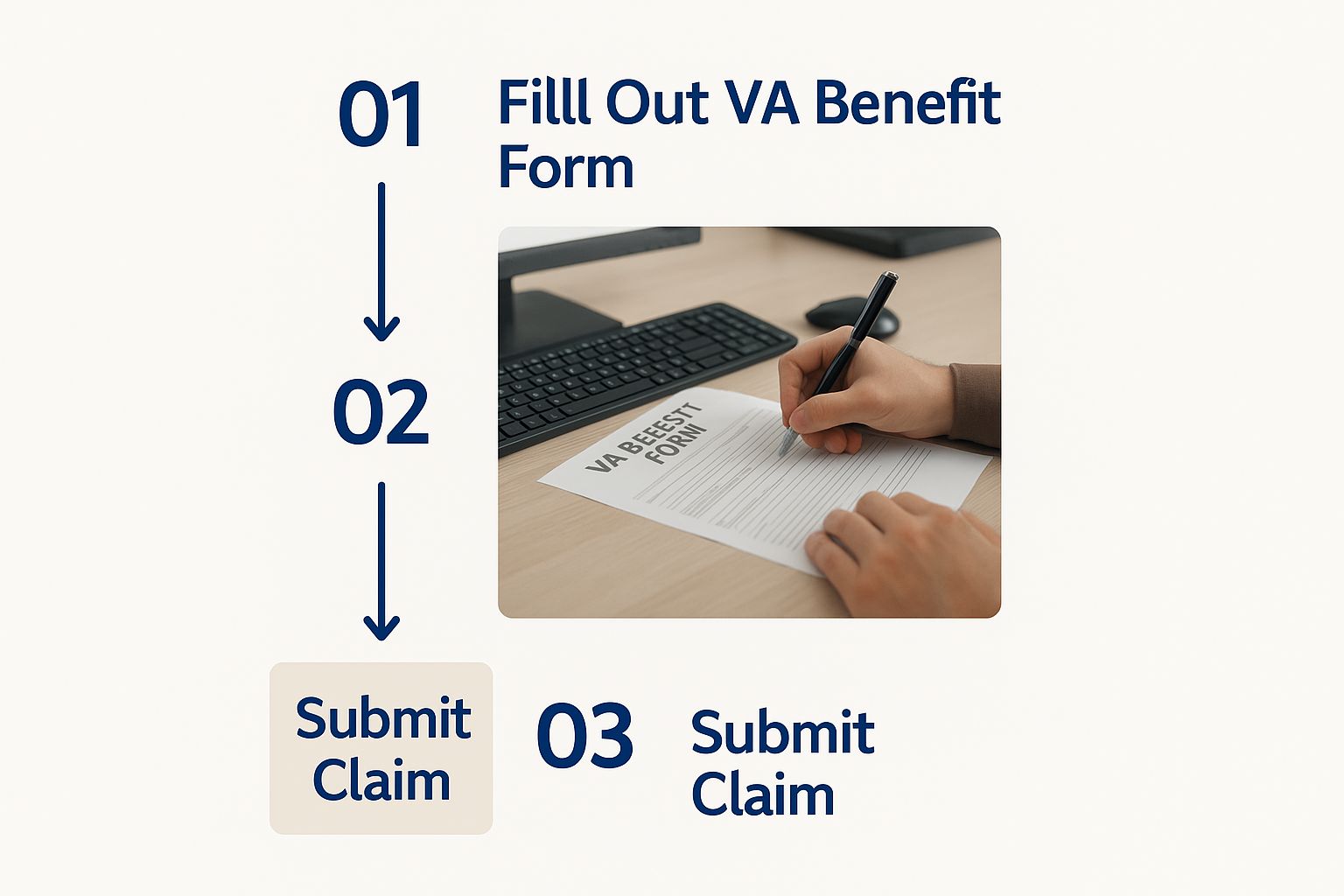
Before you even think about submitting the full application, there's a crucial first step you shouldn't skip: the Intent to File. This is done by submitting VA Form 21-0966 or simply by starting a claim online, which does it for you automatically.
Why is this a big deal? It establishes your effective date. This date is the official starting line for your benefits. If your claim is eventually approved, you'll get back pay all the way to this date. So, if it takes you another eight or ten months to track down that last medical record, you're covered. This simple action can literally mean thousands of dollars in retroactive benefits.
Think of it this way: A veteran who files an Intent to File on January 1st but doesn't submit the complete claim until November 1st will get paid back to January once approved. Someone who waits until November to start the process gets nothing for those ten months. It’s a no-brainer.
Your Submission Options
Once you're ready with your completed claim packet, you have a few solid ways to get it into the VA's hands. Each has its pros and cons.
-
Online Through VA.gov: This is, by far, the VA's preferred and fastest method. The digital application walks you through each section and lets you upload all your documents—medical records, nexus letters, buddy statements—directly. The biggest win here is the ability to easily track your claim's status online.
-
With a Veteran Service Officer (VSO): I can't recommend this option enough, especially for complex claims. VSOs are accredited experts who work for organizations like The American Legion or VFW. They provide free assistance, reviewing your claim to make sure it’s solid before you submit. A good VSO has seen it all and knows exactly what VA raters are looking for.
-
By Mail or In Person: The old-school paper method still exists. You can fill out the VA Form 21-526EZ and mail it to the VA's evidence intake center or drop it off at a VA regional office. Be warned: this is the slowest route, and it introduces the risk of lost mail and makes tracking your documents a real headache.
Making the Right Call
For most veterans comfortable using a computer, filing online at VA.gov is the most straightforward choice. It gives you instant confirmation that your claim was received and you can chip away at the application, saving your progress as you go.
That said, the value a good VSO brings to the table is immense. The VA system can be a maze, and having an experienced guide is priceless. They can spot weak points in your claim that you’d never notice, helping you build a much stronger case from the very beginning. Since their help is completely free, it’s a resource every veteran should seriously consider.
Ultimately, the choice between filing online yourself or working with a VSO comes down to how complex your case is and your personal comfort level.
What to Expect After You Hit Submit
You’ve finally submitted your claim. That’s a huge step, and you should feel a sense of relief. But as any veteran who's been through it will tell you, this is also where the waiting game—and a lot of anxiety—truly begins. Knowing what’s happening on the other side of the screen can help you stay sane and prepared for what’s next.
Hitting "submit" doesn't just send your file into a black hole. It kicks off a structured, multi-stage process. A real person, a claims assistant, will be assigned to your case to start the initial review. They're not just letting your file collect digital dust.
The First Look: Initial Review and Evidence Gathering
This first stage is mostly about paperwork and making sure the VA has the basics. They’ll look for your DD214, confirm your eligibility, and check the initial evidence you sent in. It's an administrative checkpoint.
If they spot something obvious missing, like a specific service record or a medical file you mentioned, they have a "duty to assist." This means they're required to make a reasonable effort to track down federal records for you.
But here’s a pro tip: don't count on them to build your case. Any evidence you can get yourself, especially from your private doctors, will almost always move things along faster. Waiting for the VA to request records from another federal agency can add months to your timeline.
Key Takeaway: Pay attention to your mail and your VA.gov account. The VA will send you letters during this phase. Read everything immediately. They often include deadlines for you to provide more information, and missing one can bring your claim to a dead stop.
This is also when the VA decides if they need more info. That decision often leads to the single most important appointment in your entire claim journey.
The C&P Exam: Your Day in Court
For the overwhelming majority of claims, the VA will schedule you for a Compensation and Pension (C&P) exam. This is a medical appointment with either a VA doctor or a physician contracted by the VA. The entire point of this exam is to evaluate the condition you've claimed.
It’s crucial to understand what this exam is not. The C&P examiner is not there to treat you. Their only job is to assess the severity of your disability and, often, to provide a medical opinion on whether it’s linked to your service. The report they write will carry immense weight with the person who ultimately decides your claim.
Whatever you do, don't miss this appointment. If you skip it without a very good, well-documented reason, you can almost guarantee your claim will be denied.
How to Prepare for Your C&P Exam
Walking into your C&P exam prepared can make a night-and-day difference. Your mission is to give the examiner a clear, honest, and accurate picture of how your condition impacts your life.
- Review Your File: Before you go, re-read your personal statement and the evidence you submitted. Keep your story consistent.
- Be Brutally Honest: This is not the time to be tough or downplay your symptoms. If your back pain makes it impossible to pick up a laundry basket, say that. If you can't stand for more than ten minutes without severe pain, they need to know.
- Describe Your Worst Days: The examiner will see you for 30 minutes on what might be a good day. It's on you to explain what your worst days are like. Talk about the pain, the limitations, and how it disrupts your life.
- Bring Notes: It’s easy to get flustered and forget things. Jot down a few bullet points about your symptoms and how they affect your job, your family, and your ability to just get through a normal day.
Think of this as your one opportunity to speak directly to the person whose opinion can make or break your claim. Your honest testimony is a powerful piece of evidence.
From Exam to a Final Decision
After the C&P exam, the examiner sends their report back to the VA. Your file then lands on the desk of a Rating Veterans Service Representative (RVSR), also known as a "rater." This is the person who makes the final call.
The rater is the ultimate reviewer. They look at everything—your service records, private medical files, buddy letters, your personal statement, and, most importantly, that C&P exam report. They weigh it all to decide if your condition is service-connected and, if it is, what disability percentage to assign based on its severity.
This final stage can feel like the longest wait. The good news is that the U.S. Department of Veterans Affairs has made some serious progress here, recently processing over 2 million disability claims in a single fiscal year. The average time it takes to get a decision has dropped to 131.8 days. It's a sign they are committed to getting veterans answers faster, as detailed in an official VA press release.
Once the rater makes their decision, your claim is closed, and the VA mails you a thick envelope with the results. You can usually see the updated status and decision on your VA.gov account a few days before that packet arrives in your mailbox.
Decoding Your VA Decision Letter and Planning Next Steps

That thick envelope from the Department of Veterans Affairs has finally shown up in your mailbox. It's the moment of truth, and let’s be honest, the documents inside can be incredibly dense and confusing. Your next mission is to take a deep breath and carefully read every single page.
Inside that decision packet, you'll find a few key things: a cover letter with a summary, the official rating decision, and details about your effective date. It's tempting to just glance at the first page, but the real meat is usually buried in the "Reasons for Decision" section. This is where the VA rater lays out exactly why they made the call they did.
Reading the Results
The heart of the letter will tell you which conditions you claimed were approved, denied, or deferred for a later decision. For anything approved, you'll see a disability percentage assigned, anywhere from 0% to 100%. Don't be discouraged by a 0% rating—that’s still a win. It means the VA acknowledges your condition is service-connected, opening the door to file for an increase if it gets worse down the road.
If you have more than one approved disability, the VA calculates your combined rating using what we call "VA Math." It isn't simple addition. A 30% rating and a 20% rating don't just add up to 50%. Your letter will show the final combined rating that determines your monthly payment.
Crucial Insight: The most important part of a denial is the explanation. The rater is required to tell you what evidence was missing. Was there no current diagnosis? Was the connection to your service too weak? This explanation is your roadmap for what to do next.
Once you know your rating, you can figure out your monthly compensation. These payment rates change. The VA applies a cost-of-living adjustment (COLA) to keep up with inflation. For example, a recent 3.2% COLA was implemented to ensure veterans' benefits didn't lose value, giving a direct boost to their monthly checks. You can get more details on how these adjustments affect VA disability rates on Disability Law Group's blog.
What to Do If You Disagree
Getting a lower-than-expected rating or an outright denial is tough. It feels like a setback, but it is absolutely not the end of the road. Think of it as a new starting point. The trick is to avoid a knee-jerk reaction and instead make a smart, strategic move based on why the claim didn't go your way.
You essentially have three paths forward:
- Supplemental Claim: This is your best bet if you have new and relevant evidence the VA has never seen. For example, if the denial said you lacked a current diagnosis and you’ve since gotten one from your doctor, a Supplemental Claim is the perfect vehicle.
- Higher-Level Review: Use this option if you're convinced the rater made a legal or procedural mistake with the evidence you already submitted. You can’t add new information here. A more senior rater simply re-examines the same file to look for errors.
- Board Appeal: This is the most formal route, taking your case to the Board of Veterans' Appeals. You can ask for a direct review, submit new evidence, or even have a hearing with a Veterans Law Judge. It's a much longer process and one where having professional help is a very good idea.
Your decision letter will explain these appeal options and point you to the right forms and instructions.
Your Strategic Next Steps
Choosing the right appeal lane is a critical decision. Don't rush it. Go back and review the "Reasons for Decision" with a fine-tooth comb.
Let's say the denial states, "the evidence does not show the veteran's back condition is related to their service." Filing a Higher-Level Review would be a waste of time, as a second rater would just see the same lack of a nexus. In that case, your mission is clear: get a strong nexus letter from a medical expert and submit it with a Supplemental Claim.
On the other hand, if your C&P exam report was overwhelmingly positive but the rater seemed to completely ignore it, a Higher-Level Review is the perfect tool to get a fresh set of eyes on that oversight.
Navigating the appeals process is a whole different ballgame from filing your initial claim. This is often the point where getting help from an accredited VSO or a legal professional at a firm like Homefront Group can make all the difference. They can help you decipher the VA’s logic and build the strongest possible case to keep fighting for the benefits you've earned.
Common Questions About the VA Claim Process
Even with a detailed guide in front of you, it’s only natural for more questions to pop up. The VA system has a lot of moving parts, and it's easy to feel stuck or unsure about what to do next. Let's walk through some of the most common questions I hear from veterans just starting out, so you can move forward with a bit more confidence.
How Long Does a VA Claim Typically Take?
This is probably the first question every veteran asks, and the honest answer is: it depends. The time it takes for the VA to decide on your claim can swing wildly based on a few key factors—how complex your case is, the number of disabilities you're claiming, and whatever the VA's current backlog looks like.
Right now, the VA is reporting an average processing time of around 130-140 days. But you should treat that number as a ballpark estimate, not a promise. A simple claim for something like tinnitus might sail through relatively quickly. On the other hand, a more complex claim involving multiple issues and, say, toxic exposure will almost certainly take longer.
One of the best things you can do to speed things up is to file a Fully Developed Claim (FDC). This just means you're submitting all your evidence right from the start, leaving less work for the VA to do on their end.
Can I Get Free Help Filing My Claim?
Yes, and you absolutely should. You don't have to go through this process alone, and I strongly recommend you don't. Accredited Veteran Service Officers (VSOs) are trained experts who can help you prepare and file your claim, and their services are completely free.
Expert Insight: VSOs are your secret weapon. They work for trusted organizations like The American Legion, VFW, and DAV. These folks live and breathe VA claims every single day. Having one in your corner can make a night-and-day difference in the outcome.
Think of a VSO as a seasoned guide who knows the terrain inside and out. They can look over your paperwork, identify weak spots you might have missed, and help you build the strongest possible case before the VA ever sees it.
What Should I Do If My VA Claim Is Denied?
First, take a breath. A denial feels like a punch to the gut, but it is not the end of the road. This is the point where you stop being frustrated and start being strategic. The VA has a clear appeals process, and you have options.
Your three main paths forward are:
- Supplemental Claim: This is your go-to if you have new and relevant evidence to add to your case. It’s the most common and often most effective response to a denial.
- Higher-Level Review: Use this option if you believe a mistake was made in the original decision. A more senior rater will review your existing file—no new evidence allowed.
- Board Appeal: This is the most formal route, where you take your case directly to the Board of Veterans' Appeals.
Your denial letter is your new road map. It will spell out exactly why the VA said no. That information is pure gold, giving you and your VSO the intel you need to decide which appeal option makes the most sense.
Outside of disability claims, many veterans also have questions about their housing benefits. If you're wondering how to apply for a VA loan online, plenty of great guides can walk you through that separate but equally important process.
Navigating the VA claim and appeals system can be tough, especially after a denial. If you feel like you've hit a wall, the team at Homefront Group can help. We're a veteran-owned firm focused on one thing: helping you get the benefits you earned. Take our free, 3-minute quiz to see how we can build a strategy for your case. Visit us at https://homefrontgroup.com/ to get started.