

When you've been hurt, one of the biggest questions looming over everything is, "How long will this take?" It's a tough question to answer definitively, but most personal injury cases tend to resolve somewhere between 6 to 18 months.
Of course, that's just a ballpark. Some straightforward claims might wrap up in just a few months, while more complicated cases that head to a courtroom can stretch on for several years. Every single case is different, and its timeline is shaped by a unique set of circumstances.
Your Personal Injury Case Timeline at a Glance

It’s completely natural to want a clear finish line. After an injury, getting back to normal is the top priority, and knowing the legal process won't drag on forever provides some much-needed peace of mind. Think of it like a road trip—the final destination is clear, but the time it takes to get there depends on traffic, detours, and how many stops you need to make along the way.
How Case Complexity Shapes the Timeline
The single biggest factor determining how long your case will take is its complexity. A simple fender-bender where fault is obvious is a world apart from a case involving catastrophic injuries, multiple defendants, and a fight over who was to blame. The first might resolve quickly, while the second will almost certainly take much longer.
Most cases with clear liability and minor injuries can often be settled in under 6 months. For more moderate injuries or when an insurance company pushes back, you might be looking at 9 to 15 months. If your case involves severe injuries, hotly contested fault, or requires bringing in expert witnesses, it's not uncommon for it to take 18 months or even longer.
Here’s a summary of what you might expect based on typical scenarios.
Estimated Personal Injury Case Timelines
This table offers a general idea of how long a case might take to resolve, depending on whether it settles out of court or has to go all the way to a trial.
| Case Complexity | Typical Settlement Timeline | Potential Trial Timeline |
|---|---|---|
| Simple | 3-9 Months | 1-2 Years |
| Moderate | 9-18 Months | 2-3 Years |
| Complex | 18+ Months | 3+ Years |
Remember, these are just estimates. The path your case takes will be its own, but this gives you a realistic framework for what to expect.
Why Your Recovery Is the True Pacing Item
If there's one thing to take away from all this, it's that your case timeline is directly tied to your medical recovery. We can't truly know the full value of your claim until you reach what we call Maximum Medical Improvement (MMI).
Maximum Medical Improvement (MMI) is the point at which your medical condition has stabilized, and your doctor can say with reasonable certainty what the long-term impact of your injuries will be. It doesn't mean you're fully healed, but rather that we have a clear picture of your future medical needs, limitations, and costs.
Trying to settle a case before you've reached MMI is one of the biggest mistakes you can make. It's impossible to demand fair compensation for future medical bills, lost earning capacity, or permanent pain if you don't know the full extent of the damage yet. Patience here is more than a virtue—it's a strategy.
The Four Key Phases of Every Injury Claim
People often ask, "how long will my injury case take?" The honest answer is, it's not a single event but a journey that unfolds in stages. Thinking about it this way helps you see the progress being made, even when it feels like nothing is happening.
Each phase builds on the one before it. You can't skip a step, just like you can't put a roof on a house before you've built the walls. Let's walk through the four key phases you can expect.
Phase 1: Medical Treatment and Healing
This is the most important part of the entire process, and it's all about you. Your only job right now is to focus on your health. Follow your doctor's advice, go to your appointments, and do what's necessary to recover.
There's no set timeline here; this phase simply lasts as long as it takes for you to heal. The key milestone we're waiting for is something called Maximum Medical Improvement (MMI).
MMI is the point where your doctor says your condition is as good as it’s going to get. Once you've reached MMI, we finally have a clear picture of the full, long-term impact of your injuries. Only then can we accurately calculate what your case is truly worth, including any future medical care you might need.
Phase 2: Building Your Case and Gathering Evidence
After your medical situation has stabilized, my team and I kick into high gear. This is the investigation stage. We're like detectives, piecing together every bit of evidence to build a powerful and convincing story of what happened to you.
During this phase, we're busy:
- Collecting every single medical record and bill to prove the extent of your treatment.
- Tracking down police reports, photos from the accident scene, and statements from any witnesses.
- Bringing in experts if necessary. This could be an accident reconstructionist to explain how the crash happened or a medical specialist to testify about your injuries.
This part is a careful balancing act, where we weigh all the different factors to build the strongest possible claim.
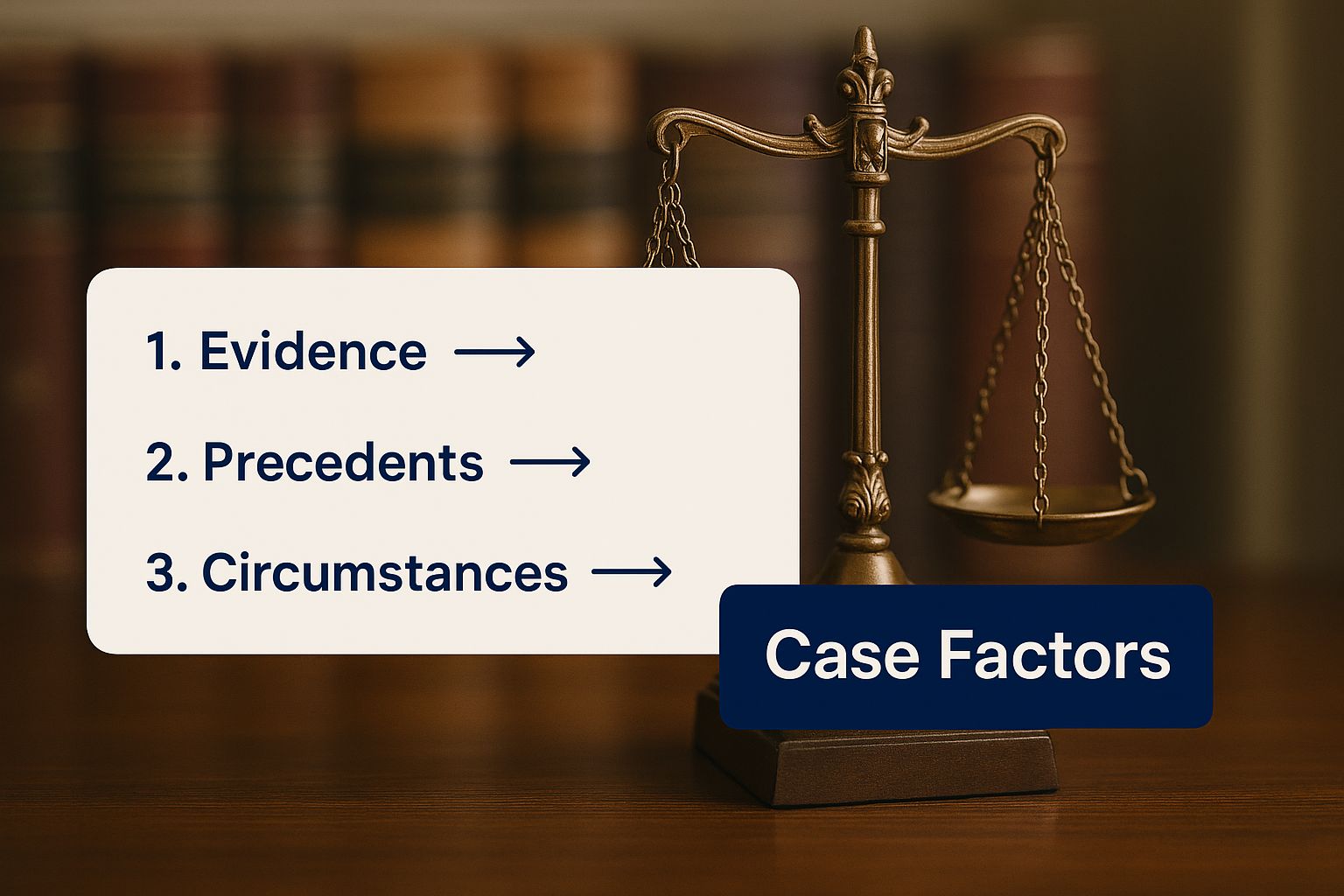
As you can see, everything from the facts of the accident to the details of your medical care has to be precisely documented and aligned to create a compelling case.
Phase 3: The Demand and Negotiation
Once we have all our ducks in a row, I'll draft a formal settlement demand letter. This isn't just a simple letter; it's a comprehensive package that lays out the facts, proves the other party was at fault, and demands a specific dollar amount to compensate you for everything you've been through.
We send this demand to the at-fault party’s insurance company, and that's what officially starts the negotiation. Don't be surprised when their first offer is insultingly low—that's just part of their playbook. I expect it, and I'll be ready with a strong counteroffer.
This back-and-forth negotiation can take several weeks or even a few months. A seasoned attorney knows the tactics insurance adjusters use to drag things out and will push back hard to get you the fair settlement you deserve without unnecessary delays.
Phase 4: Filing a Lawsuit and Potential Trial
What happens if the insurance company just won't be reasonable? If they refuse to offer a fair settlement during negotiations, our next move is to file a lawsuit.
Now, this sounds intimidating, but it's crucial to understand that filing a lawsuit doesn't mean you're automatically headed for a dramatic courtroom battle. Far from it. In reality, more than 95% of personal injury cases that are filed in court end up settling before a trial ever begins.
Often, the pressure of an official court date and the risk of facing a jury is exactly what's needed to bring the insurance company back to the negotiating table with a much better offer. While this litigation phase can add months or even over a year to the timeline, it's a vital tool for making sure justice is served when an insurer refuses to do the right thing.
Key Factors That Influence Your Case Timeline

So, why does one car accident case wrap up in six months while a nearly identical one drags on for over two years? It’s not random. The answer boils down to a handful of key variables that can either put your claim on the fast track or pump the brakes. Knowing what these are from the start helps you set realistic expectations for the journey ahead.
Every personal injury case has its own unique rhythm. No two are ever the same, and each piece of the puzzle plays a role in how long it all takes.
The Severity of Your Injuries
The single biggest driver of your case’s timeline is, without a doubt, the severity of your injuries. This might sound backward at first, but a longer and more complicated recovery almost always leads to a longer legal case. We simply can’t push for a final settlement until you’ve reached what’s known as Maximum Medical Improvement (MMI).
Think of it like building a house—you can't know the final cost until the last nail is hammered in. It's the same with your claim. We can’t accurately calculate the total value, which includes everything from future medical treatments to lost earning capacity, until your doctors have a firm grasp on your long-term prognosis. Rushing this critical stage is a huge mistake and could mean leaving a lot of money on the table.
A personal injury case timeline can stretch from one year to over five years, mostly dictated by how serious the injuries are. For instance, a case with minor cuts might settle in about 10 to 13.5 months, but one involving a traumatic brain injury could easily take 33 to 48 months—or even longer—to resolve. You can explore a full breakdown of average settlement times to see how these timelines compare.
Disputes Over Fault and Liability
Another major roadblock that can tack months onto your case is any argument over who was at fault. If the other driver or their insurance carrier refuses to accept responsibility, your claim instantly shifts from a straightforward negotiation to a contested investigation.
This change kicks off a much deeper, more detailed look into the evidence. Your attorney will have to build a rock-solid case to prove negligence, which often means:
- Hiring accident reconstruction experts to scientifically analyze the crash scene.
- Conducting depositions, which are formal, sworn interviews with witnesses to lock down a clear sequence of events.
- Digging up extensive records, like traffic camera footage or a trucking company's internal safety logs, to leave no room for doubt.
Each of these steps takes time and adds layers of complexity, turning what could have been a quick settlement into a much longer fight for the compensation you deserve.
The Insurance Company’s Tactics
Finally, you can’t overlook the behavior of the at-fault party’s insurance company. At the end of the day, insurers are for-profit businesses, and their main objective is to minimize payouts. Some are known for being particularly aggressive and will intentionally use delay tactics, hoping to wear you down until you accept a lowball offer out of sheer frustration.
These strategies can look like endless, repetitive requests for paperwork, fighting you on every single medical bill, or just going silent for long stretches. A seasoned lawyer knows these games well and understands how to apply legal pressure to keep things moving. Still, even with an expert in your corner, these tactics will almost certainly stretch out the timeline. Often, an attorney's reputation for being ready and willing to go to trial is the only thing that convinces an insurer to negotiate fairly and bring the case to a close.
What Happens When Your Case Goes to Court
Let's be realistic: while most personal injury cases settle out of court, sometimes the insurance company just won't budge. They might lowball you or flat-out refuse to offer a fair amount for what you've been through. When you hit that wall, filing a lawsuit is the only way forward.
This isn't a decision anyone takes lightly. It means your claim is moving from informal negotiations into the formal court system, a process we call litigation. Think of it this way: you’ve gone from a direct conversation to a structured, formal debate with a judge as the moderator. This shift introduces a whole new set of rules and, most importantly, a much longer timeline.
The Litigation Process Unpacked
Once a lawsuit is officially filed, the clock resets in a way. Your case enters a new, highly structured phase with its own rhythm and deadlines. The two biggest time sinks here are discovery and depositions, which are designed to make sure both sides have all the same information before ever setting foot in a courtroom.
-
Discovery: This is the formal evidence-swapping phase. Your lawyer and the defense counsel will exchange everything related to the case. This includes sending written questions (interrogatories) and requesting specific documents, like medical records or accident reports. The whole point is to avoid any "gotcha" moments at trial, but this back-and-forth can easily eat up several months.
-
Depositions: A deposition is basically a formal interview under oath. It happens outside of court, usually in a conference room. The other side’s attorney will question you, your witnesses, and any experts involved. It's a critical step where stories are locked in, and it can be one of the most drawn-out parts of the entire litigation process.
Going to court is a major strategic move. It definitely makes the answer to "how long does a personal injury case take?" much longer, but sometimes it’s the only way to force an unreasonable insurance company to do the right thing and get you the justice you deserve.
How Litigation Impacts Your Timeline
Make no mistake, heading to court adds a substantial amount of time to your case. A claim that might have settled in 15 months could easily stretch past the three-year mark once a lawsuit is filed. Why? Court calendars are packed, lawyers have scheduling conflicts, and a deep-dive discovery process all create unavoidable delays.
The numbers back this up. The median time to resolve a personal injury lawsuit can run anywhere from 20 to 31 months, depending on what your case involves. A car accident case might be on the lower end, averaging around 20 months in litigation. But something more complex, like a medical malpractice claim, often pushes closer to that 31-month mark. You can discover more insights about trial timelines and see how different case types stack up.
Ultimately, you and your attorney have to weigh the options carefully: is the chance for a bigger award at trial worth the extra time and stress, or is the certainty of a faster settlement the better path for you?
How Your Lawyer Shapes the Pace of Your Case
When you start asking, "how long is this personal injury case going to take?" it's natural to point fingers at the insurance company. But here’s something most people don't realize: the lawyer you hire has a huge say in the tempo of your claim. Think of them less as a courtroom performer and more as the strategic quarterback for your entire case.
Right from the get-go, they become your shield. A good lawyer steps in immediately, cutting off all direct communication between you and the insurance adjuster. This is critical. Adjusters are trained to coax you into saying something that could damage your claim, so having your attorney handle every call and email lets you focus purely on getting better.
Driving the Case Forward with Evidence
A proactive attorney doesn’t just sit back and wait for paperwork to show up. They go on the offensive. This early investigation is where the groundwork for a successful, and faster, case is laid. Your legal team will be actively tracking down every piece of the puzzle:
- The official police report from the accident scene
- All your medical records and bills
- Statements from anyone who saw what happened
- Expert analysis, if needed, to reconstruct the event or explain your injuries
Putting together this rock-solid package of evidence is what gives your lawyer leverage. With everything in hand, they can draft a demand letter that does more than just ask for money—it tells the insurance company why you deserve it and proves you have the evidence to back it up in court.
A thoroughly prepared demand letter tells the insurer you mean business. It shows them you aren't just guessing; you've built a case that's ready to go. This often pushes them to make a serious offer much sooner.
The Power of a Trial-Ready Reputation
Here’s a little insider secret: insurance companies keep score. They know which lawyers will take a low offer to close a file and which ones aren't afraid to step into a courtroom. An attorney known for being ready and willing to go to trial is your single most powerful asset for getting a fair settlement, faster.
That reputation completely changes the negotiation dynamic. When an insurer sees a demand letter from a firm they know will sue them, their usual playbook of delay tactics and lowball offers goes out the window. Suddenly, dragging things out becomes a much more expensive and risky option for them. This pressure forces them to the table to negotiate in good faith, which is how you get a fair resolution without unnecessary delays.
Common Questions About Personal Injury Timelines
Going through a personal injury claim can feel like you're in a constant state of waiting, and it's completely normal to have questions about how long everything will take. Let's walk through some of the most common concerns I hear from clients, because understanding the road ahead can make the journey a lot less stressful.
Can I Do Anything to Speed Up My Case?
While you can't control every piece of the puzzle—like the court's schedule or how quickly an insurance adjuster moves—your own actions can make a huge difference. Think of it this way: your legal team is driving the car, but you're the one with the map and the keys. Your cooperation keeps things moving.
Here’s what you can do to keep your case on the fast track:
- Follow your doctor's orders to the letter. Go to every appointment, every physical therapy session, and every follow-up. This is non-negotiable.
- Be responsive. When your attorney reaches out for a signature or a piece of information, try to get it back to them as quickly as you can.
- Keep everything organized. Create a simple folder for any mail or paperwork you get that's related to your accident. It'll save a ton of time later.
But here’s one thing you should never rush: your recovery. Settling a case before you and your doctors truly understand the full extent of your injuries is a massive mistake. It could mean leaving money on the table that you’ll desperately need for future care.
Do Larger Settlements Always Take More Time?
Yes, they almost always do. There’s a direct link between the value of a case and how long it takes to resolve, and it comes down to two simple reasons.
First, bigger cases usually involve more severe injuries. That means a longer road to recovery before you reach what we call Maximum Medical Improvement (MMI). We can't know the true value of your claim until we know what your long-term medical needs and limitations will be.
Second, the more money at stake, the harder the insurance company will fight. They will dig into every single detail, question who was at fault, and use every tactic in their playbook to minimize what they have to pay. That kind of intense scrutiny and tough negotiation just takes more time. For specific types of cases, such as those from vehicle collisions, you might be curious about how long it takes to settle a car accident claim, as those have their own unique timelines.
What Is Maximum Medical Improvement and Why Is It Important?
Maximum Medical Improvement, or MMI, is a huge milestone in your personal injury case. It's the point where your doctor says your condition has stabilized and further routine treatment isn’t expected to make you significantly better. You've healed as much as you're going to.
Reaching MMI is the official green light for your attorney to begin serious negotiations. It's the point where the full, final value of your claim can be calculated, including future medical costs, permanent impairment, and lost earning capacity.
Trying to settle before you hit MMI is like trying to sell a house before you know how many bedrooms it has. You simply can't ask for money to cover future needs if you don't know what those needs are yet. Once you're at MMI, it tells your lawyer that the complete picture of your damages is finally clear and it's time to demand full compensation.
If an Insurance Offer Is Too Low, Does My Case Go to Trial?
Not necessarily, and in fact, it rarely does right away. A lowball first offer is completely standard practice for insurance companies. You should see it for what it is: an opening bid in a negotiation. It's not their final answer. Your lawyer fully expects this and will hit back with a counter-demand backed by strong evidence, aiming to bridge the gap between their low offer and the amount you truly deserve.
If the insurance company digs in their heels and refuses to negotiate in good faith, then filing a lawsuit is the next step. But even that doesn't mean you're headed for a courtroom showdown. The truth is, more than 95% of cases that are filed in court still settle before a jury ever hears them. The pressure of court deadlines and the risk of a trial are often exactly what's needed to get the insurer to finally come to the table with a fair offer.
At Homefront Group, we understand that the waiting is often the hardest part. Our team, composed of fellow veterans and dedicated advocates, is here to guide you through every stage of the process with clarity and strength. Find out what you're owed by taking our free 3-minute quiz today at https://homefrontgroup.com/.