

Discovering Your Hidden Financial Advantages as a Veteran

Many veterans are unaware of the significant financial resources available to them. These resources often provide a substantial advantage over civilian counterparts. These benefits extend beyond commonly known programs and can be key to achieving long-term financial security. Understanding these advantages is the first step toward building a strong financial future. This section will explore these often overlooked opportunities and how you can use them to your benefit.
Unlocking Lesser-Known Financial Programs
Beyond the GI Bill and VA Home Loan, many lesser-known programs can significantly impact a veteran's financial well-being. For example, VA Small Business Administration loans offer favorable terms and less stringent qualifications than conventional business loans.
Additionally, programs like Veteran Readiness and Employment (VR&E) provide support for veterans with service-connected disabilities seeking employment. This includes vocational training and job placement assistance. This focused support can be invaluable when transitioning to civilian life. These programs are a powerful yet underutilized set of tools.
The Scope of Federal Investment in Veteran Financial Success
The federal government invests heavily in the financial well-being of veterans. This demonstrates a commitment to supporting those who have served. Historical data and recent federal budget proposals highlight the substantial resources allocated for veteran financial well-being. For Fiscal Year 2025, the U.S. Department of Veterans Affairs has requested $369.3 billion. This is a $32.9 billion (9.8%) increase over the 2024 estimate.
Of this total, $235.3 billion is for mandatory funding alone. This represents a 21.6%, or $41.8 billion, increase from the previous year. Find more detailed statistics here. This funding level highlights the significant resources dedicated to supporting veterans' financial needs.
Stacking Benefits for Compound Growth
The true power of these benefits lies in strategically combining them. Think of it like building blocks. Each program, from education benefits to home loan guarantees, builds a foundation for the next level of financial growth.
For instance, using the GI Bill to get a degree in a high-demand field can lead to higher earning potential. This makes it easier to secure a VA Home Loan and invest in real estate. Veterans can leverage multiple programs to create a synergistic effect, accelerating their progress toward financial independence. Understanding how to effectively combine these resources is key.
Your Military Background: A Unique Advantage
Military experience instills valuable skills. These include discipline, strategic thinking, and adaptability, all highly transferable to personal finance. These qualities, honed through service, position veterans uniquely for financial success. The disciplined approach to budgeting and saving, often learned in the military, can be a powerful tool.
Furthermore, adapting to changing circumstances, a hallmark of military life, prepares veterans to navigate the complexities of the financial world. This inherent advantage, combined with the available resources, helps set veterans apart on their path to financial security.
Mastering Your TSP For Maximum Retirement Growth
Your Thrift Savings Plan (TSP) is a powerful tool for building a secure retirement, especially for veterans. Understanding the nuances of the TSP, and particularly the differences between the BRS and Legacy systems, is key to maximizing your retirement nest egg. This involves strategic fund allocation, smart contribution timing, and taking full advantage of catch-up contributions. Let’s explore how you can optimize your TSP to achieve your retirement goals.
BRS Vs. Legacy: Understanding The Key Differences
The TSP offers two primary systems: the Blended Retirement System (BRS) and the Legacy Retirement System. The BRS, introduced in 2018, combines defined contribution and defined benefit plans. This means service members receive both a monthly pension after 20 years of service and contributions to their TSP. The Legacy system primarily offers a defined benefit pension based on years of service.
A significant difference lies in the government matching contributions. Under the BRS, the government automatically contributes 1% of basic pay to a service member’s TSP account and matches contributions up to an additional 4%. To maximize this benefit, you should contribute at least 5% of your base pay.
Data from the Federal Retirement Thrift Investment Board provides insights into participation and balance trends within both systems. Among the 1.5 million BRS participants, the average TSP balance is $17,277. The 1.25 million Legacy Retirement Plan participants have an average balance of $53,893. Impressively, 89.1% of active-duty BRS participants receive the full 5% government match. Learn more about these trends. Understanding these differences is essential for creating a personalized retirement plan.
To help visualize the key differences between the BRS and Legacy system, let's take a look at the following comparison table:
TSP Plan Comparison: BRS vs Legacy System
Side-by-side comparison of retirement benefits, contribution limits, and matching opportunities between the two military retirement systems
| Feature | Blended Retirement System | Legacy System | Key Advantage |
|---|---|---|---|
| Pension | Monthly pension after 20 years of service | Monthly pension based on years of service | Legacy System (higher pension potential for long careers) |
| Government Automatic Contribution | 1% of basic pay | None | BRS |
| Government Matching Contribution | Up to 4% of basic pay | None | BRS |
| Individual Contribution | Up to $22,500 (2024) + Catch-up | Varies | Similar |
As the table illustrates, the BRS and Legacy System offer distinct benefits. The BRS provides government contributions and matching, while the Legacy System offers a higher pension potential for long careers. Carefully consider your individual circumstances to determine which plan best suits your needs.
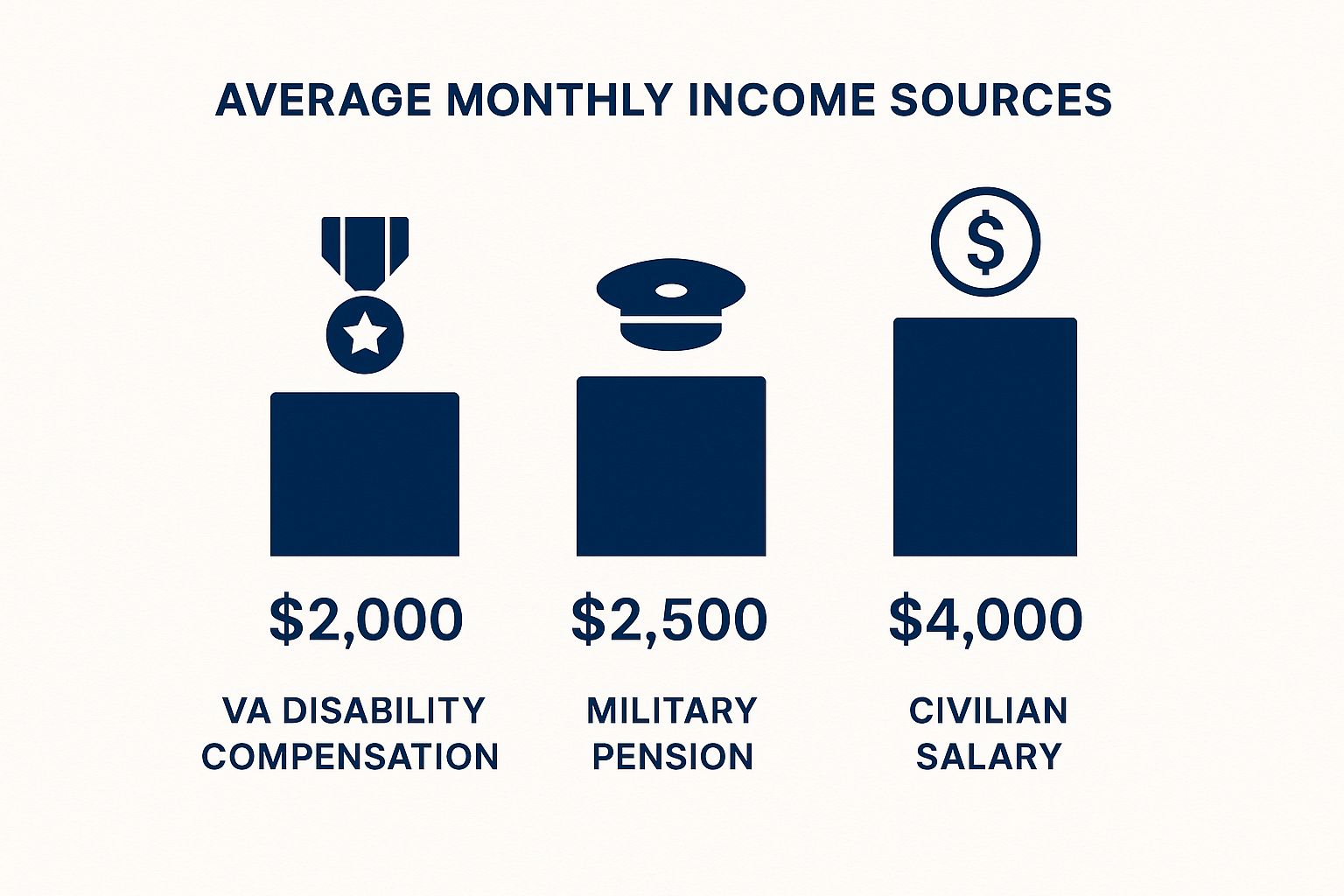
This infographic compares average monthly income from VA disability compensation, military pensions, and civilian salaries. Military pensions often provide a more substantial monthly income compared to VA disability alone. Combining these with civilian earnings creates a more robust financial foundation. This underscores the importance of considering all income sources when planning for retirement.
Advanced Strategies For Fund Allocation
Effective fund allocation is crucial for maximizing TSP growth. While diversification is important, simply spreading your contributions evenly across all funds isn't always the best approach. Consider your risk tolerance and time horizon. If you're younger and further from retirement, you may be able to accept more risk with funds like the C Fund (Common Stock Index Investment Fund), which tracks the S&P 500.
As you approach retirement, shifting towards more conservative funds like the G Fund (Government Securities Investment Fund) can help protect your savings. This strategy allows you to tailor your investments to your specific situation.
Timing Your Contributions And Withdrawals
The timing of your contributions and withdrawals significantly impacts your TSP’s performance. Consistent contributions, even small amounts, add up over time due to the power of compounding. Contributing regularly, especially early on, allows your investments more time to grow.
Careful withdrawal planning during retirement helps minimize taxes and ensures you don't deplete your savings too quickly. Strategizing both contributions and withdrawals optimizes your TSP throughout retirement.
Leveraging Catch-Up Contributions
If you are 50 or older, utilize catch-up contributions. These allow you to contribute beyond the regular limits, boosting your retirement savings. For 2024, the catch-up limit is $7,500, in addition to the elective deferral limit of $22,500. These extra contributions are a valuable tool as you near retirement.
TSP Rollovers, Loans, And Withdrawal Planning
Understanding TSP rollovers, loans, and withdrawal planning is essential for sound financial decisions. You can roll over your TSP into a civilian retirement account like an IRA or 401(k) when you leave service. This offers more control but can have tax implications. TSP loans provide access to your savings, but carefully consider interest rates and repayment terms.
Effective withdrawal planning during retirement requires considering your life expectancy, estimated expenses, and potential tax liabilities. A well-defined withdrawal strategy ensures your savings last. By maximizing these features, you can strategically use your TSP for a secure financial future.
Navigating Common Financial Hurdles Veterans Face

Transitioning from military to civilian life presents unique financial challenges. Many veterans find this period demanding, requiring careful planning and resourcefulness. This section explores common hurdles and offers solutions for veterans to maintain financial stability and build long-term wealth.
Managing Income Gaps During Transition
One of the most significant challenges veterans face is the potential income gap between military service and civilian employment. This gap can occur during the job search or when transitioning to a lower-paying civilian role. A service member with specialized military skills might need time to find a comparable civilian position. This period of unemployment or underemployment can create financial strain.
Developing a realistic budget and building an emergency fund is vital. Having 3-6 months of living expenses saved provides a safety net. This financial buffer allows veterans to focus on finding the right career path without undue financial pressure. Veterans should also explore resources like the VR&E program to gain marketable civilian skills.
Handling Service-Related Debt Strategically
Some veterans may carry service-related debt, such as student loans or credit card balances accrued during deployment. Managing this debt strategically is essential for financial stability. Debt consolidation, combining multiple debts into a single loan with a potentially lower interest rate, is one effective approach.
However, veterans should be cautious about consolidation options that might negatively impact their credit scores. Exploring debt management resources and seeking professional financial advice can help veterans make informed decisions. Proper debt management is the foundation for long-term financial health.
Overcoming Financial Literacy Gaps
Financial literacy is crucial for navigating personal finance. However, some veterans may have limited experience managing finances outside of the military structure. According to a 2024 Veteran Household Financial Health & Planning Survey by Student Veterans of America, many veteran families struggle with the military-to-civilian transition, impacting their financial stability. While GI Bill benefits and VA home loans play a critical role in socioeconomic mobility, gaps persist in financial literacy and preparedness for unexpected events. Explore this topic further.
Seeking educational resources and building a strong financial foundation is critical. Financial planning workshops and online resources can empower veterans to make informed decisions about budgeting, saving, investing, and retirement planning. Improved financial literacy builds confidence and equips veterans with the skills needed for long-term success.
Career Transition Financial Planning
Veterans transitioning to a civilian career should develop a comprehensive financial plan. This involves assessing their current financial situation, defining their financial goals, and creating a roadmap to achieve them. The plan should address income and expense projections, debt management strategies, and investment plans aligned with their risk tolerance and time horizon.
For instance, a veteran considering entrepreneurship might require a different financial plan than someone pursuing a traditional career path. Career transition financial planning helps veterans navigate this crucial stage with confidence and purpose, paving the way for lasting financial well-being. This proactive approach ensures they are prepared for the financial demands of civilian life.
Building Wealth Beyond Your Military Benefits

Transitioning from military benefits to actively building wealth requires a proactive approach. One key strategy is optimizing tax-advantaged accounts to accelerate long-term growth. This involves selecting the right accounts and maximizing contributions. You can achieve significant progress without jeopardizing the financial stability provided by military retirement.
Optimizing Tax-Advantaged Accounts
Using tax-advantaged accounts effectively helps you retain more of your earnings. Several options are available for veterans.
- Thrift Savings Plan (TSP)
- Traditional and Roth IRAs
- Health Savings Account (HSA)
Here’s a comparison of these accounts:
| Account Type | Max Annual Contribution (2024) | Tax Treatment | Veteran Advantage |
|---|---|---|---|
| Thrift Savings Plan | $23,000 | Pre-tax contributions, tax-deferred growth | Government match up to 5% |
| Roth IRA | $6,500 | After-tax contributions, tax-free withdrawals | Flexibility in retirement tax planning |
| Health Savings Account | $3,650 (self) / $7,300 (family) | Pre-tax contributions, tax-free medical expenses | Can fund long-term care costs |
Beyond tax-advantaged investing, real estate offers veterans a way to build tangible, appreciating assets.
Leveraging Real Estate Opportunities
Real estate investment can generate both appreciation and rental income. VA loans empower veterans to purchase multi-unit properties, often with no down payment. Additionally, strategies like cash-out refinancing can unlock equity for further investments. These approaches resonate with the disciplined, mission-driven mindset many veterans possess.
Creating Multiple Income Streams
Diversifying income sources beyond a pension provides a buffer against market fluctuations and career transitions. Here are a few examples:
- Consulting based on security clearances
- Online training courses leveraging military expertise
- Part-time freelance work in logistics or cybersecurity
These income streams can provide crucial financial stability during uncertain times. However, building them requires focused planning and consistent effort.
Diversifying Your Portfolio
A balanced portfolio mitigates risk associated with investing in a single sector. Consider allocating investments across various asset classes:
- Equities for growth
- Bonds for stability
- Alternative assets (REITs, commodities) for inflation protection
Regular portfolio rebalancing ensures your asset mix aligns with your risk tolerance over time.
Exploring Business Ownership
Entrepreneurship often appeals to veterans due to the leadership and problem-solving skills developed during their service. Some popular ventures include:
- Franchises with proven models
- Defense-related consulting firms
- E-commerce businesses leveraging military networks
Strategic planning and mentorship from other veteran entrepreneurs can be invaluable for achieving success.
A 2023 survey revealed that 56% of active-duty members and 41% of veterans consider themselves ‘100% financed,’ indicating they have financial plans in place. This contrasts sharply with only 7% of the non-military population. Read the full research here. This data highlights the importance of financial planning for military families and underscores the planning gap among civilians. Planning for the cost of senior care financial assistance is important to protect your family's future and the wealth you've accumulated.
Maximizing VA Loans for Real Estate Wealth Building
Your VA loan benefit is a powerful tool for building wealth, but many veterans don't fully utilize its potential. This section explores advanced strategies to leverage your VA loan beyond a simple home purchase. We'll delve into how savvy veterans are building real estate portfolios using this benefit creatively, including refinancing options, investment property considerations, and techniques to maximize returns.
Using Your VA Loan Benefit Multiple Times
A common misconception is that the VA loan is a one-time benefit. However, you can use your VA loan entitlement multiple times. Understanding how your entitlement works is key. Your full entitlement allows you to purchase a home with no down payment up to your county's loan limit.
Even after using some of your entitlement, you may still qualify for another VA loan. For example, if you've used a portion of your entitlement, you might be able to purchase a second home or an investment property by making a down payment.
Learning how to restore your full entitlement opens doors for even more opportunities. This allows veterans to expand their real estate holdings strategically over time.
Investment Property Considerations and Restrictions
Using your VA loan for investment properties can be a lucrative strategy. However, there are specific requirements. The primary requirement is that you must live in one of the units of a multi-family property (up to four units) purchased with a VA loan.
This means you can generate rental income from the other units while benefiting from the VA loan's advantages. Understanding these specific rules is crucial for maximizing your investment potential. Additionally, it's essential to thoroughly research the local rental market.
Factors like vacancy rates, property taxes, and potential maintenance costs play a significant role in the success of your investment. Careful analysis ensures veterans make informed decisions that align with their financial goals.
Refinancing Options for Savings and Wealth Growth
Refinancing your VA loan can provide substantial savings and unlock equity for further investments. The VA Interest Rate Reduction Refinance Loan (IRRRL), also known as the Streamline Refinance, allows you to lower your interest rate.
This option requires minimal paperwork and no appraisal. This process can save you thousands of dollars over the life of your loan. Another option is the VA Cash-Out Refinance Loan. This allows you to refinance your existing mortgage.
You can refinance both VA and non-VA loans and access a portion of your home's equity in cash. You can use these funds for home improvements, debt consolidation, or other investments. This provides flexibility and allows veterans to leverage their home equity.
Advanced VA Loan Strategies: Assumptions, Timing, and Multiple States
Savvy investors often use advanced VA loan strategies to maximize their returns. One such strategy is loan assumption, where a qualified buyer assumes the remaining balance and terms of your existing VA loan. This can be beneficial in certain market conditions and can facilitate a quicker sale. For veterans venturing into real estate investment, understanding online visibility is key. Learning from resources like SEO for Financial Services can be beneficial.
Another strategy is timing your real estate purchases to coincide with favorable market cycles. This requires careful market analysis and an understanding of real estate trends. You can also use your VA loan benefit in multiple states.
This provides flexibility for relocation and investment diversification. Coordinating these strategies with other investment approaches can further optimize your wealth-building plan.
VA Loan Restoration: Reclaiming Your Entitlement
Understanding the process of VA loan restoration is vital. If you've sold a property purchased with a VA loan and the buyer assumed the mortgage, you can restore your entitlement. This process involves applying to the VA and providing the necessary documentation.
Once restored, your entitlement can be used for another VA loan, maximizing your opportunities for real estate investment. This is a valuable option for veterans looking to continue building their real estate portfolios.
To help compare VA Loans with conventional financing, let's look at the table below:
VA Loan Benefits vs Conventional Financing
Comprehensive comparison showing cost savings and advantages of VA loans over traditional mortgage options
| Loan Feature | VA Loan | Conventional Loan | Veteran Savings |
|---|---|---|---|
| Down Payment | 0% | Typically 3-20% | Significant upfront savings |
| Private Mortgage Insurance (PMI) | None | Required if down payment is less than 20% | Monthly savings on PMI premiums |
| Interest Rates | Typically lower | Can be higher | Lower monthly payments |
| Closing Costs | Capped and may be paid by seller | Can be higher | Potential savings on closing costs |
| Funding Fee | Required, but can be rolled into loan | No funding fee | May increase overall loan amount |
| Credit Score Requirements | Generally more flexible | Stricter requirements | Easier qualification for veterans |
This table highlights the key differences between VA loans and conventional loans. As you can see, VA loans offer several significant advantages for veterans, including no down payment requirement, no PMI, and typically lower interest rates. While there is a funding fee associated with VA loans, the potential savings in other areas can make it a financially advantageous option.
By understanding and applying these advanced VA loan strategies, veterans can significantly enhance their wealth-building journey. This benefit, used wisely, can be a cornerstone of long-term financial success.
Estate Planning That Protects Your Military Legacy
Military service presents unique financial circumstances that require careful estate planning. This includes managing Servicemembers' Group Life Insurance (SGLI) benefits, establishing power of attorney arrangements for deployments, and ensuring the continuation of survivor benefits. Planning strategically is key to protecting your family's financial future and maximizing the transfer of your benefits. This section offers actionable guidance to help you create a personalized estate plan.
Optimizing SGLI Benefits and Survivor Protections
SGLI provides valuable life insurance coverage for service members. Keeping your beneficiary designations current is critical. While this may seem simple, life changes such as marriage, divorce, or having a child require prompt updates. Failing to do so can result in benefits being distributed to unintended parties.
You should also consider supplementing SGLI with private life insurance, particularly if you have dependents. Assessing your family's financial needs and planning accordingly ensures adequate coverage.
Understanding how SGLI coordinates with other survivor benefits, such as Dependency and Indemnity Compensation (DIC), is also important. DIC provides monthly payments to eligible surviving spouses and children of service members who die on active duty or from service-connected causes. Coordinating these benefits maximizes financial security for your loved ones.
Structuring Power of Attorney for Deployments
Deployments often necessitate granting power of attorney to a trusted person to manage your finances while you are away. A durable power of attorney is crucial, ensuring it remains valid even if you become incapacitated. Clearly defining the scope of this authority protects your interests.
Specify whether the power of attorney covers only finances or also healthcare decisions. Regularly review and update your power of attorney, especially before deployments, to align with your current wishes and circumstances.
Minimizing Taxes on Military Retirement Benefits
Military retirement benefits can be subject to both federal and state taxes. Understanding the tax implications of your retirement plan is crucial. Strategies like contributing to tax-deferred retirement accounts, such as the Thrift Savings Plan (TSP), can help reduce your taxable income.
Exploring state tax benefits for veterans can also minimize your tax burden. Some states offer exemptions for military retirement pay. A financial advisor specializing in military benefits can provide personalized guidance.
Trusts and Guardianship Considerations for Military Families
Trusts offer distinct advantages for military families, particularly in asset protection and providing for dependents. A revocable living trust allows you to maintain control of your assets during your lifetime while specifying their distribution after your death.
This can help avoid probate, a potentially lengthy and costly legal process. For families with minor children, establishing guardianship within your estate plan is essential. This designates a caregiver in the event of both parents' deaths. Clearly outlining your guardianship wishes ensures your children's care.
Estate Planning for Military-Specific Assets
Military service can lead to unique assets like veterans' life insurance policies or military decorations and medals. Incorporating these into your estate plan is important. Specifying their distribution prevents potential family disputes.
You may wish to bequeath medals to a specific heir or establish a trust to manage life insurance proceeds for your children's education. Addressing these specific assets ensures your wishes are honored.
Updating Your Estate Plan for Life Changes
Estate planning is not a one-time event. Regularly review and update it to reflect life changes, such as marriage, divorce, the birth or adoption of a child, changes in finances, or relocation.
These events can significantly impact your estate plan and require revisions to keep it aligned with your goals. Just as your financial situation changes, so should your estate plan.
Securing Your Family's Future: A Holistic Approach
Estate planning involves more than just a will. It’s about developing a holistic strategy to protect your assets, minimize taxes, and provide for your loved ones. A comprehensive estate plan includes:
- Will: Distributes your assets after death.
- Durable Power of Attorney: Authorizes someone to manage your finances.
- Healthcare Power of Attorney: Appoints someone to make healthcare decisions.
- Living Will: Outlines your end-of-life medical preferences.
- Trusts: Manage and distribute assets under specific terms.
Integrating these components ensures comprehensive protection for your family and legacy. Ready to secure your family's future and create a lasting legacy? Homefront Group provides specialized legal and professional services for veterans, including expert estate planning guidance. Schedule a free consultation with Homefront Group to protect your military legacy.