
Understanding Your Veteran Benefits Foundation
Figuring out your eligibility for veteran benefits can feel like trying to solve a complex puzzle with missing pieces. At its core, though, the entire system rests on a few fundamental principles. Think of it like building a house: before you can worry about paint colors or furniture, you must pour a solid foundation. For veteran benefits, this foundation has two main materials: your type of military service and your character of discharge. Getting these two elements right is the critical first step.
Your journey into benefits begins with your service record. The Department of Veterans Affairs (VA) must first confirm that you served on active military, naval, or air duty. This is the cornerstone of your eligibility. Just as important, however, is the story of how your service ended.
Why Your Discharge Status Is a Gateway
Your discharge status, documented on your DD-214, is like a gateway to most VA programs. It's the VA's initial checkpoint to see if your service meets the necessary standard. To qualify for most VA benefits, a veteran must have a discharge under conditions other than dishonorable. This is why a "dishonorable" discharge can unfortunately close the door to many federal benefits, while an "honorable" discharge opens it wide.
Veterans who qualify for health care are often organized into priority groups based on factors like service-connected disabilities and income levels. You can find more detailed official guidance in the most recent federal benefits handbook.
The VA's own website offers a clear starting point for understanding disability benefits eligibility.
As the image shows, eligibility for disability compensation depends on having both a current condition affecting your mind or body and having served on active duty, active duty for training, or inactive duty training.
Comparing Discharge Types and Potential Benefits
Not all discharges are the same, and their effect on benefits can be substantial. While an honorable discharge offers the most direct path, other discharge types create more layered situations. It’s not a simple "yes" or "no" system; it's more of a spectrum of access. Some benefits might be available with a general discharge, while others have stricter requirements. Knowing where you stand on this spectrum is key to managing your expectations and preparing a strong application.
To help clarify these differences, the table below shows how various discharge statuses can impact your eligibility for major VA benefit programs.
Discharge Status and Benefit Eligibility Overview
Comparison of how different discharge statuses affect eligibility for various veteran benefits
| Discharge Status | VA Health Care | Disability Benefits | Education Benefits | Home Loans |
|---|---|---|---|---|
| Honorable | Generally Eligible | Generally Eligible | Generally Eligible | Generally Eligible |
| General (Under Honorable Conditions) | Generally Eligible | Generally Eligible | Generally Eligible | Generally Eligible |
| Other Than Honorable (OTH) | Limited Eligibility* | Limited Eligibility* | Limited Eligibility* | Limited Eligibility* |
| Bad Conduct (from Special Court-Martial) | Limited Eligibility* | Limited Eligibility* | Limited Eligibility* | Limited Eligibility* |
| Dishonorable | Generally Ineligible | Generally Ineligible | Generally Ineligible | Generally Ineligible |
*Eligibility in these cases often requires a special determination from the VA, a process known as a Character of Discharge review.
As you can see, an Honorable or General discharge typically grants access to all major benefits. However, for Other Than Honorable or certain Bad Conduct discharges, eligibility isn't an automatic "no"—it just means the VA needs to conduct a more detailed review of the circumstances of your discharge. A Dishonorable discharge, however, generally makes a veteran ineligible for these benefits.
With this foundational knowledge of service and discharge requirements, you are better equipped to approach the next steps with confidence. Once this base is established, you can begin to explore how the specific details of your service history open up unique pathways to the benefits you have earned.
Making Your Service History Work for You
Your military service tells a unique story, and understanding how each chapter affects your benefit eligibility is essential. Think of your service record not as a static document, but as a collection of keys. Different keys—like your active duty time, National Guard weekends, or overseas deployments—unlock different doors. The trick is knowing which key fits which lock, ensuring you access every benefit you've rightfully earned.
This knowledge is what separates veterans who maximize their support from those who unknowingly leave benefits behind. The distinction between service types is fundamental to establishing your eligibility for veteran benefits. For example, a veteran with four years of continuous active duty has a different eligibility profile than a reservist who served for twenty years but was only federally activated for specific missions.
Active Duty vs. Reserve and National Guard Service
The most direct route to many VA benefits often comes from active duty service, which is full-time service in the U.S. Armed Forces. However, members of the National Guard and Reserve also earn significant benefits, especially when called to federal active duty under a presidential order. Here are the key factors:
- Length of Service: Many benefits, particularly education programs like the Post-9/11 GI Bill, require a minimum period of active-duty service.
- Activation Status: For Guard and Reserve members, the type of orders you served under is critical. Federal active-duty service (Title 10 orders) typically counts toward VA benefits. In contrast, state active duty (Title 32 orders) often does not, although some exceptions exist.
- Deployment History: Serving in a combat zone can establish a presumption of service connection for certain health conditions. This is a vital element when filing for disability compensation.
To present your service record effectively, you need to organize your documents—like your DD-214s, activation orders, and performance reports—to clearly show that you meet the specific time and status requirements for each benefit you're applying for.
Special Circumstances and International Perspectives
Not every military career follows a conventional path. Situations like medical separations or early discharges need careful consideration. A medical separation, for instance, can be a direct route to disability benefits if the condition is proven to be service-connected.
It's also useful to see how other countries support their veterans. Canada’s approach to eligibility for veteran benefits is based on service in the Canadian Armed Forces (CAF). Their Financial Benefits Program offers crucial economic aid to veterans and their families. Projections indicate that the number of recipients is set to grow from 29,000 to 38,200 over five years, with program spending increasing from $1.114 billion to $1.628 billion. You can learn more about Canada's expanding support for its veterans and their families.
The image below illustrates the financial support programs for Canadian veterans, showcasing different benefit types.
This shows a strong commitment to providing a safety net with programs for income replacement and compensation for pain and suffering. By understanding both the rules here at home and the approaches of other nations, you gain a fuller perspective on how to make your unique service history work for you and your family.
The Game-Changing Toxic Exposure Breakthrough
For decades, many veterans have been caught in a frustrating cycle: they felt certain their health problems were linked to their service, but they couldn't provide the specific proof the VA required. This invisible wall has finally come down. The most significant change in eligibility for veteran benefits in recent memory is here, all thanks to new laws centered on toxic exposure. This is more than a small adjustment; it’s a fundamental shift that opens doors for millions who were previously turned away.
This breakthrough flips the old system on its head. Previously, the entire burden of proof fell on the veteran. It was like being asked to find a single, specific drop of contaminated water in the middle of an ocean. Now, the system recognizes that if you served in certain locations during specific periods, your exposure is presumed.
A New Era of Presumptive Conditions
Think of presumptive conditions as a direct path to getting the benefits you've earned. If you have a diagnosed condition that is on the VA's presumptive list and you served in a qualifying location and time, the VA automatically agrees that your illness is connected to your service. You no longer need to spend years fighting to establish that crucial link. This change is the direct result of tireless advocacy and a better understanding of the long-term health consequences of various service environments.
This is especially important for illnesses that can take years, or even decades, to show up, such as specific types of cancer. For instance, a veteran who served near a burn pit in Iraq and later developed respiratory problems no longer has to pinpoint the exact source or moment of their exposure. Their service record in that location is now the key piece of evidence.
The PACT Act is the foundation of this new approach, clearly defining many of these presumptive conditions and locations.
This screenshot from the VA’s official resources shows the core promise of the legislation: finally connecting veterans to the benefits they earned through their service and sacrifice. This change directly tackles the long-standing challenge of proving a link between a health condition and toxic exposure during service.
Direct Enrollment: A Faster Path to Care
This renewed focus on toxic exposure has also made it much easier to get into the VA health care system. A major expansion has created a more direct pathway for many veterans. Starting March 5, 2024, the VA initiated direct enrollment for veterans who were exposed to toxins and other hazards. This means that any veteran who served in the Vietnam War, Gulf War, Iraq, Afghanistan, the Global War on Terror, or any other combat zone after 9/11 can enroll directly in VA health care without first applying for other benefits. This is a huge step forward, removing a major bureaucratic obstacle. You can read more about this pivotal VA health care expansion on their official news site.
What Does This Mean for You?
This breakthrough means your eligibility for veteran benefits could be completely different today than it was just a few years ago. If you were denied in the past, now is the perfect time to take another look at your situation. Here’s what you can do:
- Review your service locations: Check if your deployment areas are now recognized as locations with presumed exposure risks.
- Document your health: Even with presumptions, keeping a clear and detailed record of your diagnosis and symptoms is still very important.
- Re-apply if needed: A previous denial does not stop you from filing a new claim under these new, expanded rules.
As you consider the impact of toxic exposure, being informed about related medical science is helpful. Many conditions linked to burn pits or Agent Orange involve respiratory illnesses. Learning about recent advancements in lung cancer breakthroughs can give you valuable context for conversations with your doctors and help you build a stronger case for your benefits. This proactive approach helps you take control of your health journey and your benefits claims.
Cracking the Priority Group Code
Navigating the Department of Veterans Affairs (VA) health care system can sometimes feel complex. You might know you're eligible for care, but understanding how and when you'll receive it often comes down to a single, critical factor: your priority group. This system is the VA's method for organizing who gets enrolled for care, in what order, and what it might cost. Understanding how it works is key to making the most of your earned benefits.
Think of the priority group system as a sorting process for VA health care. It doesn’t determine your basic eligibility for veteran benefits, but it does place every enrolled veteran into one of eight distinct groups. This structure helps the VA manage its resources and make sure that veterans with the most urgent health needs—like those with significant service-connected disabilities—are first in line. Your specific group assignment depends on factors like your disability rating, income level, and other special circumstances.
How Priority Groups Impact Your Access to Care
Your assigned priority group has a direct effect on your health care experience. A lower group number (with Group 1 being the highest priority) generally means quicker access to appointments and fewer, or even zero, copayments for medical services and prescriptions. The VA uses a clear hierarchy to assign veterans to these groups.
The infographic below illustrates the fundamental steps in the veteran benefits application process, which is the journey that leads to determinations like your priority group placement.
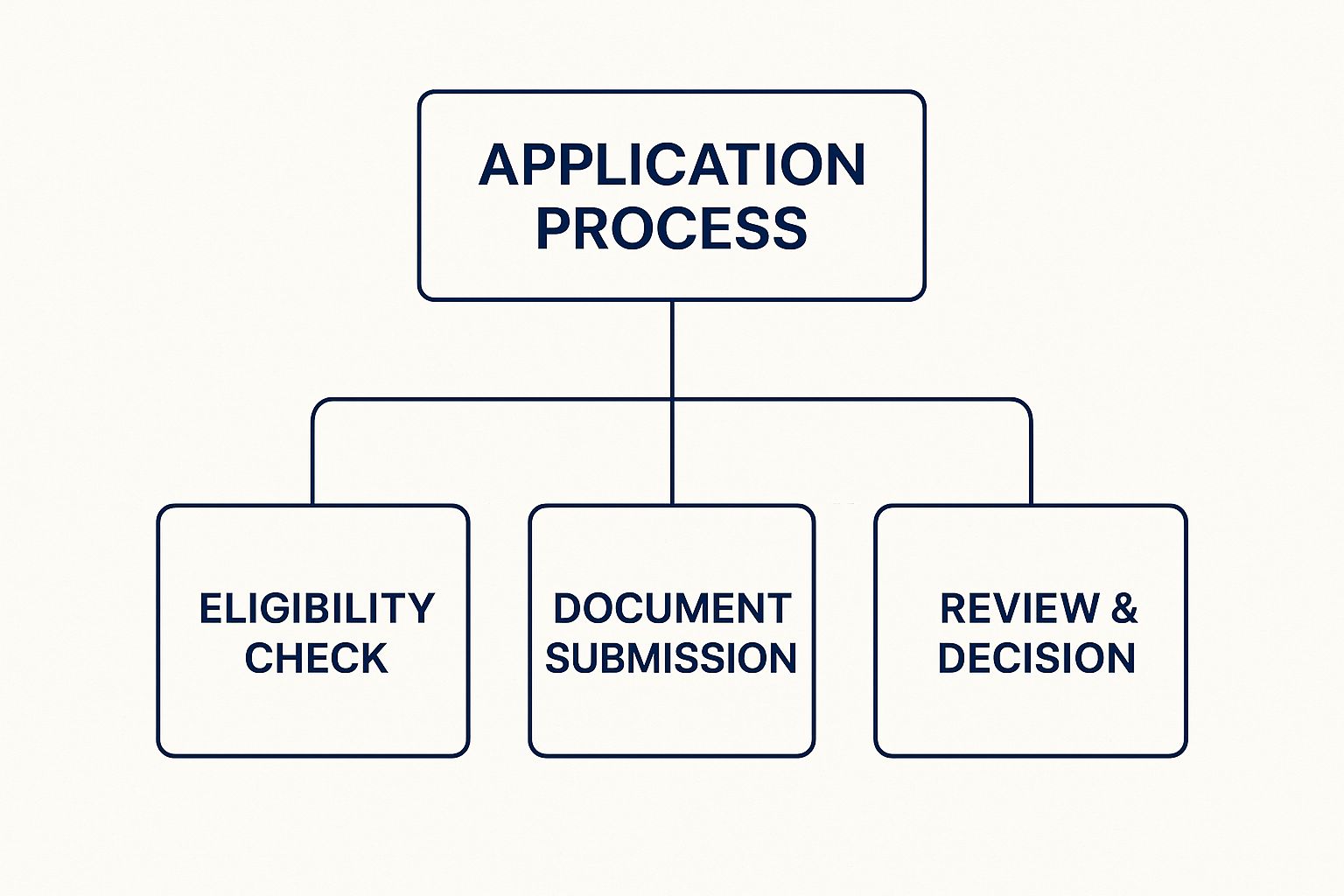
This process shows that the VA's review and priority group assignment can only happen after your basic eligibility is confirmed and all necessary documents are submitted.
To better understand how this works, here’s a look at the criteria for the highest priority groups:
- Group 1: Includes veterans with a VA service-connected disability rating of 50% or more, or those who have been determined by the VA to be unemployable due to their service-connected conditions.
- Group 2: Is for veterans holding a service-connected disability rating of 30% or 40%.
- Group 3: Covers former Prisoners of War (POWs), recipients of the Medal of Honor, and veterans with a disability rating of 10% or 20%.
In contrast, veterans in the lower priority groups (like Groups 7 and 8) often have no service-connected disabilities, and their eligibility hinges on their income. If your income is above certain VA limits, you may be required to make copayments for your care.
The table below provides a detailed breakdown of each priority group, outlining the specific criteria, copay requirements, and general enrollment status for each.
| Priority Group | Eligibility Criteria | Copay Requirements | Enrollment Status |
|---|---|---|---|
| Group 1 | Service-connected (SC) disability rated 50% or more; determined unemployable by VA. | No copays for inpatient/outpatient care or medications. | Highest priority for enrollment. |
| Group 2 | SC disability rated 30% or 40%. | No copays for SC conditions; may have copays for non-SC care. | High priority for enrollment. |
| Group 3 | Former POW; Medal of Honor recipient; SC disability rated 10% or 20%. | No copays for SC conditions; may have copays for non-SC care. | High priority for enrollment. |
| Group 4 | Receiving Aid and Attendance or Housebound benefits; determined catastrophically disabled by VA. | No copays for most care. | High priority for enrollment. |
| Group 5 | Do not meet Group 4 criteria but receive VA pension benefits or are eligible for Medicaid. | No copays for most care. | Enrollment is likely. |
| Group 6 | Exposed to Agent Orange, radiation, or environmental contaminants; served in specific combat theaters after 11/11/1998. | No copays for conditions related to exposure/service; may have others. | Enrollment is likely. |
| Group 7 | Gross household income is below VA's geographically-adjusted income limits (GMT). | Copays are required for most care and medications. | Enrollment depends on VA's capacity and funding. |
| Group 8 | Gross household income is above VA's income limits. | Copays are required for all care and medications. | Lowest priority; enrollment may be restricted. |
As the table shows, a veteran's service-connected disability status is the most significant factor in determining their priority for enrollment and their out-of-pocket costs. The system is designed to give preference to those whose health was impacted by their military service.
Strategies to Improve Your Priority Status
The most direct path to a higher priority group is to file a successful claim for a service-connected disability or request an increase to an existing disability rating. For instance, a veteran in Group 7 due to income who later gets a 10% disability rating for tinnitus would move up to Group 3. This change not only secures their enrollment in the health care system but also gets rid of copays for treating their tinnitus.
It is also important to keep the VA informed of major life changes. A significant decrease in your income could potentially move you from a group that requires copays to one that doesn't. Similarly, if you're diagnosed with a new condition that might be linked to your service—especially with expanded rules for toxic exposures—it's a good reason to file a new claim. By understanding this system, you can ensure you are always placed in the highest priority group you qualify for, giving you access to the full range of care you've earned.
Benefits That Extend Beyond the Veteran
Your military service is a point of pride, but its impact reaches far beyond just you. The benefits you've earned are not just for you alone; they can act as a protective shield for your entire family. Eligibility for veteran benefits often extends to spouses, children, and sometimes even dependent parents, though many veterans aren't aware of how deep this support system goes. It's like finding out your car insurance also covers your family members when they borrow your car—a powerful and often overlooked layer of security.
These family-oriented benefits are structured to offer stability through life's biggest moments. Whether you're getting married, welcoming a child, or going through a divorce, these events can directly influence your family's access to VA programs. Understanding how these life changes affect your benefits is key to making sure your loved ones are always covered.
Navigating Life Changes and Dependent Eligibility
A veteran's family is rarely static, and the VA understands this. When you get married or have a child, you can add them as dependents, which can lead to an increase in your monthly disability compensation payment. On the other hand, events like a divorce or a child becoming too old for dependent status require you to update your information so your benefits are calculated accurately.
Think of your dependents as passengers traveling with you on your benefits journey. You hold the main ticket, but they can come aboard under certain conditions. To add a dependent, you'll usually need to provide official documents like a marriage or birth certificate. This simple process can unlock a new level of support for your household. The VA also considers special situations, such as extending benefits for children with disabilities beyond the standard age limit, ensuring a continuous safety net for those who require it most.
The VA's official website is a great starting point for seeing the different benefits available to family members.

This resource breaks down the main types of support, from healthcare and education to home loans and survivor benefits, helping families quickly see which programs they might be eligible for.
Survivor Benefits: A Legacy of Care
One of the most important parts of family benefits is the support provided to survivors. If a veteran passes away, their spouse or children may be eligible for several programs designed to provide financial stability during a very tough time. These are not handouts; they are earned benefits that honor a veteran's service by continuing to look after their family.
Key survivor benefits include:
- Dependency and Indemnity Compensation (DIC): A tax-free monthly payment for eligible survivors of service members who died in the line of duty or from a service-related injury or illness.
- Survivors Pension: A benefit based on financial need for low-income, un-remarried surviving spouses and unmarried children of deceased veterans with wartime service.
- Education and Training (Chapter 35): Spouses and children of veterans who are permanently and totally disabled from a service-connected condition, or who died on active duty or from a service-related condition, may qualify for education benefits.
- VA-Backed Home Loans: In many situations, a surviving spouse who has not remarried can still use the VA home loan guaranty benefit.
Getting these benefits often depends on good planning and open communication within the family. Making sure your loved ones know where to find your military records (like your DD-214) and have a basic understanding of these programs can make a huge difference. By having these conversations and preparing your family, you help ensure your legacy of service continues to protect them.
Mastering the Application Process
Knowing you’re eligible for veteran benefits is the first half of the battle; successfully navigating the application is the other. The difference between an approved claim and one that gets stuck in delays often boils down to preparation and knowing how to present your case. Think of it like building a detailed legal argument where every single piece of evidence is crucial. The VA handles millions of claims, so a well-organized and thoroughly documented application will always stand out.
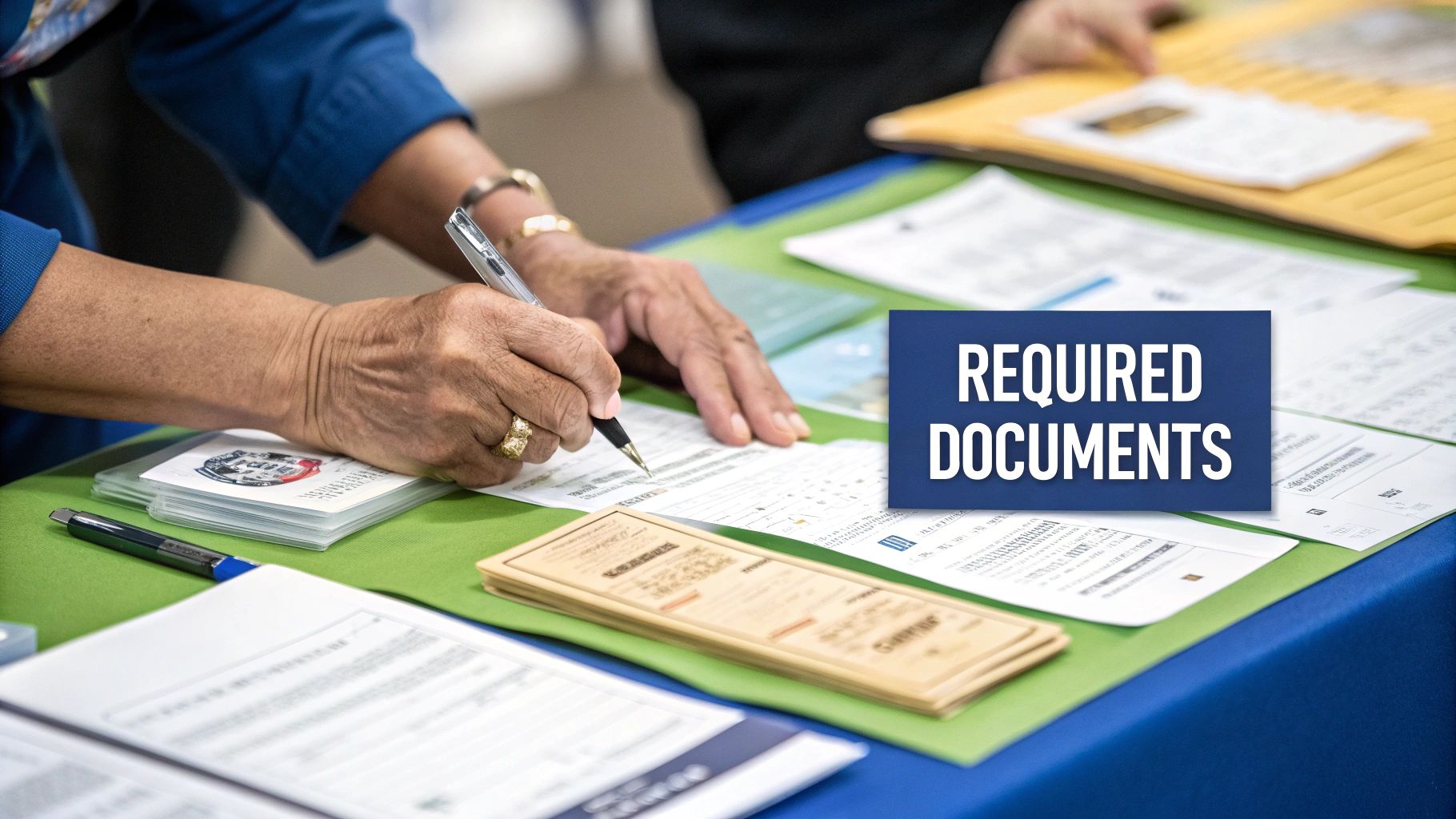
Building a Strong Foundation for Your Claim
The application process actually starts long before you fill out the first form. It begins with gathering the right proof. While your DD-214 is a cornerstone document, a successful claim—especially for disability compensation—requires much more.
Here are the essential components you'll need to assemble:
- Medical Records: This includes your service treatment records (STRs) and any records from civilian doctors related to your condition. These documents are needed to show a current diagnosis.
- Service Records: Look beyond your DD-214. Find any documents that can place you at a specific location or time, which is especially important for claims related to toxic exposures. This could be anything from performance reports and orders to award citations.
- Buddy Letters and Personal Statements: Don't underestimate the power of personal accounts. Statements from fellow service members, family, or friends who can speak to how your condition started or has impacted your life can be very influential. Your own written statement, explaining the "before and after" of your condition, provides essential context that records alone cannot.
The VA provides official guidance on how to file a disability claim, which outlines these steps.
This screenshot highlights that the process involves gathering documents and submitting the claim, with an average decision time of just over 100 days. This timeline shows why submitting a complete and organized package from the very beginning is so important to prevent unnecessary setbacks.
Common Mistakes and How to Avoid Them
Even with all the right paperwork, simple errors can sideline your application. A very common mistake is submitting an incomplete form or not responding quickly when the VA requests more information. Another frequent problem is failing to clearly connect your current disability to a specific event or injury during your service. This connection, or "nexus," is where your personal statement and supporting evidence become absolutely vital.
What to Do If Your Claim Is Denied
A denial is not the end of the line; it’s a chance to make your case stronger. The VA is required to tell you exactly why your claim was denied. Read the decision letter carefully to understand the specific reason. It could be anything from missing medical proof to an insufficient nexus between your condition and your service.
If you get a denial, you have a few ways to appeal:
- Supplemental Claim: This is often the best first move. It allows you to add new and relevant evidence that you didn't include in your original application.
- Higher-Level Review: You can request that a more senior claims adjudicator review the exact same evidence to see if a mistake was made.
- Board Appeal: You can take your case directly to the Board of Veterans' Appeals.
Successfully appealing a decision takes a strategic approach. It usually means getting more specific medical opinions or digging up new evidence that directly addresses the VA’s reason for the denial. By understanding these common issues and preparing a thorough, well-supported application from the start, you greatly improve your odds of a smooth and successful outcome.
Advanced Strategies for Maximum Benefits
Securing your basic benefits is a major step, but fully mastering the system means knowing how to layer and optimize every opportunity you've earned. Many veterans don't realize they are leaving significant value on the table. Moving beyond the basics requires a strategic mindset, much like a chess player thinking several moves ahead. This means viewing your federal benefits not as a single source of aid, but as a foundation for building a stronger financial and wellness future.
The key is to combine different programs for the greatest effect, a process often called "benefit stacking." For instance, a veteran receiving VA disability compensation could also qualify for Vocational Rehabilitation and Employment (VR&E) services. By using VR&E for education, they could save their Post-9/11 GI Bill benefits for a later degree or even pass them on to a child or spouse, effectively doubling the educational value from their service.
Leveraging State and Local Programs
Federal benefits are just one piece of the puzzle. A large, and often overlooked, source of support comes from state and local governments. These programs can provide serious financial relief, particularly when it comes to taxes. For example, most states in the U.S. offer property tax exemptions for disabled veterans. A veteran in Florida with a 100% permanent and total disability rating might not have to pay any property taxes on their main home. Likewise, over 30 states provide income tax breaks on military retirement pay.
These state-level perks go beyond just taxes. They can include anything from cheaper hunting and fishing licenses to getting preference for state government jobs. The VA's resource page is an excellent place to start looking for benefits that go beyond the federal level.
This image illustrates how the VA guides veterans to different resources, highlighting that support is available far beyond the core VA services. The important lesson here is that you need to be proactive and search for these local benefits, as they are not automatically given with your federal eligibility.
Knowing When to File for an Increase
Your eligibility for veteran benefits is not set in stone. As your health and life situations change, your benefits should change too. A common advanced tactic is understanding when and how to file for a disability rating increase. This is the right move if:
- A service-connected condition has gotten worse.
- You have a new health issue that you think is caused by an existing service-connected disability.
- New laws, such as the PACT Act, establish a presumptive connection for a condition you already have.
To be successful, you will need new medical evidence that clearly demonstrates your condition has worsened since your last rating. Keeping thorough medical records and getting opinions from specialists are vital steps. Working with a Veteran Service Organization (VSO) or a qualified professional can make a huge difference. A skilled representative can help you build a strong case, find lesser-known benefits like adaptive housing grants, and keep you informed about policy changes that might impact your long-term plan. This forward-thinking approach ensures your benefits match your current needs, maximizing the support you've earned.
At Homefront Group, we specialize in helping veterans work through these complex strategies. Our team of seasoned professionals, many of whom are veterans themselves, can help you find every benefit you qualify for and create a personalized plan to secure your future. Take our free 3-minute quiz today to start maximizing your benefits. Find out what you're owed.