

Before you can get any VA benefits for your diabetes, you have to prove it’s connected to your military service. This isn't just about having a diagnosis; it's about showing the VA how your service led to the condition. Think of it as building a case.
Learning how to do this is the most important part of filing a successful claim. Let's break down the different ways you can establish that all-important service connection.
Proving Service Connection for Your Diabetes Claim
To win a diabetes VA disability claim, you need to establish a clear link—what the VA calls a "nexus"—between your Type 2 diabetes and your time in uniform. Basically, you have to show that your military service either directly caused your diabetes, made it worse, or is legally presumed to be the cause.
The VA gives you three main avenues to do this. Which one you take really depends on your specific medical history and service record. Getting this first part right is crucial, as it lays the groundwork for your entire claim, from your C&P exam to your final rating.
Let's look at the three ways you can connect your diabetes to your service. The table below gives a quick overview, and then we'll dive into the details of each.
Pathways to Service Connection for Diabetes
| Connection Type | What It Means | Example Scenario |
|---|---|---|
| Direct Connection | An event or injury during your service directly caused your diabetes. | You suffered a pancreatic injury during combat, and medical records show your diabetes diagnosis followed that specific event. |
| Secondary Connection | Another service-connected condition you already have caused or contributed to your diabetes. | Your service-connected PTSD and the associated stress led to weight gain and hormonal changes, which then triggered Type 2 diabetes. |
| Presumptive Connection | The VA automatically assumes your diabetes is service-connected because you served in a specific place and time (e.g., exposed to Agent Orange). | You served in Vietnam during the war and were later diagnosed with Type 2 diabetes. The VA presumes the connection. |
Now, let's explore what each of these pathways looks like in a real-world claim.
The Direct Service Connection Pathway
A direct service connection is exactly what it sounds like. You're arguing that something specific that happened to you on active duty directly caused your diabetes. This path requires solid evidence to draw a straight line from an in-service event or injury to your diagnosis.
For example, I've seen cases where a veteran sustained a severe injury to their pancreas while in service. If their service medical records document that injury, and a doctor later provides a medical opinion stating the pancreatic damage led to the diabetes diagnosis, that’s a strong foundation for a direct connection claim. The key is having the paper trail.
Establishing a Secondary Connection
It's very common for veterans to develop diabetes because of another condition they're already service-connected for. We call this a secondary service connection. The first condition doesn't have to be a physical injury, either.
A classic example is a veteran who is service-connected for PTSD. The chronic stress and hormonal shifts that come with PTSD can often lead to weight gain and insulin resistance, which are known precursors to Type 2 diabetes. To connect these, you'd need a doctor to write a nexus letter stating that it's "at least as likely as not" that your service-connected PTSD contributed to you developing diabetes.

As you can see, a large majority of veterans—75%—end up with a rating of 30% or lower. This really drives home the point that you need to be thorough with your evidence if you want a rating that truly reflects how much the condition impacts your daily life.
Leveraging the Power of Presumptive Conditions
The third route, presumptive service connection, can be the most powerful for many veterans. For certain groups, the VA simply presumes their condition is linked to their service. This means you don't have to prove a direct cause-and-effect relationship.
For veterans with Type 2 diabetes, this is a game-changer. The VA acknowledges that exposure to certain tactical herbicides, most notably Agent Orange, is associated with an increased risk of developing diabetes.
If you served in places like Vietnam, the Korean DMZ, or certain areas in Thailand during specific timeframes, this presumptive status is a huge advantage. You can learn more about how presumptive eligibility for diabetes works from legal experts who specialize in this area. It means you may be eligible for benefits without the heavy burden of proving exactly how your service caused the condition.
How the VA Assigns Disability Ratings for Diabetes

Once the VA agrees your diabetes is service-connected, the next big step is figuring out your disability rating. This isn't just some random number; it's a specific calculation that directly impacts the compensation you receive each month. The VA follows a detailed formula laid out in the Code of Federal Regulations, specifically under Diagnostic Code 7913 for Diabetes Mellitus.
Getting a handle on this formula is one of the smartest things you can do for your claim. It turns the whole process from a confusing black box into a clear roadmap. When you and your doctor know exactly what the VA raters are looking for, you can provide the specific evidence they need to see the full picture of how diabetes impacts your day-to-day life.
Ultimately, the rating system all comes down to how severe your symptoms are and what it takes to keep them under control. Let's walk through what each rating level actually means in practice.
The 10 Percent and 20 Percent Ratings
The lower ratings are typically for veterans whose diabetes is less severe or is managed with minimal intervention. These ratings are a critical starting point and can always be increased down the road if your condition gets worse.
- A 10% rating is assigned if your diabetes is manageable with diet alone. This means you don't need insulin or pills, but you absolutely must follow specific dietary rules to keep your blood sugar in check.
- The 20% rating is a step up from there. You’ll land here if you require daily insulin shots or take oral hypoglycemic medication, on top of following a restricted diet.
A lot of veterans start out at the 20% level, especially if they’re put on Metformin or a similar medication right after being diagnosed. Just remember, even for this rating, your medical records have to clearly document your prescriptions and your required diet.
The 40 Percent Rating: The Importance of Activity Regulation
To get a 40% VA disability rating for diabetes, the bar is set a bit higher. This level shows the VA that your condition has a much more significant impact on your daily routines and overall lifestyle.
At this point, it's not enough to just show you're on insulin and a special diet. The VA is looking for proof that you need a “regulation of activities.” That’s a key phrase. It means your diabetes stops you from doing certain things—whether it's at work or for fun—because it could dangerously mess with your blood sugar.
Think about a veteran who can no longer handle a physically demanding job or has to give up a strenuous hobby because of the risk of a hypoglycemic event. Your doctor’s notes need to spell out these kinds of limitations explicitly to back up a 40% claim.
Key Takeaway: The jump from 20% to 40% often hinges on proving your condition restricts more than just what you eat—it restricts what you can safely do. This must be crystal clear in your medical evidence.
The 60 Percent Rating: Adding Complications to the Mix
Securing a 60% rating means you're dealing with a severe and disruptive case of diabetes. The criteria get much tougher here and demand proof of serious health episodes directly caused by your condition.
To qualify for a 60% rating, you have to show:
- Daily Insulin: One or more insulin injections are required every day.
- Restricted Diet: You're still sticking to a medically necessary diet.
- Regulation of Activities: You have documented limits on your physical activities.
- Significant Episodes: You suffer from ketoacidosis or hypoglycemic reactions that lead to one or two hospitalizations a year or require you to see your diabetic care provider at least twice a month.
This is where your personal logbooks, ER visit summaries, and regular appointment notes become absolutely essential. Every documented hypoglycemic event or visit for ketoacidosis helps build a rock-solid case for this higher rating.
The 100 Percent Rating: The Highest Level of Impairment
The 100% disability rating for diabetes is reserved for veterans battling the most severe and life-altering symptoms. The requirements reflect a condition that is incredibly difficult to manage and has a profound daily impact. The U.S. Department of Veterans Affairs (VA) assigns disability ratings for diabetes mellitus from 10% to 100%.
To get a 100% rating, you need to show you require multiple daily insulin injections, a restricted diet, regulation of activities, and experience severe complications like ketoacidosis or hypoglycemia that demand at least three hospitalizations per year or weekly visits to your diabetic care provider. If you want to dig deeper, you can learn more about how the VA assigns these ratings for diabetes mellitus and what evidence is required.
On top of the frequent hospital stays or weekly doctor visits, the VA is also looking for evidence of progressive weight loss and loss of strength, or other severe complications that get rated separately. This top rating acknowledges that diabetes has become the central, debilitating focus of a veteran's life, demanding constant and intensive medical care.
Building an Unbeatable Evidence File for Your Claim
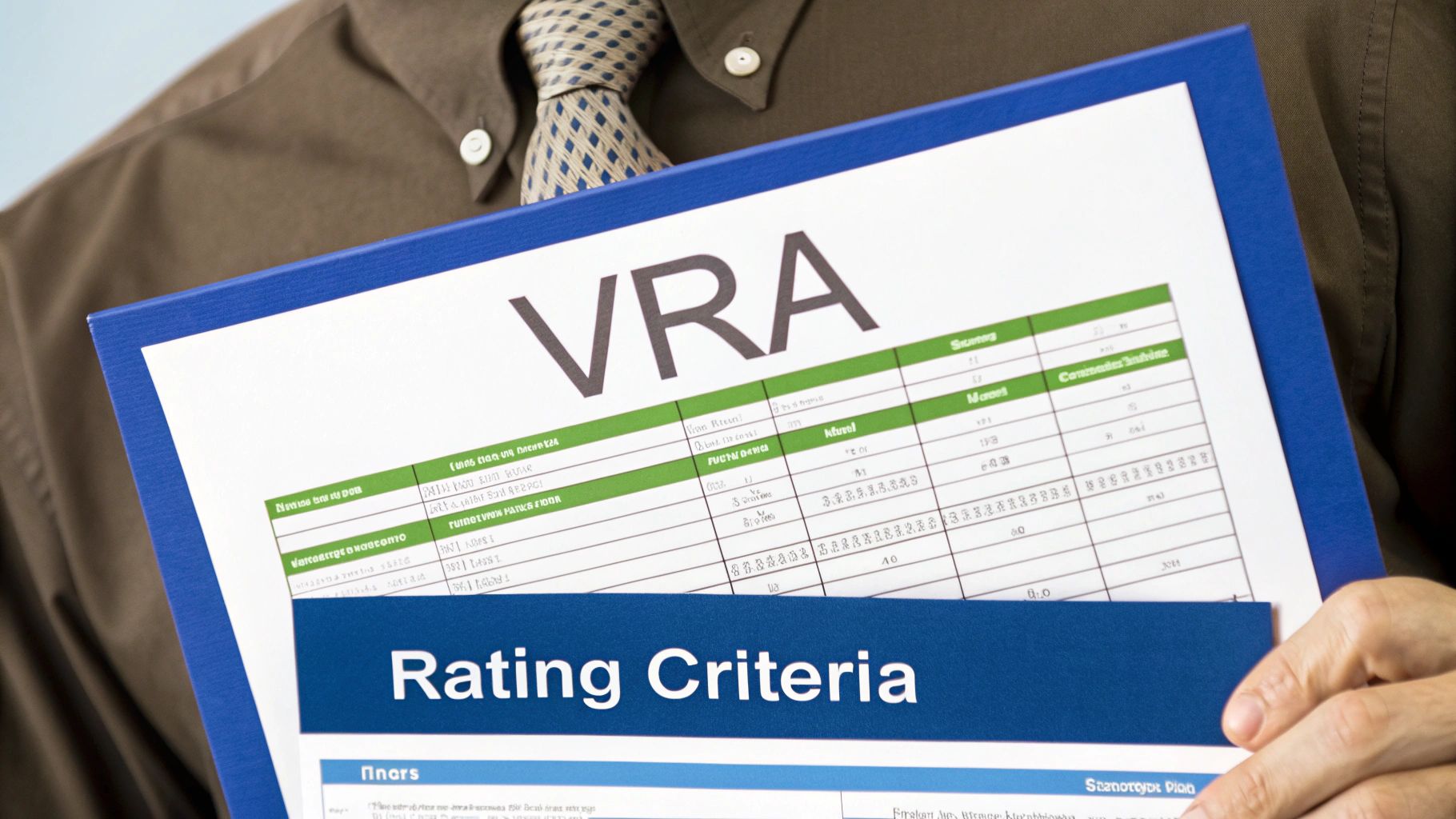
When it comes to a VA claim for diabetes, the strength of your evidence file is everything. This is where you meticulously build your case, piece by piece, to leave no room for doubt. Think of it like you're presenting a case to the VA rater—your job is to hand them a file so clear and compelling that approving your claim is the only logical next step.
This isn't just a matter of sending in a diagnosis and crossing your fingers. It's about strategically gathering every piece of proof that paints the complete picture of your condition. From that first lab test to the daily impact on your life, each document is a critical tool for securing the diabetes VA disability benefits you've earned.
The Foundation: Your Diagnosis and Medical Records
The absolute cornerstone of your evidence file is a formal diagnosis of Type 2 diabetes from a qualified medical professional. This isn't optional. It needs to be clearly stated in your medical records and backed up by supporting lab work, like A1C tests or fasting plasma glucose tests.
But a diagnosis is just the opening chapter. Your ongoing treatment records provide the critical plot points. These documents should clearly show:
- A full history of medications, from oral agents like Metformin to any required insulin injections.
- Documentation of a prescribed diet, proving that dietary management is a necessary part of your treatment.
- Notes on activity regulation, especially if a doctor has advised you to limit or avoid certain activities to manage your condition.
Your medical records are the bedrock of your claim. Getting a deeper understanding of medical documentation guidelines can help you see what the VA is looking for and ensure your file is as solid as possible. The more detail, the better.
The Power of a Persuasive Nexus Letter
For many veterans, especially those filing for secondary conditions, the single most important document you can submit is a nexus letter. This is a medical opinion from a qualified doctor that directly connects your diabetes to your military service or another service-connected disability. It’s the bridge that closes the gap between what happened in service and your diagnosis today.
A truly effective nexus letter doesn't just say there's a connection; it explains how and why. For instance, if you're claiming diabetes secondary to PTSD, a strong letter would detail the medical science behind how chronic stress can lead to weight gain and insulin resistance, ultimately contributing to the onset of diabetes.
Key takeaway: The letter must include specific language the VA looks for. It should state that your diabetes is "at least as likely as not" caused or aggravated by your service. Without that phrasing, the VA might not give the letter the weight it deserves.
Documenting Your Daily Reality
The clinical evidence from your doctor is crucial, but your personal experience provides powerful, humanizing context. The VA rater needs to understand how diabetes affects you day in and day out, and you are the only one who can truly tell that story.
Start keeping a simple log or journal to track things like:
- Hypoglycemic Episodes: Note the date, time, your symptoms (dizziness, sweating, confusion), and what you did to manage it.
- Blood Sugar Readings: A consistent log demonstrates your active role in managing a difficult condition.
- Impact on Life: Jot down times you had to leave work early, cancel plans with family, or couldn't participate in a hobby because of your diabetes.
This personal log can be submitted right along with your medical records. It adds a human element that helps the VA rater grasp the real-world severity of your symptoms, which is essential for getting the correct disability rating. Never underestimate the power of your own words.
Alright, you've put in the work to gather your evidence. Now comes the part where we officially get the ball rolling: filing your claim for diabetes VA disability. This can feel like a huge, intimidating step, but I've found it's best to see it as a very methodical process. Taking the pressure off helps you focus on getting it right.
The key to this whole thing is the VA Form 21-526EZ, which is the Application for Disability Compensation and Related Compensation Benefits. This is your official request, and trust me, how you fill it out matters. A lot. Even small mistakes—like forgetting to check a box or leaving a section blank—can cause massive delays or even get your claim denied right out of the gate. Precision is everything here.
Navigating VA Form 21-526EZ
Honestly, the most straightforward way to file is online through the VA's official website. The digital form is designed to walk you through each section, which makes it much harder to miss something important. Plus, you can upload all your evidence files directly as you go.
This is what you'll see when you start the online application process.

As you can see, the page is pretty clear. It points you right to the application and emphasizes having your documents ready. This just goes to show how critical that evidence-gathering phase we just talked about really is.
If you're looking at this and feeling overwhelmed, you're not alone. Many veterans decide to get help from a Veterans Service Officer (VSO). These are trained professionals who can guide you through preparing and submitting your claim, and their help is completely free. The big advantage is their expertise. The only potential downside is that you're working on their schedule, which can sometimes be backed up.
Preparing for Your C&P Exam
Once you submit your claim, it's almost a guarantee that the VA will schedule you for a Compensation & Pension (C&P) exam. Let me be clear: this is not a treatment appointment. It's a medical evaluation the VA orders to get an independent assessment of your disability. The report from this exam carries a ton of weight in the final decision.
Think of your C&P exam as your one shot to explain the real-world impact of your diabetes to a medical professional who will report directly to the VA. How you prepare for this appointment is just as vital as the evidence you've already submitted.
The goal of the C&P exam is simple: make sure the examiner understands the full scope of your condition. This is not the time to be a tough guy. Do not downplay your symptoms. If you have good days and bad days, describe your worst days in detail. That reflects the true severity of your disability.
Walk into that appointment with your medical history fresh in your mind and be ready to talk about it.
Communicating Effectively During the Exam
During the exam, the examiner will probably stick to a script, asking questions based on the VA's rating criteria for diabetes. They'll ask about your medications, insulin dependency, diet, and how you have to regulate your daily activities. Be honest, and be specific.
Here are a few tips from my experience:
- Be Detailed: Don't just say, "I have to watch what I eat." Explain what that actually means. "I have to test my blood sugar before and after every meal, avoid all processed sugars and most carbohydrates, and I can't eat out with my family without calling the restaurant ahead of time to check ingredients."
- Explain Activity Limits: Instead of a vague, "My activities are regulated," give them a real-life example. "I used to love hiking, but I had to give it up. A few miles on the trail can cause my blood sugar to drop dangerously low, and it's not safe for me to be far from help."
- Discuss Secondary Issues: This is crucial. If your diabetes is causing other problems like neuropathy in your feet or hands, or issues with your vision, you must tell the examiner. Describe the tingling, the numbness, the burning pain, or the blurry vision and explain exactly how it impacts your life—from struggling to button a shirt to being unable to drive at night.
The examiner can only report on what you tell them and what they observe. Giving them a clear, honest, and detailed picture of your daily struggles is the single most effective way to ensure their report accurately reflects your condition. That's what leads to a fair and accurate diabetes VA disability rating.
Boosting Your Rating with Secondary Conditions
Getting your diabetes service-connected is a huge win, but honestly, it’s often just the starting point. Diabetes is a systemic condition, which is a clinical way of saying it impacts your entire body. It rarely travels alone. The health problems that pop up because of your service-connected diabetes are what the VA calls secondary conditions, and they are absolutely critical to your overall diabetes VA disability claim.
Filing for these secondary conditions is one of the most powerful ways to increase your total disability rating. When the VA grants service connection for a secondary issue, its rating gets combined with your primary diabetes rating using what we call "VA math." This is how you ensure your final compensation truly reflects the full impact the disease has on your health and day-to-day life. If you ignore these related health problems, you're leaving benefits on the table you've earned and deserve.
Common Secondary Conditions to Watch For
Many veterans I've worked with start noticing other health issues cropping up over time. The key is to recognize when these new problems aren't just random aches and pains but are actually a direct result of the long-term wear and tear from high blood sugar. This is the whole basis of a secondary claim.
Here are some of the most common conditions we see linked directly to diabetes:
- Diabetic Neuropathy: This is nerve damage, and it most often hits the feet and legs first (peripheral neuropathy). You might feel anything from a mild tingling and numbness to excruciating burning pain. It can also mess with other body systems, leading to problems like erectile dysfunction or gastroparesis (stomach paralysis).
- Diabetic Retinopathy: This is all about your eyes. It’s damage to the tiny blood vessels in your retina, and it can cause blurry vision, "floaters," and in serious cases, blindness.
- Diabetic Nephropathy: This is a fancy term for kidney disease caused by diabetes. Over time, high blood sugar hammers your kidneys, making it harder for them to filter waste from your body.
- Hypertension (High Blood Pressure): The connection between diabetes and high blood pressure is rock-solid. Diabetes can cause your arteries to harden and get narrower, which forces your heart to pump harder and drives up your blood pressure.
- Heart Disease: Veterans with diabetes face a much higher risk for all sorts of cardiovascular issues, like coronary artery disease, heart attack, and stroke.
If you start noticing any of these symptoms, your first move should be to talk with your doctor and specifically ask about the potential link to your diabetes.
How to Build a Strong Case for a Secondary Claim
Proving a secondary condition requires the same kind of careful evidence-building as your first claim. You have to establish a clear medical link—or nexus—between your service-connected diabetes and the new condition.
Let's walk through a real-world example. Imagine a veteran is already service-connected for diabetes at 40%. A few years later, he starts getting this persistent tingling and burning pain in his feet, so bad he can’t stand for very long. His doctor diagnoses him with peripheral neuropathy.
Now, just getting that diagnosis isn't enough. To connect it for VA purposes, he needs a medical nexus letter from his doctor. This letter needs to state that it is "at least as likely as not" that his service-connected diabetes caused the peripheral neuropathy. That specific phrase is magic to the VA. When it's backed up by medical research and the veteran's own treatment history, it creates the solid bridge the VA needs to approve the secondary claim.
Crucial Tip: Don't ever assume the VA rater will connect the dots for you. You must file a specific claim for the secondary condition and hand them the evidence that proves the connection to your diabetes.
Of course, beyond the claims process, managing your diabetes is key to preventing or slowing down these secondary issues. Looking into things like the best sugar alternatives for diabetics is a small but important part of taking control of your health.
How Secondary Ratings Affect Your Bottom Line
Every secondary condition the VA approves gets its own disability rating. For instance, peripheral neuropathy can be rated from 10% to 40% for each arm or leg, depending on whether it's mild, moderate, or severe. Hypertension that requires medication is typically rated at 10%.
These ratings aren't just added up. The VA uses a complex formula to create a combined disability rating. The math itself can make your head spin, but the principle is straightforward: every single approved secondary condition will increase your overall rating and your monthly compensation.
Think back to our veteran with the 40% diabetes rating. If he gets a 20% rating for neuropathy in both of his legs and another 10% for hypertension, his combined rating will jump significantly higher than his original 40%. This is exactly why you have to pursue these claims—it’s how you get a final rating that truly reflects the widespread havoc diabetes can wreak on your body.
What to Do If the VA Denies Your Claim
Getting a denial letter for your diabetes VA disability claim is a tough pill to swallow. After all the time and effort you put into gathering records and filing, seeing that rejection in writing is just plain frustrating. But I need you to understand this: a denial is not the end of the line. Not even close.
Don't let that letter discourage you. Instead, think of it as a roadmap. The VA has to tell you exactly why they said no. Those reasons are the key to building your comeback and choosing the right way to fight back.
Your Three Paths to Appeal a Denial
Thanks to the Appeals Modernization Act (AMA), you have three distinct "lanes" to challenge a VA decision. Each one is designed for a specific situation, so picking the right one is absolutely critical to your success. You can't just pick one at random; you need to match your appeal to the VA's reason for denial.
Here are your main options:
- Supplemental Claim: This is your best bet if the VA says you didn't provide enough proof.
- Higher-Level Review: Use this option when you're convinced the VA made a mistake with the evidence you already sent.
- Board Appeal: This is the most formal route, taking your case to a Veterans Law Judge at the Board of Veterans' Appeals.
Let's dig into how each of these works so you can figure out your next move.
When to File a Supplemental Claim
If your denial letter says something like "insufficient evidence," a Supplemental Claim is exactly what you need. This is probably the most common reason for a denial. Maybe the VA said you didn't prove a solid service connection, or that your symptoms didn't warrant a higher rating. This appeal lane was created specifically so you can add new and relevant evidence to your file.
For example, let’s say you filed for diabetes secondary to your service-connected PTSD, but the VA denied it because you didn't include a strong medical opinion. To fix this, you'd go to your doctor, get a detailed nexus letter explaining the connection, and submit it with your Supplemental Claim form. The VA is then legally required to review your entire case again with that new letter in hand.
Pro Tip: "New" evidence doesn't have to be brand new. It just has to be new to the VA. A medical record from five years ago that you forgot to include in your initial application absolutely counts as new and relevant evidence.
Requesting a Higher-Level Review
What if you look at your file and know, without a doubt, that you sent everything needed, but the rater just got it wrong? That's what a Higher-Level Review (HLR) is for. When you file an HLR, you're asking a more experienced, senior reviewer to take a fresh look at your case. The key here is that you cannot submit any new evidence.
An HLR is the right move if you spot a clear error. Imagine you filed for a 60% rating for your diabetes and your records show two hospitalizations for ketoacidosis within the last year. If the VA only grants you 40%, you can use an HLR to argue that the first rater simply failed to apply the rating schedule correctly based on the evidence they already had. You're not adding new facts; you're challenging their interpretation of the existing facts.
Taking Your Case to the Board of Veterans' Appeals
If your claim involves a tricky legal question, or if you've already tried a Supplemental Claim or HLR without success, your final move is a direct appeal to the Board of Veterans' Appeals (BVA). This is the most formal and often the longest path, but it also offers the highest level of review.
When you file an appeal to the Board, you get to choose one of three dockets:
- Direct Review: The judge reviews the exact same evidence the previous rater had.
- Evidence Submission: You can submit new evidence directly to the judge for consideration.
- Hearing: You can request a hearing to speak directly with a Veterans Law Judge (VLJ), either virtually or in person.
A hearing can be a game-changer. It gives you the chance to tell your story and explain in your own words how your diabetes affects your day-to-day life. That personal testimony can add a powerful human element that a stack of papers just can't communicate.
Navigating a VA claim denial and the appeals process can feel like a full-time job, but you don’t have to do it on your own. The team at Homefront Group is made up of legal professionals and fellow veterans who know how to fight for the benefits you earned. If your claim was denied, let us help you build the strongest possible appeal. Take our 3-minute quiz to see how we can help you at https://homefrontgroup.com/.