
Understanding CRSC: More Than Just Another Benefit Program
Picture this: you're catching up with a fellow veteran over coffee, and they're radiating positivity. They just got their first Combat-Related Special Compensation (CRSC) payment. It's not just the financial relief; it’s the sense of validation. It’s the acknowledgment of the sacrifices made in the heat of combat. That's the core of CRSC.
CRSC is more than a benefit; it's a bridge. It connects a veteran's past experiences in combat with their present life. It recognizes that the wounds of war run deeper than what meets the eye. Unlike standard VA disability compensation, CRSC specifically addresses the financial strain caused by injuries sustained in combat or combat-related activities. This program acknowledges that these sacrifices deserve special attention. The world of veteran benefits can feel like a maze, but understanding the basics of available assistance—like you'll find on this page about Benefits—helps put CRSC into perspective within the bigger picture.
CRSC: A Unique Benefit With Specific Eligibility
So, what sets CRSC apart? Think of it this way: standard disability compensation acknowledges the impact an injury has on your daily life. CRSC, on the other hand, acknowledges the cause—specifically, the direct link to combat. This key difference is what makes CRSC eligibility more specific. The Combat-Related Special Compensation (CRSC) program provides tax-free monthly payments to eligible military retirees with a VA disability rating of at least 10% for combat-related disabilities. Since its creation in 2003, CRSC has expanded its reach. It now includes not only traditional retirees with 20 or more years of service but also medical retirees and those granted early retirement due to disabilities. This resource provides further details on the program. This expansion demonstrates a continuous commitment to supporting veterans affected by combat-related injuries.
CRSC isn’t just a financial supplement; it's an acknowledgment of the unique sacrifices made by those who served in combat zones or participated in hazardous duties directly tied to combat operations. It aims to cushion the financial blow these injuries can inflict, making the transition back to civilian life a little easier. The evolution of this program reflects a growing understanding of the long-term impact of combat service.
Let's delve into the specific eligibility requirements for CRSC and why grasping these criteria is so important for a smooth and successful application process.
To help clarify the distinctions, take a look at the comparison table below:
CRSC vs Other Military Benefits Comparison: A side-by-side view of CRSC compared with VA disability compensation and military retirement pay.
| Benefit Type | Tax Status | Eligibility Requirements | Payment Structure |
|---|---|---|---|
| CRSC | Tax-Free | VA disability rating of at least 10% for combat-related injuries, Military retiree (including medical and early retirees) | Offset of retired pay |
| VA Disability Compensation | Tax-Free | Service-connected disability | Based on disability rating |
| Military Retirement Pay | Taxable | 20+ years of service (or medical/early retirement) | Based on years of service and rank |
Key takeaways from this comparison: CRSC is tax-free, like VA disability, but it’s tied to retirement status and offsets retirement pay. VA disability, on the other hand, isn't tied to retirement. And while military retirement pay is earned through years of service, it’s taxable, unlike CRSC.
Who Actually Qualifies: Breaking Down The Real Requirements
Let's have a frank discussion about eligibility for Combat-Related Special Compensation (CRSC). While the official requirements might seem simple at first glance, the actual process is a bit more like navigating a winding road. Understanding the subtleties is key. There are three main routes to CRSC: traditional 20-year retirees, medical retirees whose service ended because of an injury or illness, and those who accepted early retirement packages.
Three Paths to CRSC
-
Traditional 20-Year Retirees: For veterans who served a full 20 years, the path to CRSC is often the most straightforward, as long as their disability is combat-related. Picture a soldier who retired after 20 years with a knee injury from a training exercise preparing for a combat deployment. This type of scenario often results in a smooth CRSC approval.
-
Medical Retirees: This group faces a unique hurdle: demonstrating that their disability was both severe enough to justify a medical retirement and directly caused by combat. Imagine a sailor medically retired for a back injury. If the injury happened while lifting heavy equipment during a combat mission, the connection to CRSC is pretty clear. If it happened during routine ship maintenance, establishing eligibility becomes a more complicated process.
-
Early Retirement: The rules shift again for those who opted for early retirement. These veterans must show not only a combat-related disability, but also how that disability affects their ability to hold a civilian job. Think of an airman who took early retirement because of hearing loss. If the hearing loss was caused by exposure to aircraft noise during combat missions, they have a strong case. But if the noise exposure primarily occurred during routine peacetime operations, demonstrating the crucial combat connection for CRSC becomes paramount.
Meeting the Criteria Isn't a Guarantee
Simply checking the boxes on the basic CRSC eligibility criteria doesn't guarantee approval. The specifics of your situation are what truly matter. Your combat-related disability rating, the specific nature of your injuries, and the thoroughness of your documentation all play critical roles. For example, a 10% disability rating for tinnitus connected to combat might qualify, but a 10% rating for a non-combat-related condition won't.
Furthermore, clearly documenting the link between your military service and your current condition is essential. As of 2024, the Department of Defense estimates that tens of thousands of veterans are eligible for CRSC every year. However, the number of applications doesn't reflect this. As of 2023, only about 37% of eligible veterans already receiving VA disability compensation for combat-related conditions had actually applied for CRSC. Dive deeper into CRSC statistics and information. This difference underscores the importance of really grasping the nuances of this program.
This understanding is often the deciding factor between applications that succeed and those that get bogged down. It's about presenting your personal story clearly and effectively navigating the sometimes complex application process.
The Combat-Related Connection: What Counts and What Doesn't

CRSC eligibility can feel like navigating a maze. The system isn't deliberately confusing, but the phrase "combat-related" has surprising breadth and some specific limits. Imagine building a legal case: you must show a direct link between your injury and combat operations, combat training, or combat readiness. Sometimes, the connection is crystal clear, like a wound sustained in a firefight. Other times, it's more like detective work.
Clear-Cut Cases
Some scenarios almost always meet the CRSC requirements. These include direct combat injuries, like gunshot wounds or injuries from explosions. Likewise, training accidents specifically tied to preparing for a combat mission generally qualify. Picture a paratrooper injured during a pre-deployment jump—they would likely meet this criterion. Also, conditions directly caused by combat activities, like exposure to chemical agents, fit the bill.
The Gray Areas
Certain situations are less straightforward. For instance, some PTSD cases qualify for CRSC, but the link to combat must be undeniable. This typically requires thorough medical records and a compelling personal statement describing the traumatic experience(s) that led to the condition. Injuries in combat support roles, while not directly on the front lines, can also qualify if you can demonstrate they stemmed from combat-related tasks. Think of a mechanic injured while fixing a vehicle disabled by an IED during a combat operation—they might be eligible. This shows how a "combat-related" connection can extend beyond traditional combat positions.
Thinking Through the CRSC Lens
The secret to understanding CRSC eligibility lies in analyzing your military service through a specific lens: proving the "combat-related" connection. Ask yourself: Did this injury happen because of combat-related activity? A back injury from carrying heavy combat gear during deployment is different from a similar injury during stateside training unrelated to an upcoming deployment. Thoroughly documenting this connection, including medical records and perhaps buddy statements, is crucial. By carefully considering your experience with this perspective, you can better present your case for CRSC eligibility. This proactive approach can significantly improve your chances of approval. A clear, well-supported narrative linking your injury to combat is often the strongest argument for CRSC.
Navigating The Application Process: Your Step-By-Step Journey
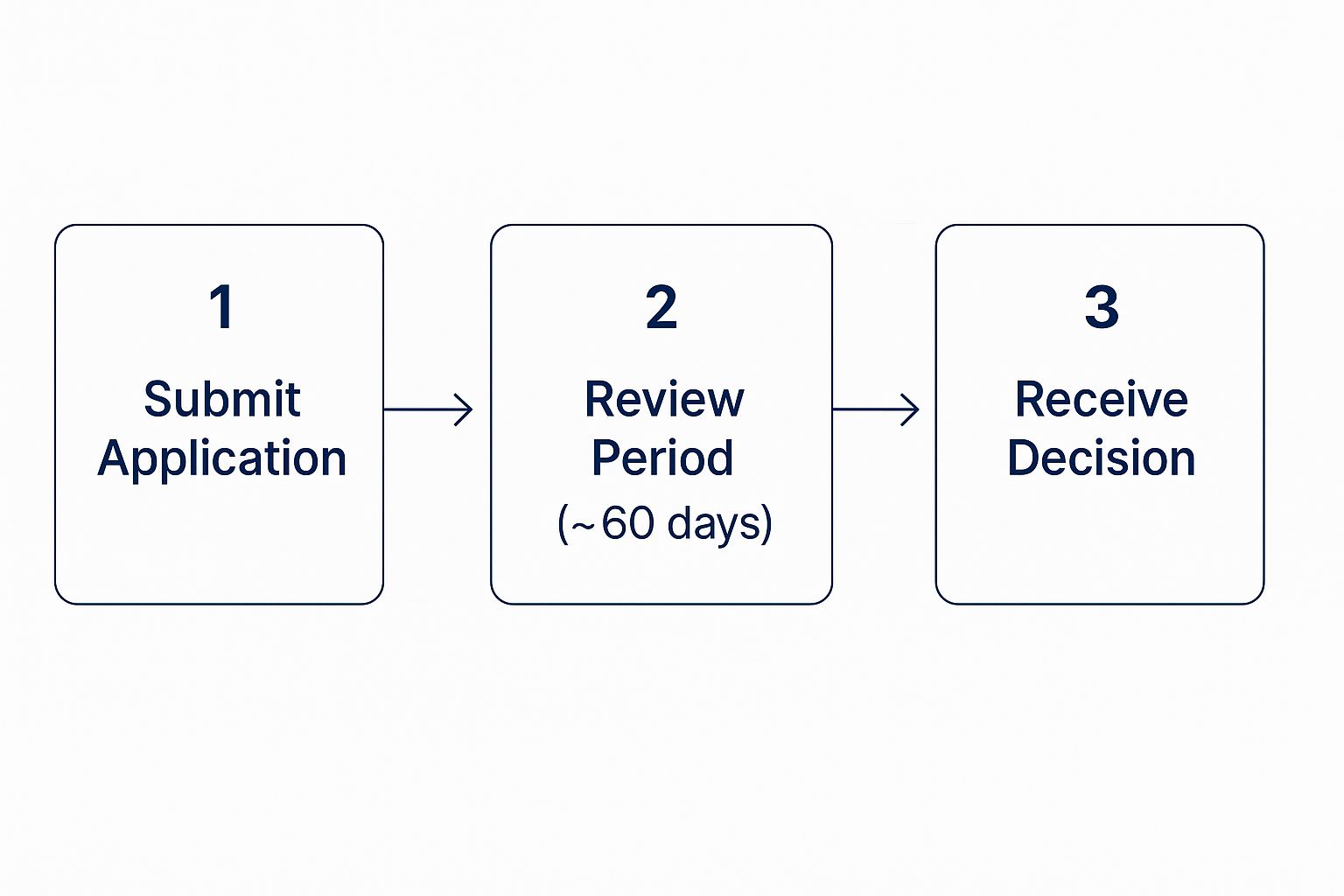
The infographic above gives you a visual roadmap of the CRSC application process. Think of it as a three-step journey from submitting your application to receiving a decision. While the process itself is fairly straightforward, each step has its own details to consider. Notice the review period: around 60 days. This highlights how important it is to submit a complete and well-organized application right from the beginning. Getting everything right upfront saves you time and potential headaches later.
Applying for CRSC isn't just about filling out forms; it's about telling your story in a way that connects your current condition to your time in combat. It’s about painting a clear picture for the reviewers. We'll walk through the entire process, starting with how to gather the necessary documentation—and how to know which documents are actually helpful to your claim.
Gathering Your Documentation: The Foundation of Your Claim
Think of your documentation as the foundation upon which your CRSC claim is built. A strong foundation means a stronger claim. You’ll need to gather military records, which might mean requesting documents from years, even decades, ago. Knowing exactly which records to request is key. Medical documentation is equally important, but keep in mind that not all medical records are created equal. Some records carry more weight with CRSC reviewers than others. Presenting this evidence clearly and logically can make all the difference.
Common Pitfalls and How to Avoid Them
Even small oversights can throw a wrench in the application process. Things like incomplete forms, missing signatures, or failing to draw a clear line between your service and your medical condition can cause significant delays. For example, let's say you have chronic back pain stemming from a training accident that happened just before a combat deployment. If you don't clearly connect that accident to the deployment itself, your claim might be weakened. We'll discuss how to avoid these common mistakes so you can submit a compelling and complete application.
Presenting Your Case: Clarity Is Key
Imagine explaining your situation to a friend who has no military background. That's the kind of clarity you should aim for in your CRSC application. Use plain language, avoid technical jargon, and stick to the facts. Clearly explain how your injuries occurred and why they continue to impact you. This straightforward approach increases the likelihood of your application being approved.
To help you stay organized and understand the timeline, let's take a look at this helpful table:
CRSC Application Timeline and Documentation Checklist
| Application Stage | Required Documents | Typical Timeframe | Pro Tips |
|---|---|---|---|
| Initial Application Submission | DD Form 2860, Medical Records, Service Records | 1-2 weeks | Make copies of everything you submit. |
| VA Review and Request for Additional Information | Any requested documentation, such as clarifying medical statements or additional service records | 4-6 weeks | Respond promptly to any requests for information. |
| Final Decision | N/A | 2-4 weeks | Be patient. While waiting is difficult, it's a normal part of the process. |
This table summarizes the typical documents required at each stage, as well as the typical processing times. Keep in mind these are estimates, and individual cases can vary.
By following these steps and presenting your information clearly, you’ll be well on your way to navigating the CRSC application process successfully. Remember, a well-prepared application is a strong application.
Guard And Reserve Members: Special Considerations And Recent Changes
Serving in the Guard and Reserve brings unique aspects to CRSC eligibility. Think of it like two roads leading to the same destination: while both active duty and reserve members face the same potential dangers, their paths to get there, and the paperwork they accumulate along the way, differ. The core requirements are similar, but proving that your disability is combat-related requires a different approach.
Documenting Your Combat Connection
For Guard and Reserve members, meticulous documentation is paramount. Deployment orders, unit histories, and specific duty assignments become vital pieces of evidence. They paint a clear picture for the CRSC reviewers, connecting your disability to your combat service. Just like building a solid legal case requires airtight evidence, a strong CRSC claim relies on these crucial documents. They form the foundation of your narrative, demonstrating the combat-related nature of your service.
Imagine assembling a complex jigsaw puzzle. Each document, like a puzzle piece, contributes to the complete image of your service history. Without these pieces, the picture remains incomplete, potentially hindering your claim.
The Impact of Drilling Status and Deployment History
Beyond deployment records, your drilling status and the nature of your deployment history play a crucial role. While active-duty service inherently implies combat readiness, Guard and Reserve members need to demonstrate this connection explicitly. Were you activated for a combat mission? Did your drills involve combat-specific training directly related to your deployment? These specifics are essential.
For example, consider a Reservist who drills as a medic but deploys as an infantryman. If their injuries occurred during their deployment as an infantryman, the connection to combat is clearer and strengthens their case for CRSC. The context of your service, not just the fact of it, is key.
Recent Changes and Expanded Eligibility
Fortunately, CRSC eligibility for Guard and Reserve members has significantly broadened. The 2015 DoD expansion acknowledges the essential contributions of citizen-soldiers in combat operations. By 2024, this resulted in approximately 8,000 reserve component retirees being eligible for CRSC, representing around 5% of all recipients. Learn more about the expansion of CRSC eligibility. This expansion reflects a growing recognition of the unique sacrifices made by Guard and Reserve members.
Understanding these specific requirements and thoroughly documenting your service are crucial steps in securing the CRSC benefits you deserve. Your service, though different in structure from active duty, holds equal weight within the CRSC program. By crafting a clear and comprehensive narrative, backed by strong documentation, you significantly improve your chances of a successful claim.
Legal Developments And Your Rights: What You Need To Know
The legal landscape surrounding CRSC is always changing, and these shifts can directly affect your benefits. Think of this section as your personal update, keeping you informed on developments that impact your financial well-being. We'll explore recent court cases that are reshaping CRSC, especially the ongoing legal battle concerning back pay limits. This case could potentially affect thousands of veterans seeking retroactive payments. Knowing your rights as an applicant is critical, particularly if your claim is denied.
Understanding Your Rights and the Appeals Process
Imagine navigating a complex maze – that's what the appeals process can feel like without the right guidance. Understanding what to do when a claim is denied, and how to challenge those decisions effectively, is paramount. We'll discuss when seeking legal counsel might be beneficial versus managing appeals independently. We’ll also explore how recent legal developments might strengthen your case. Knowing what reviewers are looking for is like having a map to navigate that maze successfully.
A significant legal issue arose in April 2025 when the Supreme Court reviewed Soto v. United States, a case challenging the six-year limit on back pay for CRSC claims. If upheld, this limit could affect thousands of veterans. The DoD reported that, as of 2023, over 90% of CRSC claims meeting the initial criteria were approved, representing over 100,000 recipients annually. Learn more about the Soto v. United States case and its implications. This case underscores the constantly evolving nature of CRSC law.
Common Reasons for Denial and How to Address Them
Let's break down common reasons for CRSC denials and how to tackle them effectively. It’s like troubleshooting a recipe – identifying the missing ingredients is key to success:
-
Insufficient Documentation: Think of your documentation as the building blocks of your claim. Without enough solid evidence, your case might not hold up. We’ll guide you on the necessary documentation to build a strong foundation for your claim.
-
Unclear Combat Connection: Establishing a clear link between your disability and combat is crucial. If the connection isn’t evident, your claim may be denied. We'll help you clarify and strengthen this vital link.
-
Missing Information: Even seemingly minor omissions can have a big impact on your application. Think of it as a puzzle – missing a piece can prevent you from seeing the full picture. We’ll show you how to avoid these common oversights.
By understanding these potential pitfalls, you can address them proactively and increase your chances of a successful claim.
The Importance of Legal Precedents
Legal precedents act as guideposts, shaping the path for future CRSC claims. We’ll explain what new legal precedents mean for both current and existing CRSC recipients. By staying informed about these developments, you can ensure you receive all the benefits you deserve. This is about practical advice, not just legal theory, to help you protect and maximize your benefits.
Maximizing Your Benefits: Pro Tips and Common Mistakes To Avoid
Successfully navigating the CRSC process isn't just about checking boxes—meeting the bare minimum requirements. It's about truly understanding the system, knowing the potential pitfalls, and presenting your case strategically. Think of it like having a trusted advisor, a seasoned veteran who's been there and done that, guiding you through the maze.
Timing Strategies and Benefit Interactions
Timing is everything. Applying for CRSC after you’ve received your VA disability rating can make the whole process smoother. Why? Because the VA rating already establishes the crucial link between your disability and your service—a cornerstone of CRSC eligibility. It’s like laying the foundation before building the house. Understanding how CRSC interacts with other benefits, such as military retirement pay, is equally important. CRSC offsets a portion of your retirement pay, so knowing the specifics helps you plan your finances.
Presenting a Compelling Case
When reviewing applications, the VA looks for clarity, conciseness, and strong documentation. Imagine you're telling a story—your story. Present your service history, your injuries, and the connection between them in a clear, logical narrative. Use everyday language, skip the technical jargon, and stick to the facts. A well-organized application with all the necessary documentation shows you’re prepared and strengthens your claim.
Common Mistakes to Avoid
Simple errors can create major headaches. Incomplete forms, missing signatures, and failing to clearly connect your disability to combat are common stumbling blocks. These are like cracks in the foundation that can weaken your entire case. Make absolutely sure your application is complete, accurate, and tells a consistent story.
Red Flags and Insider Tips
Even small details can sometimes raise red flags. For instance, inconsistencies between your medical records and your personal statement can invite extra scrutiny. Be thorough and ensure your information aligns across all documents. Here’s an insider tip: Address any potential weaknesses in your case head-on. If there are gaps in your medical records, explain why and offer other evidence to support your claim. This shows you’re proactive and thorough.
Maintaining Your Benefits After Approval
Getting approved isn't the finish line. Life throws curveballs—new medical diagnoses, changes in employment—and these can impact your CRSC status. Stay informed about what might trigger a review of your benefits and know how to handle those situations. Keeping your contact information up-to-date and responding promptly to any requests from the Department of Defense keeps your benefits flowing smoothly. Think of it as regular maintenance to keep the engine running.
Don't go it alone. Homefront Group, founded by a former Navy JAG officer, provides expert legal guidance for veterans seeking to maximize their benefits. Take the first step towards securing the benefits you deserve and visit Homefront Group today.