
Understanding The COPD And Agent Orange Connection
For many veterans, particularly those who served in Vietnam, the name Agent Orange is linked to a long list of severe health problems. While its ties to certain cancers are well-established, the connection between COPD and Agent Orange is a more complicated and often frustrating issue. To understand the hurdles veterans face, we need to look at the history and the science behind this powerful herbicide and how it could affect respiratory health. The path from exposure decades ago to a COPD diagnosis today is a long one, shaped by personal hardship and evolving medical knowledge.
What Was Agent Orange?
Agent Orange was one of several "tactical herbicides" the U.S. military used during the Vietnam War. Its job was to clear dense jungle, stripping away the tree cover that enemy forces used to hide. Think of it as a chemical designed to make leaves fall off trees. The real danger, however, came from a highly toxic contaminant within it called TCDD (2,3,7,8-tetrachlorodibenzo-p-dioxin). This dioxin, an unintended and hazardous byproduct, is the main reason for the serious health issues associated with Agent Orange exposure.
While Agent Orange is famously linked to various cancers, the direct evidence connecting it to chronic obstructive pulmonary disease (COPD) is less clear. This uncertainty exists even though the chemical was used on a massive scale. From 1962 to 1971, the military sprayed about 80 million liters of Agent Orange over roughly 10% of South Vietnam's land. You can read more about the ongoing research into the scientific debate surrounding the Agent Orange and COPD connection.
The Scientific Challenge: Proving the Link
So, why isn’t the COPD and Agent Orange connection as straightforward as it is for other diseases? The problem is the difficulty of pinpointing a single cause for a multifaceted condition like COPD. It’s like a detective trying to solve a cold case. Years after the event (the exposure), it’s tough to prove that one specific suspect (Agent Orange) was the sole cause of the outcome (COPD), especially when other factors might have played a part.
Several things make this a hard scientific question to answer:
- Time Delay: COPD often develops slowly over many years. This long delay makes it hard to directly connect the disease to a specific exposure that happened decades earlier.
- Other Risk Factors: Many veterans have other risk factors for COPD, with a history of smoking being the most common. Researchers and the VA must try to separate the effects of smoking from the potential impact of herbicide exposure.
- Exposure Measurement: It is nearly impossible to know exactly how much Agent Orange an individual veteran was exposed to. Service records can place a veteran in a location, but measuring the precise dose of TCDD they inhaled or absorbed isn't possible today.
Because of these challenges, the large-scale scientific studies have shown mixed results, even though many veterans report respiratory problems after their service. This scientific uncertainty directly affects VA policy and is a key reason why getting a VA claim for COPD and Agent Orange approved requires a more direct, evidence-based approach than a presumptive condition claim.
What The Medical Research Actually Reveals
When veterans look for a straight answer on the link between COPD and Agent Orange, the medical research can feel like trying to solve a puzzle with missing pieces. The science doesn't offer a single, simple conclusion. Instead, it paints a more complicated picture of risk, and understanding these details is crucial for any veteran building a VA claim or just trying to understand their own health.
The story told by medical studies isn't one of a direct, undeniable link for everyone. It's a story of increased risk for certain highly exposed groups mixed with conflicting data from other studies. This complexity is the main reason why COPD is not currently a presumptive condition for Agent Orange, unlike other diseases.
Analyzing Key Mortality and Exposure Studies
Some of the most powerful evidence comes from studies that zoned in on veterans with the highest levels of direct exposure. For example, research on Army Chemical Corps (ACC) veterans—the service members who personally handled and sprayed herbicides in Vietnam—shows a very concerning pattern.
These individuals have a much higher chance of dying from COPD compared to other veterans. One major report found their mortality risk was 4.82 times greater. That’s a powerful statistic that suggests a strong connection between heavy, direct exposure and fatal lung disease. You can dive deeper into the details of this mortality research to see the data for yourself.
However, not all studies have reached the same conclusion. Other research, especially studies looking at broader populations of veterans with less-defined exposure levels, have found weaker or inconclusive connections. This difference often comes down to how health problems were measured.
The Critical Difference: Symptoms vs. Objective Testing
A major hurdle in the research on COPD and Agent Orange is the gap between what a veteran feels and reports, and what a clinical test can objectively measure. This distinction is incredibly important when it comes to a VA claim.
- Self-Reported Symptoms: Many veterans genuinely experience symptoms like shortness of breath, a persistent cough, or wheezing. These are real and valid experiences. However, from the VA's perspective, symptoms alone can be tricky because many different conditions can cause them.
- Objective Medical Testing: This is where things like spirometry come in. Spirometry and other pulmonary function tests provide solid, measurable data on how well your lungs are working. Tests like the FEV1 (Forced Expiratory Volume in one second) give doctors and VA raters concrete evidence of lung damage.
Some studies that used spirometry didn't find a significant difference in lung function between veterans exposed to herbicides and those who were not. This doesn't automatically mean Agent Orange has no impact. It just means that for those specific studies, a direct causal link couldn't be proven with that particular test.
For a veteran, this reality underscores one critical point: you need a firm medical diagnosis backed by objective pulmonary function tests. Without this hard evidence, a claim trying to connect COPD and Agent Orange will face a steep climb, because the VA heavily prioritizes measurable data over subjective reports of symptoms.
Navigating VA Presumptive Conditions and COPD Claims
Understanding the Department of Veterans Affairs (VA) policies is the first step toward getting benefits for COPD and Agent Orange exposure. The VA system often uses what are called "presumptive conditions." Think of a presumptive condition as a shortcut for connecting your illness to your service. For certain diseases scientifically shown to be linked to a specific military exposure, the VA presumes your service caused it. This means you don't have to provide a medical link; you just need to prove you have the condition and served in a qualifying location and time.
This infographic shows the difficult position many veterans are in when trying to get benefits for respiratory conditions.
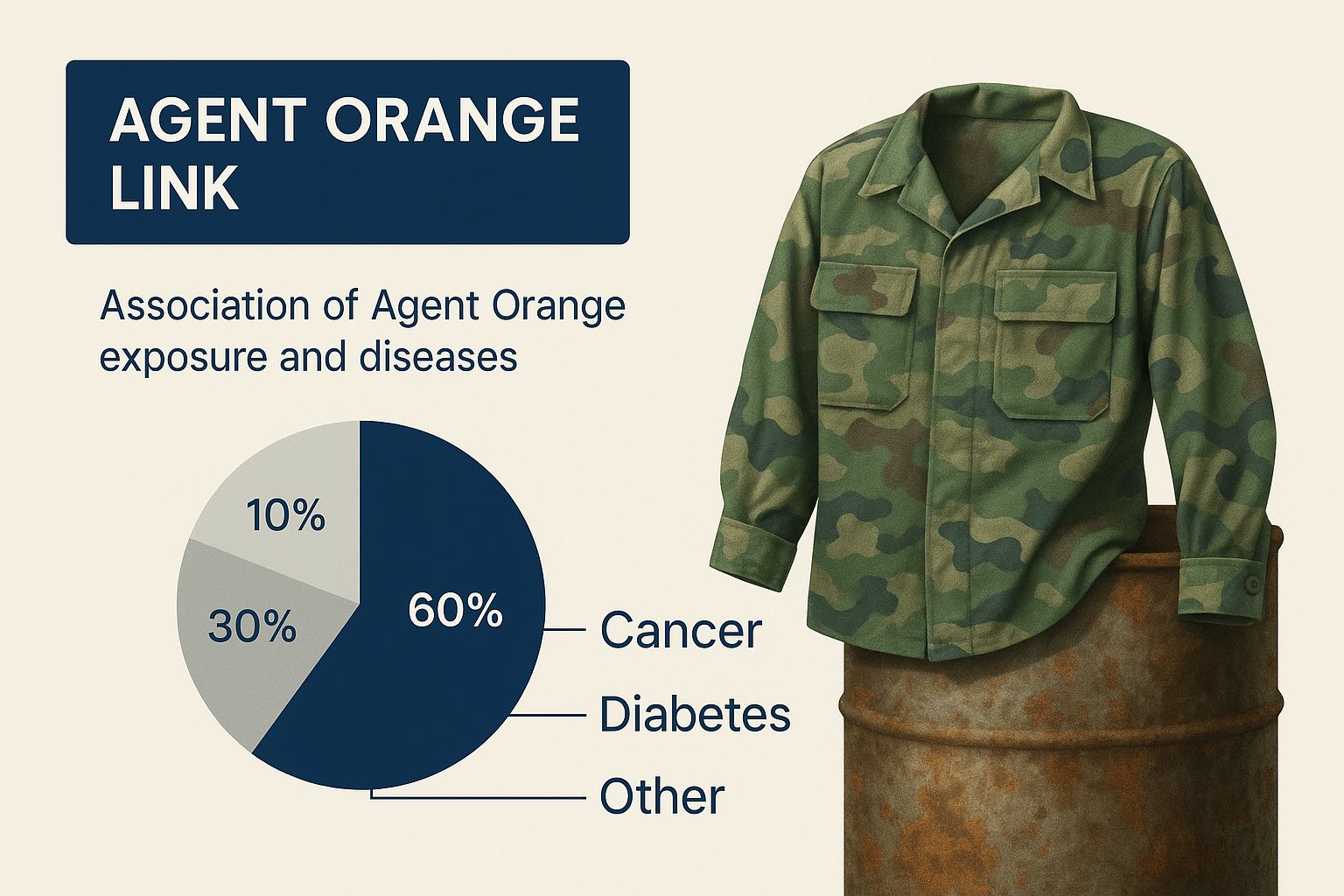
The image highlights the lasting health impact of military service. For many, Agent Orange is a major part of their health story, but getting benefits means knowing what the VA officially recognizes and what it doesn't.
Why Isn't COPD Presumptive for Agent Orange?
Despite personal stories from veterans and some supporting research, the VA does not currently list COPD as a presumptive condition for Agent Orange exposure. The VA's position is that the large-scale scientific evidence isn't yet strong enough to establish a direct link for all exposed veterans. While conditions like certain cancers, type 2 diabetes, and Parkinson's disease are on the presumptive list, COPD is not.
This policy creates a major challenge. Without the "shortcut" of presumption, the full burden of proof falls on the veteran. You must build a case from scratch to establish what's called a direct service connection. This means you have to prove that your COPD is “at least as likely as not” caused by your specific exposure to Agent Orange during your service.
How the VA Evaluates Non-Presumptive Respiratory Claims
When a condition isn't presumptive, the VA reviews your claim individually. To get your claim approved, you must provide three key pieces of evidence:
- A Current Diagnosis: You need an official diagnosis of COPD from a doctor, backed by medical tests like spirometry.
- Evidence of an In-Service Event: You have to show proof of an event or exposure during your military service. For Agent Orange claims, this usually means proving you were in a location where the herbicide was sprayed.
- A Medical Nexus: This is the most crucial—and often the hardest—part. You need a medical expert, like your primary doctor or a specialist, to provide a nexus letter. This letter must state that it's at least as likely as not that your COPD was caused or made worse by your Agent Orange exposure in service.
To better understand the difference in claim requirements, the table below compares recognized presumptive conditions with the path for a COPD claim.
| Condition Type | Presumptive Status | Evidence Required | Approval Rate |
|---|---|---|---|
| VA Presumptive Conditions (e.g., Type 2 Diabetes, certain cancers) | Yes | 1. Current diagnosis 2. Proof of service in a qualifying location/time |
Higher, as the service connection is presumed. |
| COPD Claim (related to Agent Orange) | No | 1. Current diagnosis 2. Proof of service in a qualifying location/time 3. Medical Nexus Letter linking COPD directly to Agent Orange exposure |
Lower and more variable, as it depends on the strength of the veteran's evidence. |
The key takeaway from this comparison is the medical nexus requirement. For presumptive conditions, the VA connects the dots for you. For COPD, you must provide the connection yourself with strong medical evidence.
Advocacy groups continue to push for new laws, and research is always developing. The rules could change, but for now, veterans seeking benefits for COPD and Agent Orange must focus on building a powerful, evidence-based claim for direct service connection.
Overcoming Diagnostic Challenges And Medical Testing
Getting a solid diagnosis for Chronic Obstructive Pulmonary Disease (COPD) is the first and most critical step for managing your health and building a VA claim. This process can feel complicated for veterans, especially when factors like smoking history and potential exposure to COPD and Agent Orange are both on the table. Doctors have the tough job of separating these factors to figure out the extent of your lung damage and its primary causes.
Your diagnostic journey will almost certainly start with a spirometry test. This is the most reliable method for diagnosing COPD. Think of it as a strength test for your lungs: it measures how much air you can blow out and how fast you can do it. The results give clear, objective data that the VA relies on heavily when evaluating claims.
Understanding Your Pulmonary Function Test (PFT) Results
A spirometry test provides several key numbers, but for a COPD diagnosis and a VA disability rating, these are the most important:
- FEV1 (Forced Expiratory Volume in 1 second): This is the amount of air you can force out in the first second of a powerful exhale. A lower FEV1 percentage compared to someone of your age and size without lung issues points to an obstruction.
- FVC (Forced Vital Capacity): This measures the total volume of air you can exhale after taking your deepest possible breath.
- FEV1/FVC Ratio: This calculation helps doctors confirm an obstructive lung disease like COPD. A ratio that falls below 70% is a strong indicator.
These test results are directly tied to the VA’s rating system. For instance, an FEV1 that is 56% to 70% of the predicted value often leads to a 30% disability rating. If your FEV1 drops below 40%, you could be looking at a 100% rating. This is why completing these tests is an absolute must for your claim.
Interestingly, research connecting Agent Orange exposure to specific spirometry results can be complex. A 2017 study on herbicide sprayers found an 8.4% prevalence of obstructive lung disease using spirometry but didn't find significant differences in FEV1/FVC ratios between those who were exposed and those who were not. These types of findings show why diagnosis can be challenging. You can explore the complete study on spirometry and herbicide exposure to see the data for yourself.
Beyond the initial diagnosis, it's important to keep track of your lung function over time. Using tools like a Vitalograph Peak Flow Meter at home can give you and your doctor valuable daily information about your breathing. This consistent monitoring helps manage your health in the long run and provides documentation of any changes, which can be important for future VA evaluations.
Building Your Strongest VA Disability Claim
Filing a VA claim for COPD linked to Agent Orange exposure requires a detailed and organized plan. Think of yourself as building a case, brick by brick. You need to gather the right materials (evidence), follow a clear blueprint (the VA's requirements), and present a final structure that is solid and convincing. The VA won’t connect the dots for you; it's up to you to build a case that is clear, compelling, and backed by solid proof.
This journey begins with collecting essential documents that establish the basic facts. From there, you'll add layers of medical proof and personal accounts to create a powerful argument for service connection.
The Three Pillars of a Successful Claim
Every approved claim for a direct service connection, especially for COPD and Agent Orange, is built on three fundamental pillars. You must provide solid evidence for each one.
- A Current Medical Diagnosis: You must have an official COPD diagnosis from a healthcare professional. A simple note about "breathing problems" isn't enough. The diagnosis needs to be formal and supported by objective medical tests, most importantly spirometry.
- Proof of an In-Service Event: You have to show you were exposed to Agent Orange. This is usually done with your DD Form 214 or other service records that confirm you were "boots on the ground" in Vietnam or another recognized exposure location during the specified times.
- A Medical Nexus Letter: This is arguably the most crucial piece of the puzzle. A nexus letter is an expert opinion from a medical professional that directly links your COPD to your Agent Orange exposure. The doctor must state that it is "at least as likely as not" that your military service caused or worsened your COPD.
If any one of these pillars is missing, your entire claim can fail. The VA requires all three to grant service connection and approve your benefits.
Assembling Your Evidence Dossier
To make your claim as strong as possible, you need to collect a complete set of documents. Some are mandatory, while others are highly recommended to bolster your case. The checklist below will help you prepare a file that's ready for review.
To help you organize your submission, here is a complete checklist of the required and supporting documents for your Agent Orange-related COPD claim.
Table: Essential Documents for COPD VA Claims
| Document Type | Required/Optional | Where to Obtain | Impact on Claim |
|---|---|---|---|
| DD Form 214 | Required | National Archives, eBenefits | Proves qualifying service dates and locations for exposure. |
| Medical Diagnosis Records | Required | Your doctor, VA medical center, private clinics | Establishes your current disability with objective data like spirometry results. |
| Medical Nexus Letter | Required | Your treating doctor or an independent medical examiner | Provides the expert medical opinion linking your service to your COPD. |
| Buddy Letters | Optional | Fellow service members, family, friends | Corroborates your exposure or documents the progression of your symptoms over time. |
| Personal Statement | Optional | Written by you | Explains your personal experience and the daily impact of COPD on your life. |
Gathering these documents gives the VA a full and clear picture of your situation, making it easier for the rater to approve your claim.
Your personal statement is your chance to tell your story in your own words. Describe when your breathing problems began, how they have worsened, and how they affect your daily activities, from work to family life. Combine this with "buddy letters" from friends or family who have seen your health change. These personal stories provide a human context to the medical data, creating a more persuasive case for the VA rater reviewing your COPD and Agent Orange file.
Assembling Your Expert Support Team
Filing a VA claim for a non-presumptive condition like COPD and Agent Orange can feel overwhelming, almost like you're trying to navigate a complex maze by yourself. While you are in charge of your claim, putting together a skilled support team can be the key to a successful outcome. This team should include medical professionals who understand your health and legal experts who are familiar with the VA system.
Having these experienced allies on your side often makes a significant difference.
Finding the Right Medical Professionals
The most crucial member of your support team is your primary care doctor or pulmonologist. However, not every physician is well-versed in the specific documentation the VA requires for a disability claim. The best doctor for your case will not only manage your COPD but also be willing to draft a strong, evidence-based nexus letter.
When you speak with your doctor, be ready to guide them on what the VA needs to see. You should explain that you require a professional medical opinion that connects your COPD to your military service, using the VA's "at least as likely as not" standard of proof. A great medical partner will:
- Take the time to review your complete military service records and medical history.
- Clearly explain how your exposure to Agent Orange could have caused or worsened your COPD.
- Base their opinion on your unique health situation, rather than making broad, general statements.
Developing a good working relationship with your doctor is essential. Their medical evidence is the foundation of your claim, and a persuasive nexus letter from a trusted physician is one of the most effective pieces of evidence you can have.
When to Seek Legal or Professional Help
Some veterans can file their claims without assistance, but the detailed nature of a non-presumptive COPD and Agent Orange case often means that getting professional help is a smart move. There are two primary sources of support you can turn to:
- Veterans Service Organizations (VSOs): These are non-profit organizations, such as the VFW or American Legion. They have accredited representatives who can help you prepare and file your initial claim at no cost. For many veterans, this is a fantastic place to start.
- VA Disability Attorneys or Accredited Agents: If your case is more complicated, or if you've received a denial and need to appeal, a specialized attorney can be a powerful asset. They typically work on a contingency fee basis, which means you only pay them if you win your appeal. The fee is usually a pre-agreed percentage of any back pay awarded, often between 20% and 33%. They cannot charge you for filing an initial claim.
A seasoned attorney understands the nuances of VA law, knows how to counter unfavorable VA medical exams, and can guide you in collecting the precise evidence needed for an appeal. If your initial claim is denied, talking to a firm that specializes in veterans' benefits can give you a clear path forward. Organizations like Homefront Group provide expert advice, often from fellow veterans who have been through the process themselves.
Your Next Steps and Long-Term Health Management
Getting through the VA claim process is a significant step, but it's not the end of the road. Whether your claim for benefits related to COPD and Agent Orange has been approved, denied, or is still in progress, your number one focus should always be managing your health. Taking charge of your long-term wellness not only improves your quality of life but can also provide crucial evidence for future claims or appeals.
Think of managing COPD like maintaining a classic car. It requires consistent attention, the right care, and careful monitoring to keep it running as smoothly as possible for as long as possible. Your health management plan should concentrate on a few key areas.
Prioritizing Your Respiratory Health
Working in close partnership with your healthcare team is absolutely essential. Sticking to your prescribed treatments—which might include inhalers, oxygen therapy, or pulmonary rehabilitation—is your primary defense against the progression of the disease. Lifestyle adjustments are also incredibly important. Quitting smoking is the most impactful change you can make, but other factors matter, too.
For example, creating a healthy home environment can make a world of difference. As part of managing COPD long-term, it's a good idea to consider factors that affect your breathing, such as understanding indoor air quality. Small changes in your daily surroundings can lead to significant improvements in your breathing and overall comfort.
Navigating the VA System Long-Term
The journey with the VA doesn't always conclude with the initial decision. It’s important to understand your options for what comes next.
- Appealing a Denial: If your claim is denied, don't give up. This is a common hurdle, especially for conditions that are not automatically presumed to be service-connected. You have the right to appeal this decision. This is often the point where teaming up with an experienced VA disability lawyer or a Veterans Service Organization (VSO) can be a game-changer. They know the appeals process inside and out and can help you gather the necessary evidence to strengthen your case.
- Requesting a Higher Rating: COPD is a progressive illness, which means it can get worse over time. If your symptoms have become more severe since you received your disability rating, you can file a claim for an increased rating. This requires new medical evidence, such as recent spirometry tests, that clearly shows a decline in your lung function. For instance, if your FEV-1 percentage has dropped into a lower bracket, you may be eligible for a higher disability percentage.
Staying aware of new laws, like the PACT Act which addressed other toxic exposures, and getting involved in veteran advocacy can also open doors in the future. Your personal story adds power to the ongoing effort for broader recognition of the health effects of Agent Orange.
If you've been denied benefits or feel your rating for COPD is too low, the fight isn't over. The team at Homefront Group consists of veterans and legal professionals who focus on these complex appeals. We know what evidence is needed to link COPD and Agent Orange and can help you build the strongest case possible. Take our free, 3-minute quiz to see how we can help you secure the benefits you rightfully earned.