Filing a workers' comp claim is one thing, but the waiting and wondering that comes after? That's often the hardest part. If you're looking to check your workers comp claim status, you'll generally be working with your state's board, the insurance company, or your legal representative, either online or by phone.
Navigating the Workers' Compensation Claim Journey

Once you’ve submitted your paperwork, your claim doesn't just sit in a pile. It enters a review process that can feel like a black box when you're on the outside looking in, especially while trying to recover from an injury.
First, your employer's insurance carrier takes a hard look at your report. They’re tasked with verifying every detail—the injury itself, how it happened on the job, and all the information you provided. This is a critical phase that lays the groundwork for everything to come.
Key Stages of a Claim
Knowing the typical path a claim takes helps you understand where it might be and what questions to ask when you check on its status.
- Initial Review: The insurance company goes through your forms and initial medical records to make sure everything lines up.
- Medical Evaluation: Don't be surprised if they request an Independent Medical Examination (IME). It's their way of getting a second opinion on your injury and treatment plan.
- State Board Oversight: Throughout the process, your state’s workers' compensation board is the referee, making sure the insurance carrier follows the rules.
Common Reasons for Delays
It’s incredibly frustrating when your claim seems to hit a wall. More often than not, delays happen because there’s a dispute over how the injury occurred or how severe it really is.
This is especially true for complex cases. Take the situation in New York, where over 40% of all World Trade Center claims were initially disputed by insurers. That’s a staggering figure compared to the typical 16.3% dispute rate for other claims. This kind of pushback means a much longer fight for benefits and shows why you have to stay on top of your claim's progress. You can dig into the specifics in the official WTC claim report from the NY WCB.
A disputed or "controverted" claim isn't a final rejection. Think of it as a request for more information. It's a normal, though stressful, part of the process for many veterans and first responders.
When you understand the steps and potential roadblocks, you’re better equipped to ask the right questions and supply the documents needed to push your claim forward. It’s the best way to make sure you’re not left in the dark.
Your Go-Bag: What You Need Before Checking Your Claim Status

Before you even think about picking up the phone or logging into a website, let's talk prep. Trying to check your workers' comp claim status without the right information is a recipe for a headache. Trust me, spending five minutes getting your ducks in a row now will save you a ton of time and frustration later.
Think of it like getting your gear ready for a mission—you wouldn't step off without making sure everything is in its place.
The Key to Unlocking Your File
The single most critical piece of information you’ll need is your claim number. This isn't just a random set of digits; it’s the unique identifier for your entire case, assigned by the insurance carrier or the state workers' compensation board.
Look for it on any paperwork, letters, or emails you've received since you first reported your injury. It's usually printed right at the top. Without this number, you're essentially asking someone to find a needle in a haystack.
To make things as smooth as possible, I always recommend my clients keep these essential details handy in a single, secure spot—whether that’s a physical folder or a password-protected note on your phone.
Before you make contact, have this information ready:
- Your full legal name
- Your Social Security Number (or at least the last four digits)
- The exact date of your injury
- The official name and address of your employer at the time of the incident
To simplify this, here’s a quick-reference table. It breaks down what you need, where you'll most likely find it, and why it's so important.
Required Information for Claim Status Checks
| Information Needed | Where to Find It | Why It's Required |
|---|---|---|
| Claim Number | On any mail, email, or official documents received from the insurance carrier or state board after you filed. | This is the unique ID for your case. It's the fastest way for them to locate your file. |
| Date of Injury | On your initial incident report or medical records. | A primary piece of data used to search for and verify your specific claim. |
| Personal Details | Your government-issued ID (e.g., driver's license, military ID). | Used to confirm your identity and ensure they are giving information to the right person. |
| Employer Information | Your pay stubs or employment records. | Helps confirm the policy under which the claim was filed, especially for large companies. |
Having this information at your fingertips does more than just speed things up.
When you can provide these details quickly and confidently, it shows the claims adjuster or representative that you're organized and on top of your case. It sets a professional, proactive tone right from the start, which can absolutely influence how your interactions go.
Your goal is simple: make it easy for them to help you. A little preparation goes a long way.
How to Check on Your Workers' Comp Claim
Alright, you've got your claim number and personal info ready to go. So, where do you actually look for an update? The truth is, there isn't a single, one-size-fits-all answer. The best way to check your workers' comp claim status really depends on your state's system and the specific insurance carrier managing your case.
Let's break down the most common and effective methods to get the information you need.
This graphic gives you a bird's-eye view of the claim lifecycle—from the moment you file to getting that crucial status update.
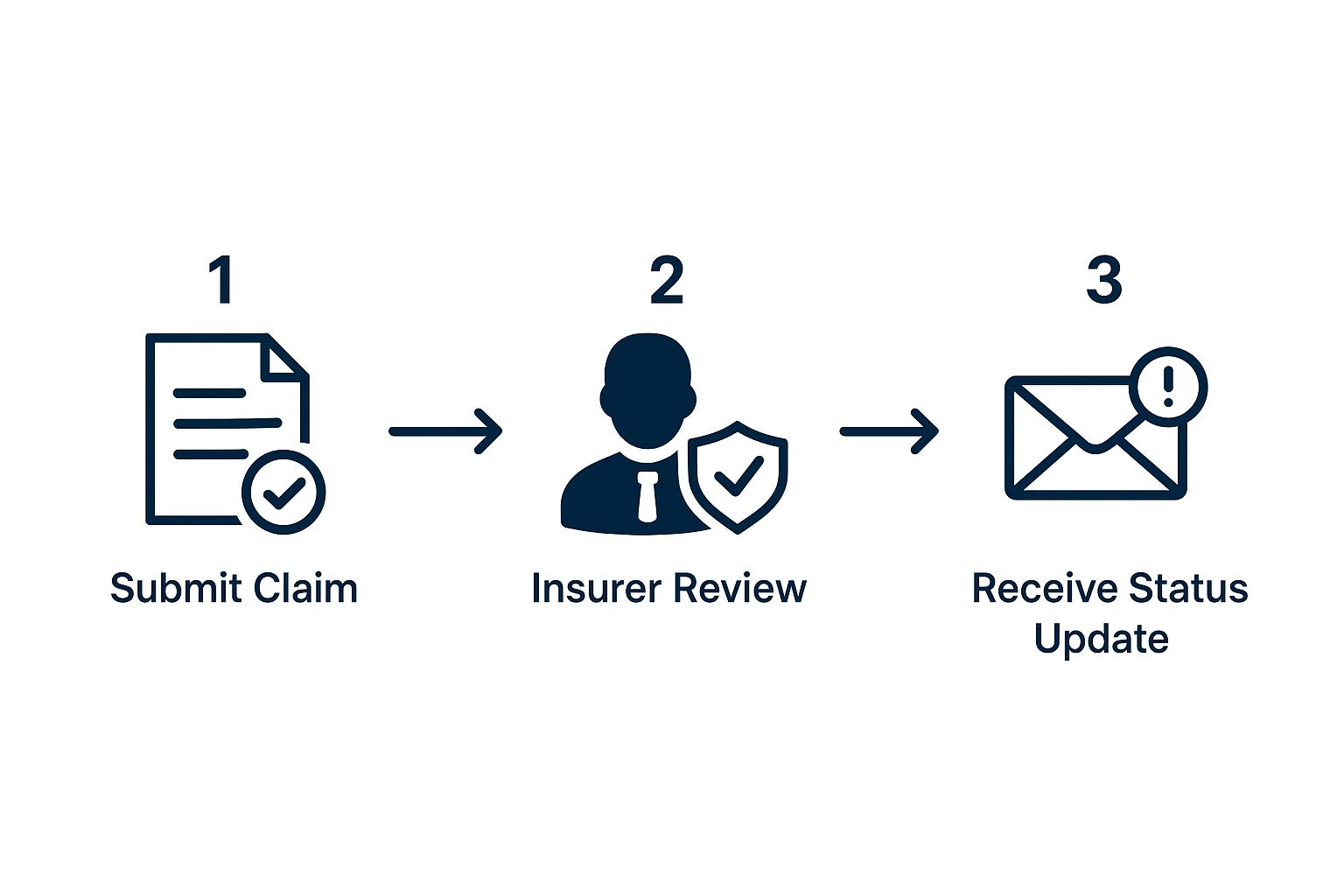
As you can see, that "Insurer Review" stage is where a lot of the waiting happens. It’s the black box of the process, which is why knowing how to monitor it is so important.
Jump Online with State and Insurer Portals
These days, most state workers' comp boards and the big insurance companies have online portals. From my experience, this is often the fastest way to get a real-time snapshot of your claim. You'll just need to set up an account, usually with your claim number and a few personal details.
Once you’re in, you can typically find key details like:
- The current status of your claim (e.g., pending, approved, or controverted).
- A history of payments made for medical bills and lost wages.
- Important upcoming dates, like hearings or independent medical exams (IMEs).
For instance, a veteran in North Carolina can head to the North Carolina Industrial Commission (NCIC) website to find their claims-related contacts. A first responder in Florida would use the Division of Workers' Compensation's online system. It's a similar process in most states: find your state board’s site and look for a link like “Claimant Services” or “Check Claim Status.”
A Quick Word of Advice: These portals are great, but they only show what's been officially entered into the system. They won't reflect a recent phone call or an informal update until the adjuster formally documents it.
Pick Up the Phone and Call Your Adjuster
Sometimes, nothing beats a direct conversation. An online portal is sterile; talking to the insurance adjuster assigned to your case can give you the context and nuance that a screen just can't.
When you call, keep it professional and have your claim number handy. Instead of a generic, "What's the status?" try asking more targeted questions to get a real answer:
- "Hi, I'm following up on claim number [Your Claim Number]. Could you tell me what the last action taken on my file was?"
- "Is there any other information you need from me or my doctor to keep things moving?"
- "What's the next step in your review, and what’s a realistic timeline for that?"
This approach doesn't just get you answers; it shows you're proactive and engaged in the process. It also helps to ground your expectations. The severity of an injury has a huge impact on the financial outcome. One study found that while 83% of claims were 'medical only' with an average payment of $1,477, more serious injuries like amputations averaged payments closer to $3,849. Knowing these figures can help you understand the landscape. You can dig into more of these workers' compensation payment findings if you're interested.
Lastly, never forget your most powerful ally: your attorney or claims representative. If you have legal counsel, they should be your go-to. They have direct lines to the insurer and can translate the legal jargon, freeing you up to focus on what really matters—your recovery.
How to Interpret Your Claim Status

When you check your workers' comp claim status, you’ll probably see a single, confusing word like “Pending,” “Approved,” or “Controverted.” It's easy to get lost in the jargon, but each term signals a specific stage in the process. Knowing what they mean is the first step to staying ahead of the game and knowing what to do next.
Let's break down what this adjuster-speak actually means for you.
Decoding Common Claim Statuses
Most of the time, the first status you'll see is "Pending." This is perfectly normal. It just means the insurance carrier has received your claim and is in the middle of their review. I've seen this stage last anywhere from a few weeks to a couple of months, all depending on how complex the case is and what your state's specific timelines are.
Here are the other big ones you’ll encounter:
- Approved or Accepted: This is the best-case scenario. The insurance company agrees that your injury is work-related and will begin covering your medical treatments and lost wages as outlined by state law. You should receive official paperwork detailing your benefits and the next steps.
- Denied: This means the insurer has rejected your claim. You'll get a formal letter in the mail explaining why they made that decision. This isn't the end of the line—it's simply your cue to start the appeals process.
- Controverted or Disputed: This is a bit of a grey area. The insurer isn't saying no, but they're questioning a part of your claim. Maybe they're disputing how the injury happened or the severity of it. They're essentially pausing to investigate further, and you’ll almost certainly need to provide more evidence to support your case.
A "Denied" or "Controverted" status can feel like a gut punch, but try not to panic. It’s a common tactic insurers use to either delay payment or push you to provide more information. Your immediate job is to get your documentation in order and prepare to fight their decision.
It's important to understand this system in a larger context. From 2015-2017, covered employment grew by 3.2%, and it went up another 2.8% by 2019. Yet, total benefits paid out to injured workers increased by less than 1% in 2019. It shows that getting the benefits you're entitled to isn't always straightforward.
For a deeper dive into these numbers, you can read the National Academy of Social Insurance's report on workers' comp trends.
Keeping Your Claim on Track: How to Be Proactive
Let’s be honest, just checking your claim status isn't enough. Sitting back and waiting for things to happen is one of the biggest mistakes you can make. If you want to keep your claim from getting stuck in limbo, you need to take an active role. It's time to shift from being a passive observer to the driver of your own case.
Your most powerful tool here is consistent, professional communication. Every single time you talk to the insurance adjuster—whether it's a phone call or an email—you need to log it. Jot down the date, the person's name, and a quick summary of what you talked about. This simple habit creates a detailed paper trail that can be a lifesaver if any disagreements pop up down the road.
Be Your Own Best Advocate
Being proactive is about more than just checking in. It’s about methodically building a case that's too strong to be ignored. Your actions, or lack thereof, can genuinely speed up or slow down the entire process.
The absolute number one rule? Go to every single medical appointment and physical therapy session. No exceptions. When you miss appointments, it sends a clear signal to the insurance company: "Maybe this injury isn't as bad as they say." That's all the reason they need to start delaying or even denying your benefits. Following your doctor's treatment plan to the letter is non-negotiable.
I always tell my clients to think of it this way: your claim is the story of your injury. Every missed appointment is a plot hole. When you show up every time and communicate clearly, you're telling a compelling story that’s nearly impossible to dispute.
Following up is an art. You don't want to be a pest, but you can't let them forget about you. I've found that checking in every couple of weeks is the sweet spot if you haven’t heard anything. A quick, polite email is perfect. For example:
"Hi [Adjuster's Name], just following up on my claim, #12345. Wanted to make sure you had everything you needed from my recent appointment with Dr. Smith. Please let me know if there's any other information I can provide."
This approach does two things: it shows you’re on top of your case, and it keeps the ball in their court. By taking these small, consistent steps, you're not just waiting for a resolution—you're actively steering your claim toward one.
Common Questions About Checking Your Claim Status
Let’s be honest, going through the workers' compensation system can feel like you’re constantly left with more questions than answers. You've figured out how to check your claim, but now you're probably wondering about the timing, what to do if things stall, and who’s looking over your shoulder.
I've heard these same questions from countless veterans and first responders over the years. Here’s a breakdown of what you can expect.
How Often Should I Check My Claim Status?
Finding the right balance is crucial here. You want to stay informed, but you don't want to drive yourself crazy.
After you first file, a good rule of thumb is to check on your claim status about once every one to two weeks. That’s enough to keep you in the loop without adding a ton of extra stress to your plate.
Now, if you're dealing with a more complicated case or if the insurance carrier is disputing it, checking in weekly makes a lot of sense. You'll be able to spot any new requests or changes right away. Anything more than that—like checking every day—is usually not worth the anxiety, since the system simply doesn't update that fast.
What If My Claim Status Hasn't Changed?
It’s incredibly frustrating to log in and see "Pending" week after week. If your claim has been stuck in neutral for more than 30 days, it’s definitely time to be proactive.
First, reach out to the insurance adjuster. A polite but direct phone call or email asking for a specific update is your best first move. A good question to ask is, "Is there any information you're waiting on from me or my doctor that could help move this forward?"
Always, and I mean always, document these conversations. Jot down the date, time, and the name of the person you spoke to. If you still don't get a clear answer or feel like you're being ignored, your next call should be to your state's Workers' Compensation Board.
When your claim hits a wall, don't just wait and hope. A simple, documented follow-up often gives the adjuster the nudge they need to pull up your file. It puts the ball back in their court.
Can My Employer See My Claim Status?
Yes, your employer will be able to see the status of your claim. They are a direct party to the claim, so both they and their insurance carrier can access high-level updates.
They'll know if the claim is Approved, Denied, or still Pending.
However, there's a limit to what they can see. Your employer won't have access to your private medical records or the detailed notes from your doctor's appointments. They only get the information that is absolutely necessary to verify that the injury is work-related. Your medical privacy is still very much protected.