
When someone else's negligence causes a car crash, you're left to pick up the pieces—physically, emotionally, and financially. Car accident injury compensation is the legal process that helps you recover the money you've lost from medical bills, missed work, and the pain you've endured. It's about making you financially whole again, with the at-fault driver's insurance company typically footing the bill.
Understanding Your Right to Compensation After a Crash

The minutes after a car accident are chaotic. Adrenaline is pumping, and your first concern is making sure everyone is safe. But once the dust settles, the financial reality of the situation starts to sink in. This is precisely why it's so critical to understand your right to compensation.
Think of this compensation not as a windfall, but as a crucial financial safety net. It's there to cover all the losses—both obvious and hidden—that you suffer because of an accident you didn't cause. Without it, you could be staring down a mountain of medical debt while being unable to earn a living and support your family.
What Does Compensation Actually Cover?
In legal terms, the money you can recover is referred to as "damages." These are the legally recognized losses you can claim from the driver who was at fault. We generally split these into two buckets: economic damages and non-economic damages.
- Economic Damages: These are the straightforward, black-and-white financial hits you've taken. If you have a receipt or a pay stub for it, it likely falls into this category.
- Non-Economic Damages: These are just as real but much more personal. This is compensation for the human cost of the accident—the pain, suffering, and emotional turmoil that don't come with an invoice.
The global impact of traffic accidents is immense. Beyond the individual tragedies, these crashes carry a heavy economic toll, costing most countries an estimated 3% of their gross domestic product. You can explore more on these global traffic injury findings directly from the World Health Organization.
A Closer Look at Recoverable Damages
To really get a handle on what your claim is worth, you need to know what you can actually ask for. Your entire case is built on meticulously documenting every single loss.
The table below breaks down the different types of damages you can pursue. It’s a good starting point for understanding the full scope of your potential claim.
Types of Compensation You Can Claim
| Damage Category | Description | Examples |
|---|---|---|
| Economic | These are the direct financial costs and losses resulting from the accident. They are tangible and can be proven with receipts, bills, and pay stubs. | Medical Bills (hospital stays, surgery, physical therapy), Lost Wages, Future Lost Earning Capacity, Property Damage (vehicle repairs), Out-of-Pocket Expenses (medication, travel to appointments). |
| Non-Economic | These are the intangible losses that affect your quality of life. They are harder to quantify but are a critical component of your total compensation. | Pain and Suffering, Emotional Distress (anxiety, PTSD), Loss of Enjoyment of Life, Disfigurement or Scarring, Loss of Consortium (impact on your spousal relationship). |
As you can see, a strong claim goes far beyond just the initial hospital bill. It accounts for the complete impact the accident has had on your life.
How Your State's Laws Affect Your Claim
Where the accident happened matters a lot. Your ability to get compensated is directly tied to your state's insurance laws, which typically fall into one of two systems: "at-fault" or "no-fault."
In an at-fault state, the path is more direct. You file a claim against the at-fault driver's insurance, and to get paid, you have to prove their negligence caused your injuries.
Things work a bit differently in a no-fault state. Here, you first turn to your own insurance policy. Your Personal Injury Protection (PIP) coverage handles your initial medical bills and lost wages, no matter who caused the crash. You can only step outside that system to sue the other driver if your injuries are severe enough to cross a certain "threshold," which is defined differently in each state.
Knowing which system you're in is the first, most crucial step. It dictates your immediate actions and is fundamental to protecting your rights from day one.
What to Do Immediately After a Car Accident

The moments right after a crash are chaotic and confusing. Your training might kick in, but it's easy to feel disoriented. What you do here, right at the scene, sets the entire foundation for your injury claim. Every piece of information you gather can make a significant difference in getting the car accident injury compensation you deserve.
First things first: safety. Check on yourself and your passengers. Only if it's safe and you're able, check on the people in the other vehicle. If the crash was minor and the cars are drivable, try to move them to the shoulder. If not, don't risk it. Just put your hazard lights on to warn oncoming traffic.
Get Police and Paramedics on the Way
Your first call should be to 911. Don't hesitate. Reporting the accident isn't just a suggestion; in most places, it's the law if there are injuries or serious damage.
When you call, make sure to request both police and an ambulance. A formal police report is one of the most powerful pieces of evidence you can have. It provides an official, objective narrative of what happened. Having paramedics check you out on-site is just as important. Adrenaline is a powerful painkiller, and you might not realize you're hurt until hours later.
While you're rendering aid or waiting for help, it's good to have a basic understanding of Good Samaritan Laws and legal protections, which can shield you from liability when you're helping in good faith.
Start Gathering Intel
While you wait for first responders, switch into information-gathering mode. Don't trust your memory—the details will get fuzzy. Use your phone to take pictures of documents and write down everything.
- Other Driver's Info: Get their full name, address, phone number, and driver's license number.
- Their Insurance: Snap a photo of their insurance card. You need the company name and policy number.
- Vehicle Details: Note the make, model, color, and license plate for every car involved.
If there were people who saw the crash, they can be your best allies. An independent witness provides a neutral perspective that can shut down any "he said, she said" arguments later. Be polite and ask for their name and phone number.
A Quick Word of Caution: Watch what you say. Even a simple, well-intentioned "I'm sorry" can be used against you by an insurance company to argue you admitted fault. Stick to the facts. Don't apologize, don't assign blame, just state what happened.
Your Phone is Your Best Evidence Tool
In this situation, your smartphone is invaluable. Photos and videos create a visual story that is incredibly difficult for an insurance adjuster to argue with. You can never take too many pictures. Get shots from far away, up close, and from every conceivable angle.
Here’s a quick checklist for your photos:
- Vehicle Damage: Start with wide shots showing where all the cars ended up. Then, get detailed close-ups of the damage on every vehicle.
- The Scene: Capture photos of skid marks, broken glass, road debris, and any relevant traffic signs or signals.
- Conditions: Was it raining? Was the sun in your eyes? Were there potholes or construction zones? Document the environment.
- Your Injuries: If you have any visible cuts, bruises, or scrapes, take clear pictures of them right away.
Taking these steps isn't just about going through the motions. You are actively building the case for your claim, ensuring the evidence you collect at the scene directly supports your fight for fair compensation.
Building an Unshakeable Case with Documentation
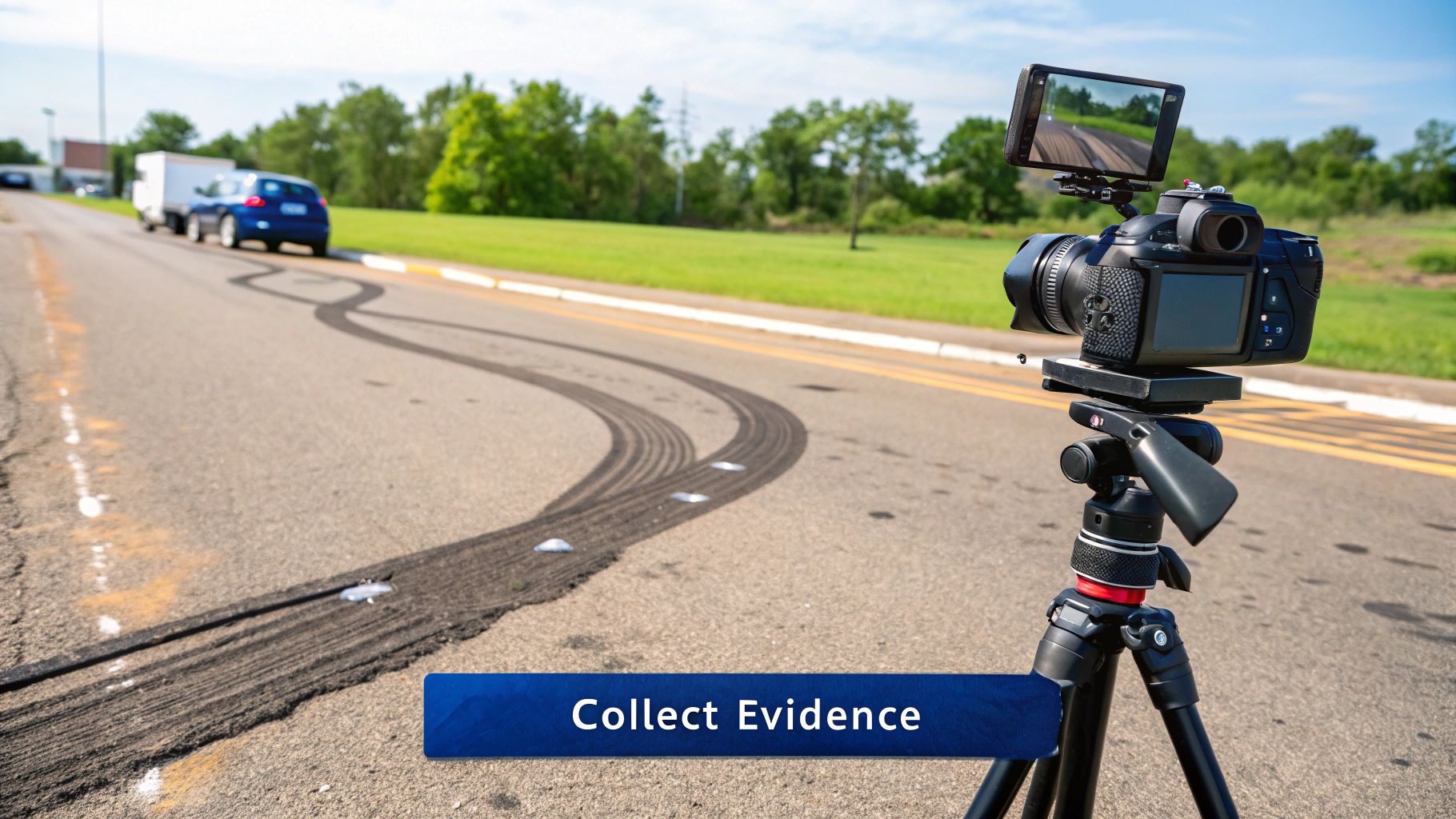
After the shock of a car wreck wears off, your next mission is to start gathering the proof you need to get the car accident injury compensation you deserve. From an insurance adjuster’s perspective, their job is to question everything—the severity of your injuries, the reason for your treatments, and the overall impact on your life. Your job is to build a fortress of evidence so strong it leaves them no room to argue.
Think of it this way: this isn't just about collecting a pile of receipts. It's about drawing a clear, undeniable line from the moment of the crash to every single consequence you've faced since. Each document you save is another stone in the wall of your case, making your claim solid and much harder to dispute.
Why Immediate Medical Care Is Your Strongest Evidence
The single most important piece of evidence you can have is a medical record created immediately after the accident. I can't stress this enough: even if you feel okay, you must get checked out. Go to an urgent care clinic, the ER, or your primary doctor. Adrenaline is a powerful painkiller and can easily mask serious injuries like whiplash or even internal bleeding, which might not show symptoms for hours or days.
When you delay medical care, you hand the insurance company a golden opportunity to weaken your claim. They'll argue that if you were really hurt, you would have seen a doctor right away. This "gap in treatment" is a classic tactic they use to suggest your injuries aren't that bad or, worse, that they were caused by something else entirely. Don't give them that opening.
Tallying Up the Financial Toll: Your Economic Damages
This is where you account for every single dollar the accident has cost you out of pocket. We call these economic damages, and they’re the tangible, black-and-white losses that need a paper trail. Get a dedicated folder or create a digital one on your computer, and be meticulous. Save everything.
Your Document Checklist:
- All Medical Bills: Every single invoice. This includes the ambulance, hospital, doctor visits, physical therapy, and chiropractor appointments.
- Pharmacy Receipts: Keep a record of every prescription and over-the-counter medicine you had to buy because of your injuries.
- Vehicle Repair Estimates: You should get at least two estimates for your car's repairs, plus the final bill if the work has been done.
- Proof of Lost Wages: This is a big one. Ask your employer for a formal letter on company letterhead that details your pay rate, how many hours you missed, and your total lost income. Back this up with recent pay stubs.
It’s a sobering fact, but car accidents in the U.S. lead to about 2.1 million emergency room visits every year. Even with those staggering numbers, only 28% of accidents officially report injuries, while 71% are listed as property damage only. This just goes to show how critical it is to have solid proof that your injuries are legitimate.
The Power of a Pain and Suffering Journal
While receipts and bills show the financial cost, a journal tells the human story. This is your most powerful tool for capturing what lawyers call non-economic damages—the pain, the suffering, the disruption to your life. These damages often make up the largest part of a settlement, but adjusters will try to dismiss them as "subjective." A detailed, consistent journal makes them real and tangible.
Grab a notebook or start a new document on your computer and make regular entries—daily is best, but weekly works too. Don't just write "My neck hurts." Get specific. Give concrete examples of how your life has changed.
What to Track in Your Journal:
- Pain Levels: Use a simple 1-10 scale to rate your pain each day. Describe the sensation—is it a sharp, stabbing pain or a dull, constant ache?
- Emotional Well-being: Write down when you feel anxious, depressed, or frustrated. Are you having trouble sleeping because of pain? Experiencing nightmares about the crash? Document it.
- Daily Struggles: Note the simple things you suddenly can't do. For example, "Couldn't lift my daughter out of her car seat," or "Tried to mow the lawn but had to stop after five minutes from the back pain."
- Missed Moments: Did you have to skip a family barbecue, your weekly golf game, or your kid's soccer match? Write down what you missed and how it made you feel.
This journal will become the narrative that your medical records can't fully capture. It gives your attorney a powerful, firsthand account of your experience to use during negotiations, ensuring you get compensated for the very real toll the accident has taken on your quality of life.
Throughout this process, you're going to be handling a lot of sensitive information. Protecting this data is just as important as collecting it. For more on this, you can check out a complete playbook for document security that offers great guidance on keeping your private data safe.
How to Handle Insurance Company Communications
Talking with an insurance adjuster can feel like you're walking into a minefield. It's a high-stakes conversation that can make or break your car accident injury compensation. The good news is, with the right approach, you can navigate these calls, stay in control, and protect your claim's value right from the start.
First thing to remember: the other driver's insurance adjuster isn't your friend. Their job is to protect their company's bottom line, which means paying you as little as possible. They are pros, trained in negotiation. Your job is to give them only the bare-bones information they need, and nothing more.
This visual guide breaks down the typical claims process, from figuring out your damages to settling the claim.
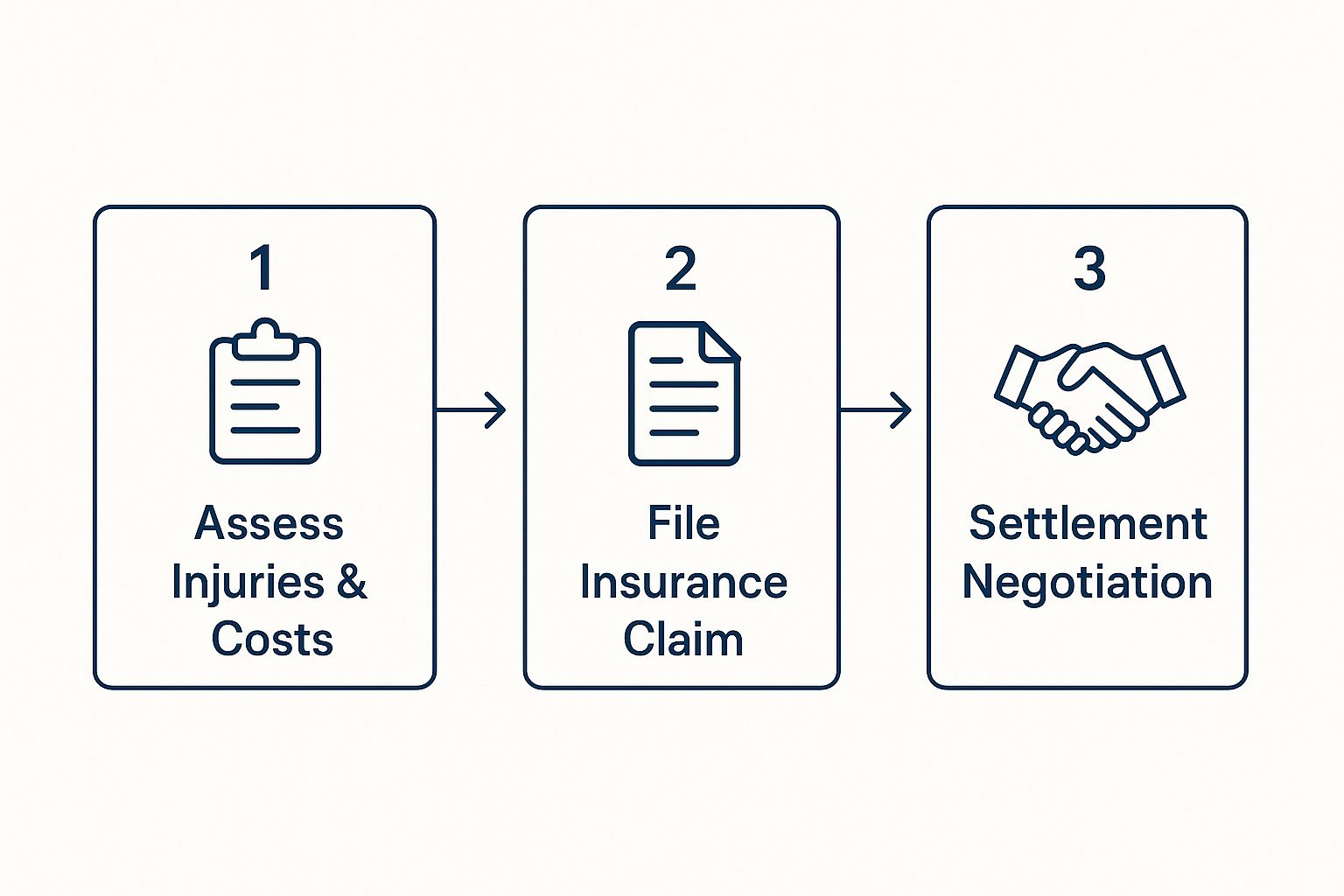
As you can see, it all begins with a full accounting of your injuries and expenses before you ever file the claim. The final step is negotiation, and you need to be prepared.
Your First Conversation with the Adjuster
That first phone call is crucial. Whether you're calling them or they're calling you, what you say—and more importantly, what you don't say—sets the stage for everything that follows.
Keep it short and sweet. Stick to the absolute basics:
- Your name and contact info.
- The date and location of the crash.
- You can confirm you were involved.
That's it. You don't owe them a detailed story or your opinion on what happened.
Adjusters are masters of the seemingly innocent question. When they ask, "How are you today?" a simple "I'm fine" can be used against you later to argue you weren't really hurt. A much safer and more accurate answer is, "I'm currently under a doctor's care and don't know the full extent of my injuries."
Resisting Common Adjuster Tactics
Insurance adjusters use a standard playbook to try and poke holes in your claim. Once you know what to look for, you can shut these tactics down.
One of their go-to moves is asking for a recorded statement. You have zero legal obligation to give one to the other driver's insurer. They use these recordings to try and catch you in a contradiction later on. A firm but polite, "I'm not providing a recorded statement right now," is all you need to say.
Another classic tactic is the quick, lowball offer. They might dangle a check for a few thousand dollars just days after the accident. They're banking on you being stressed and taking the fast cash before you even know what your future medical bills or lost wages will look like. Don't fall for it. Never even consider an offer until you've finished all medical treatment.
Remember, your claim is a marathon, not a sprint. Don't let anyone rush you. Your health and a complete understanding of your losses are what matter most before you even think about settling.
Handling these conversations with a clear strategy is key. Here’s a quick-reference guide to help you manage those calls effectively.
Communicating with Insurance Adjusters Dos and Don'ts
| Do This | Don't Do This |
|---|---|
| Do provide your basic contact information. | Don't give a recorded statement. |
| Do state you are getting medical care. | Don't guess about how the accident happened. |
| Do keep notes of every conversation. | Don't accept a quick settlement offer. |
| Do say you're still assessing your injuries. | Don't sign any medical release forms from them. |
| Do provide the police report number. | Don't downplay your injuries or pain. |
By being cautious and strategic, you protect your right to fair compensation. You're in charge of the information you share. Limiting what you say puts you in a much stronger negotiating position down the road.
And if they deny your claim? All is not lost. Knowing some expert tips on what to do when an insurance claim is denied can be critical for fighting back and protecting your rights.
Knowing When to Call in a Personal Injury Lawyer
Deciding to hire a lawyer after a wreck is a tough call. As a veteran, you're used to handling difficult situations head-on, and it's natural to think you can manage an insurance claim on your own. But I’ve seen it time and again: the insurance claims process isn't a fair fight. You’re up against a massive corporation with a team of professionals whose entire job is to pay you as little as possible.
Bringing in an attorney isn't about giving up control; it's a strategic move. It's about equipping yourself with the right expertise for this specific battle. Going toe-to-toe with a seasoned insurance adjuster without legal backup is a recipe for getting short-changed. An experienced lawyer knows their playbook, understands what your claim is really worth, and has the power to make them negotiate in good faith.
The Obvious Signs You Need an Attorney
While anyone can benefit from a legal consultation, some situations practically scream for professional help. If any of these scenarios sound familiar, it's time to get a lawyer in your corner, and fast.
- You Were Seriously Hurt: We're not talking about minor aches and pains. If you suffered broken bones, a traumatic brain injury (TBI), spinal cord damage, or any injury that required surgery or hospitalization, you absolutely need a lawyer. These cases involve complex calculations for future medical bills and long-term care that you can't afford to get wrong.
- The Insurance Company Is Pointing Fingers: Is the other driver's insurer trying to pin some or all of the blame on you? This is a direct attack on your right to compensation. A good lawyer will immediately gather evidence—police reports, witness statements, even accident reconstruction data—to shut that argument down.
- The Adjuster Is Giving You the Runaround: Are they dodging your calls? Pressuring you for a recorded statement? Dangling a quick, lowball offer to make you go away? These are classic tactics they use on people they think are easy marks. An attorney puts an immediate stop to these games.
Don't just take my word for it—the numbers speak for themselves. Studies consistently show a massive difference in outcomes. Claimants who hire a personal injury lawyer often walk away with settlements nearly three times larger than those who handle it alone. What's more, an overwhelming 91% of people with a lawyer receive a payout, compared to just 51% of unrepresented folks. You can dig into the data yourself in these personal injury case statistics.
The Financial Side of Hiring a Lawyer
I know what you might be thinking: "I can't afford a lawyer." Here's the good news. Nearly all reputable personal injury attorneys work on a contingency fee basis.
This means you pay absolutely nothing upfront. No retainer, no hourly bills. The lawyer's fee is simply a percentage of the settlement they win for you. If they don't get you any money, you don't owe them a dime for their time.
Think about it—this system puts you and your lawyer on the same team. Their success is literally tied to yours, motivating them to fight for every last dollar you deserve.
Let’s look at a real-world example. The insurance company offers you $25,000. It sounds like a decent amount, and you're tempted to take it and move on. An experienced lawyer, however, might review your medical situation and project your future needs, determining your claim is actually worth closer to $100,000.
Even after their fee (which is typically around 33%), you'd pocket roughly $67,000. That's a life-changing difference. In this light, the lawyer's fee isn't a cost—it's an investment in a much better outcome.
What Does a Lawyer Actually Do for You?
Hiring an attorney is about so much more than just negotiations. It's about offloading the enormous stress and administrative headache of a claim so you can focus on the most important thing: your recovery.
Here’s what a good lawyer and their team will handle:
- Run Point on All Communications: They become the shield between you and everyone else. The endless calls from insurance adjusters, medical billing offices, and collection agencies? They stop. All communications go through their office.
- Lead a Full-Scale Investigation: They dig deep to gather every piece of evidence. This includes police reports, all your medical records, photos from the scene, and witness interviews to build an airtight case.
- Calculate the True Value of Your Claim: They often bring in medical and economic experts to accurately calculate the full financial impact of your injuries. This covers everything from future lost income to the cost of lifelong medical care.
- Negotiate from a Position of Strength: Armed with solid evidence and a precise valuation, they go to the negotiating table ready to fight, not just accept the first lowball offer.
- Take the Fight to Court: If the insurance company refuses to be reasonable, your attorney won't hesitate to file a lawsuit and represent you at trial. The fact that the average motor vehicle lawsuit takes about 20 months shows you just how much work goes on behind the scenes.
Ultimately, choosing to hire a lawyer is about recognizing what your claim is worth and taking the smartest step to protect it. It’s how you level the playing field and give yourself the best shot at receiving the full and fair car accident injury compensation you are owed.
Common Questions After a Car Wreck
After a crash, your head is probably swimming with questions. The legal side of things can feel overwhelming, especially when you’re trying to heal. My goal here is to cut through the legal jargon and give you straight, clear answers to the questions I hear most often from folks dealing with car accident injury compensation. Getting a handle on these issues is the first step toward feeling more in control.
We'll dig into the big ones: deadlines, blame, and those notoriously low first offers from the insurance company. Understanding how these pieces fit together is crucial for protecting yourself and making smart decisions down the road.
How Long Do I Really Have to File a Claim?
This is, without a doubt, one of the most critical questions. The answer is governed by something called the statute of limitations—a strict, non-negotiable deadline for filing a lawsuit. If you miss this deadline, you lose your right to sue for compensation forever. It doesn't matter how severe your injuries are or how clear the other driver's fault was.
Every state sets its own timeline, which can be as short as one year or as long as six. Most, however, give you somewhere in the two-to-three-year range.
- Real-world example: Let's say you're in a wreck in Texas, where the statute of limitations is two years. If the accident happened on August 1, 2024, you have until August 1, 2026, to file a lawsuit. If you try to file on August 2nd, the court will throw your case out. It's that black and white.
You need to know your state's deadline right away. This isn't just about filing the final lawsuit; it’s about giving yourself breathing room to gather all your evidence, finish your medical treatment, and build a solid claim without feeling rushed.
What if the Accident Was Partially My Fault?
It's a common worry. Many people think that if they share even a little bit of the blame, they can't get any compensation. Thankfully, that's not true in most places. The outcome really boils down to your state's specific negligence laws.
The most common system is called comparative negligence. This rule allows you to recover damages, but the amount is reduced by your percentage of fault. For example, if a jury decides your total damages are $100,000 but finds you were 20% responsible for the crash, you could still collect $80,000.
A handful of states, however, follow a much tougher rule: contributory negligence. In these states, if you are found to be even 1% at fault, you get nothing. Zero. It’s an incredibly unforgiving system, which makes it vital to know which rule your state uses.
I see this all the time: A driver is doing 5 mph over the speed limit when another car blows through a red light and T-bones them. The insurance company for the at-fault driver will seize on that, arguing the speeding contributed to the severity of the crash. Their goal? To assign you a percentage of fault and reduce their payout.
Should I Accept the Insurance Company’s First Offer?
Let me be direct: Almost never. That first phone call from the adjuster often comes with a quick, lowball offer. It’s a tactic. They are trained professionals whose job is to settle claims for as little money as possible.
This initial offer is a feeler, designed to see if you'll bite on a fast payout before you know the full story.
Think about it—these offers almost always come before you’ve finished treatment. You might not know yet if you need surgery, long-term physical therapy, or if a "minor" injury will turn into a chronic pain issue.
Once you take their money and sign that release form, your case is closed for good. You give up all rights to ask for more compensation for that accident. If you find out a month later that you need a major operation, it's too late. The best move is to wait until you have a complete picture of your damages—medical bills, lost income, and future care needs—before you even start talking numbers.
At Homefront Group, we know the unique challenges veterans face, especially when navigating a personal injury claim after a car accident. Our team was founded by a former Navy JAG and includes fellow veterans who are dedicated to making sure you get the expert guidance and full compensation you've earned. If you've been injured, take our free 3-minute quiz to see how we can help you map out a strategy for your recovery. Learn more and get the support you need.