

What Camp Lejeune Settlement Amounts Really Look Like
Understanding Camp Lejeune settlement amounts can be confusing. Think of it like trying to piece together a jigsaw puzzle without the picture on the box. As initial settlements come to light, however, we begin to see the bigger picture emerge.
These early cases are like the corner pieces of the puzzle, giving us our first real glimpses into what to expect. Let’s explore these initial payouts and what they might mean for future Camp Lejeune settlements.
One key difference to grasp is the distinction between administrative claims handled by the Navy and lawsuits filed in federal court. Imagine these as two separate paths leading to the same destination, each with its own set of twists and turns. The first wave of settlements primarily came through the administrative process known as the Elective Option.
From this initial phase, the first 57 claimants received a total of $14.4 million as of 2024. This averages out to roughly $252,631 per person. You can find more details at Sokolove Law. Keep in mind, though, that this figure is just an average.
This average, however, doesn’t tell the whole story. Just like every puzzle piece is unique, so too is every Camp Lejeune case. The actual settlement amounts can vary significantly depending on several factors.
Deciphering the Factors Behind Varying Settlements
Factors influencing the final settlement amount include:
- Severity of the illness: Think of it like the difference between a small scratch and a broken bone. More serious illnesses will naturally lead to higher settlements.
- Duration of exposure at Camp Lejeune: Longer exposure is often linked to more severe health issues, thus influencing the compensation.
- Strength of supporting documentation: Solid evidence plays a vital role in building a strong case.
For example, someone diagnosed with a severe cancer after a long period living at Camp Lejeune might receive a significantly higher settlement than someone with a less serious condition and shorter exposure. Understanding these nuances is essential for setting realistic expectations.
These early settlements are simply pieces of a larger puzzle. The initial average provides a helpful starting point, but it doesn't necessarily predict what future claimants will receive.
As more cases are resolved, we'll gain a more complete understanding of the range of Camp Lejeune settlement amounts. If you’re looking for career options while dealing with this, you might explore Remote Work Jobs.
These early cases are a valuable starting point, offering important information for anyone seeking compensation. They provide crucial insights, helping claimants understand the process and prepare for the best possible outcome.
The Settlement Spectrum: Understanding $10K to $1M+ Payouts
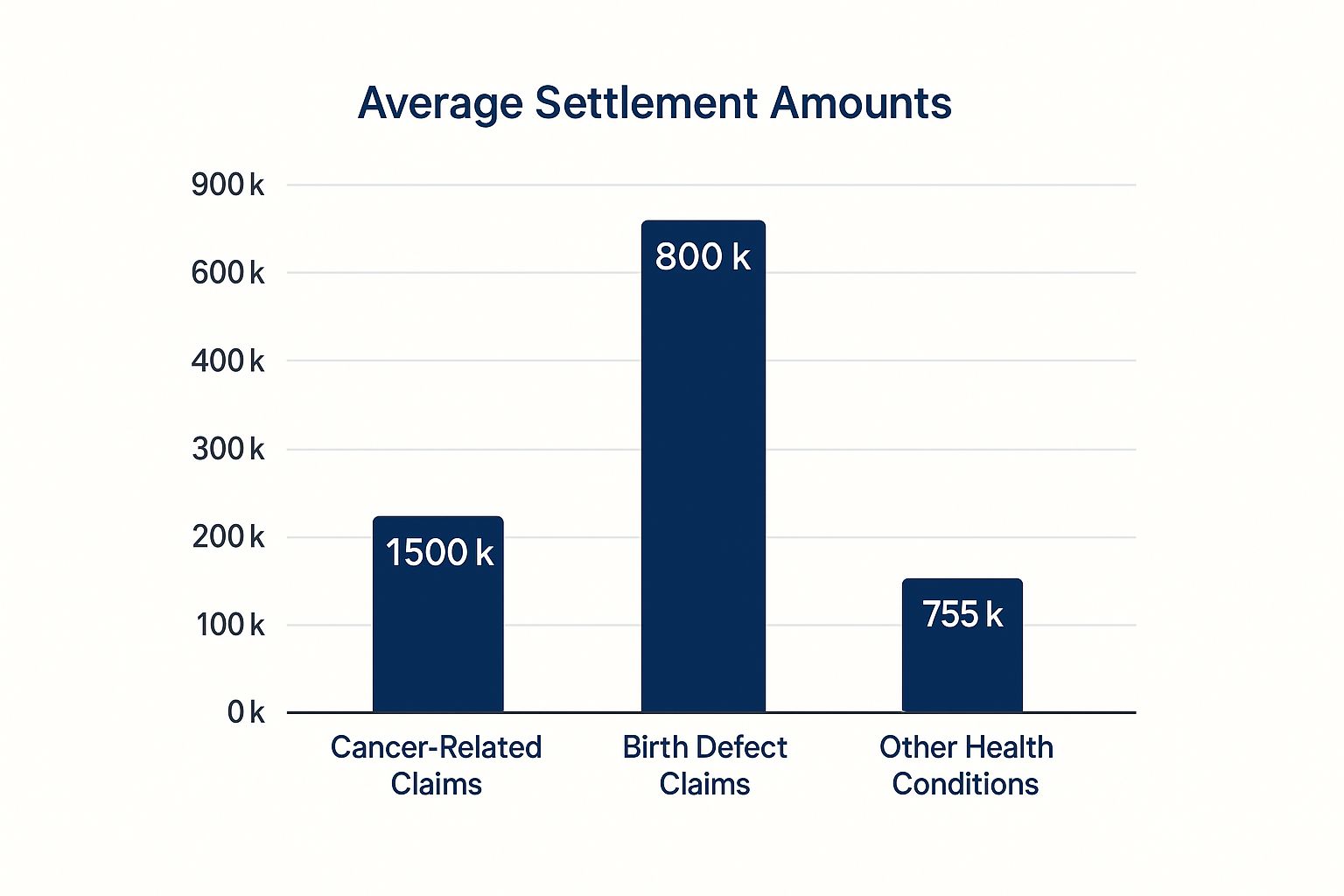
The infographic gives a visual overview of average Camp Lejeune settlement amounts. Notice the three main claim categories: cancer, birth defects, and other health conditions. You'll see that birth defect claims tend to have higher average settlements. This reflects the long-term impact these conditions have and the significant cost of lifelong care.
Now, let's talk about the range of settlement amounts. It can feel a bit overwhelming, like trying to guess the number of jellybeans in a jar. Some claimants might receive smaller amounts, while others receive significantly more. But this isn't random. There are actually patterns based on some important factors.
To get a better grasp on these patterns, we can look at the structured settlement frameworks that lawyers often use as a starting point.
These frameworks link the time spent at Camp Lejeune with potential compensation. Imagine it like a loyalty program: the more time you spent there, the higher the potential compensation.
For example, someone with five or more years of exposure might receive $450,000. Someone with one to five years might receive $300,000. And those with less than a year but at least 30 days could receive $150,000. Additionally, those with terminal conditions might be eligible for an additional $100,000. Keep in mind, though, that Camp Lejeune settlement amounts can vary widely, from $10,000 to over $1,000,000. For a deeper dive, check out this resource on Camp Lejeune water contamination settlement amounts.
It's important to remember that these framework amounts aren't set in stone. They’re more like starting points in a negotiation, similar to the sticker price on a car. The final settlement amount depends on the specifics of each case.
To illustrate this framework further, let's take a look at a table:
Camp Lejeune Settlement Amounts by Exposure Duration
| Exposure Duration | Base Settlement Amount | Terminal Condition Bonus | Total Potential |
|---|---|---|---|
| 5+ Years | $450,000 | $100,000 | $550,000 |
| 1-5 Years | $300,000 | $100,000 | $400,000 |
| 30 Days – 1 Year | $150,000 | $100,000 | $250,000 |
This table shows how the base settlement amount increases with the duration of exposure. The potential for a terminal condition bonus adds another layer to the potential compensation. As you can see, the total potential payout can vary significantly.
Decoding the Compensation Tiers
So, what else goes into determining the final amount? Well, several factors come into play. Think of it like baking a cake – the basic ingredients are important, but the final result depends on other things too.
-
Severity of the Condition: A more severe condition generally leads to higher compensation. This is like comparing a small scratch to a broken bone – the compensation reflects the level of harm.
-
Medical Documentation: Clear medical records that link your health issue to the contaminated water are essential. Think of it like building a case in court – you need strong evidence to support your claim.
-
Impact on Quality of Life: This includes things like financial losses, lost wages, and pain and suffering. It's about understanding how the contamination has affected your daily life.
This multi-faceted approach ensures each claim is reviewed individually and fairly. It's not a one-size-fits-all situation. Each case is unique, just like each person's experience at Camp Lejeune.
The Unprecedented Scale: Why 400,000+ Claims Matter to You

Imagine a city the size of Tampa, Florida, everyone needing medical attention at the same time. That’s the scale we're talking about with the Camp Lejeune water contamination issue—over 400,000 administrative claims filed with the Navy, plus thousands of lawsuits in federal court. This huge number creates a truly unique situation in American legal history, and it directly affects your potential Camp Lejeune settlement.
Just to give you a clearer picture, at least 2,900 cases were pending in the Eastern District of North Carolina alone as of June 2025. This makes Camp Lejeune one of the largest environmental exposure cases ever in the U.S. For more information, you can visit the Lawsuit Information Center.
How This Impacts Processing Times
This flood of claims creates a significant bottleneck. Think of a highway suddenly jammed with traffic—everything slows to a crawl. This slowdown impacts both the administrative claims handled by the Navy and the lawsuits going through the federal courts. The Navy, facing those 400,000 administrative claims, has a mountain of paperwork to process. This naturally leads to longer wait times and can affect how quickly you might receive a settlement.
The Dual-Track System: Navy vs. Federal Court
The Camp Lejeune case runs on two parallel tracks. The Navy handles the administrative claims, and the federal courts handle the lawsuits. This two-track system gives those filing claims a choice to make. You can try for a potentially quicker resolution through the Navy, or you might aim for a potentially bigger settlement through the courts. The best route for you depends on things like the strength of your evidence and how long you're willing to wait for a resolution.
The Influence of Precedent
With so many cases in progress, early decisions and settlements set important legal precedents. Think of these early cases as setting the rules of the game. They can influence future settlement amounts and the legal strategies used by everyone involved. The sheer volume of claims creates a complex legal landscape where each case contributes to the bigger picture.
Understanding Your Place in the Process
It’s understandable to feel overwhelmed by the scale of this legal issue. However, understanding how this massive caseload works puts you in a better position. By grasping the processing times, the dual-track system, and the influence of precedent, you’ll have a more realistic understanding of your own case and what might happen. This knowledge helps you make the best decisions for your situation and pursue a fair settlement.
The Compensation Formula: What Actually Determines Your Payout
Your Camp Lejeune settlement amount isn't a lottery. It's calculated based on specific criteria. Think of it like baking a cake: each ingredient affects the final result. Knowing the recipe helps you bake the best possible cake.
Key Factors Influencing Camp Lejeune Settlement Amounts
Claims processors and lawyers consider several key factors when evaluating your Camp Lejeune claim.
-
Type and Severity of Your Condition: A paper cut needs less attention than a broken arm. Similarly, the severity of your diagnosis significantly influences potential compensation. More serious illnesses, especially cancers linked to Camp Lejeune like bladder cancer, kidney cancer, leukemia, liver cancer, and non-Hodgkin’s lymphoma, generally result in higher settlements.
-
Quality of Medical Documentation: Imagine building a house without blueprints. Your medical records are the blueprints for your case, linking your health issues to the contaminated water. Stronger links build a stronger case.
-
Exposure Timeline and Duration: How long were you exposed? Like a dripping faucet slowly eroding stone, longer exposures are often associated with increased health risks and potentially higher settlements. Settlement frameworks may have tiers based on exposure duration, with higher compensation for those exposed for five years or more.
-
Documented Financial Losses: Besides medical expenses, have you suffered other financial losses because of your condition? Lost wages, reduced earning capacity, and other burdens directly tied to your exposure are all considered when calculating your settlement. Good documentation strengthens your case.
-
Impact on Your Quality of Life: The impact goes beyond finances. Pain, suffering, diminished quality of life, and emotional distress are factored in. This is the “human element,” reflecting the true cost beyond medical bills.
Building a Strong Case: Practical Strategies
Understanding these factors is the first step. Next is strategically building a strong case.
-
Gather Comprehensive Medical Records: Get all records related to your diagnosis, clearly linking your health issues to your time at Camp Lejeune.
-
Establish a Precise Exposure Timeline: Document the dates and length of your stay at Camp Lejeune to connect your exposure to your current health condition.
-
Document All Financial Losses: Maintain detailed records of all financial hardships caused by your exposure, including lost wages and medical expenses, to add weight to your claim.
-
Consult with Experienced Legal Counsel: Navigating Camp Lejeune settlements can be challenging. A skilled lawyer can help gather evidence, build your case, and advocate for you to maximize your potential settlement. They understand the complexities of this compensation system.
Learning From Real Cases: Settlement Stories That Matter

Understanding Camp Lejeune settlement amounts can feel overwhelming, like trying to find your way through a maze. Real-life examples, however, can serve as a guide, shedding light on the often confusing process. Let's delve into some anonymized case studies to get a better grasp of how these settlements work in practice.
Case Study 1: Kidney Cancer and a Clear Timeline
Imagine a veteran who spent three years at Camp Lejeune and is later diagnosed with kidney cancer. This veteran kept meticulous records of their time on base and was able to connect those records with medical documentation showing the onset of their illness.
This clear timeline, along with strong medical evidence linking kidney cancer to the contaminated water, formed the foundation of a successful claim. The result was a substantial settlement reflecting the severity of the illness and the undeniable connection to Camp Lejeune.
Case Study 2: Prenatal Exposure and Leukemia
Now consider a different scenario. A family member who never lived at Camp Lejeune but was exposed prenatally develops leukemia. This type of case presents unique challenges.
Proving the link between prenatal exposure and childhood leukemia required expert medical testimony and a detailed family history. While the settlement was still significant, it took longer due to the difficulty of establishing a direct cause-and-effect relationship. This highlights the critical importance of thorough documentation, especially in complex cases.
Case Study 3: The Speed of Settlement
Why do some cases resolve quickly while others drag on? One veteran diagnosed with bladder cancer, with clear documentation of a five-year exposure to contaminated water, settled relatively quickly, benefiting from a streamlined claims process.
However, another veteran with Parkinson’s disease, whose medical records were less conclusive, experienced a much longer journey. This case involved extensive litigation to solidify the connection between their condition and the contaminated water, ultimately leading to a hard-won settlement.
Let's take a look at a table summarizing these cases and the factors impacting their outcomes:
To illustrate how these factors influence settlement amounts, consider the following case studies:
Case Study Comparison: Settlement Factors and Outcomes
| Case Type | Exposure Duration | Medical Condition | Settlement Amount | Key Success Factors |
|---|---|---|---|---|
| Veteran | 3 years | Kidney Cancer | Substantial | Clear timeline, strong medical evidence |
| Family Member (Prenatal Exposure) | N/A | Leukemia | Significant | Expert medical testimony, detailed family history |
| Veteran | 5 years | Bladder Cancer | Substantial | Clear documentation, streamlined process |
| Veteran | Unspecified | Parkinson's Disease | Unspecified (Hard-fought) | Extensive litigation to establish causation |
This table demonstrates how the strength of evidence, the severity of the condition, and the complexity of proving causation can significantly influence the outcome of a Camp Lejeune water contamination claim. While a streamlined process resulted in a quicker settlement for the veteran with bladder cancer, the more complex Parkinson’s case demonstrates the potential for lengthy litigation.
Deciphering the Patterns
These Camp Lejeune settlement examples aren't just isolated incidents. They reveal crucial factors that consistently influence settlement amounts:
- Strength of Evidence: Clear medical records and a well-defined timeline of exposure are essential.
- Severity of the Condition: More severe illnesses generally result in higher settlements.
- Complexity of Causation: Cases involving complex medical arguments often require more time and resources.
By examining these real-world situations, we gain a practical understanding of the elements that shape Camp Lejeune settlements. These stories offer valuable insights and can help inform your own case preparation, providing a clearer picture of the road ahead.
Your Strategic Choice: Administrative Claims vs. Lawsuits
Choosing how to pursue compensation for Camp Lejeune water contamination is a big decision. It's kind of like choosing between two different roads to the same destination. One might be a winding scenic route, while the other is a faster highway. Both get you there, but the journeys are quite different. Let's explore these two paths: the administrative claim, handled by the Navy, and the lawsuit, filed in federal court.
Understanding Administrative Claims
Think of filing an administrative claim with the Navy as taking that scenic route. It’s generally less complicated than a lawsuit and could potentially be quicker. You submit your claim directly to the Navy with evidence of your time at Camp Lejeune, your medical diagnosis, and any related expenses or losses. The Navy reviews everything and decides whether to offer a settlement.
However, there's a catch. The approval rate for administrative claims is relatively low, hovering around 25%. That means only about one in four claims gets the green light through this route. One reason for this is the sheer volume of claims—over 400,000—which creates a backlog and makes it harder for individual claims to stand out.
Navigating the Lawsuit Path
Filing a lawsuit, on the other hand, is more like taking the highway. It can be more complex but has the potential to reach a larger settlement. You file your case in federal court, joining thousands of other Camp Lejeune cases. As of June 2025, over 2,900 cases were active in the Eastern District of North Carolina alone. This route often requires more compelling evidence and may involve expert testimony. While a lawsuit might lead to higher compensation, it’s typically a longer, more demanding process.
Weighing the Pros and Cons
Each path has its own set of advantages and disadvantages. Let's break them down:
Administrative Claims:
- Pros: Potentially faster resolution, simpler process.
- Cons: Lower approval rate, possibly smaller settlements.
Lawsuits:
- Pros: Potential for higher settlements, stronger legal arguments.
- Cons: Longer process, requires more robust evidence.
Cost Considerations and Legal Representation
Cost is a major factor to consider. Administrative claims usually have lower upfront costs, and you don't necessarily need a lawyer. However, having legal representation can greatly improve your chances, even with an administrative claim. Think of it like having a skilled navigator helping you chart the best course.
Lawsuits, as you might expect, usually involve legal fees and other expenses. These can add up, so it’s important to understand the potential financial commitment involved.
Many attorneys offer free consultations specifically for Camp Lejeune cases. This is a valuable opportunity to discuss your situation and get a clearer picture of the potential costs and benefits of each approach without any immediate financial obligation.
Making the Right Choice for You
Ultimately, the best path for you depends on the specifics of your situation, the strength of your evidence, and your personal preferences. If you need a quicker resolution and your case is relatively straightforward, an administrative claim might be a good fit. But if you're aiming for the highest possible compensation and have strong evidence, a lawsuit might be the better option.
Talking with an experienced Camp Lejeune attorney can be invaluable in helping you weigh these factors and make the most informed decision. Their guidance can be crucial in navigating the often complex landscape of Camp Lejeune settlements and maximizing your chances of receiving the compensation you deserve.
Your Action Plan: Moving Forward With Your Claim
Now that you have a better grasp of how Camp Lejeune settlement amounts work, let's talk about creating a plan for your specific situation. Think of it like planning a cross-country road trip: you need to know where you're going and the best route to get there. This section is your roadmap, whether you're just starting out or already navigating the claims process.
Gathering Your Essential Documents
Your first step is gathering all the necessary documents. This is like packing your bags for that road trip—you need the right supplies to get you to your destination. Here are the essentials:
- Military Service Records: You'll need proof that you served at Camp Lejeune during the contamination period (August 1, 1953, to December 31, 1987).
- Medical Records: These documents need to show your diagnosed condition and clearly link it to the time you spent at Camp Lejeune.
- Exposure Timeline: Create a detailed record of your time on base, including specific dates and locations if you can remember them.
Establishing Your Exposure Timeline
Building a clear timeline of your exposure is critical. It’s like retracing your steps on a map, showing exactly where and when you were at Camp Lejeune. The more specific you can be with dates and locations, the stronger your case will be.
Securing Qualified Legal Representation
Choosing the right lawyer is like choosing a reliable travel companion for a long and complicated journey. You want someone who knows the terrain and can guide you safely. Look for an attorney who specializes in Camp Lejeune cases. They can help you gather evidence, navigate the legal complexities, and fight for your best interests.
Understanding Deadlines and Avoiding Mistakes
Be mindful of important deadlines. Just like missing a flight can derail your trip, missing a deadline can seriously impact your claim. Avoid common mistakes like incomplete documentation or inaccurate timelines, which can delay or even reduce your potential Camp Lejeune settlement amount. Understanding the overall claims process can also be beneficial. You can learn more about it in this article about the homeowner insurance claim process.
Setting Realistic Expectations and Timelines
Finally, it's important to set realistic expectations. Just as some road trips take longer than others, the same is true for legal claims. Understand that administrative claims are typically faster but might lead to smaller settlements. Lawsuits, while potentially resulting in larger Camp Lejeune settlement amounts, can take significantly longer.
With a well-defined plan and realistic expectations, you can confidently move forward toward securing the compensation you deserve. Remember, you don’t have to navigate this journey alone.
Ready to start your journey toward a fair settlement? Contact the Homefront Group at https://homefrontgroup.com/ for a free consultation. Our team of experienced legal professionals, many of whom are veterans themselves, is dedicated to guiding you through the Camp Lejeune claim process. We understand the unique challenges you face and are committed to helping you secure the compensation you deserve.