

Think of Camp Lejeune presumptive conditions as a shortcut for your VA disability claim. It's a way for the VA to acknowledge that if you served at Camp Lejeune during a specific period and developed certain illnesses, the connection is automatic. You don't have to carry the immense burden of proving that link yourself, which can often be the hardest part of any claim. It’s designed to get you the benefits you earned much more quickly.
What Are Camp Lejeune Presumptive Conditions?
Usually, when a veteran files a VA claim, they have to check three boxes: a current diagnosis from a doctor, an event during their service, and a medical link—what the VA calls a "nexus"—that ties the first two together. That nexus is often the biggest hurdle. It can take years of appointments, medical records, and expert opinions to establish.
But for Camp Lejeune veterans, the presumptive condition rule changes everything.
If you served at the base during the contamination period and have one of the specific illnesses on the VA's list, the VA automatically "presumes" the connection. They essentially concede that the toxic water caused your condition. You no longer have to find a doctor to write a letter proving it.
This policy isn't just a bureaucratic shortcut; it's the result of decades of hard-fought battles and scientific studies that confirmed just how devastating the contaminated water at Camp Lejeune really was. It’s the government’s way of accepting responsibility and clearing the path for those who were harmed.
How Did The Water Get Contaminated?
For more than three decades, from August 1, 1953, to December 31, 1987, two of the main water treatment plants supplying Camp Lejeune were poisoned with a cocktail of highly toxic chemicals. We're not talking about small, trace amounts. The levels of these industrial toxins were hundreds of times higher than what is considered safe.
The primary culprits were industrial solvents that leached into the base's drinking water from on-base and off-base sources:
- Trichloroethylene (TCE): A powerful solvent used for degreasing metal parts.
- Tetrachloroethylene (PCE): A chemical primarily used in dry cleaning.
- Benzene: A well-known carcinogen found in gasoline and other industrial products.
- Vinyl Chloride: An unstable chemical formed when TCE and PCE break down in groundwater.
Countless service members, their families, and civilian workers drank, bathed in, and cooked with this poisoned water day after day, completely unaware of the danger. The long-term health consequences have been severe. A landmark study comparing the health of Marines from Camp Lejeune to those from Camp Pendleton (which had clean water) found that the Lejeune group had at least a 20% higher risk of developing various cancers. If you'd like to dive deeper, you can find out more about the study that linked Camp Lejeune's water to cancer.
VA's Presumptive Illnesses for Camp Lejeune Exposure
So, what specific conditions does the VA automatically link to this contamination? They've established an official list of eight illnesses. If you meet the service requirements and have been diagnosed with one of these, you have a direct path to filing a presumptive claim.
This table breaks down the eight presumptive conditions, making it easy to see if your diagnosis is on the list.
| Presumptive Condition | Type of Illness |
|---|---|
| Adult leukemia | Cancer |
| Aplastic anemia & other myelodysplastic syndromes | Blood Disorder |
| Bladder cancer | Cancer |
| Kidney cancer | Cancer |
| Liver cancer | Cancer |
| Multiple myeloma | Cancer |
| Non-Hodgkin’s lymphoma | Cancer |
| Parkinson’s disease | Neurological Disorder |
Knowing whether your illness is on this list is the critical first step. For veterans who have suffered from these specific and often devastating health problems, it provides a much-needed, straightforward path to securing the VA benefits they are owed.
Figuring Out if You Qualify for Presumptive Benefits
So, how do you know if you're eligible for Camp Lejeune presumptive benefits? It can seem like a complex puzzle, but it really comes down to two main pieces. You need to have both pieces in place for the VA to even look at your claim under these special rules. If you can confidently say "yes" to both, you're heading in the right direction.
First, the VA needs to confirm your time at the base. Your service records have to clearly show you were at Camp Lejeune or MCAS New River during the contamination window. This isn't just for Marines, by the way—it applies to any service member assigned there.
Second, it’s about your health today. You must have a current diagnosis of one of the specific illnesses the VA has officially tied to the contaminated water. This link between your illness and your service is what "presumptive" is all about.
The Two Pillars of Eligibility
Let's get right to it. To qualify for these presumptive disability benefits, you have to meet both of these conditions. There's no wiggle room here.
- The Service Requirement: You must have been at Marine Corps Base Camp Lejeune or Marine Corps Air Station (MCAS) New River for a total of 30 days or more between August 1, 1953, and December 31, 1987.
- The Medical Requirement: You must have been diagnosed with one of the eight specific health conditions the VA recognizes for this presumption.
These are firm rules. If you were there for 29 days, or if your illness isn't on that specific list, you won't qualify for this particular presumptive program. That doesn't mean you can't file a claim, but it won't be as straightforward. Your DD214 and your medical records are the crucial documents you'll need to prove you meet both pillars.
What Does "Cumulative" Really Mean?
That word "cumulative" is a game-changer for a lot of veterans. It simply means your 30 days of service didn't have to be all at once. The VA will look at all your different stints at Camp Lejeune or MCAS New River and add them up.
This is a really fair approach because it reflects how military life actually works. Many service members had multiple short-term training exercises or temporary duty assignments at the same base. This rule ensures they get the same consideration as someone who was permanently stationed there for a single, longer tour.
Let me give you a real-world example of how this plays out.
Example of Cumulative Service:
Let's say a Marine went to Camp Lejeune for a 15-day infantry course back in 1975. A couple of years later, in 1977, he was sent back for a 20-day advanced training exercise.
- First Trip: 15 days
- Second Trip: 20 days
- Total Cumulative Service: 15 + 20 = 35 days
Neither of his assignments was 30 days long. But because the VA adds them together, his total time on base is 35 days. This means he's met the service requirement. If he later develops one of the presumptive illnesses, he's eligible to file. It's a critical detail that has helped countless veterans get the benefits they earned.
Understanding the 8 Presumptive Illnesses

The phrase “Camp Lejeune presumptive condition” isn’t just legal jargon. It’s the result of decades of hard-fought battles and scientific research that finally connected specific, devastating illnesses to the toxic chemicals lurking in the base’s water supply.
For veterans and their families, understanding what these conditions are—and why they made the list—is incredibly empowering. It helps you speak confidently with your doctors, explain your situation to the VA, and take control of your claim. This isn't about becoming a medical expert overnight; it's about connecting the dots between your health and your time at Lejeune.
The eight presumptive conditions weren't picked out of a hat. They are the illnesses with the strongest, most direct scientific links to the industrial solvents—like TCE, PCE, benzene, and vinyl chloride—that poisoned the water for years.
Cancers Linked to the Water
Many of the presumptive conditions are cancers. This is no surprise, as the chemicals involved are known carcinogens that attack the body on a cellular level, causing uncontrolled growth that can lead to tumors.
- Adult Leukemia: This cancer of the blood and bone marrow has a very strong link to benzene, which was one of the primary contaminants discovered at Camp Lejeune.
- Bladder Cancer: Think about it—the kidneys filter toxins out of your blood and dump them into your bladder. The constant exposure to chemicals like PCE essentially bathed the bladder's lining in poison, creating a high-risk zone for cancer.
- Kidney Cancer: As the body's main filtration plant, the kidneys were on the front lines, working overtime to process these dangerous chemicals. This immense strain made them incredibly vulnerable to damage and cancerous growth.
- Liver Cancer: The liver is responsible for breaking down chemicals. Bombarding it with toxins like vinyl chloride for years on end overwhelmed its natural defenses, directly increasing the risk of liver cancer.
- Multiple Myeloma: This is another cancer affecting blood cells, specifically the plasma cells in your bone marrow that are essential for a healthy immune system.
- Non-Hodgkin’s Lymphoma: This cancer attacks the lymphatic system, a cornerstone of your body's immune defenses. The solvents in the water are known to damage these critical immune cells.
This clear, scientific connection between a specific toxin and the resulting disease is the entire basis for the presumptive status. The evidence simply became too overwhelming to ignore.
Other Presumptive Conditions
The contamination didn't just cause cancer. The toxic water has also been definitively tied to other life-altering health problems that attack the body’s most fundamental systems.
Aplastic Anemia and Other Myelodysplastic Syndromes
These are severe blood disorders where the bone marrow simply stops making enough new blood cells. Research has shown that benzene and other solvents can directly damage bone marrow, shutting down its ability to function. This well-established link is a key reason these syndromes made the presumptive list.
Parkinson’s Disease
We now know there's a powerful connection between TCE exposure and this progressive neurological disorder. Parkinson's is caused by the death of dopamine-producing neurons in the brain, and studies have shown that solvents like TCE can cross the blood-brain barrier and inflict that precise kind of targeted damage.
The bottom line is this: for each of these eight conditions, scientists have drawn a clear line. They can explain the biological pathway of how a specific chemical known to be in the water could trigger a specific illness.
Researchers didn't just guess. They used advanced modeling to calculate just how much exposure people had to toxins like TCE and PCE. The data revealed a deadly trend: even a tenfold increase in cumulative exposure led to a major spike in the risk of dying from these related diseases. You can read more about the mortality studies at Camp Lejeune to see the hard evidence for yourself.
This is why these specific eight illnesses were granted presumptive status—to give affected veterans and their families a direct path to getting the care and benefits they so rightfully deserve.
How to File Your Presumptive VA Claim
Filing a Camp Lejeune presumptive claim can feel like a mountain of paperwork, but knowing what to expect turns it into a manageable, step-by-step mission. Think of it like prepping your gear before heading into the field—the more organized you are upfront, the smoother everything goes. Your objective is simple: build a clear, undeniable case for the VA.
At its core, your claim stands on two pillars: proof of your service and proof of your medical condition. Without solid evidence for both, the claim simply won't have a foundation to stand on. This initial prep work is, without a doubt, the most critical part of the whole process.
Gathering Your Essential Documents
Before you even touch an application form, your first job is to get all your documents in order. Trust me, spending the time to be thorough here will save you a world of headaches down the road.
- Your DD214 (or equivalent service records): This is the big one. It's the official proof of your service dates and locations, showing you were at Camp Lejeune or MCAS New River for at least 30 cumulative days between August 1953 and December 1987.
- Complete Medical Records: You need the official diagnosis from a doctor for one of the eight presumptive illnesses. Gather every related report, test result, and note from your physician that clearly identifies your condition.
- Nexus Letter (If Available): While not strictly required for a presumptive claim (that's the whole point!), a letter from your doctor explicitly connecting your illness to toxic exposure can still add weight to your case. It’s an extra layer of support that never hurts.
This infographic gives you a bird's-eye view of the ideal path your claim should take once you have your paperwork squared away.
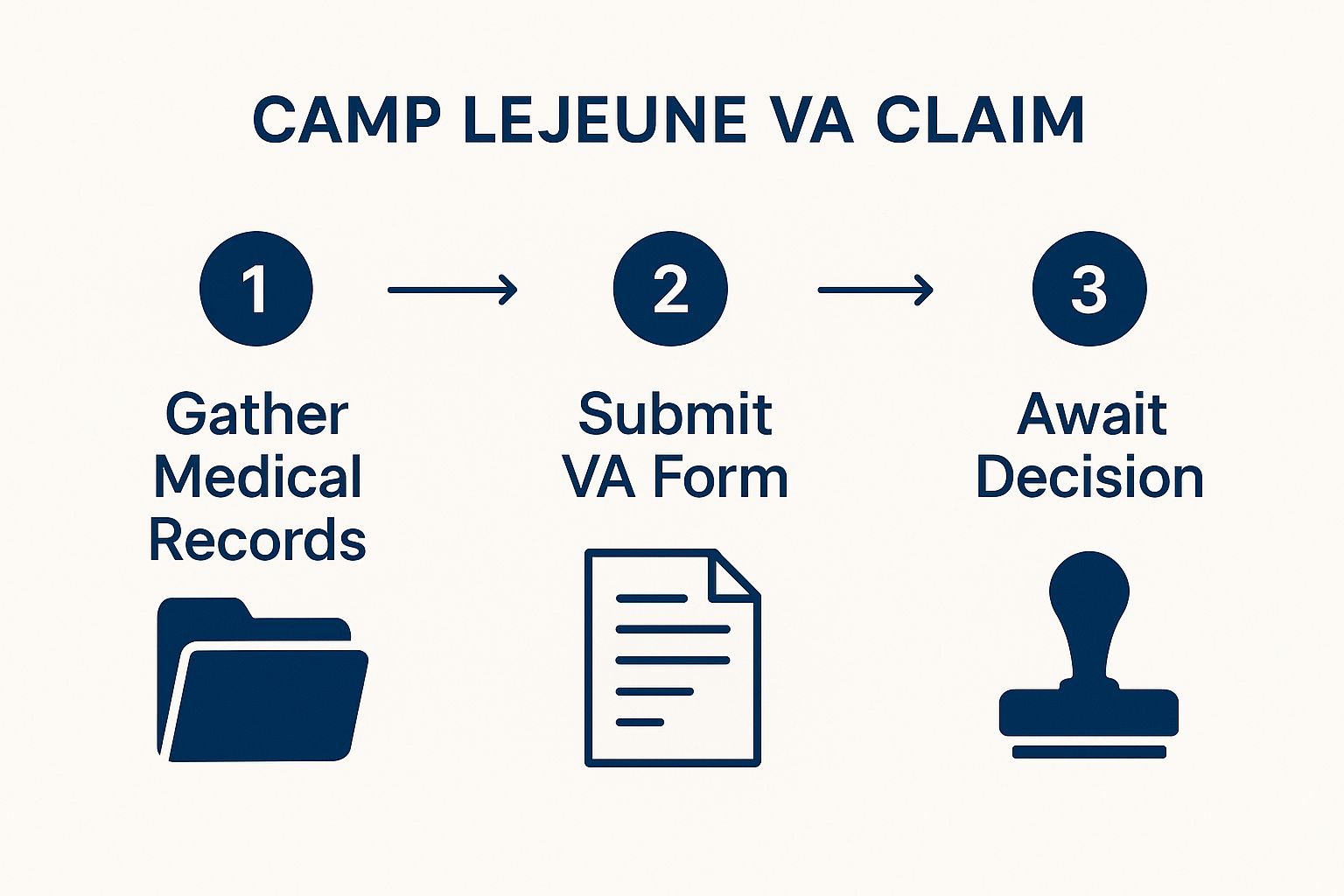
As you can see, gathering your evidence is the launchpad for everything that follows. It's what makes a streamlined, successful claim possible.
Choosing Your Filing Method
Once you have your evidence packet ready, you’ve got a few ways to get it to the VA. There’s no single "best" way; it's about what works for you.
- File Online: The VA's website is typically the quickest and most direct route. You can upload your documents right then and there, and the online system walks you through each step.
- File by Mail: If you'd rather deal with hard copies, you can always mail your completed application (VA Form 21-526EZ) and all your supporting documents to the VA's evidence intake center.
- Work with a Veterans Service Officer (VSO): These are trained professionals who help veterans with their claims for free. A good VSO can be an invaluable ally, helping you review your paperwork to make sure it's all in order before you submit.
To get a better handle on the full scope of veteran benefits and how the general claims process works, you may want to look at a comprehensive veteran benefits guide.
Why So Many Past Claims Were Denied
For years, getting a claim approved for an illness tied to Camp Lejeune was an uphill battle. The new presumptive status exists for one reason: to fix a long history of unfair denials.
In fact, VA data shows that between March 2017 and March 2021, around 57,500 Camp Lejeune-related disability claims were filed. An unbelievable 71% of them were denied.
So, what was the problem? Many of those denials happened because the veteran couldn't provide a "nexus" letter—a doctor's statement directly linking their illness to the contaminated water. For most, proving that connection decades later was a nearly impossible task. On top of that, improper processing by some VA offices only made the problem worse, creating a cycle of frustration for thousands of deserving veterans.
The new Camp Lejeune presumptive rules were created to break that cycle. By automatically acknowledging the service connection for these specific conditions, the VA has removed the single biggest roadblock that caused all those past denials. This gives you a much fairer shot at getting the benefits you earned.
What If Your Condition Is Not on the Presumptive List?

It can feel like a gut punch to find out your illness isn't on the official presumptive list. But don't let that discourage you. Not having a Camp Lejeune presumptive condition doesn't mean your fight for benefits is over—not by a long shot. It just means you have to take a different route to prove your case.
This route is called “direct service connection.” Think of the presumptive list as an express lane at the VA. If your condition isn't on it, you’re not shut out; you just have to use the standard lanes. The destination is the same, but you’ll have to show a bit more proof to the person at the toll booth.
Instead of the VA automatically agreeing that the contaminated water caused your illness, the burden falls on you to connect the dots. You have to build that bridge yourself by gathering the right evidence to link your time at Camp Lejeune to your current medical diagnosis.
Building Your Case for Direct Service Connection
For a non-presumptive condition, your goal is to prove to the VA that it's “at least as likely as not” that the contaminated water caused your health problems. That legal standard might sound intimidating, but it just means you have to show a 50% or greater chance the exposure is the culprit.
To do this, your claim needs to stand on three solid pillars of evidence:
- Proof of Service: This is straightforward. Your DD214 or other military records must show you served at Camp Lejeune for at least 30 days during the contamination period.
- A Current Diagnosis: You need up-to-date medical records from a qualified doctor that clearly identify and diagnose your illness.
- A Medical Nexus: This is the absolute linchpin of your claim. It’s a professional medical opinion that directly connects your diagnosis to the toxic water exposure.
Without that nexus, the other two pieces of evidence can't stand on their own. It’s the glue that holds your entire case together.
The Power of a Medical Nexus Letter
So, how do you get that critical medical nexus? The single most effective tool is a “medical nexus letter.” This is a detailed, written opinion from a medical professional—like your family doctor or a specialist—who can draw a clear, logical line from your toxic exposure at Camp Lejeune to your current health condition.
A strong nexus letter isn't just a doctor's note. It explains the "why." The doctor needs to review your service records, your full medical history, and the scientific research linking toxins like TCE or benzene to your specific illness. Then, they must lay out their professional reasoning in a clear, persuasive document for the VA.
This letter essentially becomes your expert witness. It tells the VA, in credible medical terms, precisely why your service at the base is the most likely cause of your suffering. It bridges the exact gap that the presumptive list automatically fills for other veterans.
For instance, if you developed a rare form of cancer not on the official list, your doctor’s letter would cite studies linking that specific cancer to the industrial solvents found in Camp Lejeune's water. The letter would then explain that, given your personal medical history and a lack of other risk factors, the exposure is the most probable cause.
Filing a non-presumptive claim definitely takes more legwork, but it's a necessary path for thousands of veterans and their families. Don't give up just because your illness isn't on the "fast track" list. By focusing on building a rock-solid case with a powerful medical nexus letter, you can still win the VA benefits you rightfully earned.
VA Benefits vs. The Camp Lejeune Justice Act
If you’re dealing with a Camp Lejeune presumptive condition, it's easy to get confused by the different ways to get compensation. You'll constantly hear about two main options: VA benefits and the Camp Lejeune Justice Act (CLJA). While they might sound like they do the same thing, they are actually very different tools designed for completely different purposes.
Here’s a simple way to think about it: VA benefits are like a steady, reliable support system for the long haul. A CLJA lawsuit, on the other hand, is a one-time legal action aimed at holding the government accountable for the specific harm and suffering you’ve experienced. Getting this distinction right is crucial, because it empowers you to pursue every bit of support you and your family deserve.
The single most important takeaway is this: you can pursue both at the same time. Filing a lawsuit under the CLJA won't stop you from getting your monthly VA disability benefits.
The Two Paths Explained
So what’s the practical difference between these two paths? Let's break down exactly what each one offers. This isn't about picking one over the other; it’s about seeing how they can work together to give your family the most complete support possible.
-
VA Disability Benefits: This is a recurring, non-taxable monthly payment you receive from the Department of Veterans Affairs. It's designed specifically to compensate for your reduced earning ability caused by your service-connected illness. Securing these benefits also opens the door to VA healthcare.
-
The Camp Lejeune Justice Act (CLJA): This is a federal lawsuit filed in civil court. A CLJA claim is all about securing a one-time financial settlement or verdict. This money covers the kind of damages VA benefits simply don't address, like pain and suffering, emotional trauma, and the overall loss of your quality of life.
The CLJA was a groundbreaking piece of legislation that carved out a special legal path for those harmed by the contaminated water. When you're trying to understand the nuances between these two systems, it often helps to look at legal precedent. For anyone wanting to dig deeper into the legal background, learning how to find case law can provide some fascinating context on how these kinds of landmark decisions come to be.
How Do They Work Together?
Now, here’s how they interact. If you win an award from a CLJA lawsuit, that amount will be "offset"—or reduced—by any VA disability payments you've already been given for the same health condition. The government does this to avoid what it calls a "double payment" for a single injury.
Think of it as a coordinated effort. The VA is there to provide consistent, monthly support for your disability. The CLJA provides a lump-sum payment to acknowledge the profound personal suffering you and your loved ones went through. One doesn't cancel the other out; they're meant to fit together.
This offset system ensures that even if you receive a large CLJA settlement, your right to future VA benefits and healthcare is protected. Pursuing both avenues is, without a doubt, the best strategy to make sure you get the full range of financial and medical support you’re entitled to after being exposed to the toxic water at Camp Lejeune.
Common Questions About Camp Lejeune Benefits
When you start digging into Camp Lejeune presumptive benefits, a lot of questions pop up. It’s completely normal to wonder how all these rules and new laws apply to your family’s specific story. The process can feel tangled, especially when you're juggling VA claims and legal actions.
This section is here to answer the questions we hear most often. We'll give you direct, clear answers to help you see the path forward. Think of it as a quick guide to cut through the confusion and give you the confidence to take the right next steps for your family.
Can Family Members Get Presumptive Benefits?
This is a big one, and we get this question all the time. The short answer is that VA presumptive disability benefits are technically just for the veteran. But that absolutely does not mean your family members who lived on base are left out in the cold—they just have a different route to getting help.
Family members who were also exposed to the contaminated water at Camp Lejeune have two main avenues for support:
- The Camp Lejeune Family Member Program (CLFMP): This program is designed to reimburse you for out-of-pocket healthcare costs for 15 specific medical conditions.
- The Camp Lejeune Justice Act (CLJA): Through the CLJA, family members can file a civil lawsuit to seek damages for their suffering. This is a totally separate track from VA benefits.
It's really important to see these as two distinct but parallel paths. Disability compensation is tied to the service member's record, while these other programs were created specifically to help the spouses and children who were also harmed.
What Happens If the Exposed Veteran Is Deceased?
Tragically, many veterans died from their illnesses long before anyone officially connected the dots back to Camp Lejeune. If you lost a loved one who served at Lejeune during the contamination period, their surviving family may still be eligible for significant benefits.
A surviving spouse, dependent children, or dependent parents can file a claim for Dependency and Indemnity Compensation (DIC). This is a recurring, tax-free monetary benefit for eligible survivors of veterans whose death was caused by a service-related illness.
To get these benefits, the survivor's claim needs to prove two things: first, that the veteran served at Camp Lejeune during the right time frame, and second, that their death was due to one of the presumptive conditions. This creates a direct path for families to receive the ongoing financial support they deserve.
Do I Need a New Medical Exam to File?
While you'll need your existing medical records showing a diagnosis to get your claim started, you should fully expect the VA to schedule a Compensation & Pension (C&P) exam. It's a standard, mandatory part of the process, so don't be surprised when you get the notice.
This exam is how the VA officially confirms your diagnosis and, just as crucial, gauges the current severity of your condition. The C&P exam results are what drive your disability rating, which in turn sets the amount of your monthly compensation. So, while you don't schedule it yourself before filing, attending the C&P exam that the VA sets up for you is a non-negotiable step toward getting your claim approved.
Does a CLJA Settlement Affect My VA Benefits?
Yes, there's a financial link between a Camp Lejeune Justice Act (CLJA) settlement and your VA benefits, but it's crucial to understand that you can—and should—pursue both if you qualify. The rule is that any award from a CLJA lawsuit will be offset, or reduced, by the amount of VA disability benefits you've already received for that same illness.
Think of it this way: the government wants to avoid paying twice for the same injury. But filing a lawsuit doesn't stop you from getting your future VA payments or using VA healthcare. The two systems are meant to work together to give you and your family the most complete support possible.
Trying to make sense of VA claims and toxic exposure cases can be a heavy burden to carry alone. The team at Homefront Group is made up of veterans and legal professionals who live and breathe this stuff. We're here to help you get the justice and compensation you've earned. Take our free, 3-minute quiz to see what benefits you qualify for and start building your strategy today. Visit us at https://homefrontgroup.com/ to learn more.