
Understanding Your Rights: What Burn Pit Compensation Actually Means
When you hear the term burn pit compensation, it’s easy to get lost in thoughts of red tape and complex forms. But at its core, this is the nation's formal promise to acknowledge that your military service may have exposed you to serious, lasting health risks.
Think of it less as a government handout and more like an insurance policy you've already paid for through your service. It's a commitment to provide support for the long-term health consequences that can arise from your time in uniform.
This brings us to the single most important part of the new laws: the presumptive condition. For years, the burden of proof was entirely on the veteran. You had to draw a direct, undeniable line between your illness and a specific exposure event, which was an almost impossible standard to meet.
Now, that has changed. For a growing list of cancers, respiratory illnesses, and other conditions, the VA presumes the connection. If you served in a qualifying location and timeframe and later developed one of these conditions, the link to your service is automatically assumed. This completely changes the game for filing a claim.
What Does Compensation Include?
A successful claim is about more than a single payment. It provides a package of benefits designed to support both your long-term health and your family's financial stability. Veterans who are granted compensation typically gain access to:
- Monthly tax-free disability payments: The amount is based on your disability rating, which reflects the severity of your condition.
- Comprehensive VA healthcare: This covers treatment for your service-connected presumptive conditions and other health needs.
- Survivor benefits: In the event of your death, this can provide vital financial support for your spouse and dependents.
The official VA website on hazardous material exposure is the best place to start. It lays out the specific requirements clearly.
As this overview from the VA shows, eligibility boils down to two key factors: where and when you served, and having a diagnosed medical condition that is on the presumptive list.
Overcoming Misconceptions
It's understandable why many veterans hesitate to file a claim. There are a lot of myths and outdated beliefs that can feel like roadblocks. Let's clear a few of them up.
One major worry is that the process is simply too difficult. While there are steps to follow, the presumptive condition status has eliminated the single biggest hurdle that stopped veterans in the past. You no longer have to find that "smoking gun" evidence yourself.
Another concern is that an illness isn't on the "official" list. It’s important to know that this list is not final; new conditions are added as more research becomes available. You can also file a non-presumptive claim with supporting medical evidence if your condition isn't listed yet.
Finally, some veterans feel like they shouldn't be asking for help. This is perhaps the most important misconception to overcome. This is not charity. It is a measure of accountability for injuries that happened in the line of duty. It is an earned right.
How the PACT Act Revolutionized Veterans' Path to Justice

When Congress passed the Promise to Address Comprehensive Toxics (PACT Act) in August 2022, it did more than just create a new law—it fundamentally changed the rules for veterans seeking benefits. Before, getting compensation was an uphill battle where veterans had to prove their illness was directly caused by their service.
The PACT Act flipped that script. It establishes an assumed link between service in burn pit locations and specific health conditions. This change clears a major hurdle, allowing many more veterans to pursue and receive burn pit compensation.
Shifting the Burden of Proof
Imagine having to act as your own detective, piecing together clues to build a case for your own illness. That was the reality for countless veterans trying to connect their health problems to their service. The PACT Act moved this heavy burden of proof from the veteran to the VA.
Instead of spending months or years hunting for obscure records, you can now focus on your health. The VA is required to assume the connection for you if you meet the criteria.
Key changes include:
- A New Presumption: The VA automatically assumes a service connection for a long list of specific illnesses.
- Simpler Paperwork: The evidence required from your medical and service records is much more direct.
- More Locations Covered: The law now includes many new locations and scenarios involving toxic exposure.
This new approach is centered on a powerful idea: presumptive conditions.
Decoding Presumptive Conditions
What exactly are presumptive conditions? Think of them as a safety net. If you can show you served in a qualifying location and you have a diagnosis for one of the conditions on the VA's list, the connection is automatically made. You don't have to argue about causation.
This means that for many illnesses, like certain cancers and respiratory diseases, the link to burn pit exposure is already established by law. This removes the most difficult part of the claims process for many veterans.
Real-World Impact and Data
This isn't just a change on paper; the results are clear. The numbers tell a powerful story about how many lives have been affected since the law was passed.
As of May 2024, more than 1 million PACT Act-related claims have been granted, delivering over $5.7 billion in earned benefits to veterans and their families. This data shows a clear shift from uncertainty to support. You can explore more details on these statistics here.
| Metric | Before PACT Act (pre-Aug 2022) | After PACT Act (by May 2024) |
|---|---|---|
| Approval Rate | ~54% | 72% |
| Total Claims Granted | ~300,000 | 1,000,000+ |
| Benefits Distributed | $1.2 billion | $5.7 billion |
These results show just how profoundly the PACT Act has changed the lives of veterans and their families.
Tips for Navigating Claims Under the PACT Act
Even with these positive changes, filing a claim requires preparation. A clear plan can make the process feel much less intimidating. During your claim, you may need to discuss sensitive medical information with VA staff or medical examiners. Knowing that secure communication options exist, such as HIPAA compliant video conferencing, can provide peace of mind.
To prepare a strong claim, follow these best practices:
- Gather Your Service Records: Get your DD-214 and any other documents that confirm your deployment dates and locations.
- Document Your Diagnosis: Work closely with your doctor to ensure your medical records clearly state your diagnosis for any presumptive condition.
- Create a Medical Timeline: A simple, chronological summary of your medical history related to the condition can be very helpful for the VA reviewer.
Next, we'll explore qualifying service locations and dates in depth.
Qualifying for Benefits: Service Locations and Timing That Matter

Think of your burn pit compensation claim like a legal case. Before you can argue the details, you must first establish that you were in the right place at the right time. These specific locations weren't picked at random; they are directly linked to major military operations like Desert Storm, Iraqi Freedom, and Enduring Freedom.
During these conflicts, massive forward operating bases sprang up, and many relied on open-air burn pits as the primary method for waste disposal. Simply being there is the first, non-negotiable step to unlocking potential benefits. Your service record is the key.
The Geographic and Time-Based Rules
The VA has established clear "where and when" requirements for eligibility. Thanks to the PACT Act, if you served in certain regions during specific periods, the VA now has a presumption of exposure. This means they automatically assume you were exposed to toxins without you having to prove the burn pit was right next to your tent.
This is a significant change that simplifies the process for many veterans. The rules are tied to two main eras of conflict. For service in Iraq and other Gulf War theater locations, the period begins on or after August 2, 1990. For service in post-9/11 locations like Afghanistan, Djibouti, Syria, and Yemen, the start date is on or after September 11, 2001. This also includes the airspace above these locations.
To help you see if your service history aligns with these rules, we've put together a table outlining the key locations and timeframes. You can explore the VA's complete list of qualifying locations and timeframes for more detail.
The following table breaks down the primary locations and service dates that grant presumptive exposure status under the PACT Act. Check to see if your deployment history matches these criteria.
Burn Pit Exposure Eligibility by Location and Time Period
Geographic and temporal requirements for burn pit compensation eligibility
| Location/Region | Eligible Service Dates | Service Type | Special Notes |
|---|---|---|---|
| Gulf War Theater (Iraq, Kuwait, Saudi Arabia, Bahrain, Qatar, U.A.E., Oman, Gulf of Aden, Gulf of Oman, Persian Gulf, Arabian Sea, Red Sea) | On or after August 2, 1990, to present | Active, Reserve, National Guard | Covers veterans of Desert Shield, Desert Storm, and subsequent operations in the region. |
| Post-9/11 Theater (Afghanistan, Djibouti, Egypt, Jordan, Lebanon, Syria, Uzbekistan, Yemen) | On or after September 11, 2001, to present | Active, Reserve, National Guard | Includes operations like Enduring Freedom and Iraqi Freedom. |
| Airspace | Same as ground locations | Active, Reserve, National Guard | Critically, service in the airspace above any of the listed locations also qualifies. |
As you can see, the list is extensive and covers decades of military operations. If your service falls within these parameters, you have met the first requirement for a presumptive claim.
What If Your Records Are Unclear?
It's a surprisingly common problem: a veteran’s DD-214 might just list a country without specifying the exact base, or the details might be vague. If your official paperwork doesn't tell the whole story, don't worry. The VA allows you to submit other evidence to fill in the gaps and place you in a qualifying zone.
Think of it as corroborating your story. You can use several types of supporting documents to build a stronger case:
- Buddy Letters: These are official statements from fellow service members who were with you and can confirm your location and duties. Their testimony can be incredibly powerful.
- Personal Photos or Videos: A picture is worth a thousand words. Photos with clear geographic markers, base signs, or date stamps can visually place you in a presumptive area.
- Performance Reports & Award Citations: Official documents like NCOERs, OERs, or award write-ups often mention specific operations, campaigns, or locations that can substantiate your claim.
These materials help paint a complete picture for the VA reviewer, connecting the dots that your official records might have missed.
For members of the National Guard and Reserves, the key is federal activation. Your eligibility is tied to being deployed to a covered location under Title 10 orders. Standard weekend drills or state-level active duty unfortunately do not count. The critical document to find is your set of activation orders that sent you overseas.
Properly documenting your service location and dates is the foundation of a successful claim. It confirms you were in an area of known toxic risk. Once this is firmly established, you can move to the next crucial phase: linking that exposure to your current health conditions.
Connecting Your Health Issues: Presumptive Conditions Explained

Once you've established that your service history meets the time and location requirements, the focus shifts to your health. This is where the PACT Act creates a much clearer path forward. It introduces the concept of a presumptive condition, which acts like a shortcut for your claim.
In the past, the burden was on the veteran to prove their illness was a direct result of their service. A presumptive condition removes that enormous hurdle. The VA now officially "presumes" the connection, saving you from having to find definitive proof that was often impossible to obtain.
What Qualifies as a Presumptive Condition?
A presumptive condition is a specific illness that the VA has formally recognized as being likely caused by exposure to burn pits and other toxins. If you served in a designated location and time frame and later developed one of these conditions, the VA automatically assumes your service caused it.
This policy is a game-changer for getting burn pit compensation. The list of conditions is substantial and continues to be updated. Some of the major categories include:
- Cancers: Brain, pancreatic, kidney, lymphoma, and recently added conditions like male breast cancer.
- Respiratory Illnesses: Asthma (if diagnosed after service), chronic bronchitis, and Chronic Obstructive Pulmonary Disease (COPD).
- Sinus and Throat Conditions: Chronic sinusitis, chronic rhinitis, and constrictive bronchiolitis.
Because new conditions are added as more research becomes available, the most reliable resource is the official source. You can find the complete and current list on the VA's website covering presumptive conditions. Checking this list is the best way to see if your diagnosis is covered.
Getting the Right Medical Documentation
While the PACT Act presumes the link between your service and your illness, it doesn't presume the illness itself. You must still provide a formal medical diagnosis from a healthcare professional. This is a non-negotiable part of your claim.
Your primary job is to work with your doctor to get your condition officially on record. It’s important to understand your doctor's role here: they are not responsible for connecting your illness to burn pits. The law already does that for presumptive conditions. Their job is simply to provide an accurate diagnosis.
To gather the necessary medical evidence, you should:
- Ask your doctor for a written diagnosis that uses the specific medical term found on the VA's presumptive list.
- Collect copies of all supporting documents, like lab results, imaging reports (X-rays, MRIs), and notes from any specialists you've seen.
If your health issue is not on the presumptive list, you can still apply for benefits. However, the process is more involved and will require extra evidence, such as a medical opinion directly linking your condition to your service. For veterans with a presumptive condition, a solid diagnosis is the key that unlocks a more straightforward path to the burn pit compensation you deserve.
Filing Your Claim: A Practical Step-by-Step Approach
Once you have your service history verified and a medical diagnosis, it’s time to take action. Filing for burn pit compensation is more than just filling out forms; it’s about building a convincing case. Think of it like assembling a puzzle for the VA reviewer. Each piece of evidence is a critical part of the final picture, and if any are missing or don’t fit, your claim could be delayed or denied.
Organizing Your Evidence: The Foundation of Your Claim
A strong claim is built on clear, well-organized evidence. The two cornerstones of your application are your military service records and your medical documentation. Your DD-214 is the non-negotiable proof of your service, while your medical records confirm your diagnosed condition by a healthcare professional.
Beyond these two essentials, gathering supplementary evidence can significantly strengthen your case. To help you stay organized, here is a checklist of documents to gather.
Burn Pit Claim Documentation Checklist
Essential documents and evidence needed for a successful burn pit compensation claim
| Document Type | Required/Optional | Where to Obtain | Tips for Submission |
|---|---|---|---|
| DD-214 (or equivalent) | Required | National Archives, VA eBenefits portal | This is the most crucial document to prove your service location and dates. Ensure it's a clear, legible copy. |
| VA Medical Records | Required | Your local VA Medical Center or through My HealtheVet | Include all records related to the diagnosis and treatment of your presumptive condition. |
| Private Medical Records | Required (if applicable) | Your private doctor's office or hospital | The VA needs a complete picture of your health. Submit records from any non-VA providers you have seen for your condition. |
| "Buddy Letters" | Optional (highly recommended) | Fellow service members | A statement from someone you served with, attesting to your exposure or symptoms, can be very powerful. |
| Personal Journal | Optional | Created by you | Documenting your symptoms, their severity, and their impact on your daily life can provide valuable context for the reviewer. |
This checklist covers the key items you'll need. Putting in the effort to collect and organize these documents now will create a much smoother process later.
Other supporting evidence can also be helpful. For example, "buddy letters" from service members who witnessed your exposure or the start of your symptoms can add a personal and credible layer to your claim. Personal journals detailing your symptoms over time also provide important context. Many veterans dealing with the after-effects of burn pits experience severe fatigue and may use things like supplements for chronic fatigue. Documenting these secondary effects helps paint a full picture for the reviewer.
The Submission Process: From Paperwork to "Pending"
With your evidence gathered and organized, you're ready to submit your claim. While you can file the paperwork yourself, consider working with a Veterans Service Officer (VSO) or an accredited representative. They can help you navigate the system and avoid common mistakes that lead to delays.
The submission process follows these main steps:
- Gather Your Documents: Collect your DD-214, all VA and private medical records, and any supporting statements or evidence you've prepared.
- Complete the Application: The key document is VA Form 21-526EZ, the "Application for Disability Compensation and Related Compensation Benefits." Take your time to fill it out accurately and completely.
- Submit Your Claim: You have three options for submission: online through the VA website, by mail, or in person at a VA regional office. The online portal is usually the fastest and provides the easiest way to track your claim's progress.
This visual guide shows how these steps fit into the overall journey.
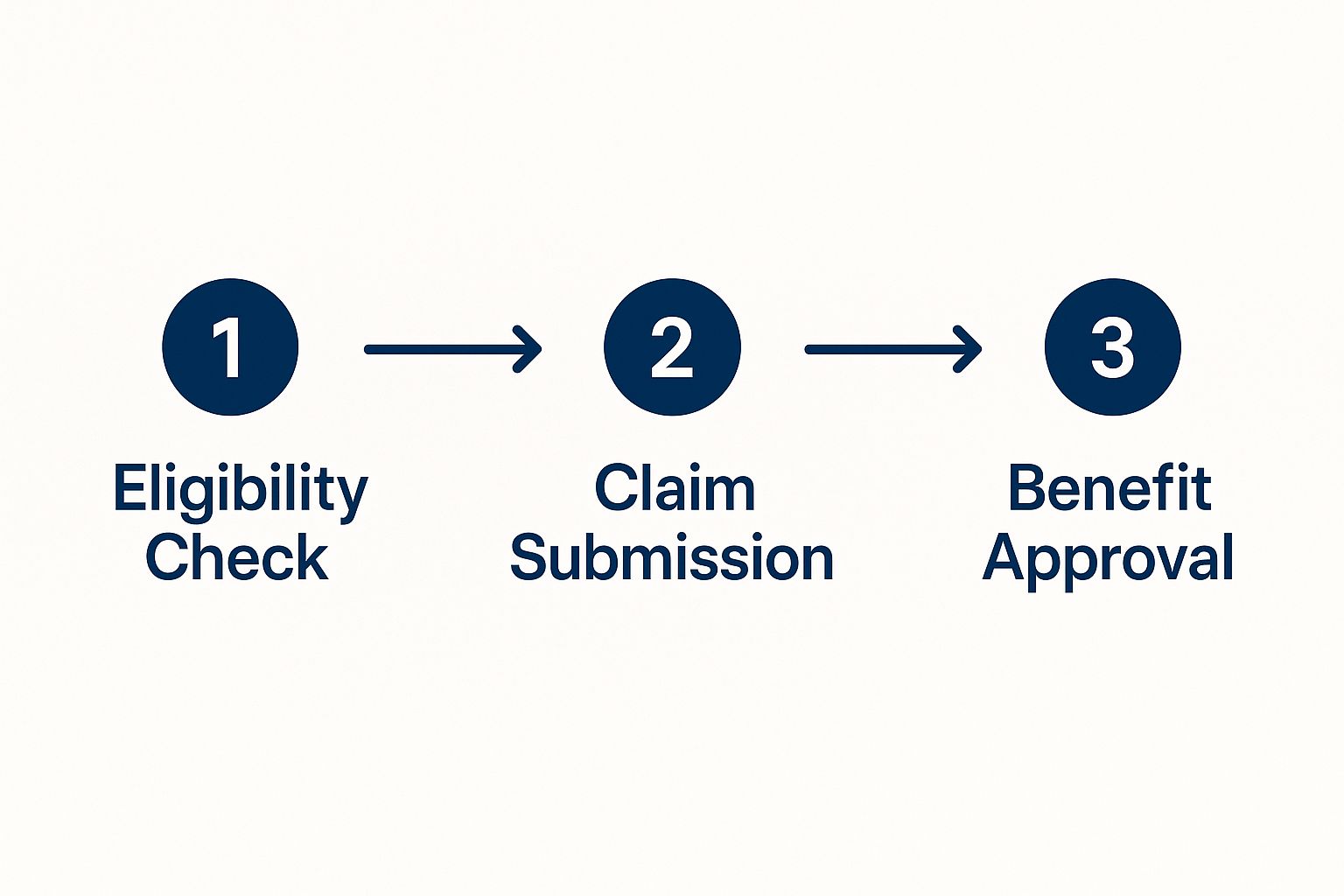
As the infographic highlights, a successful claim flows from confirming eligibility to submitting the right paperwork. A mistake in the submission step can bring everything to a halt, putting your case on hold.
One of the most common errors is submitting an incomplete application. Before you submit, double-check that every required field is filled in and that all your supporting documents are attached and clearly labeled. A well-organized submission not only helps the reviewer but also demonstrates the clear validity of your claim. Once you've submitted, your claim status will become "pending," and the waiting period begins.
Maximizing Your Compensation: Disability Ratings Decoded
Getting your burn pit claim approved is a major win, but the process isn’t over yet. The next piece of the puzzle is your VA disability rating. This rating is what determines the exact amount of your monthly burn pit compensation.
The VA assigns this rating as a percentage, from 0% to 100% in 10-point steps. The number is meant to represent how significantly your service-connected condition affects your ability to function in your day-to-day life.
How the VA Assigns a Disability Rating
So, how does the VA come up with this number? It’s not random. The VA uses a detailed rulebook called the VA Schedule for Rating Disabilities (VASRD) to evaluate your case systematically.
For every condition, a VA rater will look closely at all your medical evidence. They'll consider the severity of your symptoms, review test results and scans, and analyze how the illness limits your ability to work or handle daily tasks. A more severe impact on your health and your ability to earn a living results in a higher percentage.
The Financial Impact of Your Rating
This percentage directly connects to a specific, tax-free monthly payment. That's why getting an accurate rating is so important for your financial stability. The difference from one level to the next can be huge.
To give you a real-world idea, look at the 2023 figures. A veteran with a 30% disability rating received $165.92 per month. But a 50% rating jumps that payment to $1,041.82 a month. For the most severe conditions, a 100% rating meant a payment of at least $3,621.95 monthly. These numbers show just how critical a proper rating is for your long-term well-being. You can explore more about how the VA calculates these ratings.
Combining Multiple Conditions for a Higher Rating
Many veterans deal with more than one health condition related to their service. A common mistake is thinking the VA just adds the disability percentages together. That’s not how it works.
The VA uses a complicated formula, famously known as “VA Math,” to figure out a combined rating. The goal is to reflect the total impact on your health as a single person.
Here’s a simple way to think about it: If you have a 30% rating for asthma and a 20% rating for sinusitis, your combined rating is not 50%. The VA first considers you 100% healthy. The 30% rating for asthma reduces your "healthy" status to 70%. The second rating, 20%, is then calculated from that remaining 70%, not the original 100%.
Because this calculation can be tricky, it's crucial that the evidence for each condition is perfectly organized. Using tools like legal document automation software can help you prepare a well-structured claim, making a stronger argument for a higher combined rating.
Remember, if you feel your rating is too low, you have the right to appeal. You can also file for an increase if one of your conditions gets worse over time.
Managing Expectations: Timelines and Smart Waiting Strategies
After you’ve submitted your claim, the waiting game begins. This part of the journey can be the most challenging, but understanding what happens behind the scenes can help manage the frustration. A burn pit compensation claim is not a simple approval or denial; it’s a detailed review process designed to give every veteran’s case a fair and thorough look.
How Long Will It Take?
This is the big question, and the honest answer is: it varies. A straightforward claim with solid documentation might take several months, while more complex cases can easily stretch beyond a year. Several factors affect your wait time, including the VA's current workload, the specifics of your medical conditions, and how quickly you reply to any requests for more information. Patience is key.
Tracking Your Claim’s Progress
The best way to keep tabs on your claim is through the official VA.gov claim status tool. This online portal is your window into the process, showing you exactly where your claim stands as it moves through the different stages, from "Claim Received" all the way to "Preparation for Decision." Having access to this information provides transparency and can offer some peace of mind.
The VA's claim status tracker provides a clear, step-by-step view of your claim's journey.
This dashboard helps you see what's happening at a glance, demystifying what can often feel like a complicated system.
Smart Waiting Strategies
Waiting doesn't have to be a passive activity. While the VA reviews your file, you can take productive steps that support your case and, just as importantly, your own well-being. Staying engaged can make a real difference.
Consider taking these actions while you wait:
- Continue Medical Treatment: Don't skip your doctor's appointments. Consistent medical records create a clear, unbroken story of your health conditions, which adds significant weight to your claim.
- Respond Promptly: If the VA sends a letter asking for more details or schedules you for a Compensation & Pension (C&P) exam, act on it immediately. Delays on your end will unfortunately cause delays in the final decision.
- Keep a Symptom Journal: On a simple notepad or on your phone, jot down how your symptoms affect your daily life. This information provides powerful, personal evidence that can be crucial if you need to appeal a decision later.
- Avoid Constant Check-ins: Checking your claim status every day can drive up your stress levels. Unless you're expecting a specific update, try to limit yourself to checking once a week.
The waiting period is often the most stressful part of filing a VA claim. If you're feeling overwhelmed by delays or uncertainty with your burn pit compensation claim, remember you don't have to navigate it alone. The team at Homefront Group provides guidance from veterans for veterans. Take our free 3-minute quiz to see how we can support you through every stage of the process.