

Understanding How The Board Actually Works

The Board of Veterans Appeals (BVA) plays a vital role in assisting veterans seeking disability benefits. It serves as the final decision-making body within the Department of Veterans Affairs (VA) before a veteran's case can move to the U.S. Court of Appeals for Veterans Claims. Understanding the BVA's operations can significantly impact a veteran's appeal. This involves understanding both the formal procedures and the individuals involved in the decision-making process.
How Cases Are Reviewed
Each case arriving at the BVA is assigned to a Veterans Law Judge (VLJ). These judges thoroughly examine the veteran's complete file. This includes medical records, service history, and any prior VA decisions. They carefully analyze the information to establish a clear connection between the veteran’s current disability and their military service. This detailed review process involves evaluating all evidence to understand its relevance to the veteran’s claim.
Factors Affecting Decision Speed
Several factors can influence the time it takes for a case to progress through the BVA. The complexity of the case is a major factor. Cases involving multiple disabilities or requiring extensive medical documentation typically require more time. The availability of VLJs and the Board's overall workload also impact processing times. However, the BVA has been actively working to improve its efficiency.
The BVA has made considerable strides in recent years. In Fiscal Year 2024, the BVA issued a record 116,192 decisions. This marks the sixth consecutive year the Board has delivered over 95,000 decisions, totaling more than 612,200 since FY 2019. For a deeper dive into the statistics, see the BVA's annual report: BVA Annual Report FY2024 This increased efficiency aims to provide quicker resolutions for veterans and their families.
The Human Side of the Board
While the process may seem formal, the human element is essential. VLJs are not just applying regulations; they're considering how their decisions impact veterans' lives. They carefully consider complex medical information and weigh the evidence presented, aiming for fair and impartial outcomes. This underscores the importance of presenting a well-organized and persuasive case to the Board. A clear and compelling narrative, supported by solid evidence, helps the VLJ fully understand the veteran’s situation and make an informed decision.
Navigating Two Different Appeals Systems
The Board of Veterans Appeals (BVA) can be challenging to navigate. This complexity arises from the two separate appeals systems: the Legacy appeals system and the Appeals Modernization Act (AMA) system. Knowing which system your case falls under is essential for a successful appeal.
Understanding Legacy vs. AMA
The Legacy system, established before the AMA, involves a more traditional appeals process. This often results in longer processing times. The AMA, implemented in 2017, provides three review options designed for quicker processing and increased flexibility. The date your appeal was filed determines which system applies to your case. This date dictates the rules, procedures, and expected timelines.
Key Differences Between the Systems
The Legacy system follows a structured, multi-stage process. This can lead to significant processing time. The AMA offers three tracks: Direct Review, Evidence Submission, and Hearing Request. These options offer varying levels of review and involvement. This allows veterans to choose the best strategy for their individual needs. The flexibility of the AMA is a significant advantage.
The BVA faces the challenge of managing the workload of both appeals systems concurrently. As of December 2024, the pending Legacy appeals were reduced to 15,215 cases, a considerable decrease from 157,251 cases in November 2017. For more information on the BVA's workload, visit: BVA Workload Challenges
Why Timing Matters
Understanding the regulations surrounding your appeal is vital; you can find additional information in this resource on medical device regulatory compliance. The date of your appeal, and therefore whether it falls under the Legacy or AMA system, significantly affects your options. The AMA, for instance, allows for submitting new evidence or requesting a hearing, which may not be possible under the Legacy system. This can be a deciding factor in the outcome of your appeal.
Navigating Your Specific Case
To determine which system your appeal falls under, you need to know the filing date of your Notice of Disagreement (NOD) or Form 9. If filed before February 19, 2018, your case is under the Legacy system. Appeals filed after this date fall under the AMA system. Understanding this distinction is paramount. This knowledge informs you of the specific processes and procedures for your claim, ultimately impacting your strategy for a successful outcome.
What Success Rates Really Mean For Your Case
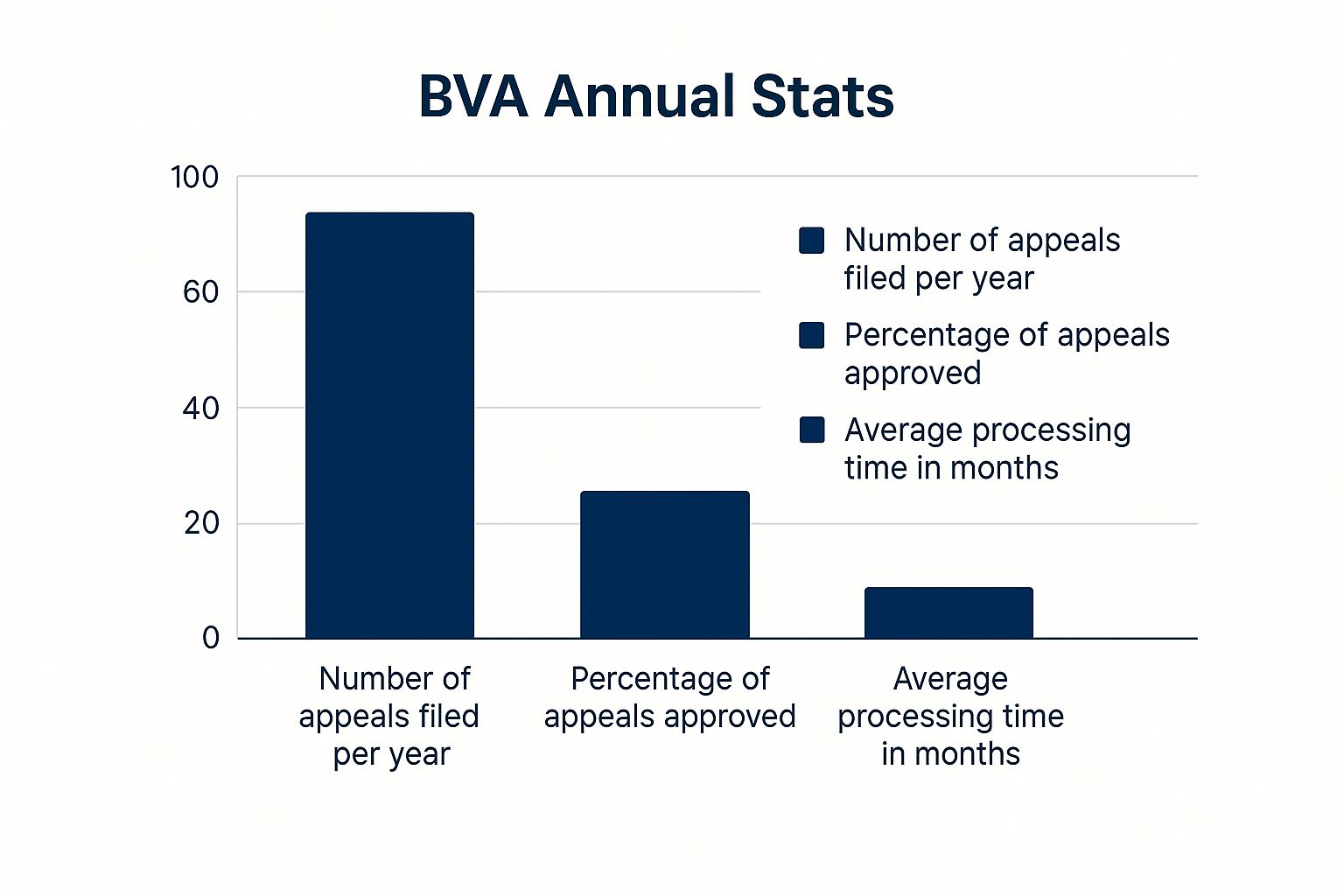
The infographic above presents key annual statistics from the Board of Veterans Appeals (BVA), including the total number of appeals, the overall approval percentage, and the average processing time. While the volume of appeals filed annually is substantial, the approval rate and processing time can fluctuate significantly. Understanding the factors that influence these outcomes is essential for veterans navigating this complex process.
Understanding the BVA's overall success rates is a good starting point, but it's crucial to remember these are just averages. Your individual situation, including the specific disability you're claiming and the strength of your evidence, plays a major role in your likelihood of success. The type of appeal you file – Legacy or Appeals Modernization Act (AMA) – is another critical factor.
The success rate also depends on the specific appeal type chosen within the AMA system. Legacy appeals have a success rate of around 36%. Under the AMA, Direct Review has a 34% success rate, while both Evidence Submission and Hearing options have a success rate of 41%. More detailed statistics are available here. Choosing the right appeal type is a key decision that can significantly impact your chances.
Decoding the Data: Grant Rates and Remands
The grant rate, representing the percentage of appeals fully approved by the BVA, is a key metric. However, a substantial number of appeals are remanded back to the regional office for additional review or information. While a remand isn't a denial, it does add to the overall processing time. Understanding why remands occur is vital. Common reasons include insufficient evidence or procedural errors.
Why Denial Reasons Matter
Analyzing common reasons for BVA denials offers valuable insights into strengthening your appeal. For example, if many denials stem from insufficient medical evidence, you'll know to prioritize gathering comprehensive medical documentation directly linking your disability to your military service. This targeted approach can substantially increase your chances of a successful outcome.
If denials often result from weak service connection arguments, focus on crafting a clear and compelling narrative that firmly establishes the link between your service and your current disability. Building a strong case from the outset can save you time and frustration in the long run.
To further illustrate the varying success rates, consider the following table:
BVA Success Rates By Appeal Type
Comparison of success rates across different Board of Veterans Appeals claim types and processing options
| Appeal Type | Success Rate | Key Characteristics |
|---|---|---|
| Legacy Appeals | 36% | Traditional appeal process |
| AMA Direct Review | 34% | Review of existing evidence |
| AMA Evidence Submission | 41% | Submission of new evidence |
| AMA Hearing | 41% | Opportunity to present case before a judge |
As this table demonstrates, the path you choose within the appeals process can influence your likelihood of success. Carefully consider your individual circumstances and consult with an accredited representative to determine the best approach for your case.
How Trends Impact Your Appeal
Staying current with recent trends in BVA decisions can give you an edge. Be aware of any changes in how the Board interprets regulations or the types of evidence they deem most persuasive. By staying informed, you can adapt your strategy to best align with the BVA’s current adjudication approach, maximizing your chances of a favorable decision. This proactive approach will help ensure your appeal is presented effectively and addresses the specific issues that often lead to remands or denials.
Choosing Your AMA Lane Strategically
Navigating the appeals process through the Appeals Modernization Act (AMA) can feel complex. Choosing the right lane significantly impacts your appeal to the Board of Veterans Appeals. This article breaks down the three options: Direct Review, Evidence Submission, and Hearing Request, highlighting their strengths and ideal circumstances for use. Understanding these nuances is vital for veterans seeking the best possible outcome.
Direct Review: For Strong Cases With Solid Evidence
Direct Review is the simplest and often fastest path. This option is best when you believe your existing evidence is strong enough for a favorable decision. A Veterans Law Judge conducts a streamlined review of your current file. No new evidence is allowed; the judge’s decision rests solely on existing documentation.
This avenue is ideal when the issue is a misinterpretation of current evidence, not a lack of it. For example, if your medical records clearly show service connection, but the VA misinterpreted a medical term, Direct Review can be an effective strategy. This focused approach can lead to faster decisions, saving you the time and effort of gathering more documents.
Evidence Submission: Filling The Gaps In Your Claim
If your claim lacks crucial supporting evidence, the Evidence Submission lane lets you submit new documentation to strengthen your case. Think of it as adding the missing puzzle pieces. Perhaps you’ve obtained new medical records, expert opinions, or buddy statements since your initial claim. The Evidence Submission path allows you to present this vital information to the Board of Veterans Appeals.
This option is particularly helpful in complex cases. If your claim involves a rare condition or requires specialized medical expertise, new evidence can significantly improve your chances of a successful outcome. This allows you to bolster any weaknesses in your initial claim, building a more persuasive argument for your disability benefits.
Hearing Requests: When Your Personal Testimony Matters
A Hearing Request lets you present your case directly to a Veterans Law Judge. This personal testimony adds a powerful human element, especially if the key to your claim lies in explaining the nuances of your experience. Imagine explaining how your disability affects your daily life, details medical records alone can't capture. This direct interaction with the judge adds context and strengthens your appeal.
This route is advantageous when medical evidence is ambiguous or open to interpretation. Your testimony can clarify uncertainties, providing the judge with a more complete understanding. Consider your comfort level and preparedness to testify effectively before a judge.
Matching Your Strategy To Your Circumstances
The best AMA lane depends on your case’s specifics. If your evidence is solid, Direct Review might be the most efficient. If you need to add documentation, Evidence Submission provides that chance. If your personal story is crucial, a Hearing Request can be invaluable.
Carefully consider your case's strengths and weaknesses to choose the optimal path. Consulting with an experienced veteran's representative offers invaluable guidance in this crucial decision. Their expertise can help you objectively assess your situation and select the strategy most likely to lead to a favorable outcome.
Building Evidence That Actually Persuades
Building a persuasive case for the Board of Veterans Appeals (BVA) isn't about overwhelming them with paperwork. It's about a strategic approach: presenting relevant, impactful evidence. Your evidence must directly address the reasons for your prior denial, clearly connecting your disability to your military service. This section explores how to assemble evidence that resonates with Veterans Law Judges (VLJs), avoiding common pitfalls that lead to further remands or denials.
The Power of Medical Evidence
Medical evidence is crucial for most appeals. However, submitting every medical record isn't effective. VLJs need a clear causal link between your service and your condition. Your medical evidence should:
- Clearly diagnose your disability.
- Explain how your service caused or aggravated the condition.
- Detail the current severity and its impact on your daily life.
For example, a knee injury appeal requires records diagnosing the injury and explaining its connection to a specific in-service incident or activity. Recent exams showing the injury’s current impact – like limited mobility or chronic pain – are also vital.
Crafting Compelling Lay Statements
Medical evidence offers clinical support, but lay statements add a crucial human element. These statements, from you, family, or fellow service members, provide firsthand accounts of your disability’s impact. A well-written lay statement can:
- Corroborate your medical records.
- Offer personal context often missing from medical records.
- Show the real-world effects on your work, relationships, and daily activities.
For example, a buddy statement might describe witnessing your knee injury during training. A family member's statement could detail how it now limits your participation in family life.
Building Airtight Service Connection Arguments
Your entire case relies on proving service connection: demonstrating a direct link between your disability and your military service. This can be established through:
- Direct Service Connection: Evidence clearly shows the disability originated during service.
- Aggravation: Evidence shows service worsened a pre-existing condition.
- Secondary Service Connection: Evidence shows your service-connected disability caused another disability.
Imagine building a bridge between your service and your disability. Each piece of evidence is a support beam. Gaps weaken the bridge, making your case less convincing. For some claims, comparing available treatment options, like those discussed in this article on Best Hair Loss Treatment Options, can be helpful.
Working with Representatives and Experts
An accredited representative can be invaluable for navigating the BVA appeals process. They can:
- Organize and present your evidence effectively.
- Identify any gaps in your claim.
- Develop strong legal arguments.
Expert opinions can also strengthen your case. A medical expert could analyze your condition, clarifying complex medical issues and reinforcing the link between your disability and your service. This professional support can significantly improve your chances of a favorable outcome.
Addressing Prior Denial Reasons
Critically, your evidence must directly address the specific reasons for your previous denial. Insufficient medical evidence requires additional documentation. A weak service connection argument needs a stronger narrative and more compelling evidence linking your disability to your service. This targeted approach shows the VLJ you've considered their feedback and strengthened your claim, demonstrating your commitment to a comprehensive and persuasive case. Meticulously addressing each point of contention significantly increases your success.
Managing Wait Times and Your Expectations
The appeals process at the Board of Veterans Appeals (BVA) requires patience. Understanding realistic timelines and managing your expectations is crucial for navigating this process effectively. This involves recognizing the factors that influence processing speed, learning how to track your appeal’s progress, and understanding how to use the waiting period productively.
Realistic Timelines for Board Appeals
The timeframe for a BVA decision varies based on several factors. These include the complexity of your case, the type of appeal (Legacy or AMA), and the chosen review option (Direct Review, Evidence Submission, or Hearing Request). Generally, appeals involving complex medical conditions or extensive evidence require more time.
Additionally, hearings typically add to the processing time. Scheduling and conducting the hearing itself can take several months. It's important to have a realistic understanding of these potential delays.
Factors Influencing Processing Speed
The BVA’s overall workload and the availability of Veterans Law Judges (VLJs) also affect processing times. While the BVA has made efforts to improve efficiency, factors like the backlog of appeals and the complexity of individual cases can influence how quickly a decision is reached.
It’s essential to remember these factors are often outside of your control. Focusing on aspects you can control, like gathering strong evidence, is crucial for a successful appeal.
What You Can Do While Waiting
The waiting period offers a valuable opportunity to strengthen your case. If you’re awaiting a hearing, this time allows for thorough preparation. Reviewing your evidence, practicing your testimony, and anticipating potential questions from the VLJ are vital steps in presenting a compelling case.
For all appeal types, you can revisit your claim file to ensure all necessary evidence is present and clearly organized. This proactive approach can prevent unnecessary delays or remands. Taking advantage of this time can significantly improve your chances of a favorable outcome.
Understanding the BVA Docket System
The BVA utilizes a docket system for managing and prioritizing cases. While it might not provide minute-by-minute updates, understanding this system can help you gain a general understanding of where your appeal stands in the queue.
Learning about the different stages of the docket and the factors that influence case prioritization can set more realistic expectations for the timeline of your appeal. This knowledge can help reduce anxiety and uncertainty during the waiting period.
Priority Processing and Tracking Your Appeal
Certain cases, like those involving terminal illnesses or severe financial hardship, are granted priority processing. Understanding the criteria for priority processing can help you determine if your case qualifies for expedited review.
Additionally, resources are available for tracking your appeal’s progress through the BVA system. Utilizing these tools can help you stay informed and prepared for the next steps in the process.
To help you better understand the current processing times, we've provided the table below:
Current BVA Processing Times By Appeal Type
Average wait times and processing statistics for different Board of Veterans Appeals claim categories
| Appeal Type | Average Wait Time | Current Inventory* | Processing Priority |
|---|---|---|---|
| Legacy Appeals | Varies | Decreasing | Lower |
| AMA Direct Review | Generally faster | Varies | Moderate |
| AMA Evidence Submission | Varies | Varies | Moderate |
| AMA Hearing Request | Generally longer | Varies | Moderate |
*Inventory numbers are dynamic and constantly changing.
This table provides a general overview of BVA processing times. However, it’s crucial to remember that actual processing times can vary significantly. The Board of Veterans’ Appeals estimates wait times can be up to two years for your claim to be decided if you request a hearing.
This information highlights the importance of managing expectations and focusing on preparing the strongest possible case while you await a decision. Use this time strategically to gather additional evidence or refine your existing documentation, ensuring your claim is well-supported and presented effectively.
Your Next Steps After The Board Decides
The Board of Veterans Appeals (BVA) decision isn't necessarily the end of the road. Whether the BVA grants, denies, or remands your claim, understanding your options is crucial for getting the most out of your benefits. This section outlines the possible outcomes and offers practical advice for navigating each one.
Understanding the Outcomes: Grants, Denials, and Remands
The BVA can issue three main decisions:
-
Grant: The BVA approves your appeal and awards the benefits you requested. This is the best-case scenario, validating your claim and providing the necessary financial and medical support.
-
Denial: The BVA upholds the prior denial of your claim. While this is disappointing, you may still have further appeal options.
-
Remand: The BVA sends your case back to the regional office for additional development or review. This isn't a denial, but it does extend the process. Remands typically happen when information is missing or procedural errors occurred. This gives you another opportunity to bolster your claim with further evidence.
Next Steps After a Grant: Implementation and Effective Dates
After a grant, the VA implements the BVA’s decision, awarding your benefits. This includes determining the effective date of your benefits, which significantly impacts the amount of retroactive compensation you'll receive. Knowing how the VA calculates this date ensures you receive everything you're entitled to.
The VA also outlines the details of your awarded benefits, including the disability rating and the corresponding monthly compensation. Carefully review this information to verify its accuracy.
Handling Remands Strategically: Avoiding Repeat Mistakes
A remand provides a second chance to present your case. However, it's important to understand why the BVA remanded it. Address the specific points raised by the BVA, such as submitting missing information or fixing any errors. Simply repeating the same arguments without addressing the BVA's concerns may lead to another remand or a denial.
Working with an accredited representative is particularly helpful during a remand. They can pinpoint the weaknesses in your claim and devise a strategy for presenting a stronger argument to the regional office.
Appealing to the Court of Appeals for Veterans Claims: When It Makes Sense
If the BVA denies your appeal, you might consider appealing to the Court of Appeals for Veterans Claims (CAVC). This separate judicial body reviews BVA decisions for legal errors. The CAVC does not re-evaluate the facts of your case; it examines whether the BVA applied the law correctly.
Appealing to the CAVC is complex and involves specific legal procedures and deadlines. Consulting with an attorney specializing in veterans law is crucial at this stage. They can evaluate the strength of your appeal, guide you through the legal process, and represent your interests in court.
Realistic Prospects and Knowing When to Accept an Outcome
While pursuing further appeals is possible, realistically assess the chances of success. If the BVA's decision has a solid legal basis and is supported by substantial evidence, further appeals may not be worthwhile. Sometimes, accepting the outcome, even if it's not what you hoped for, is the most practical approach.
Consider the time, effort, and potential expenses of continued appeals. Weigh these factors against the likelihood of a successful outcome. Careful consideration allows you to make informed decisions about your next steps. According to the BVA, requesting a hearing can add up to two years to the wait time for a decision.
Working Effectively with Regional Offices on Remanded Claims
If your claim is remanded, effectively communicating and cooperating with the regional office is essential. Respond promptly to information requests, supply the necessary documentation, and keep in contact with the VA personnel assigned to your case. This proactive approach can expedite the process and minimize delays.
Balancing Continued Appeals with Acceptance
Deciding whether to pursue further appeals or accept the outcome is a personal one. Balance the potential benefits of further appeals against the emotional and time commitment they require. Consider the impact on your well-being. Sometimes, focusing on other aspects of your life is the best approach, even if it means accepting a less-than-ideal result.
Navigating the VA appeals process can be difficult. At Homefront Group, we offer specialized services designed to help veterans. From VA appeals and toxic exposure claims to estate planning and financial guidance, we provide comprehensive support tailored to your individual needs. Connect with Homefront Group today for a free consultation and let us help you secure the benefits and support you deserve.