

It's natural to want a quick, simple answer, but the concept of an average workers' comp settlement can be incredibly misleading. Think of it like hearing the "average price of a house" in the U.S. That single number tells you nothing about the market in your neighborhood, the size of the house, or its condition. The nationwide average for a settlement is just a starting point—not a reliable map for your own journey.
What an Average Workers Comp Settlement Really Means

At its core, a workers' compensation settlement is a formal agreement. You agree to close your claim, and in return, you receive a lump-sum payment. It's crucial to understand that this isn't a penalty against your employer or a jackpot for your pain and suffering. It's a carefully calculated amount meant to cover very specific, real-world losses you've suffered because of a work injury or illness.
This agreement marks the end of the insurance company's financial responsibility for your case. For you, it means having the funds to move forward without waiting on weekly checks. For the insurer, it provides closure and predictability by eliminating any future risk tied to your claim.
Beyond the National Average
So what is that big, national number? According to data compiled by the National Safety Council, the nationwide average workers' compensation settlement is approximately $44,179. But that figure is a blend of everything from a minor broken finger to a catastrophic, career-ending injury. You can dig deeper into the factors behind settlement figures and find more data in the National Safety Council’s findings.
Fixating on that $44,179 average can set unrealistic expectations, either too high or too low. Your settlement will be built brick by brick from the unique facts of your injury, your personal recovery process, and your future needs—not on what happened to someone else.
A workers' comp settlement isn't a lottery ticket. It is a carefully negotiated agreement intended to replace what was lost: your ability to earn an income and your health. The goal is to make you whole again, financially.
The Building Blocks of a Fair Settlement
A fair settlement is carefully constructed from several distinct financial components. Once you understand these building blocks, you can shift your focus from a vague national average to the real potential value of your specific claim. Each piece represents a tangible loss that needs to be addressed.
To make this clearer, let's break down the main elements that come together to form a settlement's total value.
The Building Blocks of a Workers' Comp Settlement
| Component | What It Covers |
|---|---|
| Medical Expenses | This covers all past, current, and future medical care tied to your injury. Think ER visits, surgery, prescriptions, physical therapy, and even medical devices. |
| Lost Wages | This replaces the income you lost while out of work. Crucially, it also includes compensation for a loss of future earning capacity if you can't return to your old job. |
| Disability Payments | If the injury leaves you with a permanent impairment, this provides benefits based on a disability rating from a doctor, which measures your long-term physical limitations. |
Each of these components is a critical piece of the puzzle. A strong settlement negotiation ensures that none of them are overlooked and that each is valued correctly based on your individual circumstances.
What Factors Actually Determine Your Settlement Amount?
When we talk about the average workers' comp settlement, we're looking at a big-picture number. But your case isn't an average—it's your life, your injury, and your future. So, let's pull back the curtain and look at the specific factors that really drive the final value of your settlement.
Think of it less like a simple calculation and more like building a case, brick by brick. Your medical records, your job history, and the long-term effects of your injury are all critical pieces of the puzzle. Grasping these elements is the first step toward understanding what your claim is truly worth.
The Severity and Nature of Your Injury
This is, without a doubt, the cornerstone of your claim's value. The more serious the injury, the higher the settlement. It’s a matter of common sense, but the details are what matter. An injury requiring a spinal fusion and years of physical therapy is in a completely different league than a broken wrist that heals in a few months.
But it goes deeper than just the medical diagnosis. How has the injury fundamentally changed your life? If you can no longer coach your kid's soccer team, work in your garden, or even handle basic household chores without pain, that loss of quality of life has a real, tangible value in your settlement.
Past and Future Medical Bills
Your settlement needs to cover every single medical expense tied to your work injury. This starts with the obvious things, like the initial emergency room visit, surgeries, and physical therapy sessions you've already had. But the real heavy lifting comes from calculating what you'll need down the road.
This is where future medical needs become the most critical—and often largest—part of the equation.
- Future Surgeries: Is your doctor predicting another knee replacement in ten years?
- Ongoing Care: Will you need a lifetime of pain management or physical therapy?
- Prescription Drugs: What will it cost to fill your necessary prescriptions for the rest of your life?
- Medical Devices: This could be anything from a special brace or wheelchair to making your home handicap-accessible.
A good legal team doesn't just guess; they bring in medical and financial experts to create a detailed projection of these costs. Settling a case without accurately forecasting these expenses is a huge mistake—one that could leave you paying for your own work-related medical care for years to come.
Lost Wages vs. Loss of Earning Capacity
Calculating the wages you lost while out of work is fairly straightforward. It's the pay you missed while recovering. The much bigger, and more complex, piece is your Loss of Earning Capacity. This isn't about the past; it's about your ability to earn a living for the rest of your working life.
What if the injury means you can't go back to your old job? If a skilled electrician suffers a permanent hand injury and has to take a lower-paying job as a dispatcher, the settlement needs to account for that difference in income, projected over decades.
A fair settlement isn’t just about making up for lost paychecks. It’s about protecting your financial stability when an injury permanently changes your power to earn.
Your Permanent Disability Rating
At some point, your doctor will declare that you've reached Maximum Medical Improvement (MMI). This doesn't mean you're "cured," but rather that your condition has stabilized and isn't likely to get much better. At this stage, you'll be assigned a Permanent Partial Disability (PPD) rating.
This rating is a percentage that represents the degree of permanent impairment you've been left with. State laws have complex formulas that convert this percentage directly into a dollar amount, making it a pivotal factor in your settlement negotiations. Insurance companies will often try to get a low rating from their hand-picked doctor, which is why having strong medical evidence from your own physician is so crucial.
For people in physically demanding jobs, like veterans and first responders, a PPD rating can be career-ending. It can be the one thing that determines whether they can return to serving their community or are forced into an early medical retirement, making an accurate rating absolutely non-negotiable.
How Different Injuries Affect Settlement Amounts

It’s just common sense: a career-ending spinal injury is going to command a much higher settlement than a broken wrist that heals in a few months. The single biggest factor driving the final value of your workers' comp case is the specific body part injured and, just as importantly, the severity of that injury.
This is where looking at the average workers comp settlement can be a bit misleading. The real story is in the details of the injury itself.
The core reason for the massive difference in value comes down to the long-term impact on your life and your ability to earn a living. An injury that demands extensive surgery, lifelong pain management, or permanently stops you from doing your job has a much higher financial cost. Those costs—both for medical care and lost future wages—are what a settlement is meant to cover.
Common Injuries and Their Impact on Value
Some injuries almost always lead to higher settlements because they're notoriously complex, tough to treat, and frequently leave behind permanent limitations. This is especially true for physically demanding jobs, like those often held by veterans or first responders, where an injury to the back, head, or a major joint can be a career-ender.
For instance, claim data consistently shows that injuries involving the head, neck, and back result in the highest settlement amounts. This is because they can impact your entire body's function, often require a team of specialists, and result in significant permanent disability ratings.
The real question isn't just, "What did you injure?" It's, "How has this injury permanently changed what you are able to do?" Your settlement's value is the direct financial answer to that second question.
Think about it from the insurance company's perspective. They are trying to calculate their future risk. An injury with a predictable, short recovery is a low financial risk for them. On the other hand, an injury with a murky prognosis and the potential need for more surgeries down the road represents a huge financial gamble—and that's what motivates them to offer a larger settlement to close the book on your case for good.
A Closer Look at How Body Parts Influence Settlements
To give you a more concrete idea of how this works, let's break down how settlement values can shift depending on the body part involved. To illustrate the point, the table below provides some typical ranges, showing a clear pattern of how injury severity drives the final numbers.
Typical Settlement Ranges by Injury Type
| Injury Type | Common Settlement Range | Key Value Drivers |
|---|---|---|
| Extremities (Hand, Wrist, Ankle) | $2,000 – $40,000 | Shorter recovery times, lower chance of permanent disability, and often less invasive treatment. |
| Shoulders & Knees | $45,000 – $100,000 | Complex joints often needing surgery (e.g., rotator cuff repair, ACL reconstruction) and extensive physical therapy. |
| Back & Neck | $80,000 – $200,000+ | High risk of chronic pain, nerve damage, and major surgeries like spinal fusion. Central to all physical activity. |
| Head & Brain (TBI) | $100,000 – $500,000+ | Catastrophic impact, potential for lifelong cognitive and physical impairment, and complete loss of earning capacity. |
| Multiple Body Parts | $125,000 – $750,000+ | Involves compounding medical issues, complex care coordination, and a significantly higher permanent disability rating. |
As you can see, the complexity and long-term consequences of the injury are what truly determine the settlement's value. A simple fracture is one thing; a complex joint or spinal injury is a completely different ballgame.
Understanding these benchmarks helps put your own injury into a more realistic context. While every case is unique, seeing the logic behind these valuations is a crucial first step in fighting for the compensation you rightfully deserve.
Why State Laws Can Change Everything

When we talk about the average workers' comp settlement, it's easy to think there's a single, nationwide number. But here’s the most important thing to understand: there is no federal workers' compensation program. It’s all handled at the state level.
This single fact creates a patchwork of completely different systems across the country. Your final settlement amount isn't just influenced by your state's laws—it's defined by them.
Imagine two carpenters, one working in New York and the other in Texas, who both suffer the exact same rotator cuff injury on the job. Even with identical medical reports and time off work, their settlement offers could be worlds apart. Why? Because each state writes its own rulebook.
How State Rules Dictate Your Bottom Line
These state-specific regulations control every single piece of a workers' comp claim. They determine how much you can receive in weekly benefits, which can vary by hundreds of dollars from one state to the next. They also spell out which medical treatments are considered standard, directly impacting the quality and scope of your care.
Some of the biggest differences you'll see from state to state include:
- Maximum Weekly Benefits: Every state puts a cap on weekly wage loss benefits. A high-income worker in one state might get $1,100 per week, but that same person could be limited to just $850 in a neighboring state.
- Medical Treatment Guidelines: Some states follow very rigid, pre-approved guidelines for what treatments are covered. Others give doctors more freedom to prescribe what they believe is best for their patients.
- Choice of Doctor: In some states, you can choose your own physician. In others, you must see a doctor from a company-approved list, which can have a massive impact on everything from your diagnosis to your final disability rating.
These rules don't just tweak the numbers; they create entirely different financial realities for injured workers. This is exactly why a national "average" is more of a blurry suggestion than a reliable benchmark for your own situation.
A Tale of Two States
Let's look at a real-world example. California is well-known for having a very comprehensive—and very complex—workers' comp system. It even includes things like supplemental job displacement benefits if your injury prevents you from returning to your old line of work.
Now, take a state like Florida. It has its own unique set of laws governing everything from initial claim filing deadlines to specific legal procedures. To see just how different the legal frameworks can be, it’s worth exploring Florida's specific workers' compensation requirements. Getting a handle on these local details isn't just helpful; it's absolutely necessary for a fair outcome.
Your geographic location isn't just a minor detail on a form. It's the primary factor that sets the stage—and the rules—for your entire claim.
This complexity is reflected in the industry data. While the number of claims has gone down, the cost per claim has risen. The average indemnity cost per claim hovers around $30,000, and with private insurance carriers maintaining a profitable combined ratio of 86%, it's clear they are navigating these varied state systems very effectively.
Ultimately, your settlement will be negotiated on your state's home turf. Knowing the local rules of the game is your best strategy for coming out ahead.
A Step-by-Step Guide to the Settlement Process
Trying to navigate the workers' compensation system can feel like you've been dropped in a maze without a map. It's confusing, stressful, and it’s easy to feel completely lost. Think of this guide as your compass, designed to walk you through the entire journey—from the moment you get hurt to reaching a final settlement.
The whole process gets rolling the second your injury happens. The first few steps you take are critical and set the stage for your entire claim. From there, your case will move through some very distinct medical and legal phases before a settlement is even on the table. Knowing what to expect can make all the difference.
This simple graphic below lays out the core stages of the journey.
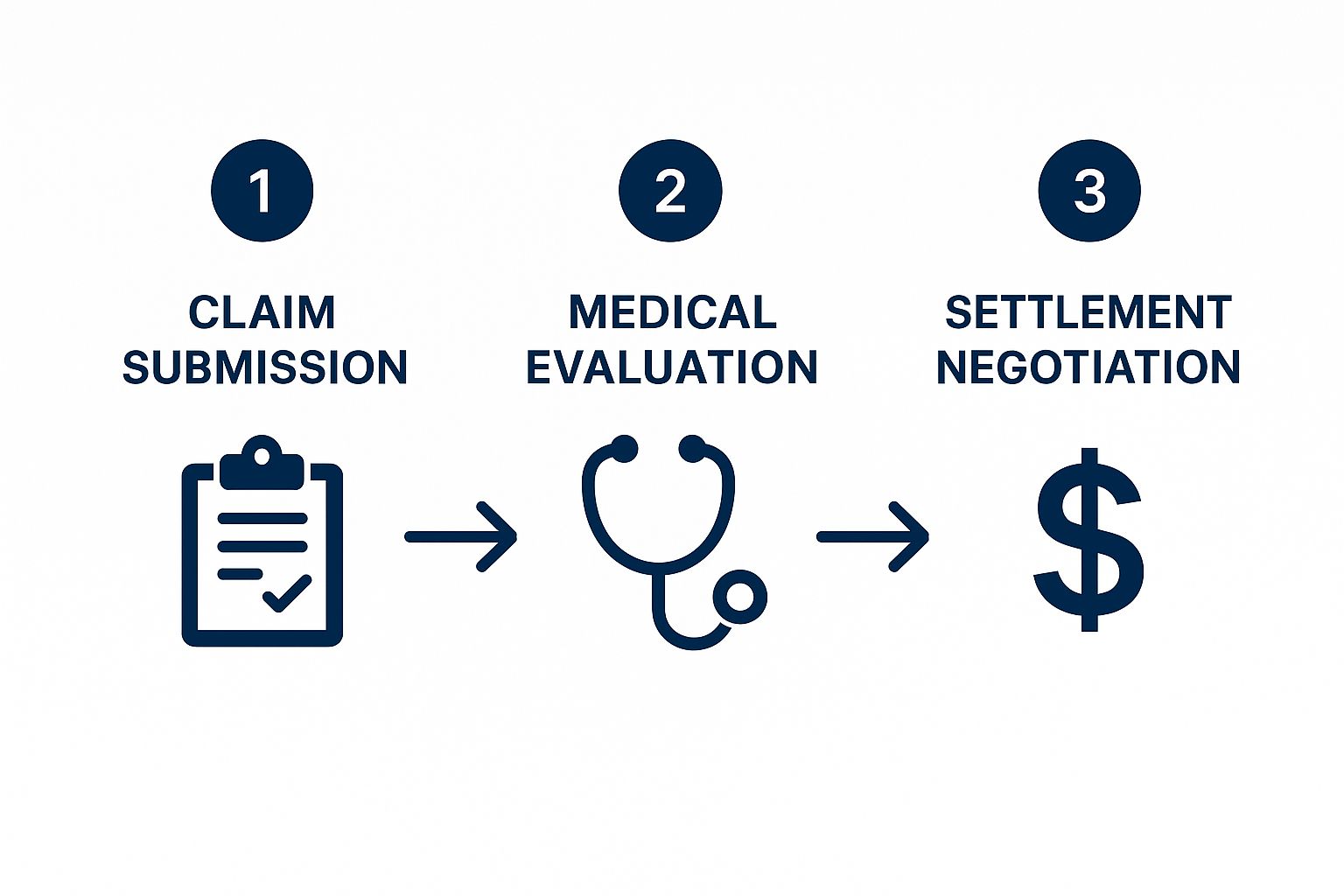
As you can see, it's a progression. You start by officially reporting the injury, then move into a thorough medical evaluation, and only then can negotiations begin. It really highlights that solid documentation and medical evidence are the foundation of any successful claim.
Stage 1: Report the Injury and File the Claim
The clock starts ticking the moment you get hurt at work. Your absolute first step is to report your injury to your employer—and do it in writing as soon as you possibly can. States have different deadlines, some as short as a few days, so you can't afford to wait. This official report is what formally kicks things off and requires your employer to give you the necessary claim forms.
Once you have the form (in a state like California, this is often called a "DWC-1"), you need to fill it out completely and accurately. Then, you file it with the state workers' compensation board. This is the official action that opens your case and legally establishes your right to benefits.
Stage 2: Reach Maximum Medical Improvement
After filing, your focus should be squarely on your health. You'll receive treatment from doctors authorized to handle workers' comp cases, and the insurance company is responsible for the costs. This phase can last for months, or in serious cases, even years. The most important milestone you're working toward is called Maximum Medical Improvement (MMI).
MMI is a medical turning point, not a legal one. It simply means your doctor has determined that your condition has stabilized and isn't likely to get any better with more routine treatment. It's crucial to understand that MMI doesn't mean you're fully healed or back to 100%.
Reaching MMI is the gateway to a settlement. Until your doctor declares you've reached MMI, it’s impossible to know the full, long-term cost of your injury, making any settlement negotiation premature.
Stage 3: The Independent Medical Examination
Once you've reached MMI, you can bet the insurance company will send you for an Independent Medical Examination (IME). Don't let the name fool you; the doctor performing this exam is chosen and paid for by the insurance company. Their primary role is to evaluate your condition and assign a permanent disability rating.
This rating is a percentage that reflects how much permanent impairment the injury has caused. It’s one of the single biggest factors in determining the final value of your settlement. This is why having strong, detailed medical evidence from your own treating physician is so critical—it’s your best tool to counter a potentially low rating from the IME doctor.
Stage 4: Negotiation and Resolution
With a disability rating established, the negotiation can finally begin. This is where your attorney and the insurance adjuster start the back-and-forth, arguing over the true value of your case. They will go over every detail, from the disability rating and future medical costs to your diminished ability to earn a living.
At its core, a workers' comp settlement is a form of contract dispute resolution that helps both sides avoid a long, drawn-out court battle. The goal is to land on a number everyone can live with. If you and the insurance company can reach an agreement, the settlement is finalized. If not, the next step may be a formal hearing in front of a workers' compensation judge.
When you’re laid up with a work injury, the last thing you want is a pile of new worries. But the settlement process can feel like a maze of confusing rules and timelines, often creating more questions than it answers. To cut through the noise, we've put together some straight answers to the questions we hear most from injured workers.
Think of this as your practical guide to setting realistic expectations and making smart decisions for your future.
How Long Does a Settlement Take?
There's no magic number here. A workers' comp settlement can wrap up in a few months or drag on for over two years. It all comes down to two things: how complicated your case is and how your own recovery goes.
If you have a pretty straightforward injury and you’ve reached what’s called Maximum Medical Improvement (MMI), you might see a settlement in about six to twelve months. MMI is the point where your doctor says your condition is as good as it's going to get. Once that's established, it’s much easier for everyone to agree on a fair number because your future medical needs are clear.
On the other hand, complex cases take time. A severe injury requiring lifelong care, a fight over who was at fault, or disagreements on your level of disability can easily push the timeline to two years or more. These long delays often happen when negotiations break down and your case has to go before a workers' compensation judge for a formal hearing.
Will I Pay Taxes on My Settlement?
For almost everyone, the answer is a relieving "no." The IRS doesn't see your workers' comp settlement as taxable income. That includes the money you get for medical bills and lost wages. This is the rule at the federal level, and just about every state plays by the same book.
The whole point of a settlement is to make you financially whole again after an injury—it's not a lottery win. Since the money is just replacing what you lost (your health and your income), the government typically keeps its hands off.
Now, there is one big exception: Social Security Disability Insurance (SSDI). If you're getting both workers' comp and SSDI, something called a "workers' compensation offset" can kick in, which lowers your Social Security payments. If your settlement isn't structured the right way, it could accidentally make some of your SSDI benefits taxable. This is where you absolutely must talk to a lawyer or tax professional to make sure you don't lose the benefits you need.
Can I Reopen My Case After I Settle?
This is a huge question, and the answer hangs on the fine print of the settlement agreement you sign. For most people, a settlement is a final deal. Once you cash that check, the door to your case closes for good.
You’ll typically see one of two types of agreements:
- Compromise and Release (C&R): This is the most common deal on the table. Think of it as a total buyout of your claim. You get a single lump-sum payment, and in return, you "release" the insurance company from any future responsibility. That means you can never reopen the claim, even if your injury flares up years later.
- Stipulation with Request for Award: This one is less common. Here, you and the insurer "stipulate," or agree, on specific details, like your disability rating. This usually leads to bi-weekly payments instead of one big check. The critical difference is that a Stipulation might only settle your lost wages, leaving your right to future medical care open for a set amount of time—or even for life.
You have to know exactly which type of settlement you're signing. A C&R gives you a clean break and more money upfront, but a Stipulation acts as a long-term safety net for your medical needs.
What Percentage Does a Lawyer Take?
Hiring a lawyer to handle your average workers comp settlement won't cost you anything out of pocket. That’s because they work on a contingency fee basis. In plain English, it means they don't get paid unless they win your case and get you a settlement or an award.
Their fee is simply a percentage of your final settlement. But unlike personal injury cases where fees can hit 33% or more, workers' comp lawyer fees are tightly controlled by state law. They are usually capped at a much lower rate, often landing somewhere between 15% and 25%.
What's more, every lawyer's fee in a workers' comp case has to be approved by a judge. This provides a crucial layer of protection, making sure the fee is fair for the work they did. The system is built this way so that every injured worker can afford to get the expert help they deserve.
At Homefront Group, we are committed to ensuring veterans and first responders receive the benefits and support they've earned. Our team understands the unique challenges you face and provides expert guidance on workers' compensation, VA claims, and more. Take our 3-minute quiz today to see what benefits you qualify for and let us help you build a secure future.