
Getting that denial letter from the VA can feel like a punch to the gut, but I promise you, this is far from the end of the road.
Decoding Your VA Disability Claim Denial
The absolute first thing you must do after a denial is figure out exactly why the VA said no. That decision letter isn't just a rejection—it's your playbook. It points out every weak spot in your original claim, and learning to read it correctly is the first step to a successful appeal of a VA disability claim.
Don't get bogged down by the dense, official language. Think of the letter as a strategy guide handed to you by the other side. It tells you precisely which arguments you need to strengthen and what new evidence will make a difference.
Pinpointing the Reason for Denial
The VA is required to explain its decision, and these reasons typically fall into a few common buckets. Your job is to find which one fits your situation. Was it a simple paperwork mistake, or something more substantial about the evidence itself?
I've seen thousands of these letters over the years, and most denials boil down to one of these issues:
- Lack of Medical Diagnosis: You might have described your pain or symptoms perfectly, but if there's no formal diagnosis from a doctor in your file, the VA can't approve the claim.
- No Service Connection (Nexus): This is a big one. You have a diagnosed condition, but the VA rater didn't see a clear link connecting it back to your military service.
- Insufficient Medical Evidence: The records you sent in just weren't enough to prove how severe your condition is or that it started during your service.
Your VA decision letter is the most critical piece of evidence you have right now. It explicitly states what the VA rater found unconvincing, giving you a clear target for your appeal.
Understanding the VA's Perspective
It helps to remember the sheer volume the VA is dealing with. Take fiscal year 2025, for example. The VA hit its one-millionth processed disability claim by February 20, which was almost two weeks faster than the year before. That's a massive achievement.
Even with a 15.6% increase in new claims, they managed to grant over 60% of them. These numbers, which you can find in the VA's official report on claim processing milestones, show that the system is working for many veterans. But it also means that claims without rock-solid evidence are the ones that get denied.
Building Your Counter-Argument
Once you’ve nailed down the specific reason for your denial, you can start building a targeted counter-argument. If the problem was a missing nexus, your mission is now to get a strong nexus letter from a medical expert. If it was a lack of evidence, you know you need to track down buddy letters or get more detailed records from a private doctor.
It’s just common sense. If your denial says "no clear nexus," sending the exact same medical files again won't change a thing. You have to give them the specific thing they said was missing. This focused approach is infinitely more effective than just throwing more paperwork at the problem and hoping for the best.
From this point on, your job is to directly address the VA’s concerns and build a case they simply can't deny.
Choosing the Right VA Appeal Lane for Your Case
Once that denial letter lands in your mailbox, it's time to decide on your next move. This isn't a one-size-fits-all situation. The VA gives you three distinct paths, or "lanes," to appeal a VA disability claim, and I can tell you from experience that picking the right one is the most critical strategic decision you'll make in this entire process.
Each lane has a specific purpose. If you choose the wrong one, you’re likely setting yourself up for another denial or, at the very least, a frustrating and unnecessary delay. The whole game is about matching the reason for your denial to the appeal lane designed to fix that exact problem.
The Supplemental Claim Lane
Think of the Supplemental Claim lane as your "I've got new proof" option. This is the path you'll want to take when you have new and relevant evidence that the VA hasn't seen before. Honestly, it's the most common route, and for good reason—it’s often the most effective.
Let's say your denial letter stated you were missing a "nexus" to connect your back pain to that injury you sustained during service. A Supplemental Claim is tailor-made for this. You can go out, get a powerful nexus letter from a private doctor that clearly establishes that link, and submit it.
This path is also your best bet if you need to add things like:
- Records from a new private doctor or specialist.
- "Buddy letters" from friends, family, or fellow service members who can speak to how your condition affects you.
- The results from an Independent Medical Examination (IME) you had done.
A Supplemental Claim is your chance to look the VA in the eye and say, "You told me I was missing this piece of the puzzle. Well, here it is."
The Higher-Level Review Lane
The Higher-Level Review (HLR) lane works completely differently. With an HLR, you cannot submit any new evidence. This lane is strictly for situations where you're convinced the VA made a mistake with the evidence they already had. You're essentially asking for a fresh set of eyes—a more senior adjudicator—to review the file and correct an error.
A classic case for an HLR is when the VA simply got the law wrong or misapplied a regulation. Maybe they completely overlooked a critical document in your service treatment records or botched the math when calculating your disability rating according to their own schedule. It happens more than you'd think.
This decision tree can help you visualize whether you need to go find new evidence for a Supplemental Claim.
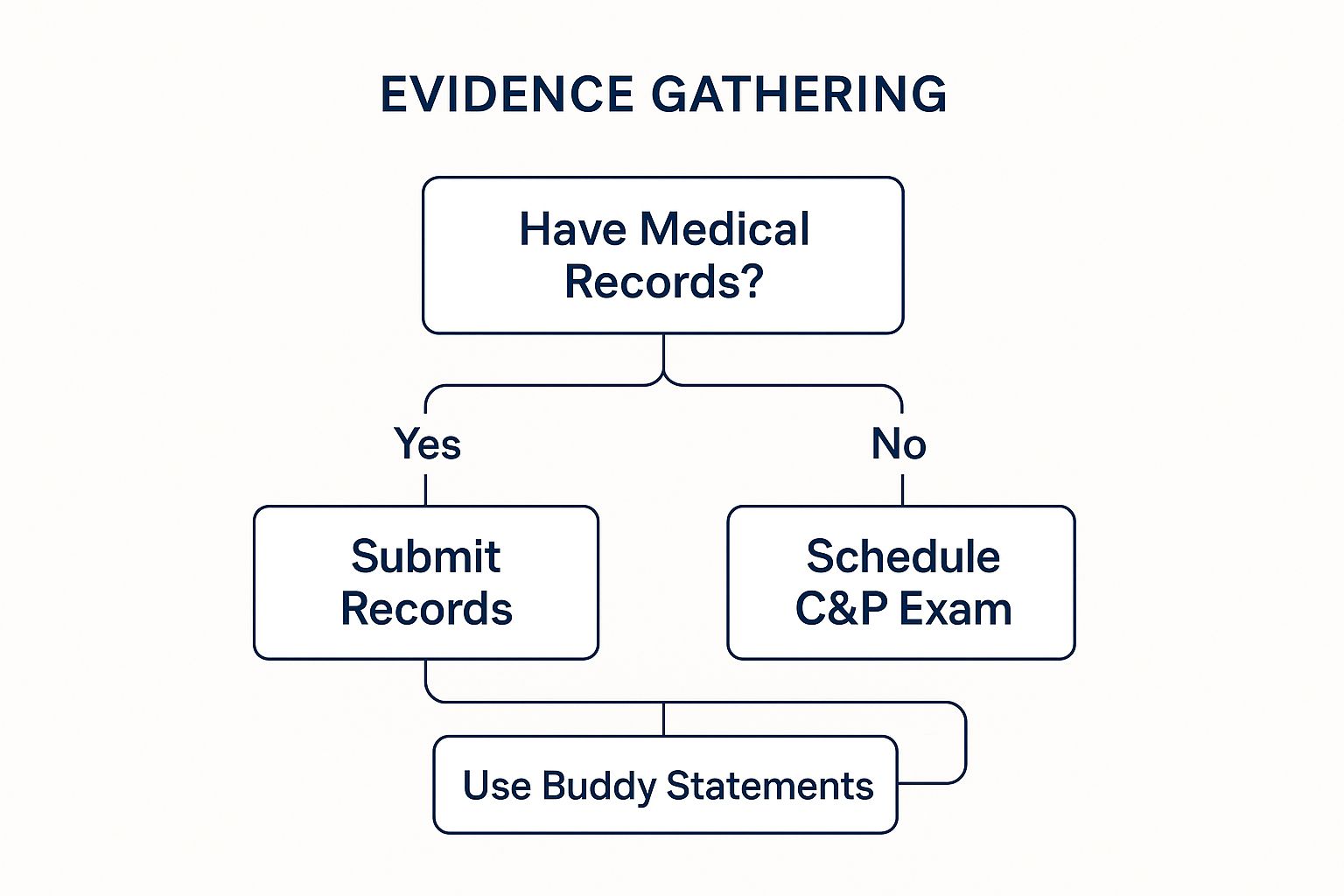
As the infographic shows, if your current records aren't strong enough, you'll need to get things like new exams or witness statements, which points you directly toward filing a Supplemental Claim.
VA Disability Appeal Options at a Glance
Choosing between these options can feel overwhelming. This table breaks down the key differences to help you see which lane best fits your specific situation.
| Appeal Lane | Best For | New Evidence Allowed? | Reviewer |
|---|---|---|---|
| Supplemental Claim | When you have new and relevant evidence that addresses the reason for denial. | Yes | A new reviewer at the Regional Office. |
| Higher-Level Review | When you believe the VA made a legal or factual error with the existing evidence. | No | A more experienced, senior reviewer. |
| Board of Veterans' Appeals | For complex legal arguments or after other lanes have failed. | Depends on the BVA option you choose. | A Veterans Law Judge. |
Ultimately, your denial letter and the evidence you currently have (or can get) will be your guide.
The Board of Veterans' Appeals Lane
Finally, we have the Board of Veterans' Appeals (BVA). This is the most formal and, frankly, the longest route. You're taking your case "upstairs," outside of your local regional office and directly to a Veterans Law Judge (VLJ) in Washington, D.C.
Filing a BVA appeal opens up three more choices:
- Direct Review: You ask the judge to review the exact same evidence the previous rater saw, arguing they interpreted it incorrectly.
- Evidence Submission: You want to submit new evidence for the judge's consideration, but you don't need to testify.
- Hearing: You want to appear before the judge (virtually or in person) to testify and present your case directly.
Choosing the Board is a major decision, and it’s typically the right call for cases with tricky legal issues or when you've already been denied through the other lanes. Just be prepared for a significant wait. Making the right choice from the start gives you the best shot at winning your appeal and getting the benefits you've earned without losing years to the process.
Gathering Compelling Evidence for Your Appeal

Once you’ve dissected your denial letter and picked an appeal lane, your next mission is to build a rock-solid case. Winning an appeal of a VA disability claim isn’t about burying the VA in paperwork; it’s about providing the right evidence that directly addresses why you were denied in the first place.
This isn’t a do-over. You’re not just resubmitting what you sent before. Think of it like a legal case: you're presenting new, targeted proof to counter the VA's specific arguments. Every document you add should have a clear purpose.
The Power of a Nexus Letter
If your denial letter says there’s no "service connection," your most powerful weapon is a nexus letter. This is an expert opinion from a medical professional—ideally a specialist who treats your specific condition—that draws a clear line from your disability back to your military service.
A truly effective nexus letter does more than just state a diagnosis. It must include specific, critical language. The doctor needs to state that it is "at least as likely as not" (meaning a 50% or greater chance) that your military service caused or aggravated your condition. That phrase is the VA’s standard of proof, and having it in a letter from a credible doctor can completely turn an appeal around.
Leveraging Private Medical Records
Your service treatment records are obviously important, but don't overlook your private medical records. Any treatment you received from civilian doctors, especially after leaving the service, can fill in critical gaps in your medical history.
These private records can show:
- A more detailed timeline of your symptoms and treatments.
- An independent diagnosis that backs up your claim.
- A history of continuous treatment, proving your disability is ongoing and severe.
Keep in mind that the VA is swamped. In fiscal year 2025 alone, they processed over 2 million disability claims, getting the average processing time down to 131.8 days. That speed means your evidence has to be crystal clear and persuasive right out of the gate. To get a sense of the volume they're dealing with, you can read more about the VA's record processing times.
The Impact of Buddy Letters and IMEs
Firsthand accounts from people who know you can be incredibly powerful. These are called buddy letters (or lay statements), and they come from spouses, friends, family, or fellow veterans who can speak to how your condition affects you.
A buddy letter provides the human story that medical records can’t. It paints a picture for the VA rater, showing how your disability impacts your daily life, your work, and your relationships. That context is invaluable.
Finally, you might want to consider an Independent Medical Examination (IME). This is an evaluation you get from a private physician, completely separate from the VA’s own Compensation and Pension (C&P) exams. Yes, it's an out-of-pocket cost, but an IME provides a fresh, unbiased medical opinion that can directly challenge the C&P exam that led to your denial. It puts you back in control of the medical evidence.
Filing Your VA Appeal Forms Without Errors
You’ve gathered your evidence and mapped out your strategy. Now comes the part where every detail matters: filling out the official VA forms. This might feel like just another administrative task, but I've seen more appeals get tripped up here by simple mistakes than almost anywhere else. One wrong box or a vague statement can easily send your file right back to the bottom of the pile, adding months to your wait.
When you appeal a VA disability claim, the paperwork you file is the official vessel for all your hard work. Don't think of it as just a form; it's the formal legal argument you're presenting to the VA. It has to be clean, complete, and compelling.
Mastering the Most Common Appeal Forms
For the vast majority of veterans, the appeal journey kicks off with one of two key documents. The form you use is determined entirely by the appeal lane you've chosen. Let's break down what you need to know.
-
VA Form 20-0995 (Supplemental Claim): This is the form you'll use when you're adding new and relevant evidence to your case. The most critical part of this form is the section where you list that new evidence. You have to be specific here. Instead of just writing "Doctor's records," be explicit: "Nexus letter from Dr. Jane Smith, dated July 14, 2025," or "Treatment records from Main Street Physical Therapy, June 2025."
-
VA Form 20-0996 (Higher-Level Review): You'll file this form if you believe the VA made a mistake with the evidence already in your file. The most important choice on this form is the option to request an informal conference. I almost always tell veterans to check this box. It gets you a 15-20 minute phone call to personally explain to a senior reviewer why you think an error was made.
Submitting your appeal forms isn't just a bureaucratic step—it's your official request for reconsideration. A clean, error-free submission respects the reviewer's time and makes it easier for them to rule in your favor.
Avoiding Unforced Errors That Cause Delays
It’s the small, avoidable mistakes that are the most maddening. They don't have to happen, but they do all the time, causing needless delays that can stretch on for months. Getting it right the first time is your single best strategy.
One of the most common mistakes I see is a veteran filing for a Higher-Level Review (VA Form 20-0996) but then also trying to mail in new evidence. The system is designed to automatically reject this. Remember, the Higher-Level Review lane does not allow for new evidence. Period.
Another frequent error is vagueness. In the section that asks for the "specific issue" you disagree with, don't just put "denied for PTSD." Be precise and formal: "I disagree with the denial of service connection for Post-Traumatic Stress Disorder." This leaves zero room for misinterpretation.
Filing these forms online through the VA's official website is often your best bet. It gives you instant confirmation that it was received and has built-in checks that can help you avoid some of these common errors.
What to Expect After You File Your VA Appeal
So, you’ve filed your appeal. That’s a huge milestone, but now comes what is honestly the hardest part for most veterans: the wait. It can feel like your file has vanished into a bureaucratic black hole, but knowing what’s actually happening behind the scenes can make the whole process feel a lot less stressful.
Your appeal doesn’t just land on one person's desk. It first enters a queue, where it's checked to make sure all the i's are dotted and t's are crossed. Think of it as an administrative pit stop before it gets assigned to an actual decision-maker.
You’re not completely in the dark during this time. You can keep tabs on your appeal's progress through your account on the official VA.gov website. The updates might seem a little vague at times, but they give you a general sense of where your file is in the system.
Understanding the Appeal Timelines
The million-dollar question every veteran asks is, "How long is this going to take?" There's no single answer, unfortunately. The VA does publish its target processing times for each appeal lane, but it's crucial to remember these are goals, not guarantees. A more complex case will almost always take longer.
Here's a realistic breakdown of what you might be looking at:
- Supplemental Claim: The VA aims to decide these in about 4 to 5 months. If your new evidence is straightforward and convincing, this is usually the fastest route.
- Higher-Level Review: The goal here is also around 4 to 5 months. Because you can't submit new evidence, the timeline is often more predictable.
- Board of Veterans' Appeals (BVA): This is where you settle in for the long haul. A direct review could easily take a year or more. If you've requested a hearing with a Veterans Law Judge, expect an even longer wait.
Preparing for a C&P Exam
Don't be alarmed if you get a notice for another Compensation & Pension (C&P) exam after you appeal a VA disability claim. This is a very common and normal part of the process, especially if you’ve submitted new medical records. The VA wants one of its own doctors to weigh in on your updated file.
A word of caution: Attending your C&P exam is absolutely mandatory. Missing this appointment is one of the quickest ways to see your appeal get denied. Treat it like the most important appointment on your calendar.
How do you prepare? Go back and review the evidence you submitted with your appeal. Be ready to clearly explain how your condition affects your ability to work and live your life. The C&P examiner's report carries a lot of weight, so your honest and detailed input is critical. While you're waiting for the VA's final decision, the best things you can do are stay engaged, check your status periodically, and be ready to respond quickly to any requests.
Common Questions About the VA Appeal Process

Even with a solid plan, the VA appeals system can feel like a maze. It’s natural to have questions pop up along the way. Getting clear, straightforward answers is key to moving forward with confidence and avoiding simple mistakes that could derail your case.
Let's walk through some of the most common questions I hear from veterans when they decide to appeal a VA disability claim. These answers come from years of guiding folks through this exact process, and understanding them can make a world of difference.
How Long Do I Have to File an Appeal?
This is probably the most critical question, and thankfully, the answer is simple: you generally have one year from the date on your VA decision letter to file your appeal.
Hitting this deadline is non-negotiable. Why? Because that one-year window locks in your "effective date." If your appeal is eventually granted, the VA uses that effective date to calculate your back pay. Miss it, and you could lose out on a significant amount of retroactive benefits—sometimes thousands of dollars—and you might have to start the whole claim over from square one.
Should I Get Help from a VSO or a Lawyer?
While you absolutely can file an appeal on your own, many veterans find that getting professional help is a game-changer. The two main options are a Veteran Service Officer (VSO) or an accredited VA attorney.
- Veteran Service Officer (VSO): These are trained professionals who provide free, expert help. They work for great organizations like the VFW or DAV and are fantastic for gathering evidence and filing the correct paperwork.
- Attorney or Claims Agent: An accredited attorney or agent usually works on a contingency basis, which means they don’t get paid unless you win your appeal. Their expertise is especially valuable for really complex cases, like those involving tricky legal arguments or heading to the Board of Veterans' Appeals.
The right choice really depends on your case's complexity and your own comfort level. For a fairly straightforward appeal where you have clear new evidence, a VSO might be all you need. If your case is a tough nut to crack, an attorney’s strategic know-how could be what pushes it over the finish line.
The decision to get help is personal, but a good advocate does more than just fill out forms. They bring experience to the table, helping you build the strongest possible case to win the benefits you rightfully earned.
What Happens at a C&P Exam?
A Compensation and Pension (C&P) exam is a medical appointment the VA schedules to learn more about your disability. If the VA schedules one during your appeal, you must attend. Missing it is one of the fastest ways to get your appeal denied.
During the exam, a doctor or other healthcare professional will evaluate your condition. They'll ask about your symptoms, how they affect your daily life, and the connection to your military service. Just be open and honest. The report this examiner writes will have a huge impact on the VA's final decision.
Can I Add New Evidence to a Higher-Level Review?
The short answer is no. You cannot submit new evidence with a Higher-Level Review (HLR). The entire point of an HLR is for a more senior adjudicator to check for errors in the original decision using only the evidence the VA already had at that time.
If you have powerful new evidence—like a fresh nexus letter from your doctor or recent medical records—the right move is to file a Supplemental Claim. Choosing the correct appeal lane is fundamental. Trying to shoehorn new evidence into an HLR will just lead to delays and a dead end for that evidence.
Navigating a VA appeal is tough, but you don't have to go it alone. The team at Homefront Group is made up of veterans and legal experts who are dedicated to helping you get the benefits you've earned. See how we can help build a winning strategy for your appeal by taking our quick, 3-minute quiz.