
When a VA decision letter lands in your mailbox, your first move is critical. You need to read it—and I mean really read it. This document holds the keys to your entire appeal. It explains exactly why your claim was denied or why you received a low rating. Most importantly, it contains the decision date, which starts the one-year countdown for you to take action.
Your First Steps After Getting a VA Decision
Getting that envelope from the Department of Veterans Affairs can be tough. It often brings a mix of confusion, frustration, and maybe even a feeling of defeat. But this isn't the end of the road; it's just the beginning of the next phase. The most important thing you can do right now is break down that decision letter, piece by piece.
Think of it as your battle plan. The VA has to explain its reasoning, and that explanation is your guide to a successful appeal. Don't just skim it. Read every single line, especially the part labeled "Reasons for Decision."
Find the Critical Information
Every VA decision letter has a few key details you need to find right away. This is your first mission, and it sets the stage for everything that comes next.
Here’s what you’re looking for:
- The Decision Date: This is the big one. The date on that letter officially starts your one-year deadline to appeal a VA decision. Circle it, highlight it, and put it on your calendar immediately.
- The Issues Decided: The letter will list every condition you claimed and what the VA decided—granted, denied, or deferred.
- The "Reasons for Decision" Section: This is your intel. The VA will tell you why it made its decision. You'll see phrases like "no evidence of a current diagnosis" or "no link (nexus) between your condition and your service."
Pro Tip: Make a copy of your decision letter the moment you get it. Keep the original in a safe place and use the copy to make notes and highlight key sections. This way, the original document stays clean while you work.
Understand the VA's Rationale
Once you find the "Reasons for Decision" section, you need to translate the VA's jargon into a clear plan. The VA's reasoning usually falls into a few common buckets, and figuring out which one applies to you is how you'll build a strong counter-argument.
For example, if the VA denied your claim for back pain, the letter might say that while your medical records show you have a back problem now, there’s no proof it started in the service. That tells you exactly what you need to fix: find evidence that connects your back condition to your time in uniform.
Or maybe you were granted service connection for a knee injury but only got a 10% rating. The reasoning might point to the limited range of motion noted in your Compensation and Pension (C&P) exam. Your job, then, is to show your symptoms are actually worse than what that one exam captured. This could be a statement from your spouse detailing your daily struggles or a new report from a private doctor. This analysis turns a frustrating letter into a strategic blueprint for your appeal.
Choosing the Right VA Appeal Path for Your Case
Once you've dissected your decision letter, your next mission is to pick the right appeal lane. This is one of the most critical choices you'll make in this entire journey. The VA now offers three distinct paths, and understanding which one fits your specific situation is the key to getting a different outcome.
Think of it like choosing a tool for a specific job. You wouldn't use a hammer to turn a screw, right? In the same way, filing for a Higher-Level Review when what you really need is to submit new evidence will just lead to another denial and a lot of wasted time.
Let's break down each option so you can make a smart, strategic move.
Supplemental Claim: The Lane for New Evidence
The Supplemental Claim is your best bet if the VA denied your claim because you were missing a key piece of the puzzle. This lane is built specifically for submitting new and relevant evidence that wasn't in your file the first time around.
So, what exactly does "new and relevant" mean?
- New Evidence: This is simple. It’s any document the VA hasn't seen before. Think recent doctor's reports, a powerful nexus letter from a private specialist, or "buddy letters" from friends you served with.
- Relevant Evidence: The evidence has to directly address the reason the VA denied you. If they said there was no link between your condition and your service, a nexus letter is about as relevant as it gets.
I once worked with a Marine who was denied benefits for tinnitus because his service records didn't mention hearing loss. He got a buddy letter from another Marine who was on the rifle range with him, describing how they both had constant ringing in their ears after qualifying. That letter was new and highly relevant—a perfect fit for a Supplemental Claim.
Higher-Level Review: For When the VA Made an Error
What if you're confident you have all the necessary evidence, but you believe the VA just got it wrong? This is precisely what the Higher-Level Review (HLR) is for. When you choose an HLR, you're asking a more experienced VA claims adjudicator to take a fresh look at the exact same evidence that was already submitted.
You cannot submit new evidence in this lane. The HLR is strictly for correcting errors of law or fact.
Maybe the first reviewer overlooked a crucial medical record or simply misinterpreted a regulation. The senior reviewer has the authority to overturn the original decision based on the existing file. You can also request an "informal conference"—a quick phone call where you can point out the specific error you believe was made.
Board of Veterans' Appeals: Taking Your Case to a Judge
If your case is particularly complex, or if you’ve already been denied after trying the other options, you can take your appeal directly to the Board of Veterans' Appeals (BVA). This is a more formal process where your case is reviewed by a Veterans Law Judge (VLJ). You have one year from the date on your decision letter to file a BVA appeal.
When you go to the Board, you have to choose one of three dockets:
- Direct Review: The judge reviews the same evidence the VA already had. This is the fastest BVA option.
- Evidence Submission: You can submit new evidence directly to the Board, but you must do it within 90 days of filing your appeal.
- Hearing Request: You can testify before a Veterans Law Judge, either virtually from home or in person. While this gives you a chance to tell your story directly, it's also the path that takes the longest.
The infographic below shows an older version of the appeals process, but it does a great job of highlighting the significant time commitment that has always been a part of appealing to the BVA.
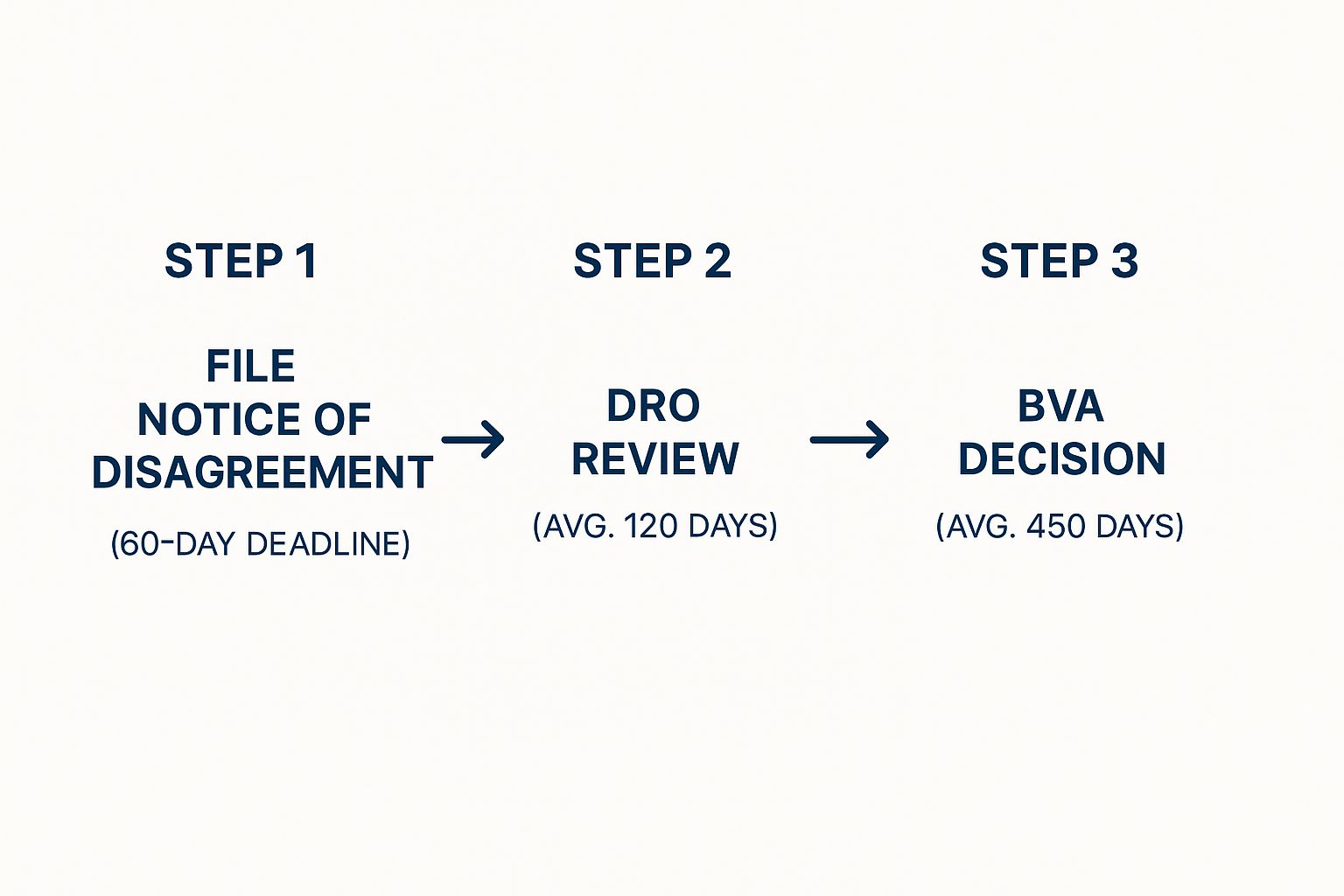
This visual really drives home the point that escalating an appeal can mean a very long wait, which makes your initial choice of appeal lane all the more important.
Looking ahead to 2025, a Higher-Level Review might take 4 to 6 months, and a Supplemental Claim could take 4 to 8 months. But appeals to the Board, especially those with hearing requests, can easily stretch to 24 months or more. This shows just how vital it is to select the most efficient route from the get-go. You can learn more about how long VA appeals take and the factors that influence these timelines.
Key Takeaway: Choosing the right appeal lane is a strategic decision. Don't rush it. Assess your decision letter, evaluate your evidence, and pick the path that gives you the best shot at success without unnecessary delays.
Gathering Evidence That Makes a Difference

If you're filing a Supplemental Claim, you're on a specific mission: find and submit evidence that forces the VA to reconsider. You can't just send in the same old paperwork and hope for a different result. The whole point of this appeal lane is to present “new and relevant” evidence that directly plugs the holes in your original claim.
This isn't about overwhelming the VA with a mountain of documents. It's about being strategic. The right piece of evidence can single-handedly turn a denied claim into an approved one. Let's get past the generic advice and dig into the types of proof that actually move the needle.
The Power of a Nexus Letter
A nexus letter is, without a doubt, one of the most powerful tools in a veteran's arsenal. It's a formal medical opinion from a qualified professional—like your doctor or a specialist—that connects the dots. It draws a clear, unmistakable line from your current disability back to a specific event, injury, or illness from your military service. Think of it as the "missing link" that so many denied claims are missing.
Here’s a real-world example: A veteran files for sleep apnea but gets denied because it developed years after he left the service. The VA sees no connection. But a strong nexus letter from his sleep doctor could explain that the veteran's service-connected PTSD is a well-known cause of sleep apnea. The letter concludes that it's "at least as likely as not" that his PTSD led to the condition. Suddenly, that evidentiary gap is filled.
Independent Medical Opinions
An Independent Medical Opinion (IMO) is like a nexus letter but often goes much deeper. It's a comprehensive evaluation from a private healthcare provider who has no connection to the VA. This is your best move if you feel the C&P exam was rushed, inaccurate, or didn't capture the true severity of your condition.
An IMO can accomplish several key things:
- Challenge a Bad C&P Exam: If the C&P examiner claimed your range of motion was fine, an IMO from your private orthopedist showing significant limitations can directly challenge that finding.
- Establish a Diagnosis: The VA might say you don't have a current diagnosis. An IMO can provide one, officially and on the record.
- Detail the Severity: An IMO can paint a vivid picture of how your symptoms affect your day-to-day life and your ability to hold a job, which is crucial for getting the correct disability rating.
Key Insight: The VA is legally required to consider all the evidence you submit. A well-written, credible IMO from a specialist in the field carries enormous weight and can absolutely be the piece of evidence that tips the scales in your favor.
To really make your evidence count, mastering effective document collection techniques is a game-changer. A well-organized file ensures your most powerful documents get the attention they deserve.
Buddy Letters Personalize Your Claim
Medical records are essential, but they don't tell the full story. Buddy letters, also known as lay statements, are where the human element comes in. These are firsthand accounts from people who have witnessed how your condition affects you.
The most impactful letters come from people who know you best:
- Fellow Service Members: Someone from your unit who saw the injury happen or witnessed the day-to-day toll your duties took on you.
- Spouses or Family: They see the daily reality—the struggles with pain, the PTSD triggers, the challenges with mobility.
- Supervisors or Co-workers: They can speak directly to how your condition limits your ability to perform at work.
A letter from your old squad leader describing how you limped back to the FOB after every patrol is a powerful piece of evidence for a knee claim, especially if you were the type to never go to sick call. These personal stories help the VA reviewer see you as a person, not just a case number.
Given the sheer volume of cases the VA handles, your evidence has to be clear and compelling. In fiscal year 2024, the Board of Veterans’ Appeals (BVA) issued a record-breaking 116,192 decisions. With that kind of workload, evidence that is easy to understand and directly proves your point is your best path to a win.
Filing Your Appeal Without Costly Mistakes
When it's time to appeal a VA decision, filling out forms and hitting deadlines isn't just a box-ticking exercise—it's a zero-failure mission. I've seen it happen too many times: a simple mistake, like a missed signature or a checked wrong box, gets a claim kicked back, costing a veteran months of waiting and stress. This part of the process isn't glamorous, but getting it right is the foundation of protecting your claim and your all-important effective date.
Think of each VA form as a specific tool for a very specific job. Using the wrong one or filling it out incorrectly is like trying to hammer a nail with a screwdriver. It just won't work. The VA is notoriously particular about its paperwork, so your best ally here is absolute precision.
Navigating the Essential VA Appeal Forms
The VA has a specific form for each of the three appeal lanes. Your first and most critical task is to pick the right one and complete it perfectly. Let's break down which form to use and where veterans often stumble.
-
For a Supplemental Claim: VA Form 20-0995
This is your form if you have new and relevant evidence to add to your case. The most common pitfall is in Section II, where you identify that new evidence. Don't just write "see attached medical records." That's a classic mistake. You have to be explicit. List each piece of evidence by name and date, like, "Nexus letter from Dr. Smith, dated 05/15/2024" or "Buddy letter from John Doe." This leaves no doubt for the reviewer about what new information they need to consider. -
For a Higher-Level Review: VA Form 20-0996
Use this form to ask a more senior reviewer to look for an error in the original decision, without submitting new evidence. Here’s a critical tip: when the form asks if you want an informal conference, always check "yes." This is your chance to get on the phone with the reviewer and point out exactly where you believe they went wrong. Skipping this opportunity is a major tactical error. -
For a Board Appeal: VA Form 10182
Officially called the "Notice of Disagreement," this is the form that sends your case to a Veterans Law Judge at the Board of Veterans' Appeals. The most important choice you'll make here is selecting one of three dockets: Direct Review, Evidence Submission, or a Hearing. This single choice dramatically impacts your wait time and what you can do next, so make sure you understand the pros and cons of each before you check that box.
The Unforgiving One-Year Deadline
From the date stamped on your VA decision letter, a one-year clock starts ticking. If you miss this deadline, you lose your right to appeal that decision—forever. This also means you could lose your original effective date, which might cost you thousands of dollars in back pay you've earned.
Crucial Reminder: Your appeal is considered "filed" on the date the VA receives it, not the date you mail it. This is why submitting online is almost always the safest bet. You get an instant, dated receipt confirming your submission.
If you have to mail your appeal, use a tracked service like USPS Certified Mail with a return receipt. It provides undeniable proof of the delivery date. The principles of strict documentation and deadlines are universal in government appeals, as shown in guides on topics like how to appeal an IRS tax decision.
Filing Methods Compared
| Method | Pros | Cons |
|---|---|---|
| Online (VA.gov) | Instant confirmation; easiest way to track status; safest for meeting deadlines. | Requires internet access and some comfort with technology. |
| Good option for those without internet; allows for physical documents. | Risk of mail delays or loss; no instant proof; filed date is upon receipt. | |
| In-Person | You can get help from a VSO and ask questions on the spot. | Requires travel and is limited by office hours; not available everywhere. |
No matter how you choose to file, the objective is the same: submit the right form, filled out completely, on time. One simple error can derail your entire effort, forcing you to start over and risk losing the benefits you deserve. Double-check every single field before you hit "submit" or seal that envelope.
What Happens After You File Your VA Appeal
The wait after you’ve submitted all your paperwork can be one of the most stressful parts of the entire process to appeal a VA decision. You've poured your energy into building your case, and now it feels like it has vanished into a bureaucratic black hole. Knowing what's actually happening behind the curtain can make this waiting game a lot less frustrating.
First thing’s first: confirm the VA actually has your appeal. If you filed online through VA.gov, you should see an immediate confirmation. For those who sent it by mail, this is where paying for tracking really gives you peace of mind. Your appeal will eventually show up in your VA.gov profile, but the status updates can often be vague and confusing.
Key Takeaway: The VA will mail you a letter acknowledging they’ve received your appeal. Hold onto this document. It’s your official confirmation that your appeal is in the queue and on their radar.
Your Journey Through the Different Appeal Lanes
Each of the three appeal lanes moves at its own pace and follows a very different path. The experience of a Higher-Level Review is nothing like the journey of a Board Appeal, so it pays to know what to expect from the lane you chose.
The Higher-Level Review (HLR) Path
If you went with an HLR, your file gets a fresh look from a more experienced Senior Reviewer. They will meticulously re-examine the exact same evidence from your initial claim, specifically hunting for errors.
- The Informal Conference: If you requested this, you’ll get a call from the Senior Reviewer. This is your single best chance to verbally walk them through why you believe a mistake was made. Prepare for this call. Have your notes ready and be prepared to point to specific evidence in your file.
- The Decision: After the review (and conference, if you had one), the reviewer will either grant your claim, deny it again, or find a “duty to assist” error. If an error is found, your HLR gets converted into a Supplemental Claim so the VA can gather the necessary evidence.
The Supplemental Claim Path
This lane is all about the new and relevant evidence you submitted. Once you file a Supplemental Claim, the VA has a duty to assist you in developing your case.
- Evidence Gathering: The VA will review your new documents. This is also when they might schedule a new Compensation & Pension (C&P) exam if your evidence calls for one. Don’t take this exam lightly; be ready to explain how your condition has worsened or how the new evidence proves your case.
- The Decision: Once all the evidence is in, including the results from any new C&P exams, a rater will make a brand-new decision on your claim.
Navigating the Board of Veterans' Appeals Docket System
Taking your appeal all the way to the Board of Veterans' Appeals (BVA) means you're entering a more formal and, frankly, longer process. The docket you choose directly dictates your wait time.
- Direct Review Docket: This is the quickest BVA option because a judge only reviews the evidence that was already in your file. You can’t add new evidence or have a hearing.
- Evidence Submission Docket: You get 90 days from your BVA appeal notice to turn in new evidence. The judge will consider this new information right alongside your original file.
- Hearing Docket: This is the longest route by far. You’ll be scheduled for a hearing to give testimony before a Veterans Law Judge. Because of significant backlogs, the wait for a hearing can be substantial.
The appeals modernization system has made a real difference here. The percentage of veterans taking their cases to the Board has dropped from 17% in 2021 to about 10% in recent years. More veterans are getting successful outcomes with faster options like Supplemental Claims. You can find more on the VA's workload challenges and progress to see how these changes are helping veterans get quicker decisions.
Your Top Questions About Appealing a VA Decision
Trying to appeal a VA decision can feel overwhelming. It’s a world filled with its own unique language, strict deadlines, and frustrating roadblocks. Even when you follow a guide, you’re bound to have specific questions pop up that leave you feeling stuck.
Let's clear the air. This section tackles the most common questions and concerns I hear from veterans every day. My goal is to give you direct, no-nonsense answers so you can keep moving forward.
Should I Hire a Lawyer for My Appeal?
This is often the very first question veterans ask, and it’s a big one. The short answer is no, you are not required to hire a lawyer. Many veterans get the benefits they deserve with the fantastic, free help of a Veterans Service Officer (VSO).
However, there are definitely times when bringing in an accredited attorney or claims agent makes a huge difference.
You should seriously consider getting legal help if:
- Your case is a tangled mess. Maybe you have several denied conditions, or the VA’s reasoning requires a deep, technical legal argument. This is where an expert can untangle the knots.
- You've been denied more than once. If you're stuck in a cycle of denials, a lawyer can provide a fresh set of eyes to find the weak spots in your past appeals and build a much stronger case.
- You're taking your case to the Board of Veterans' Appeals. A BVA hearing is a formal legal setting. Having a seasoned advocate who knows how to navigate it can be a game-changer.
A good VA lawyer does more than just fill out paperwork—they craft a winning legal strategy. They've seen what works and what doesn't, and they know how to dismantle the VA's arguments for denial.
A Quick Word on Fees: It's crucial to understand how VA attorneys are paid. They almost always work on contingency, which means you don't pay them unless they win your case. Their fee comes from a percentage of the back pay you're awarded, usually capped at 20-33%. Remember, they are legally prohibited from charging you to file an initial claim.
What’s This Appeal Going to Cost Me?
Filing the appeal itself is completely free. The VA doesn’t charge you a dime to submit a Supplemental Claim, request a Higher-Level Review, or file an appeal to the Board.
The real costs come from building a rock-solid case.
Here’s what you might have to budget for:
- Independent Medical Opinions (IMOs): This is often the biggest expense. A specialist is being paid for their expert time to meticulously review your file and write a powerful report linking your condition to your service. It's often worth every penny.
- Copying Records: Your civilian doctors might charge a small administrative fee to copy your medical files.
- Postage: If you're mailing your documents, it's smart to use certified mail for proof of delivery, which adds a few dollars.
While these costs can feel like a burden, try to see them as an investment. A single, well-written IMO from the right doctor can be the piece of evidence that finally turns a "no" into a "yes."
What if They Deny My Appeal… Again?
Getting another denial letter after you've put in all that work is a gut punch. I get it. But it is absolutely not the end of the road. What you can do next depends entirely on which appeal lane you just tried.
For example, if your Higher-Level Review was denied, you now have the option to file a Supplemental Claim (this time with new and relevant evidence) or take your case to the Board. If it was your Supplemental Claim that got denied, you can now request a Higher-Level Review of that new decision or appeal to the Board.
The system is designed so that you almost always have another path forward, as long as you act within that critical one-year deadline. The trick is to carefully read the new denial letter, pinpoint exactly why the VA said no, and then make a strategic choice about your next step.
At Homefront Group, we know just how draining the VA appeals process can be. Our team of veteran advocates and legal pros is dedicated to making sure you're never in this fight alone. We specialize in building the strongest case possible so you can get the benefits you earned. Take our free 3-minute quiz today and see how we can help you win your appeal. Find out more at https://homefrontgroup.com/.